Introduction to the criminal justice system (CJS)
 Studied by 0 people
 Call Kai
 Learn
Learn Practice Test
 Spaced Repetition
 Match
Match Flashcards
 Knowt Play
1/8

There's no tags or description
Looks like no tags are added yet.
Name | Mastery | Learn | Test | Matching | Spaced | Call with Kai |
|---|
No analytics yet
Send a link to your students to track their progress
9 Terms
What are the 4 types of law?
Common law- Ancient law of England based upon social customs and precedent
Case law- The law established by the outcome of former cases
Statute law- An act of parliament
Bye laws- These are local laws made by local authorities such as obstructing pavements, urinating in the street
What are the 3 offence types? What courts do they attend?
- Summary – lower level crime – magistrates- call them judge
- Either way – lower or higher
- Indictable only – higher level crime – crown court – jury- pass a higher sentence- your honour
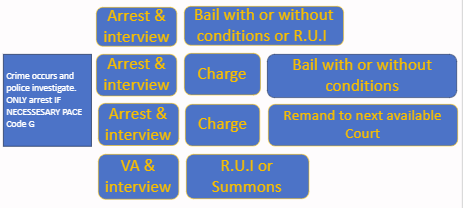
What are the 4 type of police process and prosecution are there? i.e. we arresst them then what will happen?
Crime occurs and arrest if NECESSARY PACE code G
- Arrest & interview bail with or without conditions or R.U.I (released under investigation) (no charge)
- Arrest & interview and then charge then bail with or without conditions (seen on cctv and they maybe admit it- so substantial evidence we can police charge them then bail and give them a court date)
- Arrest & interview and then charge and remand to next available court (take them into police custody until they can go to court)
- VA (voluntary attendance interview if they refuse then arrest) and R.U.I or summons
What cases go to youth court?
Is there a jury and press?
- Criminal age is 10
- 10-17 years old
- No public gallery and restrictions to who can attend i.e. press can attend but restriction on reporting
- No jury
- 3 magistrates or a district judge
- Serious offence goes to crown court or tried with an adult
What cases go to magistrates court? What is the judge called? What sentences go there?
Magistrates
- Summary or either way offences
- Cases heard by 2 or 3 magistrates (volunteers appointed by the crown) or a district judge
- Sentences up to 12 months (usually 6-12 months)
- “Your worship”
What cases go to crown court? What is the judge called? What sentences go there?
Crown
- Indictable only
- Not guilt cases are heard by a jury of usually 12 months
- “Your honour”
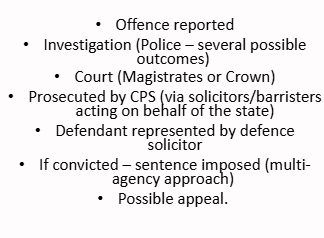
What is the process of prosecution?
What is the burden of proof?
For criminal proceedings the burden of proof is on the prosecution to prove beyond a reasonable doubt.
What are the 3 types of civil court?
Family, coroners, county
 Note
Note  Flashcards (393)