Primary and secondary immune response
0.0(0)
 Studied by 1 person
0.0(0)
 Call Kai
 Learn
Learn Practice Test
 Spaced Repetition
 Match
Match Flashcards
 Knowt Play
Card Sorting
1/10

Last updated 7:45 PM on 2/6/26
Name | Mastery | Learn | Test | Matching | Spaced | Call with Kai |
|---|
No analytics yet
Send a link to your students to track their progress
11 Terms
1
New cards
What does primary immune response respond to
newly encountered antigen
2
New cards
What does secondary immune response respond to
previously encountered antigen
3
New cards
During clonal expansion, what do T and B cells form?
memory cells
4
New cards
How would antibody concentration fluctuate depending on the primary and secondary response?
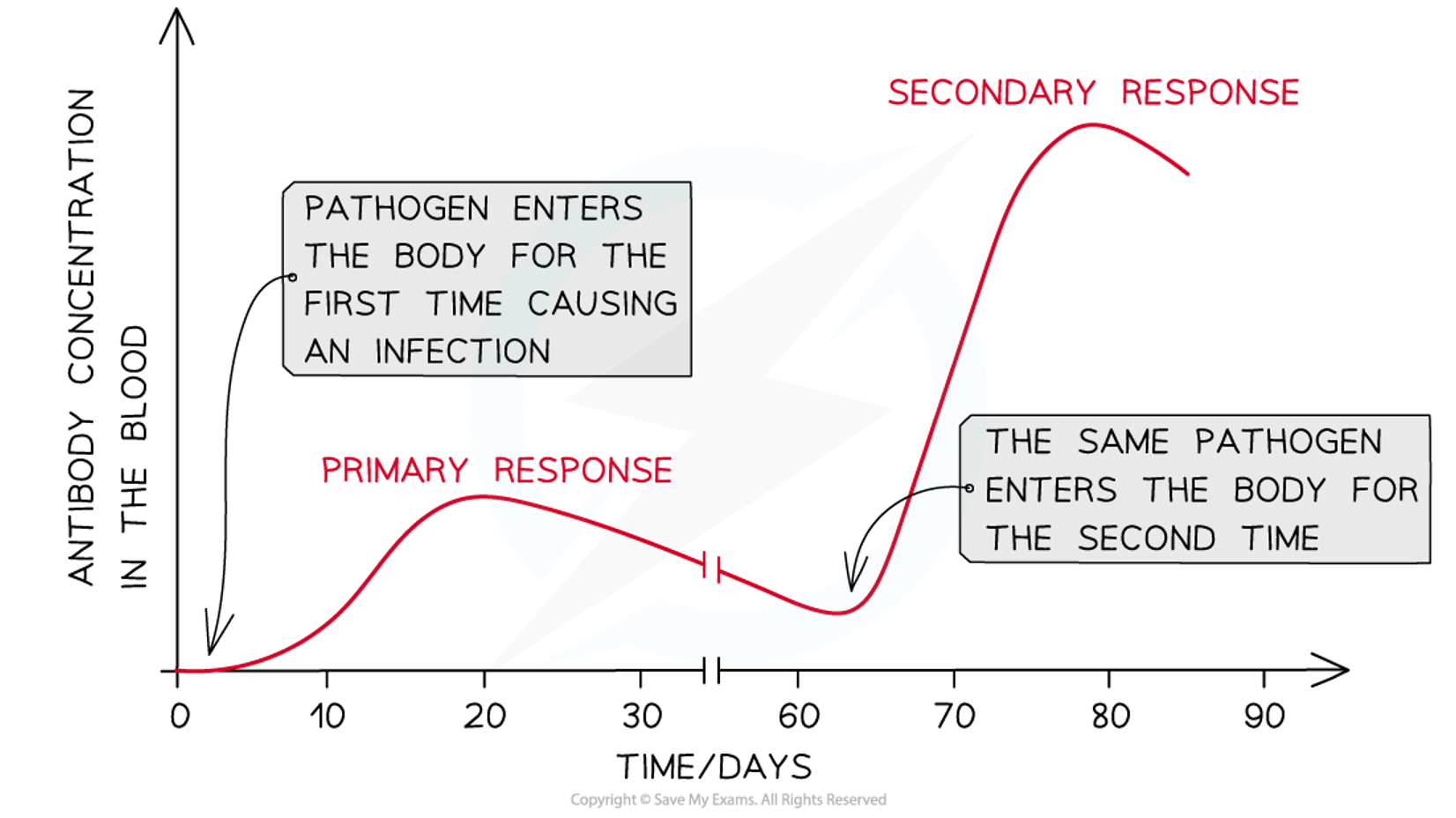
5
New cards
Why does the primary immune response take so long?
A lot of time and energy is required for:
\
* clonal selection and expansion of specific T and B cells
* antibody synthesis
\
* clonal selection and expansion of specific T and B cells
* antibody synthesis
6
New cards
Roughly how long does it take for antibodies to appear in the blood after the foreign antigen has entered the body?
10-17 days
7
New cards
What does the time delay of the primary immune response cause?
Patient experiences symptoms
8
New cards
What is the life span of plasma cells
short
9
New cards
How does the secondary immune response work?
* If the ^^**same foreign antigen**^^ is found in the body a **second time**, the ^^**B memory cells**^^ **recognise** the antigen
\
* B memory cells divide very quickly and differentiate into plasma cells (to produce antibodies) and more memory cells
\
* This response is **very quick**, meaning that **the** ^^**infection can be destroyed and removed** ^^before the pathogen population increases too much and symptoms of the disease develop
\
* This response to a previously encountered pathogen is, **relative to the primary immune response, extremely fast**
\
* B memory cells divide very quickly and differentiate into plasma cells (to produce antibodies) and more memory cells
\
* This response is **very quick**, meaning that **the** ^^**infection can be destroyed and removed** ^^before the pathogen population increases too much and symptoms of the disease develop
\
* This response to a previously encountered pathogen is, **relative to the primary immune response, extremely fast**
10
New cards
What do you call the immunity you were born with
Innate immunity
11
New cards
What do T memory cells produce?
Memory helper T cells
Memory killer T cells
Memory killer T cells
 Note
Note  Flashcards (35)