Biology 1020 1
 Studied by 1 person
 Call Kai
 Learn
Learn Practice Test
 Spaced Repetition
 Match
Match Flashcards
 Knowt Play
1/131

Earn XP
Description and Tags
Cards for Midterm One- Lectures 1-11
Name | Mastery | Learn | Test | Matching | Spaced | Call with Kai |
|---|
No analytics yet
Send a link to your students to track their progress
132 Terms
What is GUT?
The Grand Unifying Theory. Evolution is considered this.
Who is accredited with evolution?
Charles Darwin.
What is adaptation?
The framework of variation in nature.
What are the types of relationships organisms can have with one another in their environment?
Commensalism- one benefits one is unharmed
Mutualism- both benefit
Parasitism- one benefits and one is harmed
Competition- Competing for resources between organisms of the same species or other species
Predation- predator and prey relationship
How do we broadly define evolution?
Growth and modifications over time throughout generations. Survival of the fittest fits into evolution as well.
What are phylogenies?
A hypothesis for an evolutionary tree.
What is macroevolution?
A series of speciation events that contribute to evolution.
What is the narrow definition of evolution?
A change in the genetic composition of a population over generations. Evolution is something that happens to populations, not individuals.
What does immutable mean and what were the “immutable ideas” of evolution?
Immutable means unchanging. The previously immutable ideas of Darwin’s time were that God had put them on the planet (faith based science) and that the laws of humans did not equal the laws of animals.
What are some important dates regarding evolution?
1795- Hutton proposes gradualism
1798- Malthus publishes “Essay on the Principle of Population”
1809- Lamarck publishes his hypothesis of evolution~ Darwin born
1812- Cuvier publishes extensive studies of vertebrate fossils
1830- Lyell publishes “Principles of Geology”
1844- Darwin writes his essay on descent with modification
1858- Wallace sends Darwin his hypothesis on natural selection
1859- “On the Origin of Species” is published
Who is Thomas Malthus?
An economist who proposed the idea that as technology increased, so should population. Darwin applied his ideas to plants and animals.
Who is George Cuvier?
A paleontologist that advocated catastrophism (repopulation after catastrophes). He proved that there was change over time throughout fossils, but did not support evolution.
Who were James Hutton and Charles Lyell?
Two geologists who supported gradualism throughout the past and present. Lyell had the principle of uniformitarianism (changes of the Earth’s crust during geological history)
This thinking strongly influenced Darwin.
Who was Jean-Baptiste de Lamarck?
Observed evolution in fossil records but accredited it to the inheritance of acquired characters rather than genetic. Also had the theory of use and disuse.
Who was August Weismann?
He disproved Lamarck’s acquired characters theory through his mouse experiments.
Lamarck’s ideas were often vilified. Why is his contribution important?
His ideas could actually be tested through the observation of species over time and experiments like Weismann’s.
Who is Charles Darwin?
A naturalist (botany and zoology) who created a hypothesis on evolution and natural selection after observing fossils and living beings from the same region while on the voyage of the Beagle. He is credited with the theory of natural selection despite not being the first with the hypothesis.
Who is Alfred Russel Wallace?
He reached the same conclusions as Darwin. He wrote his manuscript and sent it to him
Describe “On the Origin of Species by Means of Natural Selection”
Where Darwin explained his three broad observations:
The unity of life
The diversity of life
The match between organisms and their environments
What is descent with modification?
A term used in place of evolution in the first edition of “Origin.” It attributes unity of life to the descent of all organisms from a common ancestor. Includes the idea of the accumulation of modifications throughout years that lead to adaptations and biodiversity.
Common knowledge for phylogenies?
Phylogenies are hypothesis. They can change with new data
Extinct branches don’t reach as far as extant branches
Nodes indicate common ancestors
The more recent the common ancestor, the more closely relate the taxa are
More changes and more recent ancestors= more closely related
What is artificial selection?
A breeding modification in which desirable traits are selectively bred.
What observations and inferences did Darwin make?
Observation 1: Memebers in a population vary in their inherited traits
Inference 1: Individuals who have traits better suited for the environment will leave more offspring
Observation 2: All species can reproduce more than the environment can support, so many offspring fail to survive and later reproduce
Inference 2: The unequal ability to survive leads to the accumulation of favourable traits
True or False: Adaptations are chance and sorted events
True. Adaptations usually originate from a mutation that ended up being favourable for the environment
True or False: Adaptations are immutable
False. Advantages may change overtime as environments change. Some changes that could affect favourable adaptations are humans or introduced species.
What must traits be for natural selection to act?
Inheritable and variable.
What direct observations can be made about evolution?
Macroevolution can lead to speciation
Gene flow is required for speciation
If gene flow ceases for a continued period of time, a new species has likely been created
Variability is necessary
Natural selection edits existing genes; it does not create new genes (could not create the perfect specimen)
What can homology say about evolution?
Supports descent with modification because homology = a trait shared over time between descendants of a common ancestor
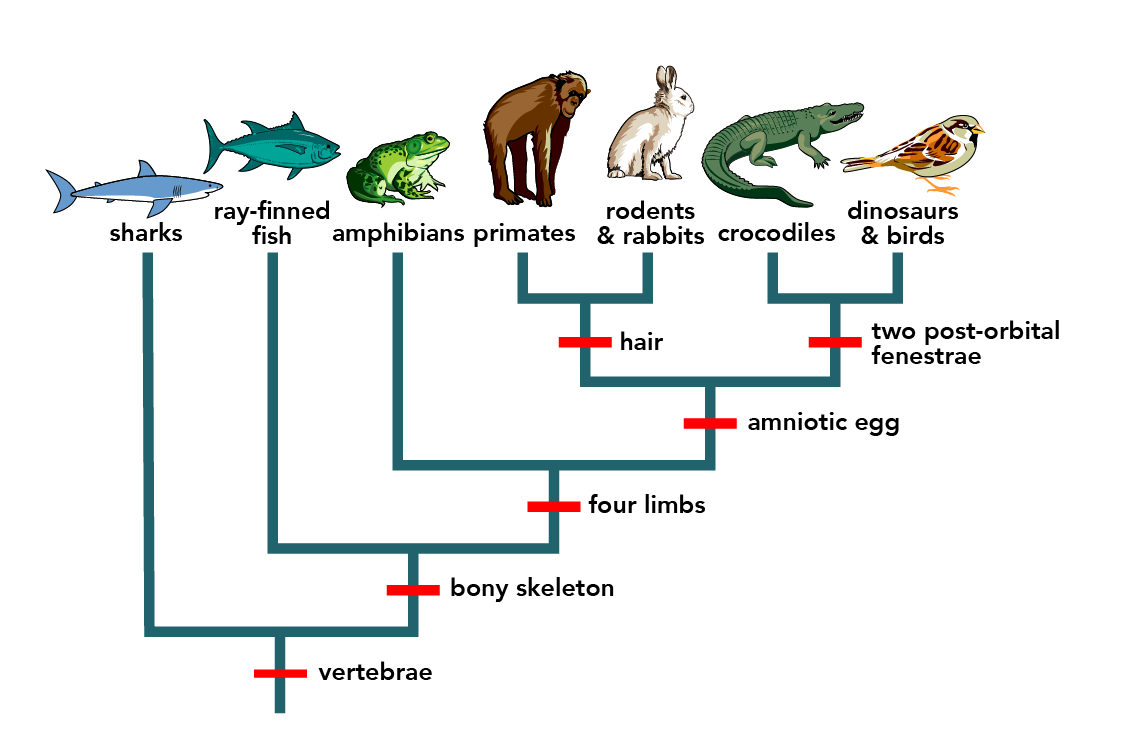
How many homologies are shared between rodents and amphibians?
Vertebrate, bony skeleton, and four limbs.
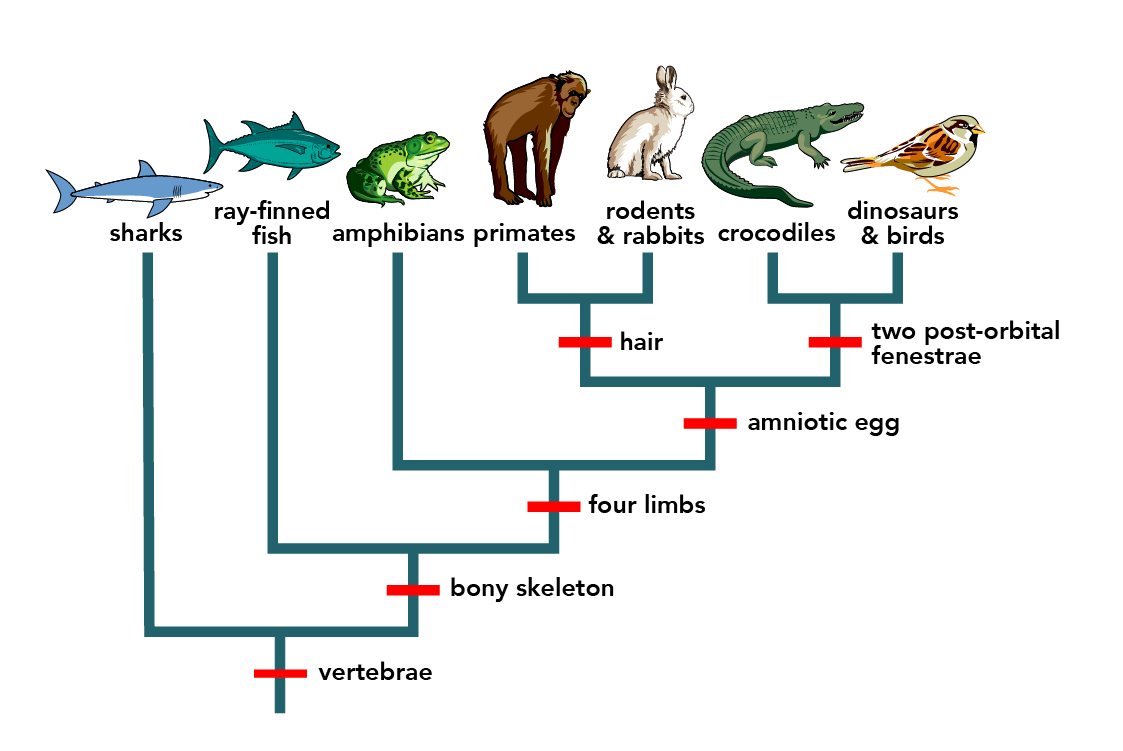
Based off the phylogeny, which lineage are amphibians most closely related to?
Primates, because of the amount of shared homolgous traits, and the recent common ancestor.
What can fossil records say about evolution?
Fossils can document the transition of traits throughout time.
What can biogeography say about evolution?
We are able to predict where modern species evolved from based off the continental drift.
What is biogeography?
The study of geographic dsitr
What was one of the challenges to Darwin’s theory of evolution by natural selection?
Lack of understanding of inheritance. To Darwin, this was the “mystery of mysteries.” The common thought was blended inheritance, which is half mother and half father, exclusively.
Who was Gregor Mendel?
Demonstrated particulate inheritance. Famous pea plan experiment
What is modern synthesis?
Better understood inheritance
Population genetics develop
Stage is set for a synthesis of several disciplines under evolutionary biology
Basically is the central point of all major bases of biology at that point
True or False: Individuals evolve
False. Populations evolve, not individuals
What is microevolution?
A change in allele frequencies in a population over generations.
What is the difference between micro and macro evolution?
Micro= small scale changes over a short amount of time
Macro= the accumulation of changes over a longer period of time
Only macroevolution can lead to speciation
What three things can cause allele frequency change?
Natural selection- chance events
Genetic drift- adaptation
Gene flow- movement
Only natural selection will lead to adaptive evolution
What causes genetic variation (as seen in Mendel’s pea plants)?
A difference in genes or other DNA segments.
What makes up a phenotype?
Genetics and environment.
All phenotypic variation is the result of genetic variation.
What is an example of genetic variation within populations?
Heterozygosity.
Where does genetic variation come from?
Mutation, sexual reproduction (recombinant genes), or gene duplication.
What is the Hardy-Weinberg equation?
An equation used to test whether a population is evolving. If there is a difference between measured frequencies and calculated frequencies then their is evolutionary change.
What is a population?
A localized group of individuals capable of interbreeding and producing fertile offspring. Same type, same place, same time.
What is a gene pool?
All the alleles for all loci in a population.
How can you tell if a locus is fixed?
If all individuals in a population are homozygous for the same allele. All alleles will be the same, which pauses genetic variation until mutation or gene flow can reintroduce it.
How can environment cause two populations of one species?
A physical barrier is often the cause of separation of a species. This can pause the gene flow and cause divergence, and eventually speciation.
What is codominance?
When the heterozygous has a distinct phenotype.
Ex. White flowers= aa
Red flowers= AA
Pink flowers= Aa
What is a Hardy-Weinberg equilibrium?
A population with random mating, Mendelian inheritance, and constant genotype frequencies throughout generations (no gene flow or mutation)
What is genetic drift?
Random events that cause gene displacement. They affect smaller populations more than large ones. It creates a decrease in variation within populations.
What is the founder effect?
When a new population is created by a small number of individuals that have migrated away from the larger population.
What is the bottleneck effect?
When a population is reduced due to a chance catastrophic event.
What are some consequences of genetic drift for a population?
It decreases genetic variation within a population, and can cause alleles to become fixed or lost, which reduces or completely gets rid of the chance for evolution.
On the contrary, genetic drift can lead to an increase of genetic drift among populations because the change in allele frequency is random.
What is gene flow?
A movement of alleles among populations.
Alleles can be transferred through movement of fertile gametes.
How can gene flow affect a population?
It can decrease the fitness of a population because it can limit genetic differences between populations.
Gene flow can increase genetic variation within a population because there is a mixing of genes between separated groups.
How does gene flow affect fitness of a population?
It increases the fitness because it increases genetic variation which increases survival rates and chances of adaptation and macroevolutionary events through the introduction of new traits. It also can lead to the spread of beneficial alleles.
What effect does genetic drift have on the genetic variation within populations?
Reduce genetic variation.
What is survival of the fittest?
Chances of survival are increased due to relative fitness and reproductive success.
What is relative fitness?
The contribution a genotype makes to the gene pool of the next generation (number of offspring produced), relative to the contributions of other genotypes.
How does natural selection affect relative fitness?
Increases the frequency of alleles that grant a reproductive advantage.
What are the three basic forms of natural section?
Directional, Disruptive, and Stabilizing.
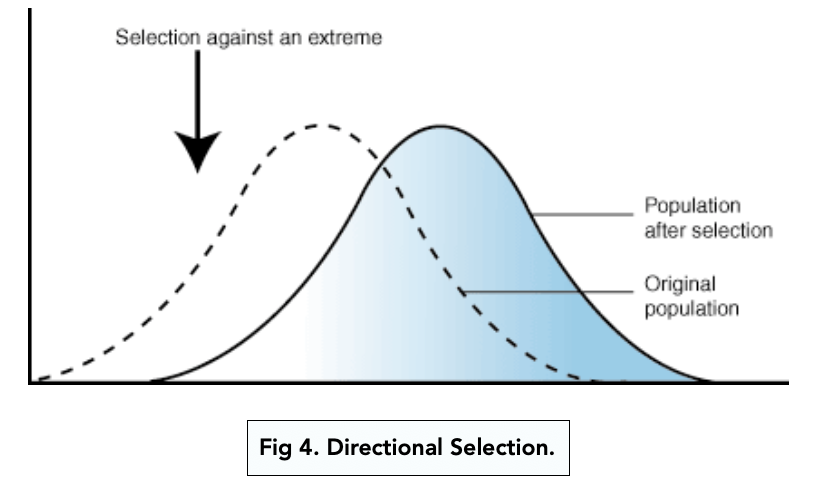
What is directional selection?
A favouring of individuals at one extreme of a phenotype.
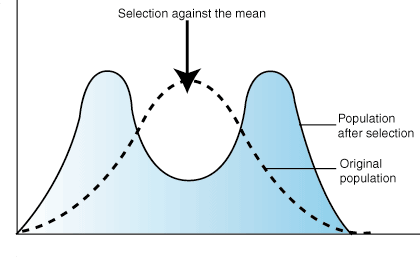
What is disruptive selection?
A favouring of individuals at both phenotypic extremes. It can lead to speciation.
What is stabilizing selection?
A favouring of the intermediate (sometimes heterozygous) phenotype; an act against both phenotypic extremes.
What are some special types of natural selection?
Sexual, balancing, and frequency-dependent.
Each can be associated with any basic form of selection.
What is sexual selection?
Natural selection for mating success that can lead to sexual dimorphism. Certain traits can result in an increase in desirability.
aka Female choosiness
What is sexual dimorphism?
Marked differences between the sexes.
What is the difference between intrasexual and intersexual selection?
Intra- a need to balance. often male lead
Inter- mate choice, female choosiness
True or false: Female choosiness is linked to relative fitness.
True. Sometimes, male traits that seem mostly for show are linked to better genes
Ex. Long vs short call frogs experiment
What is balancing selection?
When natural selection maintains stable frequencies of two or more phenotypic forms.
Includes:
Heterozygote advantage
Frequency-dependent selection
What is heterozygote advantage?
When heterozygotes have a higher fitness than both homozygotes. Can result from stabilizing or directional selection. In order for them to have an advantage, the heterozygote must have a distinct phenotype.
In other words, the heterozygote has the extreme phenotype.
What is frequency-dependent selection?
When selection favours the less common phenotype.
Why can’t natural selection perfect an organism?
Can only act on existing variations
Limited by ancestral anatomy
Adaptions are compromises
Chance events can affect allele variability
Environment changes
Natural selection wants to increase relative fitness, not make the perfect specimen
True or false: Gene flow cessation always results in speciation.
False. Gene flow can stop and restart, and still could not end in speciation 100% of the time.
What is speciation?
The origin of new species. The focal point of evolutionary theory.
What is a species?
A concept based off the ability to interbreed than on physical similarity.
Hybrids are a complication regarding species, as they prove species can interbreed, but the resulting offspring are not fertile.
What is are the prezygotic barriers preventing hybrids?
Habitat isolation
Temporal isolation- differing breeding times
Behavioural isolation
Mechanical isolation- morphologic differences
Gametic isolation- sperm cannot fertilize eggs of another species
What are the post zygotic barriers preventing hybrids?
Reduced Hybrid Viability- impairment of development or survival
Reduce Hybrid Fertility
Hybrid Breakdown- offspring are feeble or sterile
What is trait divergence?
When a group goes through parallel changes that result in a splitting of the group, resulting in morphologic differences.
What is allopatric speciation?
A physical barrier preventing gene flow.
What is sympatric speciation?
No gene flow despite the absence of a barrier. gene flow may be reduced by polyploidy (chromosome difference within one generation between parents and offspring), sexual selection, and habitat differences.
If nucleotide variability at a locus is 0%, how many alleles are there?
Only one.
What are the three possible outcomes of hybridization?
Reinforcement, fusion, and stability.
What is hybridization?
The breeding of two different species resulting in a hybrid offspring.
What is a hybrid zone?
A region in which members of different species mate and produce hybrids. This is the connection between two different populations.
Hybrid zones can reveal factors that cause reproductive isolation.
Which sex is most against hybrids?
Males are against hybrids because hybrids are physically fit.
Where are hybrids zones most common?
In the northern hemisphere due to glaciation and glacial retreat. Populations move back and forth over time due to the movement of glaciers.
What is an ecotone?
The connection between two different environments. Hybrids are more common here because they are suited for both environments due to their combination of traits from both populations.
What is hybrid speciation?
A phenomenon more common in plants where a new species is created from the hybrids of two others.
What does conspecific mean and how can it relate to hybridization?
Conspecific means to belong to the same species. It relates to hybridization in the sense that some females can’t tell between hybrids and conspecific in certain environments.
What is reinforcement?
A series of traits that show a pattern of reproductive character displacement, causing divergence within a sympatric population.
What is the difference between allopatric and sympatric populations?
Allo- no overlap between species
Sympatric- the overlap between species
What is admixture?
The mixing of genes.
How can pollution affect hybridization?
Pollution can create confusion between species due to lack of visibility. It can cause an increase of mating between species and creates many hybrids.
What happens when hybrids are equally as fit as parents?
It can create reverse speciation or backcrossing.
Why is the hybrid zone maintained?
Despite hybrids being less fit, they are continuously formed due to overlapping zones, which maintains the hybrid zone.
What is adaptive radiation?
A process in which organisms diversify rapidly from an ancestral species to a bunch of new species (punctuated pattern).
How many genes need to change in order for a new species to be formed.
As little as one gene can cause speciation.
 Note
Note  Flashcards (125)