A&P Discussion U2Wk4&5: Skeletal System Introduction
 Call Kai
 Learn
Learn Practice Test
 Spaced Repetition
 Match
Match Flashcards
 Knowt Play
1/83

There's no tags or description
Looks like no tags are added yet.
Name | Mastery | Learn | Test | Matching | Spaced | Call with Kai |
|---|
No analytics yet
Send a link to your students to track their progress
84 Terms
fxns of bone (6)
support, protect, movement, reservoir, hematopoiesis, storage
living, dynamic tissue - always remodeling (building and breaking down)
bone
two major tissues of the skeletal system
bone, cartilage
highly vascularized CT with a hard, mineralized extracellular matrix
bone
protein fibers: what are they made of, organic or inorganic
collagen, organic
ground substance: what is it made of, organic or inorganic
hydroxyapatite crystals, inorganic
________ is a poorly vascularized C.T. with a matrix composed of chondroitin sulfate and various fibers
cartilage
3 major types of cartilage
hyaline cartilage, fibrocartilage, elastic cartilage
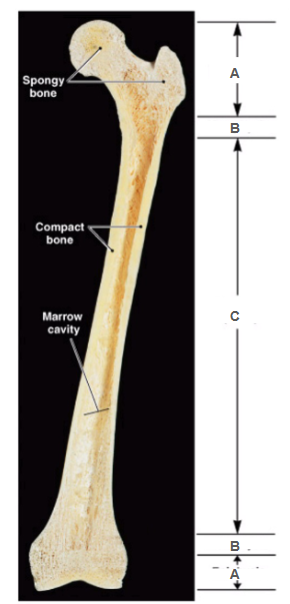
label A
epiphysis
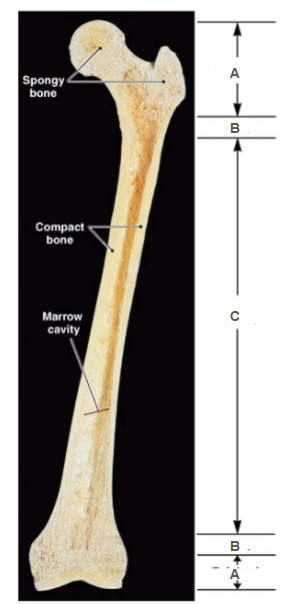
label B
metaphysis

label C
diaphysis
Central cylinder of compact bone (“shaft”) with medullary cavity
diaphysis
enlarged end w/ compact and trabecular bone
epiphysis
b/t diaphysis and epiphysis; region of growth plate
metaphysis
• Layer of hyaline cartilage on articular surface of epiphyses
• Generic term for any cartilage between 2 bones
articular cartilage
Hollow central portion of diaphysis in large long bones; contains yellow marrow in adults
medullary (marrow) cavity
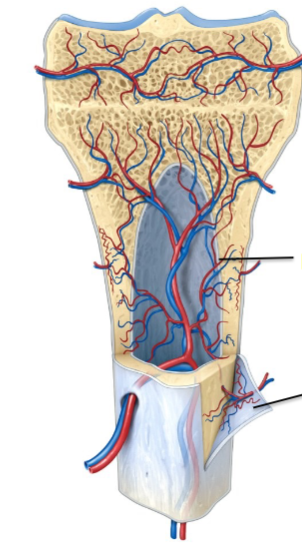
label top arrow (covers inner bone surfaces)
endosteum
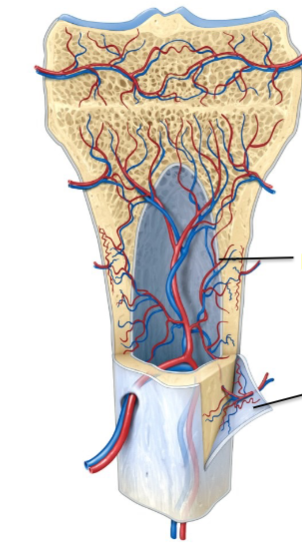
label bottom arrow (covers outer bone surface)
periosteum
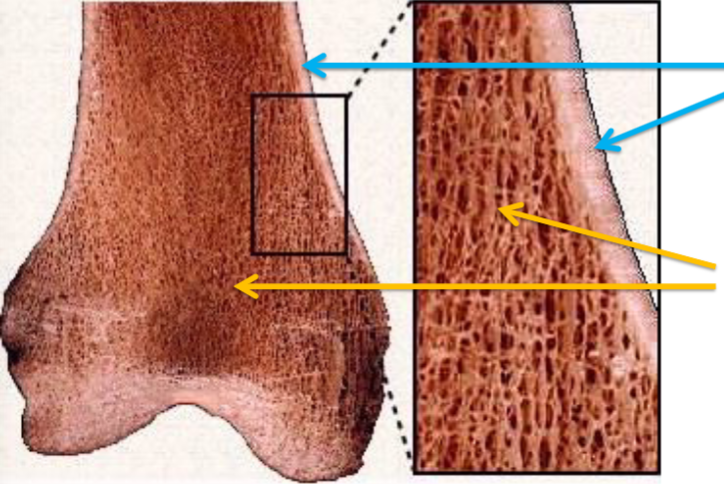
label blue arrows
compact bone
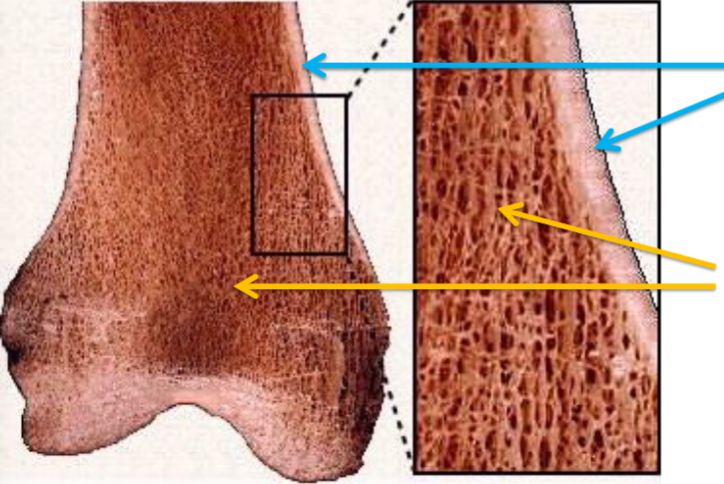
label yellow arrows
spongy bones
_______ bone is good at providing protection and support. Forms the superficial layer of all bones and shaft of long bones; made of layers called lamellae
compact
_______ bone is lightweight and provides tissue support. Fills the ends and internal spaces of long bones and is always found deep to compact bone.
spongy
______ are the fxn units of compact bone
osteons
________ ________ are rings of calcified matrix creating the osteon
concentric lamellae
_______ ______ b/t osteons are left over fragments of older osteons
interstitial lamellae
________ _______ lamellae encircle the bone beneath the periosteum.
outer circumferential
_____ ______ lamellae encircle the medullary cavity
inner circumferential
______ canals: transmits blood vessels and nerves
central (Haversian)
_____ canals: perpendicular channels connecting vessels and nerves
perforating
______: small spaces b/t the lamellae which house osteocytes
lacunae
_____: small channels filled w/ extracellular fluid connecting the lacunae
canliculi
Spongy bone lacks osteons. Instead, lamellae are arranged in a lattice of thin columns called ______
trabeculae
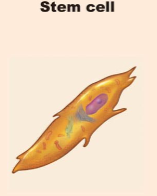
label cell
osteogenic cell

label cell
osteoblast
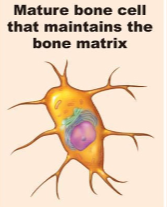
label cell
osteocyte
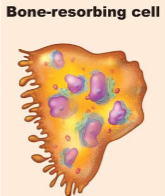
label cell
osteoclast
• Capable of degrading and reabsorbing matrix • Found on surface of any bone undergoing remodeling
osteoclasts
All connective tissues develop in utero from an embryonic connective tissue called ______
mesenchyme
Bone forms directly within mesenchyme (embryonic CT), arranged in sheet-like layers
intramembranous ossification
Most bones form this way
– The mesenchyme produces hyaline cartilage, which then forms the bone
– Causes growth of bones until 20s-30s; some don’t fully fuse until 50!
endochondral ossification

——— bones: greater in length than width; slightly curved for purpose of weight bearing (ex: femur, tibia, humerus, ulna, metacarpals)
long
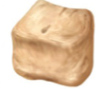
_____ bones: cube shaped
short
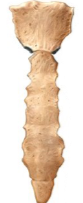
_____ bones: thin, nearly parallel layers of compact bone enclosing a layer of spongy bone
flat
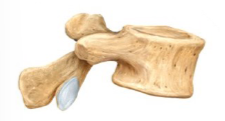
_____ bones have complex shapes
irregular
______ bones vary in # and protect tendons from excessive wear
sesamoid
_____ bones: extra bones b/t the plates of the skull - highly variable b/t individuals - not individually named
sutural
these surface markings allow the passage of blood vessels and nerves and form joints or provide space for muscle bellies
depressions/openings
these surface markings are projections/outgrowths that form joints and serve as attachment points for ligaments and tendons
processes
cleft, groove, or slit in bone
fissure
shallow depression
fossa
groove or furrow
sulcus
tube-like opening
meatus
smooth, eblarged end of bone on constricted neck
head
smooth, rounded articular surface, usually located o the epiphyseal ends of bones
condyle
small, fat, smooth articular surfac
facet
bony marking: prominent ridge
crest
bony markings: extension of bone marking an angle with the rest of the structure
ramus (rami)
bony markings: short projection of bone
spine
bony markings: thin, continuous ridge
line
trochanter(s)
swellings of bone of femur (greater, lesser)
bony markings: small, rounded projecting process
tubercle
bony markings: broad, roughened process
tuberosity
bony markings: spindle/pulley shaped articular surface (humerus)
trochlea
bony markings: prominence above a condyle
epicondyle
bony spaces: mucus-lined, air-filled cavity (cranial)
sinus
bony spaces: sockets in bone where teeth attach
alveolus
discussion 7

