Ap Psych - Sensation and Perception
0.0(0)
 Studied by 0 people
 Call Kai
 Learn
Learn Practice Test
 Spaced Repetition
 Match
Match Flashcards
 Knowt Play
Card Sorting
1/113

Earn XP
Description and Tags
Last updated 5:45 PM on 3/28/23
Name | Mastery | Learn | Test | Matching | Spaced | Call with Kai |
|---|
No analytics yet
Send a link to your students to track their progress
114 Terms
1
New cards
Define Sensation
The process by which sensory receptors (in eye, ear, etc.) receive and are stimulated by stimulus energies from the environment.
2
New cards
Define Perception
The process of organizing and interpreting sensory information, enabling us to recognize meaningful objects and events.
3
New cards
What is bottom-up processing?
Analysis that begins with the sense receptors and works up to the brain's processing of the information.
4
New cards
What is top-down processing?
Information processing guided by higher-level processes, such as our expectations.
5
New cards
What is the absolute threshold?
The minimum stimulation needed to detect a particular stimulus 50% of the time.
6
New cards
What is the Signal Detection Theory?
Predicts how and when we detect faint stimuli (dependent on experience, expectations, motivation & fatigue.
7
New cards
What is Subliminal Stimulation?
Stimulation below one's threshold of conscious awareness. Research reveals a *subtle, fleeting effect on thinking, but no effect on behavior.*
8
New cards
What is a Difference Threshold?
The minimum difference between two stimuli required for detection 50% of the time. It is also called the ***just noticeable difference or JND.*** It is based on **Weber's Law:** The difference threshold is in proportion to the strength of the original stimulus.
9
New cards
What is Sensory Adaptation?
Our diminishing sensitivity to unchanging stimuli
10
New cards
What is Selective Attention?
The focusing of attention on specific stimuli, while ignoring other stimuli (e.g., the cocktail party effect).
11
New cards
What is transduction?
The transforming of stimulus energies (i.e., light waves, sound waves) into neural impulses.
12
New cards
What is wavelength?
Distance from the peak of one light or sound wave to the next.
13
New cards
What does wavelength determine in vision?
hue of a color; shorter is blue, longer is red
14
New cards
What does wavelength determine in sound?
pitch; shorter is higher, longer is lower
15
New cards
What is amplitude?
The height of a light or sound wave.
16
New cards
What does amplitude determine in vision?
brightness; larger = brighter, smaller = more dull
17
New cards
What does amplitude determine in hearing?
loudness; larger = louder, smaller = quieter
18
New cards
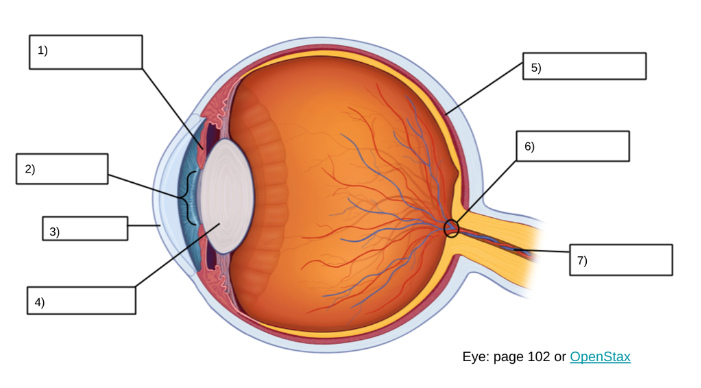
What is 1 pointing to?
Iris
19
New cards
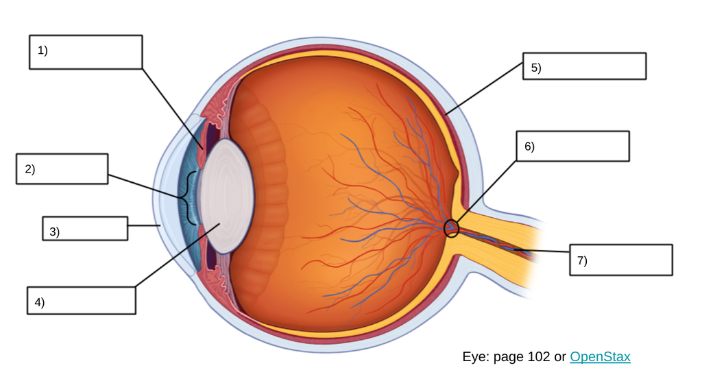
What is 2 pointing to?
pupil
20
New cards
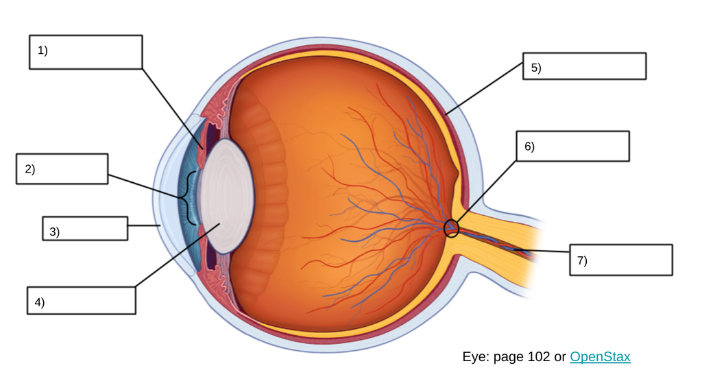
What is 3 pointing to?
cornea
21
New cards
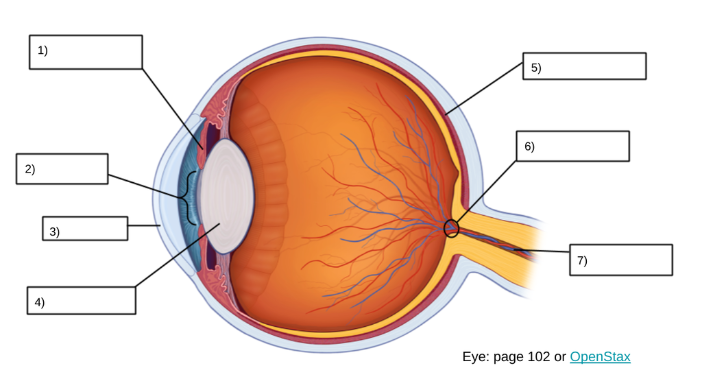
What is 4 pointing to?
lens
22
New cards
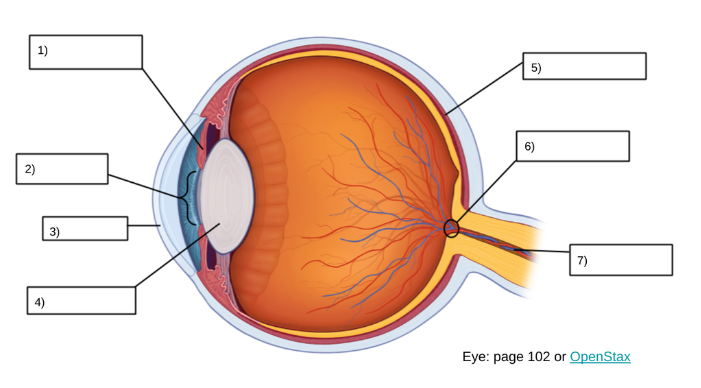
What is 5 pointing to?
retina
23
New cards
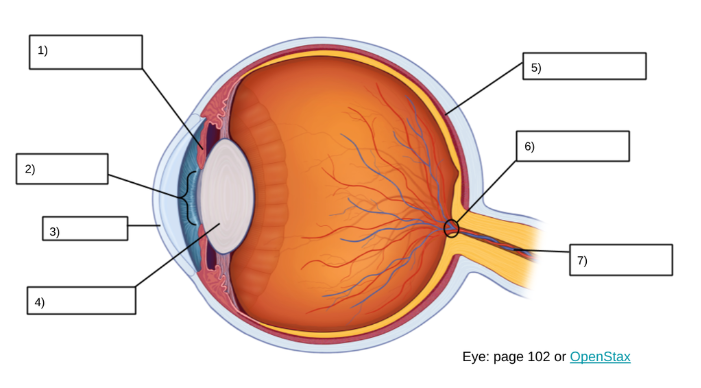
What is 6 pointing to?
blind spot in the retina
24
New cards
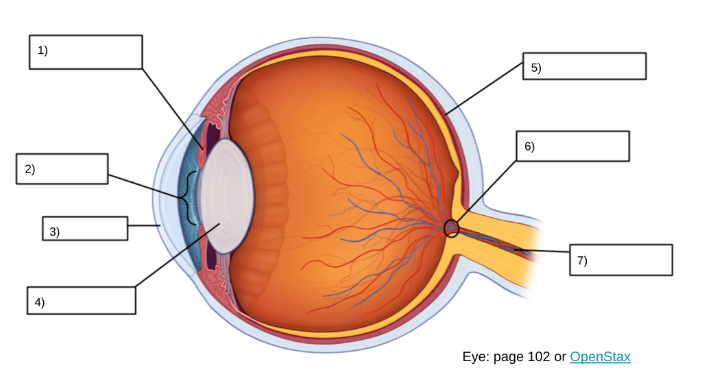
What is 7 pointing to?
optic nerve
25
New cards
What is the purpose of the iris?
A ring of muscle tissue that forms the colored part of the eye. It controls the size of the pupil
26
New cards
What is the purpose of the pupil?
Adjustable opening in the center of the eye through which light passes.
27
New cards
What is the purpose of the cornea?
protects the eye, begins to bend the light
28
New cards
What is the purpose of the lens?
The transparent structure behind the pupil that changes shape (called **accommodation**) to help focus images on the retina.
29
New cards
What is the purpose of the retina?
contains rods and cones, converts light energy to nerve impulses
30
New cards
What is the purpose of the Optic Nerve?
transmits visual information to the brain
31
New cards
What is visual acuity?
The sharpness of vision
32
New cards
What is nearsightedness?
Can see nearby objects more clearly because distant object focus in front of the retina (eyeball may be too long).
33
New cards
What is farsightedness?
Can see distant objects more clearly because nearby objects focus behind the retina (eyeball may be too short).
34
New cards
What are the receptor cells for vision? What is the purpose of these cells?
Rods and Cones: Receptor cells are specialized neurons designed, in this case, to transduce light energy into neural impulses.
35
New cards
What specifically do rods do?
detect black, white, & gray. Found mainly in the periphery of the retina. More than one rod connects to each bipolar cell. Thus, less light energy is necessary for them to cause the bipolar cells to fire. Necessary for *NIGHT VISION & PERIPHERAL VISION.*
36
New cards
What specifically do cones do?
Found mainly in the center (**fovea)** of the retina. Necessary for *COLOR VISION* and *VISUAL ACUITY*.
37
New cards
Describe the process from light hitting rods and cones to getting to the brain.
Light waves stimulate **rods & cones** which synapse to **bipolar cells,** which synapse to **ganglion cells.** The **axons of the ganglion cells** come together to form the **Optic nerves** which transmit visual information to the brain.
38
New cards
What is the blindspot in the eye?
The area in the retina where the optic nerve leaves the back of the eye. No rods or cones are located there, so no vision is possible at that location.
39
New cards
What are the feature detectors?
Nerve cells in the brain that respond to specific features of a visual stimulus, such as shape, angle, or movement.
40
New cards
What is parallel processing?
The ability of the brain to process several aspects of a situation simultaneously.
41
New cards
What is the Young-Helmholtz Trichromatic Theory
The theory that the retina contains three different types of cones--one most sensitive to red, one to blue, and one to green--which when stimulated in combination can produce any color.
42
New cards
What are the primary colors of lightwaves?
**RED, GREEN, & BLUE**
43
New cards
What is Opponent-Processing Theory?
Theory that opposing retinal processes (red-green, yellow-blue, & black-white) enable color vision. For example some cells are stimulated by red while inhibited by green; others are stimulated by yellow, while inhibited by blue.
44
New cards
What are afterimages? What helps explain this?
Afterimages are created by the tiring of one color from a pair of opposing retinal processes. When we stare at something green for awhile, we may see a red afterimage when we look away (explained by Opponent-Processing Theory)
45
New cards
What is color constancy?
Perceiving familiar objects as having consistent color, even if changing illumination alters the wavelength reflected by the object.
46
New cards
Define audition
The sense of hearing.
47
New cards
What is frequency?
The number of complete **wavelengths** in a given period of time. Frequency determines **pitch.**
48
New cards
What is Sound localization?
Sound waves strike one ear **sooner** and with **more intensity** than the other ear. With this information, the brain can determine the location of the sound.
49
New cards
What is the Middle Ear?
\
Chamber between the eardrum and the oval window which contains the **ossicles** (three tiny bones--hammer, anvil, & stirrup) which concentrate the vibrations of the eardrum.
Chamber between the eardrum and the oval window which contains the **ossicles** (three tiny bones--hammer, anvil, & stirrup) which concentrate the vibrations of the eardrum.
50
New cards
What’s contained in the Inner Ear?
Contains the cochlea, semicircular canals, and vestibular sacs.
51
New cards
What is the cochlea?
a coiled, bony, fluid-filled tube through which sound waves trigger nerve impulses.
52
New cards
What is the Basilar Membrane?
Membrane along the center of the cochlea that contains **hair cells** (the receptor cells for sound)
53
New cards
How do the hair receptor cells in the ear work?
Axons from the hair cells form the **Auditory Nerves,** which transmit neural impulses to the brain.
54
New cards
What is the Place Theory?
Theory that the pitch we hear is associated with the **place** where the basilar membrane is stimulated. Best for explaining *high-pitched tones.*
55
New cards
What is the Frequency Theory?
Theory that the rate of nerve impulses traveling up the auditory nerve matches the frequency of the tone we are hearing. Best for explaining *low-pitched tones.*
56
New cards
What is the Volley Principle?
Helps explain in frequency theory how we can hear sounds with a frequency greater than 1000 cycles per second. While some neurons are "recharging" during the refractory period, others are firing.
57
New cards
What is Conduction Deafness?
Caused by damage to the structures that conduct sound waves through the ear (eardrum, ossicles); far less common than nerve hearing loss
58
New cards
What is Nerve Deafness?
Caused by damage to the cochlea's hair cells or the auditory nerve; also called sensorineural hearing loss
59
New cards
What are the 4 different skin senses that we know of?
pressure, warmth, cold, pain
60
New cards
What is the only skin sense that has identifiable sense receptors?
pressure
61
New cards
What two skin senses create the feeling of wetness? Hotness?
cold + pressure; cold + warmth
62
New cards
What is the Gate-control theory?
Theory that the spinal cord contains a neurological "gate" that blocks pain signals or allows them to pass.
63
New cards
How is the “gate” in Gate-control theory opened? closed?
The gate is opened by stimulation of small nerve fibers and closed by stimulation of larger fiber or by information coming from the brain.
64
New cards
What is the Gustatory sense? What else is it
taste; it is also a chemical sense
65
New cards
What are the five different taste senses?
sweet, sour, bitter, salty, umami
66
New cards
What is umami?
a meaty taste; present in MSGs
67
New cards
About how many taste buds does each bump of the tongue have?
200
68
New cards
How does a taste bud work?
each contains a porethat captures food molecules. The molecules cause **hair-like neurons** within the pores to fire.
69
New cards
How quickly do taste buds reproduce themselves?
every 2-3 weeks
70
New cards
What is sensory interaction?
The principle that one sense may be influenced by another, as when the smell of food influences its taste.
71
New cards
Which is the Olfactory sense? What else is it?
smell; it is also a chemical sense
72
New cards
About how many smells can we detect?
about 10,000
73
New cards
Where in the brain are odors processed?
The limbic system and temporal lobe
74
New cards
How do smells reach our brain?
Molecules in the air reach millions of receptor cells in each nasal cavity. These cells send messages to the **olfactory bulb** and the **olfactory nerve** which transmits the messages to the brain
75
New cards
What is Kinesthesis?
The system for sensing the position and movement of individual body parts. The **receptor cells** for kinesthesis are found in our **muscles, tendons, & joints.**
76
New cards
What is Vestibular sense?
The system that monitors the head's (and thus the body's) position and movement. It is our sense of **equilibrium.**
77
New cards
How do we know our head’s position?
The **semicircular canals and vestibular sacs** in the **inner ear** contain receptors that tell us
78
New cards
What is the figure ground relationship?
Our ability to perceive any object (the *figure*) as distinct from its surroundings (the *ground).*
79
New cards
What is visual capture?
The tendency for vision to dominate the other senses when conflicting information is being received.
80
New cards
What is the idea of Gestalt Organizational Principles?
emphasize our tendency to integrate individual pieces of information into a meaningful whole. To bring order and form to basic visual sensations, our brains follow certain rules for __**grouping**__ stimuli together.
81
New cards
What are the 5 Gestalt Organizational Principles?
Proximity, Similarity, Continuity, Connectedness, Closure
82
New cards
What is Proximity in relation to Gestalt?
We group nearby objects as belonging together
83
New cards
What is Similarity in relation to Gestalt?
Figures similar to each other (i.e., as in shape or color) are grouped together.
84
New cards
What is Continuity in relation to Gestalt?
We perceive smooth, continuous patterns rather than discontinuous ones.
85
New cards
What is Connectedness in relation to Gestalt?
When uniform and linked, we perceive spots, lines, or areas as single units.
86
New cards
What is Closure in relation to Gestalt?
We fill in gaps to create complete, whole objects
87
New cards
How do we know depth perception is at least somewhat innate?
A laboratory device for testing depth perception in infants. Even when coaxed, infants are reluctant to venture onto the glass over the cliff.
88
New cards
What are the binocular cues?
Retinal Disparity and Convergence
89
New cards
What is Retinal Disparity?
By comparing the two slightly different images received on each retina, the brain computes the distance of what we are looking at. The **greater the disparity** (difference) between the two images, **the closer the object.**
90
New cards
What is Convergence?
The extent to which the eyes converge inward when looking at an object. The **greater the convergence, the closer the object.**
91
New cards
What are the Monocular Cues?
Relative size, Interposition, relative clarity, texture gradient, relative height, linear perspective, light & shadow, relative motion
92
New cards
What is relative size?
If we assume two objects are about the same size, the one that casts the smaller retinal image is perceived as being farther away.
93
New cards
What is Interposition?
If one object partially blocks another, the one that is partially blocked is perceived to be farther away.
94
New cards
What is relative clarity?
Because light from distant objects must pass through more atmosphere, we perceive hazy objects as being farther away than clear, distinct objects.
95
New cards
What is texture gradient?
A gradual change from a coarse, distinct texture to a fine, indistinct texture signals increasing distance.
96
New cards
What is relative height?
We perceive objects higher in our visual field as being further away.
97
New cards
What is Linear Perspective?
Parallel lines (such as railroad tracks) appear further away as they converge in the distance.
98
New cards
What is light & shadow?
relative brightness; Nearby objects reflect more light. Thus, given two identical objects, the dimmer one seems further away.
99
New cards
What is relative motion?
also called motion parallax; If while riding in a train you fix your gaze on some object (the fixation point), objects closer than the fixation point appear to be moving backward. The nearer an object is, the faster it seems to move. Objects behind the fixation point appear to be moving with you: The farther away the object is from the fixation point, the more slowly it appears to move.
100
New cards
What is one way we perceive motion?
by knowing that if an object keeps getting bigger, it is probably moving towards us. If an object is shrinking, it is moving away from us.
 Note
Note  Flashcards (500)