PS231: Synaptic Plasticity & the Etiology of Schizophrenia
 Studied by 0 people
 Call Kai
 Learn
Learn Practice Test
 Spaced Repetition
 Match
Match Flashcards
 Knowt Play
1/15

There's no tags or description
Looks like no tags are added yet.
Name | Mastery | Learn | Test | Matching | Spaced | Call with Kai |
|---|
No analytics yet
Send a link to your students to track their progress
16 Terms
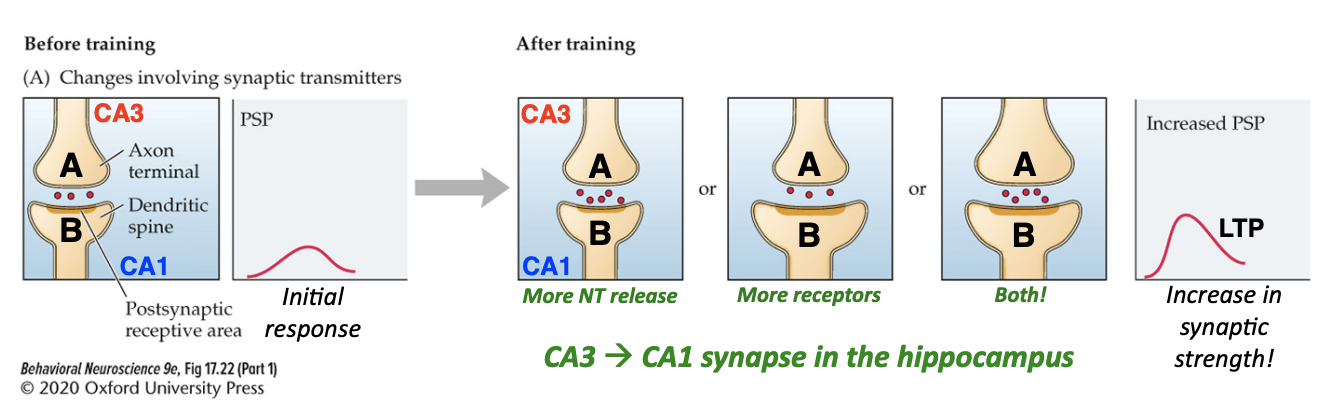
Training a Rat on a Spatial Memory Task Strengthens the Synaptic Connections Between CA3 and CA1 Pyramidal Neurons
Following training on a spatial memory task, the synaptic connections between pyramidal neurons in the hippocampus become potentiated (in other words, they get stronger)
At first, neuron A causes a small post synaptic potential (PSP) in neuron B (left), but over time if neuron A continues to simulate neuron B, the connection between them becomes strengthened such that the PSP is now larger (right) even with the same amount of stimulation—this phenomenon is known as long-term potentiation (LTP), a form of synaptic plasticity
The million dollar question is, how does synaptic plasticity happen? It turns out there’s a few ways this phenomenon can occur, but we’ll focus on the most common way—LTP
Synaptic Plasticity
The biological process by which specific patterns of synaptic activity result in changes in synaptic strength thought to contribute to learning and memory
LTP
A form of synaptic plasticity wherein specific synapses are strengthened in an activitydependent manner within minutes—this strengthening of synapses is the physiological basis of learning and memory—this is what happens in our brain when we learn
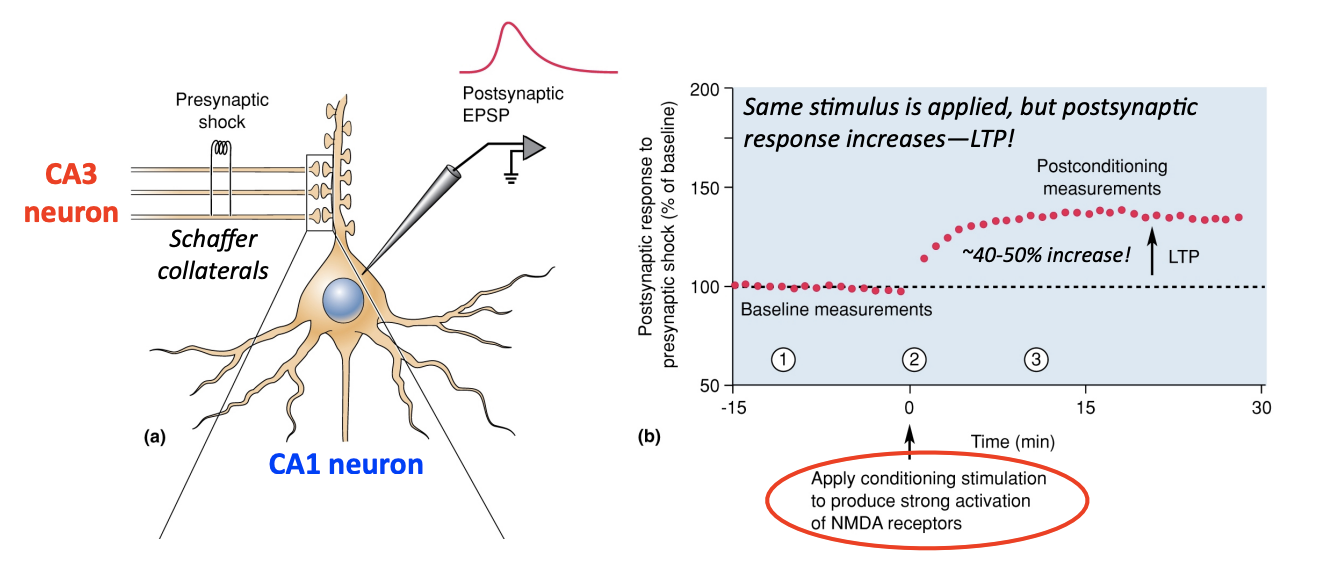
Long-Term Potentiation (LTP) Strengthens Synaptic Connections Between Neurons (Physiological Changes)
Applying a brief burst (5s) of high frequency stimulation (100 Hz) onto the CA1 neuron causes a long-lasting, potentiated (stronger) response in the CA1 neuron—this is LTP
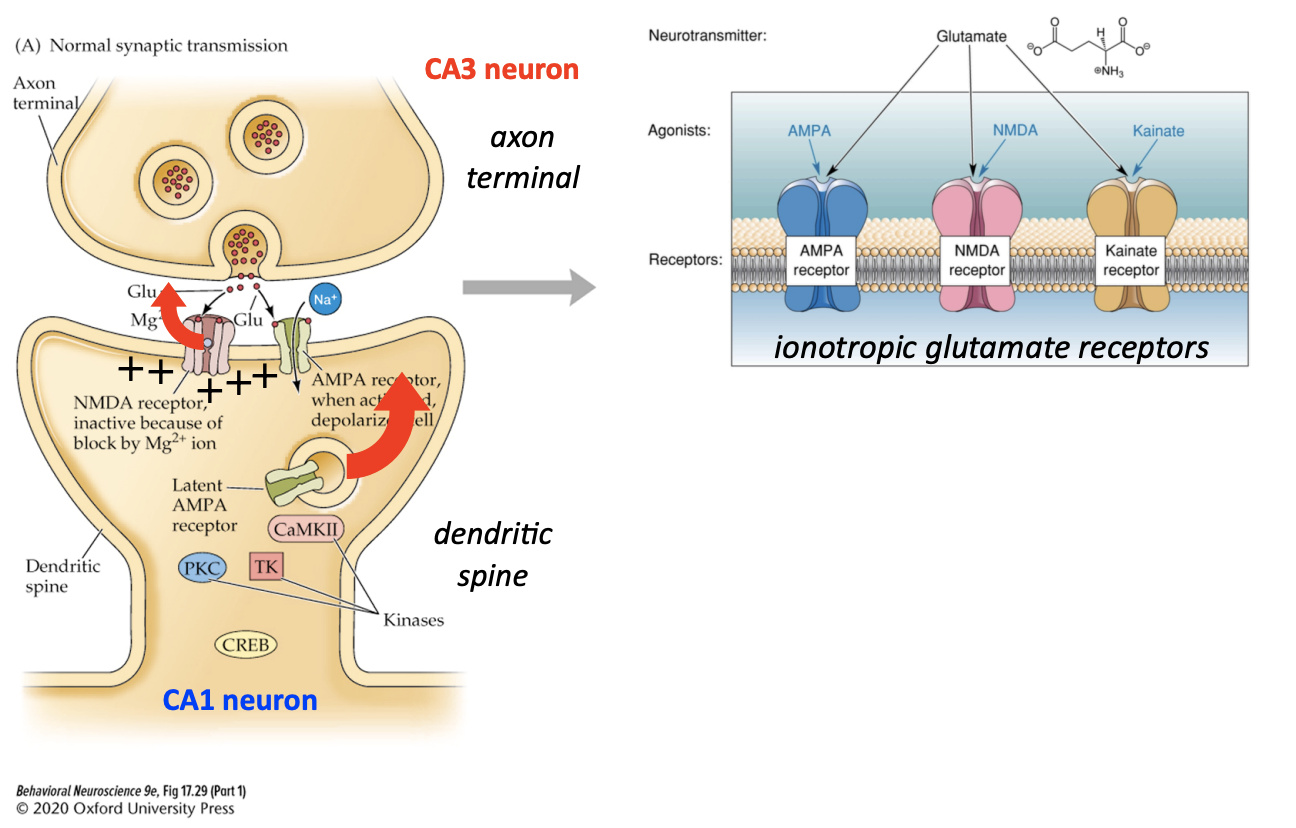
Long-Term Potentiation (LTP) is Mediated by AMPA and NMDA (Glutamate) Receptors
At first, glutamate activates only AMPARs, allowing Na+ influx
If enough Na+ flows in, the membrane becomes depolarized, which removes the Mg2+ block from NMDARs
This allows the influx of Na+ and Ca2+ though the NMDAR
Ca2+ then goes on activate proteins in the cell that traffic more AMPARs to the membrane, making the cell more excitable!
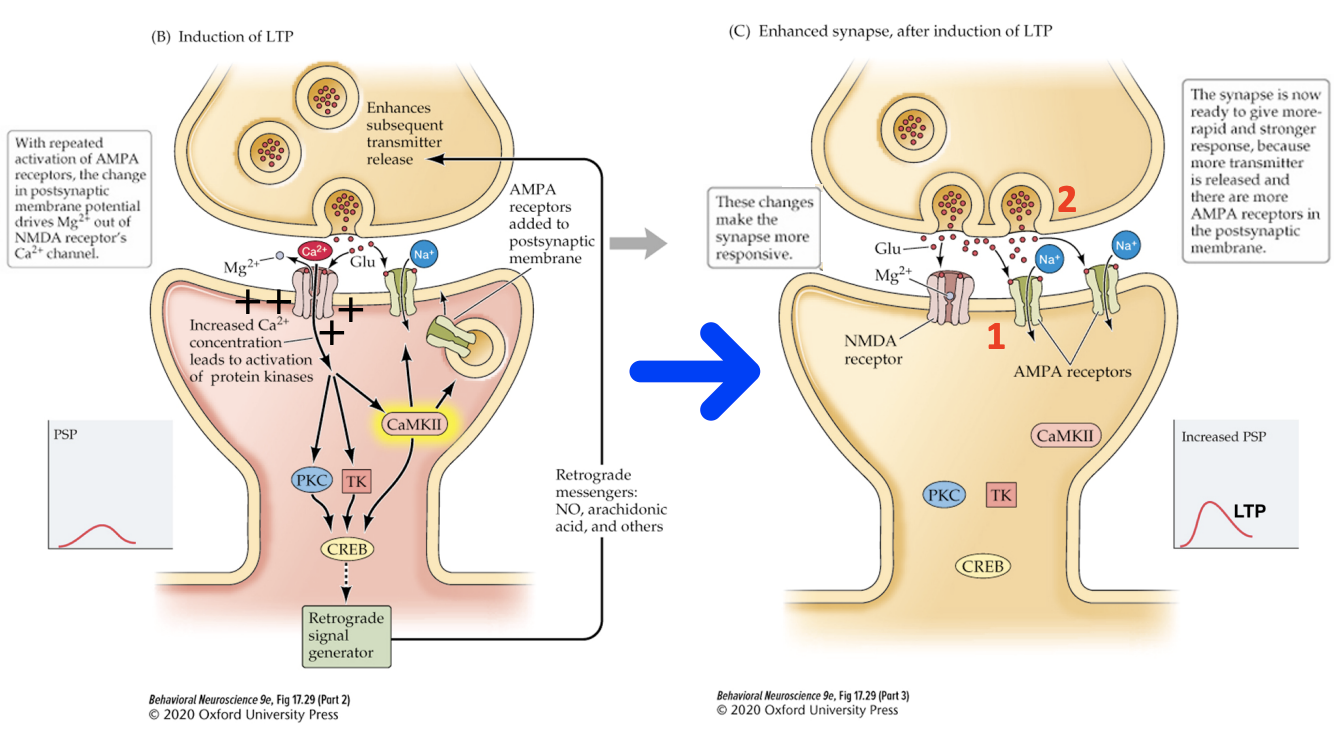
Long-Term Potentiation (LTP) Results From the Addition of More AMPA Receptors to the Postsynaptic Membrane
NMDAR activation leads to
more APMARs added to the post-synaptic membrane and
more glutamate release, which makes the connection stronger!
Over Longer Timescales, Regular Communication Between Neurons Can Lead to Structural Changes: the Formation of New Dendritic Spines
In the long term (approx. few days), LTP can cause structural changes in neurons such as the growth of more dendritic spines—more synaptic connections!
These structural changes take longer because they rely on activity-dependent changes in gene expression (e.g. actin scaffolding proteins to build new dendritic spines)
This is yet another efficient way to make stronger connections between communicating neurons!
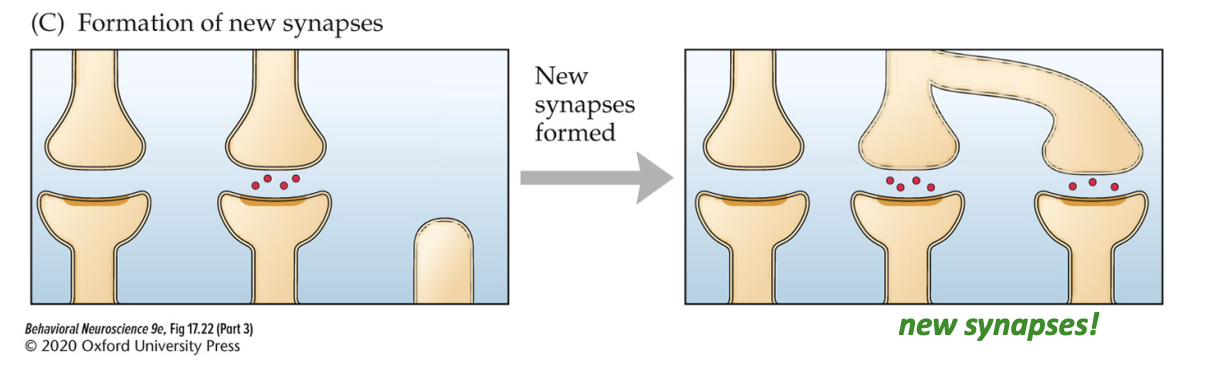
Review of Synaptic Plasticity: LTP Can Cause Physiological and (Eventually) Structural Changes in Neurons
Left: In the short term (within minutes), LTP induces physiological changes in neurons (e.g. more NT release, more AMPARs, or both) that enhance/strengthen the synaptic connection between communicating neurons
Right: In the long term (within a few days), LTP can cause structural changes in neurons such as the growth of more dendritic spines—more synaptic connections between communicating neurons = stronger connection!
Trephined skulls 5000 BCE
Release of demons
Belief that mental disorders due to evil spirits, etc.

Hippocrates (400 BCE) and Galen (2nd Century CE)
Imbalance of body humors (fluids)
Medical treatments designed to restore balance
Galen: personalities
Shakespeare often described his characters in terms of the core humors
History of Psychopathology: “Lunatic Asylums”
First: St Mary of Bethlehem
London, 1247
“Bedlam” for horrific practices and conditions
Funding: violent patients put on display for public; calmer patients sent to beg on streets
Pite-Salpetriere Hospital
Paris, 1656
Mostly for women: prostitutes, mentally ill, or just poor
Prison
Both hospitals still function today
Nineteenth century treatment for psychiatric disorders
Rotational therapy: reduce brain congestion
Benjamin Rush: tranquilizing chair
Teeth removal to treat mental illness
Hydrotherapy: lay in bathtub
Psychotic disorders
Schizophrenia
Delusional disorder
Substance-induced psychotic disorder
Affective disorder
Major depressive disorder
Bipolar disorder
Premenstrual dysphoric disorder
Post-partum depression
Anxiety disorder
Generalized anxiety disorder
Social anxiety disorder
Panic disorder
Schizophrenia
Greek: schizen, “to split” and phren, “mind”
This “splitting of the mind” however, does not refer to multiple personalities within the same individual (i.e. dissociative identity disorder, as is commonly misunderstood), but rather a disconnect between thought, emotion, and behavior—different aspects of a single personality
In “psychotic disorders” such as schizophrenia, people experience psychoses: disturbances in thoughts and perceptions that result in a loss of touch with reality (e.g. delusions and hallucinations)
Modern treatment usually consists of a combination of behavioral therapy and use of antipsychotic medications
 Note
Note  Flashcards (44)