ANSC 331 Exam 4:Placentation and Gestation
 Call Kai
 Learn
Learn Practice Test
 Spaced Repetition
 Match
Match Flashcards
 Knowt Play
1/24

There's no tags or description
Looks like no tags are added yet.
Name | Mastery | Learn | Test | Matching | Spaced | Call with Kai |
|---|
No analytics yet
Send a link to your students to track their progress
25 Terms
What is gestation?
the action or process of carrying or being carried in the uterus between conception and birth
What are Monotremes
Egg laying mammals (oviparous)
- platypus, echidna
What are Marsupials?
mammals with a pouch
- viviparity = no longer lay eggs; gained the ability to produce living young
True or False: Marsupals have a very short gestation period.
True
- the offspring develops for a long time in the pouch after birth
What are Eutheria?
placental mammals
What are the two ways to classify a placenta?
1. Chorionic villus distribution (How are they distributed?)
2. Number of layers between fetal & maternal blood
What is the chorionic villus and what is its function?
The functional unit of the placenta:
- small, finger like projections on the surface of the chorion
- nutrient exchange apparatus - increase SA
- may be grouped in various arrangements
What is a placenta? What are the functions of the placenta?
Transient organ of pregnancy
- acts as a metabolic interface between mother & fetus(es)
- endocrine gland (maintains pregnancy, promote fetal & mammary gland growth, induces parturition)
Functions:
- blood supply
- nutrient transport
- elimination of waste
Describe the placentation types - by villus distribution. Which is found in which species?
Diffuse: uniform villi distribution (pig, horse)
Cotyledonary: villi located on button-like structures called cotyledons (sheep, cattle)
- placentome, fetal cotyledon, maternal carnuncle
Zonary: villi form a zone around the middle of the cenceptus (dog, cat)
- like a "belt" around the fetus
Discoid: villi form a regionalized disc (humans, primates, rodents)
What is the placentome made of? The fetal cotyledon? The maternal caruncle?
Placentome: maternal caruncle + fetal cotyledon
Fetal cotyledon: Trophectoderm origin (fetal)
Maternal caruncle: caruncular region of the uterus
Describe the placentation types - by number of layers. Which layers are found in each placenta type? Which is more invasive? Least invasive? Which is found in which species?
1. Epitheliiochorial: maternal side "epithelio" and fetal side "chorial"
- minimally invasive
- 6 layers (endometrial capillaries, interstitium, epithelium, chorionic epithelium, interstitum, capillaries)
- sows & mares
2. Synepitheliochorial: endometrial epithelium transiently erodes and regrows
- cattle & sheep
- 2nd to least invasive
- has 6 layers but the uterine epithelium temp. erodes (changes to 5 layers) and then grows back
- intermittent exposure of maternal capillaries to chorionic epithelium
3. Endotheliochorial: complete erosion of the endometrial epithelium and partial erosion of underlying interstitum
- dogs & cats
- semi-invasive plancentation
- 5 layers (endometerial capillaries, interstitium, chorionic epithelium, interstitium, capillaries)
4. Hemochorial: chorionic epithelium in direct apposition to maternal pools of blood
- humans, primates, rodents
- most invasive
- 3 layers (chorionic epithelium, interstitium, capillaries)
Describe the placentation type in pigs
Epitheliochorial:
- pigs have a folded bilayer to increase SA thereby maximizing nutrient transport
- folds get bigger as pregnancy progresses
- can "peel" placenta from the underlying endometrium
What are BNGCs? Where do they originate from? What do they secrete?
Binucleate giant cells (BNGCs) form from the chorionic (fetal origin) cells *2 of them
- migrate from chorionic epithelium & invade endometrial epithelium
- secrete placental lactogen, estrogen, and progesterone
- secrete pregnancy specific B
**Unique to ruminants, used in pregnancy test via blood sample (BioPryn)
How are nutrients transported across the placenta?
Nutrients are transported via:
- Passive transport (simple/facilitated diffusion): no energy required
- Active transport: energy required
Name the species where antibodies do and do not cross the placenta.
DO NOT:
- ruminants
- sows
- cats
- dogs
DO:
- humans
- rodents
Provide examples of what does and does not cross the placenta
DO:
- Vitamins: water soluble (B,C) & lipid soluble (A,D, E)
DO NOT:
- Lipids
- Large peptide hormones (thyroid stimulating hormone, growth hormone, insulin, and glucagon)
Describe the molecules transported across the placenta and the mechanism/functions.
Diffusion (simple):
- O2, CO2, H2O; free FA, Na, K, Cl; small viruses, drugs, pharmaceuticals & toxins
- functions: homeostasis; substrate for growth; (-) effects for fetus
Diffusion (facilitated): glucose, converted into fructose by the placenta
- functions: fetal nutrition
Active: AA; Fe, Ca, P, Zn
- functions: protein synthesis; fetal nutrition & growth
Why is hormone production by the placenta critical?
- pregnancy maintenance
- ovarian function
- fetal growth
- mammary gland development
- parturition
What is unique about the mare placenta?
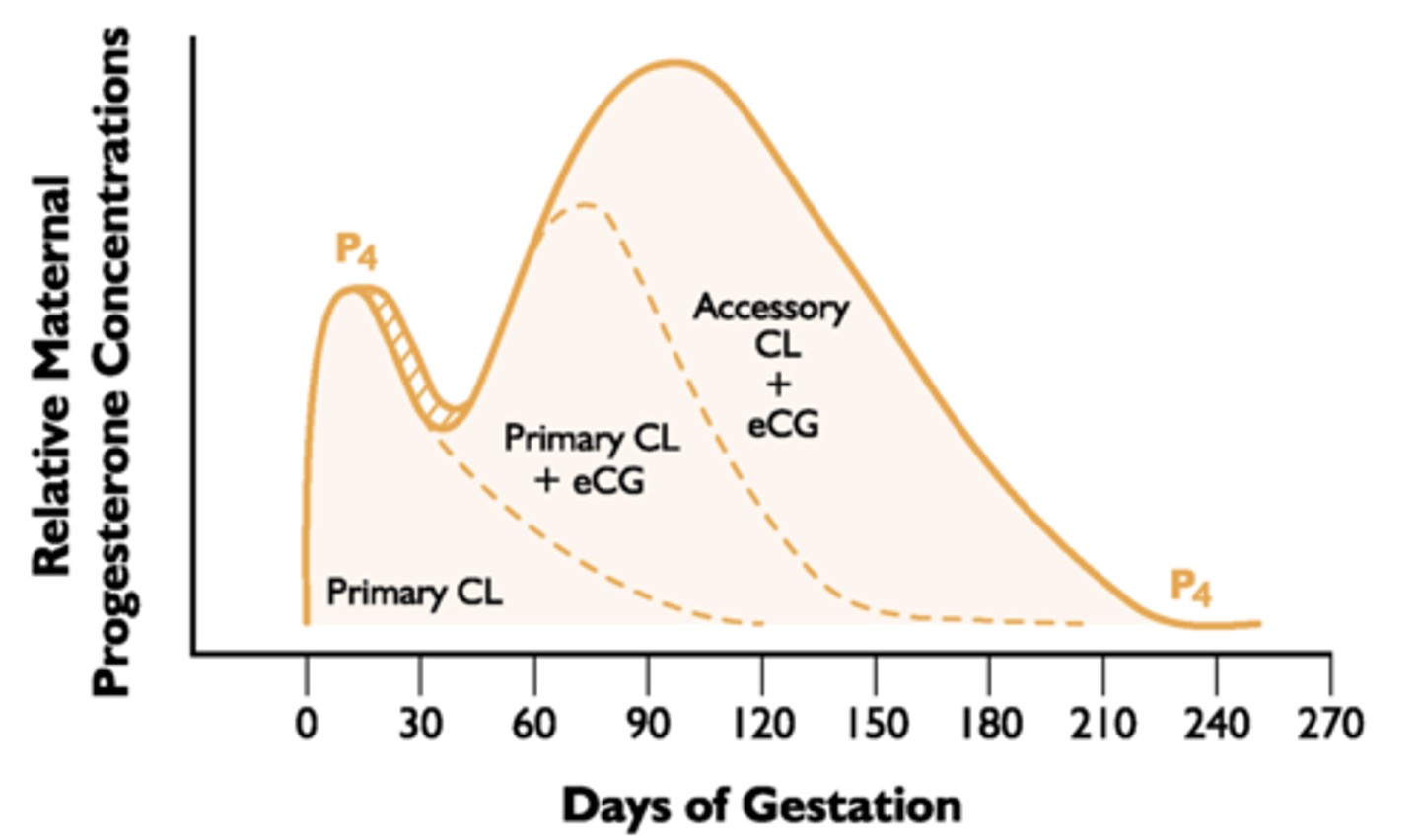
The mare placenta contains endometrial cups (transient organs of trophoblast and endometrial origin
- secretes eCG
What makes eCG? what is the function of eCG?
Pregnant mare serum gonadotropin-PMSG
- maintains the CL and progesterone production
- initiates the formation of accessory CL to increase progesterone
- FSH like actions: induces superovulation (cow, sheep, rabbit)
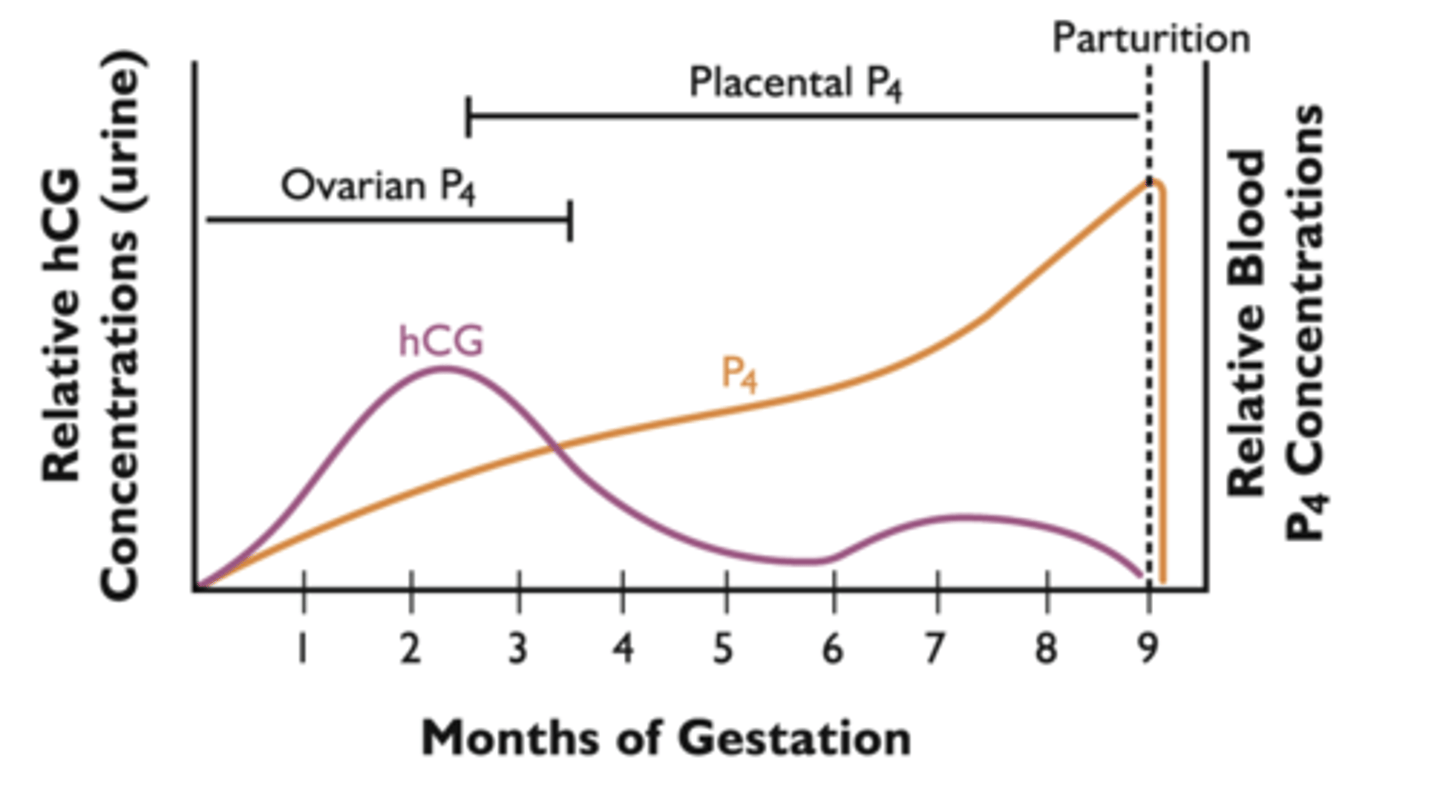
What makes hCG? What does hCG do?
Human Chorionic Gonadotropin (hCG)
- produced by trophoblast cells of chorion
- function: provides luteotropic stimulus for the CL
What is placental lactogen? What is its function?
stimulates fetal growth (somatotrophic effects) and mammary gland development/function (lactogenic effect)
What are the primary functions of progesterone in maintaining pregnancy?
- block myometrial contractions
- stimulate endometrial gland secretion of nutrients in early pregnancy
In what species does the CL produce progesterone for the entire pregnancy?
- rabbit
- sow
In what species does the placenta take over progesterone production?
- sheep, 50 d
- cow, 6,8 month
- mare, 70 d
- human, 60-70 d

