Physics Chapter 4 Conceptual Qs
 Call Kai
 Learn
Learn Practice Test
 Spaced Repetition
 Match
Match Flashcards
 Knowt Play
1/36

There's no tags or description
Looks like no tags are added yet.
Name | Mastery | Learn | Test | Matching | Spaced | Call with Kai |
|---|
No analytics yet
Send a link to your students to track their progress
37 Terms
Which one is not a unit of mass?
Choices:
kilogram
N⋅s2/m
newton
slug
gram
Newton
Complete the following statement: The term net force most accurately describes
Choices:
the quantity that changes the velocity of an object.
the quantity that keeps an object moving.
the quantity that causes displacement.
the mass of an object.
the inertia of an object.
the quantity that changes the velocity of an object.
Net force causes acceleration, and acceleration means change in velocity.
Which one of the following terms is used to indicate the natural tendency of an object to remain at rest or in motion at a constant speed along a straight line?
Choices:
acceleration
velocity
equilibrium
force
inertia
inertia
Inertia means resisting changes in motion.
Force is a push or pull that changes motion, not the natural tendency to remain at rest or in motion.
Complete the following statement: An inertial reference frame is one in which
Newton’s first law of motion is valid.
the acceleration due to gravity is greater than zero m/s².
the inertias of objects within the frame are zero.
the frame is accelerating.
Newton’s third law of motion is not valid.
Newton’s first law of motion is valid.
An inertial reference frame is just a point of view that is not accelerating.
Which one of the following statements is true according to Newton’s first law of motion?
Choices:
A net force is required to change an object’s velocity.
A net force is required to maintain an object’s constant velocity.
A net force is required to maintain an object at rest.
A net force is required to change an object’s velocity
Which one of the following statements concerning Newton’s first law of motion is false?
Choices:
All objects in motion have forces acting on them.
All of the answers above are false.
If no net force acts on an object, the object cannot accelerate.
If no force acts on an object, the object’s velocity cannot change.
All objects in motion have forces acting on them.
Why false:
An object can be moving with no net force acting on it.
Motion does not require force.
Only change in motion requires force.
What unit is defined by a 1-m/s² acceleration of a 1-kg object?
Choices:
Nelson
Einstein
Lorenz
Dawson
Newton
Newton
1kg(1m/s²) is the definition of a Newton
1) Complete the following statement: The net force that results when two or more forces act on an object is
Choices:
the largest force acting on the object.
determined by adding the magnitudes of the individual forces. The direction of the net force is the same as the direction of motion.
determined using vector addition of the individual forces acting on the object.
the magnitude of the largest force acting on the object. The direction of the net force is the same as the direction of motion.
determined using vector addition of the individual forces acting on the object
Which equation is associated with Newton’s 2nd law?
F = ma
Which one of the following tools is useful in representing the forces acting on an object and simplifies problem solving?
Choices:
free-body diagram
vector analyzer
Newton’s ladder
scalar drawing
force monitor
free-body diagram
Two forces act on a hockey puck. For which orientation of the forces will the puck acquire an acceleration with the largest magnitude?
Choices:
The magnitude of the acceleration will be the same in all four cases shown above.
two equal arrows in opposite directions
two arrows in the same direction
two arrows at 90°
two arrows at some smaller angle
the case where the two arrows point in the same direction
Which one of the following statements is true according to Newton’s third law of motion?
Choices:
A force on an object produces another differing in magnitude, but oppositely directed force on another object.
A force on an object produces another equal in magnitude, but oppositely directed force on that object.
A force on an object produces another differing in magnitude, but oppositely directed force on that object.
The vector sum of all forces acting on an object is zero.
A force on an object produces an equal in magnitude, but oppositely directed force on another object.
A force on an object produces an equal in magnitude, but oppositely directed force on another object.
If I push on a wall, the wall pushes back on me. Not "if I push on a wall, the arm pushes back on me”
A cell phone is sitting on a desk. Which one of the following is the reaction force to the cell phone’s weight on the desk?
Choices:
the normal force of the Earth on the table
the gravitational force on the table
the normal force of the cell phone on the table
the gravitational force by the cell phone on the Earth
the normal force of the table on the cell phone
the gravitational force by the cell phone on the Earth
The earth is pulling on the cellphone, but my cellphone is pulling on the earth.
Complete the following statement: Near the surface of the earth, the weight of an object
Choices:
has the same value regardless of the altitude above the surface of the earth.
has the same value regardless of the mass of the object.
is the gravitational force by the earth on the object.
is the same as the mass of the object.
is the gravitational force by the earth on the object.
Which one of the following statements concerning the two "gravitational constants" G, the universal gravitational constant, and g the magnitude of the acceleration due to gravity is true?
Choices:
The value of G is the same everywhere in the universe, but the value of g is not.
The values of g and G do not depend on location.
The values of g and G are equal on the surface of any planet, but in general, vary with location in the universe.
The value of g is the same everywhere in the universe, but the value of G is not.
The values of g and G depend on location.
The value of G is the same everywhere in the universe, but the value of g is not.
Which one of the following statements best explains why the weight of an object of mass mmm is different on Mars than it is on the Earth?
Choices:
The constant G is different on Mars.
The mass and radius of Mars, which are both less than those of Earth, happen to work out to a smaller value of g.
The mass of Mars is different from that of Earth.
The object’s mass will be different on Mars.
The object is further from Mars' center when it is on Mars.
The mass and radius of Mars, which are both less than those of Earth, happen to work out to a smaller value of g.
Ryan walked to a cliff and dropped a stone. Neglecting any effects due to the air as it falls vertically, which one of the following is the reaction force to the Earth’s gravity on the stone?
Choices:
the normal force of the ground below
the normal force of Ryan’s hand on the stone
No reaction force appears in this situation since the stone is not exerting any forces on anything else.
the gravitational force of the stone acting on the Earth
the gravitational force of the stone acting on the Earth
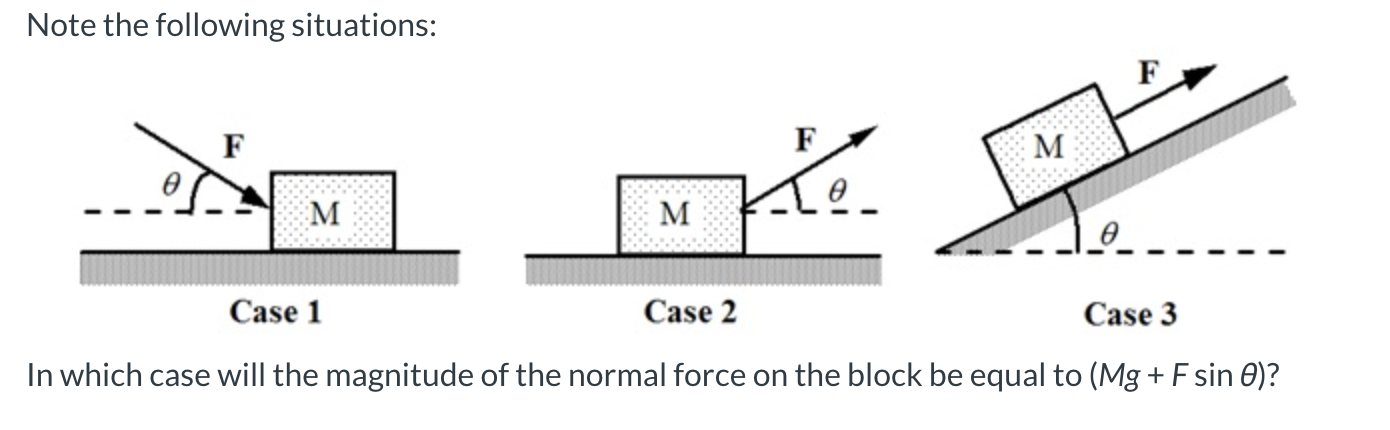
Case 1 only. Fy = Fn - W - Fsin(theta) = 0, so Fn = Mg + Fsin(theta)
The magnitude of the weight of an object is always the same as which of the following quantities?
Choices:
Fn, the magnitude of the normal force acting on the object
ma, the object’s mass times its acceleration
W−Fn, the weight of the object minus the normal force
the net force acting on the object
mg, the object’s mass times the acceleration due to gravity
mg, the object’s mass times the acceleration due to gravity
What is the meaning of the word “normal” in the term “normal force?”
Choices:
that the normal force is one that is encountered in everyday life
that the normal force has a magnitude of 1 newton
that the normal force is measurable
that the normal force is directed perpendicular (normal) to a surface
that the normal force is equal in magnitude and opposite in direction to the weight of the object
that the normal force is directed perpendicular (normal) to a surface
Which one of the following statements concerning static and kinetic frictional forces is correct?
Choices:
The static frictional force acts on an object when it is stationary and the kinetic frictional force acts on it when it is sliding.
When an object is stationary, only the kinetic frictional force acts on it.
When an object is stationary, both static and kinetic frictional forces are acting on it.
When an object is sliding, only the static frictional force acts on it.
Static and kinetic frictional forces act in the same direction as the normal force.
The static frictional force acts on an object when it is stationary and the kinetic frictional force acts on it when it is sliding.
Which of the following are true?
I. Force is a scalar quantity.
II. Force is a vector quantity.
III. A force is a push or a pull between objects that occurs only when the objects are in physical contact.
IV. Non-contact forces are also called action-at-a-distance forces.
True:
II and IV only
Why:
I is false because force is not a scalar.
II is true because force has magnitude and direction, so it is a vector.
III is false because some forces happen without contact, like gravity and electric force.
IV is true because non-contact forces do act over a distance, so they’re called action-at-a-distance forces.
Which of the following is correct?
I. Mass is a vector quantity.
II. Mass is a scalar quantity.
III. Mass is a measure of how much matter an object contains.
IV. There is no relationship between force and mass.
V. Isaac Newton developed three important laws of motion that describe the relationship between force and mass.
II, III, and V only
Why:
I is false because mass has no direction, so it is not a vector.
II is true because mass is a scalar.
III is true because mass tells how much matter an object has.
IV is false because force and mass are related by Newton’s 2nd law:
V is true because Newton’s laws do describe motion and how force relates to mass and acceleration.
Net external force = 0. What explains it?
The object can only be stationary.
The object can be either stationary or traveling with constant velocity.
The object can only be traveling with a velocity that is changing.
The object can only be traveling with a constant velocity.
The object can be either stationary or traveling with constant velocity.
In Case A, an object is moving in a straight line at a constant speed of 9.8 m/s. In Case B, an object is moving in a straight line with a constant acceleration of 9.8 m/s². Which of the following statements is true? Choices:
A. A nonzero net external force acts on the object in Case B only.
B. A nonzero net external force acts on the object in both cases.
C. A nonzero net external force acts on the object in Case A only.
D. A nonzero net external force acts on the object in neither case.
A nonzero net external force acts on the object in Case B only.
Newton’s second law indicates that when a net force acts on an object, it must accelerate. Does this mean that when two or more forces are applied to an object simultaneously, it must accelerate? Choices:
A. Yes
B. No
No
Which of the following statements is true? Choices:
A. Newton’s third law states that for every acceleration of one object, there is an equal but opposite acceleration of another object.
B. Newton’s third law is only valid for contact forces.
C. Newton’s third law is also known as the action/reaction law.
D. Newton’s third law is also known as F = ma
Newton’s third law is also known as the action/reaction law.
A father and his seven-year-old daughter are facing each other on ice skates. With their hands, they push off against one another. Which of the following statements is/are true? Statements:
I. Each experiences an acceleration that has a different magnitude.
II. Each experiences an acceleration that has the same magnitude.
III. Each experiences a pushing force that has a different magnitude.
IV. Each experiences a pushing force that has the same magnitude.
I and IV only
When they push off each other, the forces are equal. So IV is true, III is false.
Using F = ma, they feel the same force, but have different masses, so they’ll experience different accelerations. So I is true, II is false.
In nature, there are two types of forces: Fundamental and nonfundamental. True or false.
True
Which of the following is not one of the fundamental forces? Choices:
A. The gravitational force.
B. The strong nuclear force.
C. The normal force.
D. The electroweak force.
Normal Force.
Fundamental forces: gravity, nuclear force, electroweak force
Nonfundamental forces: Tension, friction, normal force, applied force
When a body is moved from sea level to the top of a mountain, what changes? Choices:
A. the body's mass
B. the body's weight
C. both the body's mass and weight
the body’s weight
A body is moved from sea level to the top of a high mountain. Which of the following statements is/are true concerning the following quantities? Statements:
I. The body’s mass.
II. The body’s weight.
III. The gravitational force on the body.
Choices:
A. Only I changes.
B. Both I and III change.
C. Only II changes.
D. Both II and III change.
E. Only III changes.
Both II and III change.
Three particles have identical masses. Each particle experiences only the gravitational forces from the other two particles. How should the particles be arranged so that each one experiences a net gravitational force of the same magnitude? Choices:
A. Equally spaced on a straight line.
B. On the corners of a right triangle.
C. On three of the four corners of a square.
D. On the corners of an equilateral triangle.
On the corners of an equilateral triangle.
Same masses, same distances = same force to each other
The apparent weight of a passenger in an elevator is greater than his true weight. Which one of the following is true? Choices:
A. The elevator is either moving upward with a decreasing speed or moving downward with a decreasing speed.
B. The elevator is either moving upward with an increasing speed or moving downward with an increasing speed.
C. The elevator is either moving upward with a decreasing speed or moving downward with an increasing speed.
D. The elevator is either moving upward with an increasing speed or moving downward with a decreasing speed.
E. The elevator is either moving upward with an increasing speed or moving upward with a decreasing speed.
D. The elevator is either moving upward with an increasing speed or moving downward with a decreasing speed.
In a elevator: N - mg = ma, then N (apparent weight) = mg + ma.
Decreasing speed moving up means -a, so N is less than my true weight. Increasing speed going downward is -a, so N is less than my true weight. Therefore, I need an option that is moving upward with increasing speed or moving downward with decreasing speed so acceleration is positive. Only choice D does this.
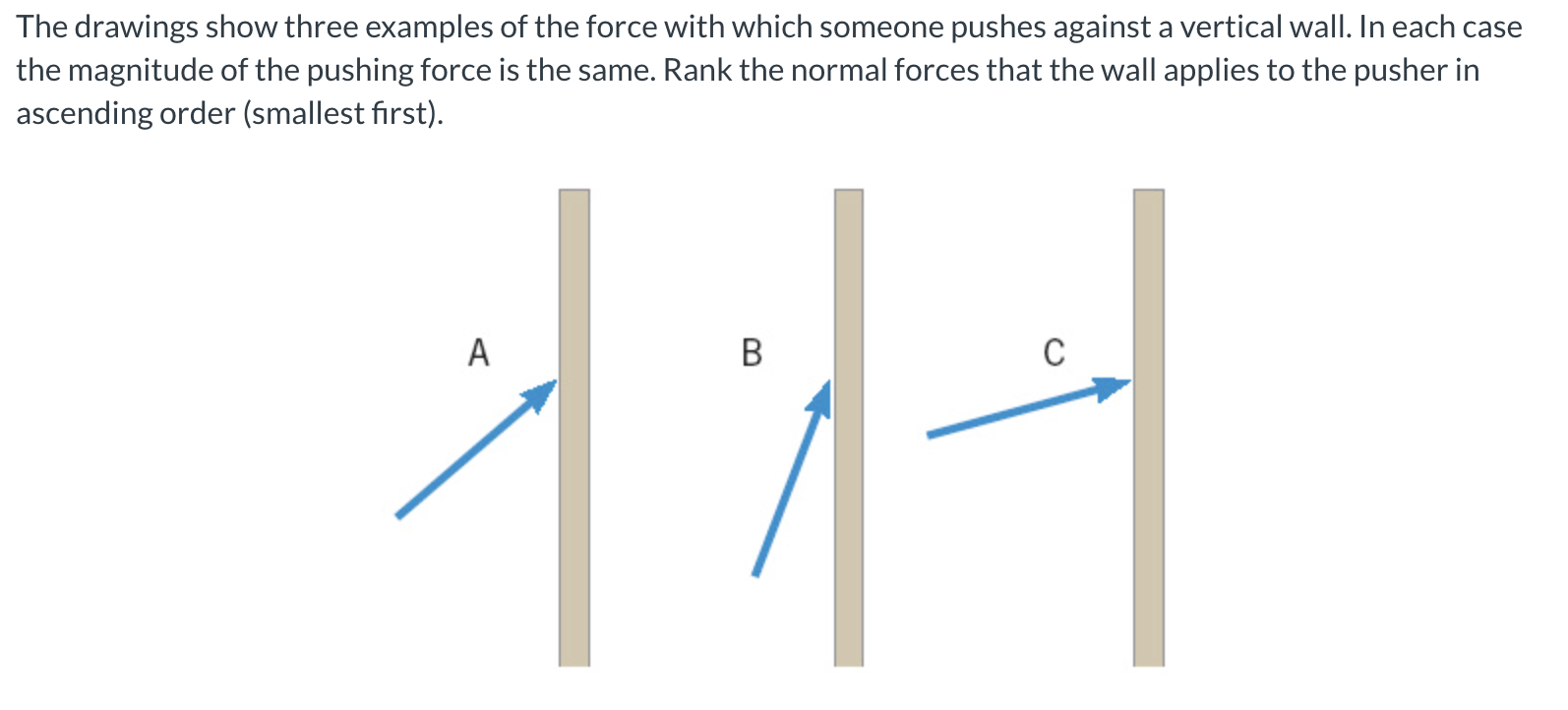
Smallest to largest: B, A, C

Less force to pull the sled
Pushing scenario: Net force in Y direction = N - mg - Fsin(theta) = 0
so N = mg + Fsin(theta). This makes N bigger, making kinetic friction bigger (Fk = uk(N)). So pushing would require more force to move the sled.

