B3.3 MUSCLE AND MOBILITY
 Studied by 7 people
 Call Kai
 Learn
Learn Practice Test
 Spaced Repetition
 Match
Match Flashcards
 Knowt Play
1/11

There's no tags or description
Looks like no tags are added yet.
Name | Mastery | Learn | Test | Matching | Spaced | Call with Kai |
|---|
No analytics yet
Send a link to your students to track their progress
12 Terms
outline the adaptions for movement as a universal feature of living organisms
internal movement (movement that occurs within the body)
peristalsis: rhythmic contractions in gut for food transport
locomotion: movement of entire body from one place to another
bar-tailed godwit: migratory wings for flight
sessile organisms: remain fixed in one position
plants: roots anchor plants in soil’ rely on growth movements instead of migration
outline the structure of muscles
each muscle is made up of groups of muscle fibers which contain multiple parallel myofibrils, made up of repeating sarcomeres
sarcomeres are seperated by z-discs and consists of alternating light and dark bands
light bands: actin filaments only
dark bands: myosin filaments with overlapping actin
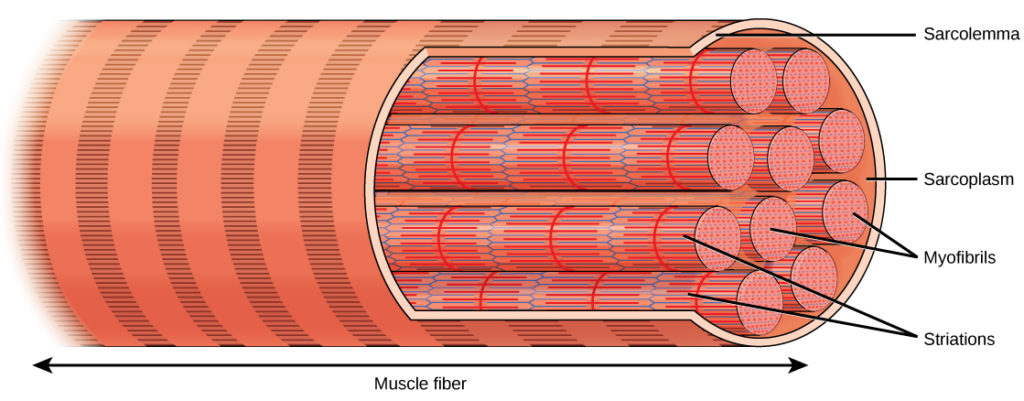
outline the structure and function of striated muscle fibers
sarcolemma
contractile membrane that surrounds a muscle fiber
myofibrils
contains sarcomeres which consist of light and dark bands
sarcoplasmic reticulum
specialised endoplasmic reticulum which forms a network for the release of calcium ions into the sarcoplasm follow the stimulation from an action potential
sarcoplasm
cytoplasm of muscle cells
outline the structure of a sarcomere
a sarcomere is a unit of contraction, many sarcomeres are consisted in a single myofibril
Z disks: boundaries of one sarcomere
dark band: consists of myosin filaments and actin filaments
light band: consists of only actin filaments
contain myosin binding sites for muscle contraction
M line: the center of a sarcomere which anchors the myosin filaments
titin: elastic protein which acts as a spring
outline the role of titin in muscle relaxation
titin: giant/immense elastic protein which acts as a molecular spring (acts as elastic band tot prevent overstretching of relaxed muscle)
one end is attached to Z disk while the other end is attached to the M line
when a sarcomere is stretched, the titin is stretched and stores potential energy until the force is released and the energy is also released
this helps sarcomeres recoil after stretching
explain the silding filament theory (explain how a sarcomere contracts)
OVERVIEW: (outlining)
actin filaments slide over myosin filaments towards the center of the sarcomere (towards the M line)
Z disks are pulled closer together which shortens both the sarcomere and the muscle overall
IN DETAIL: (explaining)
calcium ion release
an action potential triggers the release of calcium ions from the sarcoplasmic reticulum into the muscle fiber
binding site exposure:
calcium ions bind to troponin, causing a conformational change that moves moves tropomyosin away from the myosin binding site
cross-bridge formation:
myosin heads bind to the exposed binding sites on actin, forming cross bridges
power stroke:
the myosin heads pivot, pulling the actin filaments towards the center of the sarcomere, the M line which is powered by the hydrolysis of ATP
detachment:/release of ADP and Pi:
after the power stroke, ADP and inorganic phosphate are released from the myosin head
resetting the myosin head:
once a new ATP molecule attaches to the myosin head, it causes the myosin to release from the actin filament
explain the role of the skeletal system
skeletal system cannot move on its own, serves as an anchorage point for muscles
due to rigid nature they act as levers
joint is the fulcrum, contracting muscles create the force
endoskeleton (internal skeleton)
vertebrates have this type
compromised of bone/cartilage
provides support/protection for the body
exoskeleton (external skeleton)
arthropods have this type
possess rough exoskeleton made of chitin and jointed legs
provides protection from damage
explain the movement at the synovial joint
joints: where two or more bones meet, also known as articulation (allows and limits motion)
synovial joint:
freely moveable joints which contain synovial fluid in a joint cavity that lubricates the joint to allow for smooth movement
cartalige covers the ends of the nones to prevent friction and wear and tear
soft/spongy connective tissue
joint capsule helps prevent wear and tear of the bones
ligaments:
type of tissue that is tough/fibrous/slightly elastic
connect bone to bone
tendons:
strong, inelastic, fibrous bands of connective tissue which attach muscle to bone and allows muscles to pull on the bone
outline antagonistic muscles
muscle pairs that have opposite actions, when one contracts, the other relaxes to allow for movement
muscular contractions only generate force in one direction
using internal and external intercostal muscles as an example, explain how they are antagonistic muscles
external intercostal muscles (closest to the body)
run in downward and forward direction
diagonally towards the center of the chest
contraction of these movements cause the rib cage to move up and out
internal intercostal muscles (deeper in the body)
run in upward and forward direction towards the center of the chest
perpendicular to the external intercostal muscles
contraction of these muscles cause the ribcage to move down and in
outline reasons for locomotion
foraging for food
grazing on vegetation, actively hunting and capturing prey, searching for fruits/nuts etc
bees forage for nectar, pollen, water to bring back to the hive for the colony
escaping from danger
quick behavious so animal can quickly avoid threats (jumping, flying, running)
elephants can detect infrasonic sounds
searching for mate/reproduction
most animals will move to locations where members of opposite sex can be found
tigers have low pop density so they have limited opportunities with nearby females, as a result males have to cover large distances to find a mate
migration
large scale seasonal movements of a group of animals from one place to another
young salmon migrate from rivers to sea, as adults migrate back to river to breed
outline the adaptations for swimming in marine mammals
water is 1000x times denser than air, much more viscous
streamlining bodies that minimise drag:
flippers and dorsol fin have elongated teardrop profile in transverse section
body surface is smooth due to even distribution of blubber and absence of hind legs
forelimbs adapted to form flippers at the sides of usually long and narrow bodies
used to steer, generate upward force
contribute to streamlined shape
adaptation of the tail to form a fat/wide fluke
can be used for steering and propulsion in the water with up and down movements
changes to airways
allows for periodic breathing between dives (whales and dolphin blowholes)
 Note
Note  Flashcards (500)