Module 5: Solid Waste Management
 Call Kai
 Learn
Learn Practice Test
 Spaced Repetition
 Match
Match Flashcards
 Knowt Play
1/107

There's no tags or description
Looks like no tags are added yet.
Name | Mastery | Learn | Test | Matching | Spaced | Call with Kai |
|---|
No analytics yet
Send a link to your students to track their progress
108 Terms
solid waste
left-over, redundant product of no or marginal value for the owner and the owner wants to discard
solid waste; RA 9003
garbage or discarded materials generated from household, commercial, institutional, agricultural, and industrial activities or operations including street sweepings, construction debris, and other non-hazardous/non-toxic solid waste; definition from?
solid waste management; RA 9003
discipline associated with the control of generation, storage, collection, transfer and transport, processing, and disposal of solid wastes in a manner that is in accord with the best principles of public health, economics, engineering, conservation, aesthetics, and other environmental considerations, and that is also responsive to public attitudes; definition from?
RA 9003: Ecological Solid Waste Management Act of 2000
full name of RA 9003R
RA 9003
an act providing for an ecological SWM program, creating necessary institutional mechanisms and incentives, declaring certain acts prohibited and providing penalties, appropriating funds therefor, and for other purposes
National Solid Waste Management Commission
established due to RA 9003
compostables, recyclables, special wastes, and residuals
classification of waste by RA 9003
1: polyethylene terephthalate (PET)
plastic that can store food again
2: high density polytethylene (HDPE)
may not be reused for food
3: polyvinyl chloride (PVC)
hard to recycle because of high amounts of chlorine and other additivies like plasticizers
4: low density polyehylene (LDPE)
lightweight so hard to collect and not competitive recycled prize
5: polypropylene (PP)
may not be reused for food
6: polystyrene
absorbs oil and grease readily from food, so not recyclable
7: other
usually low worth and unspecified so not recycled easily
7: multilayer film sachets
not easy to recycle because it is made of a collection of different types of plastics and sometimes includes metal layer; also has ink that may be contaminant so harder to recycle
recyclables > recycling facility > junkyards/factories;
compostables > gardens/farms;
special wastes > material recovery facility > residuals management;
non-recyclables > collection by municipality/city level > residuals management
conceptual framework of RA 9003
SP-2140 — Plastic Bag Reduction Ordinance (environmental fee of Php 2.00 for use), regulates use of plastic bags
SP-2130 — Mandates businesses to display notice that encourages customers to bring own reusable bags
SP-2868 — Total Plastic Ban in Retail (No option to pay fee for plastic bag, only exception is to wrap unpacked fresh/cooked foods)
SP-2876 — Total Ban for single-use plastics/disposable materials in all hotels and restaurants in QC
ordinances on plastics
Extended Producer Responsibility (EPR) Act of 2022 (RA 11898)
act institutionalizing extended producer responsibility on plastic packaging waste, amending for this purpose RA No. 9003
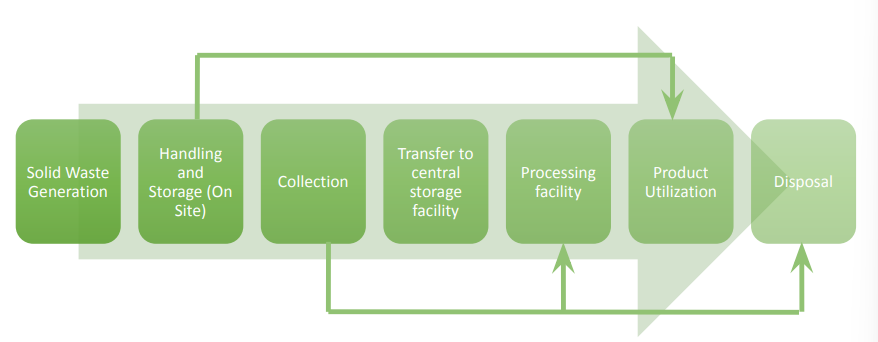
visualize elements of a SWM system
waste generation rate; kg/cap/day
amount of waste generated per person per day, good for waste reduction strategies; units
90%
in low-income countries, over ____ of waste is mismanaged
3.6 million
projected waste generation in NCR and Region 4A each
residential
contributes majority of various sources of MSW
biodegradables
contributes majority of MSW fractions
avoidance > reduction > reuse > recycling > recovery > treatment > safe disposal
waste management hierarchy from most preferred to least preferred
avoidance, reduction, reuse, recycling
most preferred options under waste management hierachy
recovery, treatment, safe disposal
least preferred options under waste management hierachy
avoidance, reduction, reuse, recycling
components under waste management hierarchy in which household/commercial generators have direct responsibility
reuse, recycling, recovery
components under waste management hierarchy in which barangays have direct responsibility
recycling, recovery, treatment, safe disposal
components under waste management hierarchy in which municipalities/cities have direct responsibility
treatment, safe disposal
components under waste management hierarchy in which provinces/metro/first-class cities have direct responsibility
refuse, reduce, reuse, repurpose, recycle
5 Rs
effect of storage on waste
type of container
container location
public health and aesthetics
considerations in onsite storage
waste collection
gathering or picking up of solid wastes from various sources; hauling of wastest to location where contents are emptied/unloaded
curbside collection and drop-off center
types of collection
container size
time until decay and emit foul odor
length of fly-breeding cycle
considerations in frequency of garbage collection
false
true or false: heavily traveled streets should ideally be trash collected during rush hours
true
true or false: higher elevations should be at start of garbage collection route
materials recovery facility
facility where recyclables are sorted accdg to materials and recycling mkt demands; sorting, recycling, composting
recovery rate
percent of recyclables recovered from original waste stream
composting
transformation of organic material through decomposition into biologically humus-rich substance suitable for plant growth; aided by invertebrates and microorganisms
green/wet materials
fruit and veg scraps, eggshells, teabags, tea leaves, fresh green grass clippings and plant trimmings, garden refuse, green grass clippings, coffee grounds
nitrogen
element attributed to green/wet materials for compost
brown/dry materials
chopped dry leaves, dried grass clippings, wood shavings or sawdust, nuts and shells, untreated coffee paper filters, pinecones, pine needles, shredded newspaper and other paper products, twigs, peanut shells
carbon
element associated with brown/dry materials for compost
vermicomposting
using worms to recycle food scraps and other organic material
vermicompost
compost made using worms
windrow composting
piling organic matter or biodegradable waste in long rows
The Great Pacific Garbage Patch
massive vortex of plastic litter in north central Pacific Ocean formed as a result of massive plastic pollution in oceans
uncontrolled dumpsites > controlled dumpsites > sanitary landfills
supposed evolution of landfills accdg to RA 9003
2021
when open dumpsites in the Philippines should have been closedo
open dumpsite
dumpsite operated and used with the least consideration to environmental protection
sanitary landfilling
method of disposing refuse on land without creating nuisance or hazards to public health safety by utilizing engineering principles
sanitary landfilling
confine the refuse to the smallest possible volume and cover it periodically with layer of earth
sanitary landfilling
engineered site where waste is isolated from environment below ground or on top until safe and completely degraded biologically, chemically, and physically
pit lining
daily cover
no scavenging
record-keeping
post closure plan and monitoring
protective engineering works
environmental monitoring
components of a sanitary landfill that distinguish it from open dump
costing
site selection
design
construction
operation
closure
post-closure
landfill stages
Not in my backyard
NIMBY meaning
Locally Undesirable Land Uses
LULU meaning
false
true or false: sanitary landfill site must be inaccessible from major roadways or thoroughfares to isolate it from residential areas
true
true or false: sanitary landfill site must have an adequate quanityto f earth cover material that is easily handled and compacted
true
true or false: sanitary landfill site must be chosen with regard for sensitivities of community residents
false
true or false: it is fine to compromise the environmentally sensitive resources around the landfill area
5 years
how long should sanitary landfill site be able to accommodate community’s wastes
true
true or false: sanitary landfill must have a separate containment area for household hazardous wastes
leachate
highly toxic liquid produced in disposal sites, increasing in quanity with rainwater presence
4,000—100,000 mg/L
chemical oxygen demand of production of leachate
CH4 and CO2
landfill gases produced by sanitary landfills
leachate
liquid that has percolated through solid waste and extracted dissolved or suspended materials
liner system
placed on the bottom and lateral sides of landfill to act as barrier against transport of leachate solutes, isolate solid waste, and prevent contamination of surrounding osil and groundwater
liner system
most important element of landfill
compacted clay liners (CCL)
geomembranes
geosynthetic clay liners (GCL)
types of liners
compacted clay liners (CCL)
low permeability soils (clays, silty-clays, clayey sands, silty sands, soil-bentonite mixtures)
geomembranes
low permeability material that is thin and flexible
geosynthetic clay liners (GCL)
composite liner comprised of two or more low-permeability components made of different materials in ocntact with each other
geotextile
permeable geosynthetic comprised solely of txetitles, usually made of polypropylene or polyester polymers formed into fibers or yarns and finally into a woven or nonwoven fabric
geonet
geosynthetic material similar in structure to geogrid, consisting of integrally connected parallel sets of ribs overlying similar sets at various angles for in-plane drainage of liquids or gases
leachate collection and removal system (LCRS)
used to collect leachate produced in landfill to prevent buildup of leachate head on liner and to drain leachate to wastewater treatment plant by sanitary sewer line
leachate collection pond
designed to catch leachate that can get into water bodies that goes through trash in a landfill
pre-treatment
recirculation
biological treatment
natural attenuation
leachate treatment stages
aeration
activated sludge
trickling filter
types of biological leachate treatment
methane and carbon dioxide
2 primary gas constituents in landfill
gas collection and control system
used to collect landfill gas during decomposition of organic components of solid waste
Payatas Controlled Disposal Facility
approximately 22 ha, composed of two dumpsites, old and new, 35-40 meters high, no bottom liners, landfill in QC
Philippine National Oil Corporation
collaborated with city government to set a 100-kW pilot methane powerp lant at Payatasa Controlled Disposal Facility
certified emission reduction
CER meaning
clean development mechanism
CER produced by developing countries > (CER/carbon trading) > industrialized countries > (goal) > emission reduction targets under Kyoto Protocol
1 ton CO2
1 CER equivalent in CO2
scalehouse/weighbridge
approaching landfill scale, register, weigh, and check vehicles entering site
scalehouse/weighbridge
heart of SWM information system; can be computerized for oversight and data analysis
1400 lb/yd3
ideal compaction rate
6”
total thickness of compacted waste
daily, intermediate, and final
types of landfill covers
daily cover
covers that spread 1-ft thick clay soil, compact to 6 in or 150mm; alternatively, plastic tarp, comeercially available foams, hydromulch
daily cover
covers that prevent littering of waste, bad odor from spreading, and harmful vectors like flies from breeding
daily cover
usually permeable and porous sand types are used for this cover to ensure easy spreading and compaction of solid wastes, stabilize landfill waste layers, and not hinder decomposition
intermediate covers
covers that provide foundation for roads for collection vehicles and draining rainwater away from landfill sites which are left to be exposed for long
intermediate covers
usually clayey soil used to prevent gases from dispersing or rainwater from seeping into waste layers; if for foundation, crusher stones are more recommended; around 30-60cm thick
final cover
consists of barrier and drainage layers, to minimize water infiltration into landfill to reduce amount of leachate generated after closure
daily: 0.15 m
intermediate: 0.30 m
final: 0.60 m
recommended depths of cover types

