Ch. 4.3 Expectancy Theory (Reinforcement Theory)
 Studied by 0 people
 Call Kai
 Learn
Learn Practice Test
 Spaced Repetition
 Match
Match Flashcards
 Knowt Play
1/31

There's no tags or description
Looks like no tags are added yet.
Name | Mastery | Learn | Test | Matching | Spaced | Call with Kai |
|---|
No analytics yet
Send a link to your students to track their progress
32 Terms
Expectancy Theory
& Theorist
Vroom suggested that an “individual’s behavior was motivated by anticipated results or consequences.” Focuses on the importance of consequences in motivating our actions. That we are more driven to perform if we know that we will be recognized or rewarded.
The theory that individuals act based on their evaluation of:
Whether their effort will lead to good performance.
Whether a given outcome will follow good performance.
Whether that outcome is attractive.
Motivations of Expectancy Theory
3 Motivations
Says that employees will be motivated to exert a high level of effort when they believe the following:
Good performance: Effort will lead to good performance.
Organizational Rewards: Good performance will lead to organizational rewards (salary increases and/or intrinsic rewards).
Personal Goals: Rewards will satisfy employees’ personal goals.
Three Relationships (Expectancy Theory)
Expectancy
(Effort-performance relationship)
Instrumentality
(Performance-rewards relationship)
Valence
(Rewards–Personal Goals Relationship)
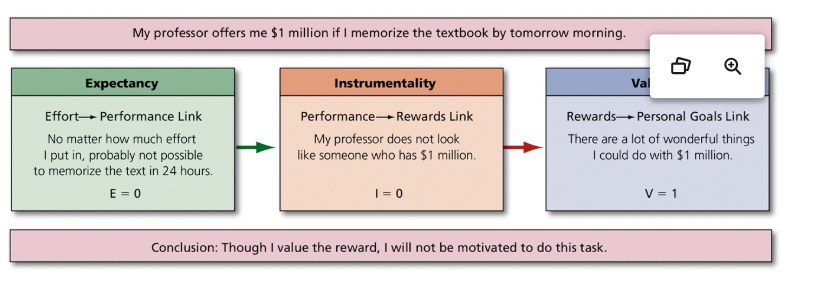
Expectancy (Effort-Performance Relationships)
Expression Value
Answers the question: “If I give a maximum effort, will it be recognized in my performance appraisal?”
The belief that effort is related to performance.
Can be expressed as a probability and ranges from 0 to 1.
Instrumentality (Performance–Rewards Relationship)
Expression Value
Answers the question: If I get a good performance appraisal, will it lead to organizational rewards?
The belief that performance is related to rewards.
When pay is based on factors such as having seniority, being cooperative, or flattering the boss, employees are likely to see the performance–rewards relationship as weak and demotivating.
Ranges from -1 to +1.
A negative indicates that high performance reduces the chances of getting the desired outcome.
A 0 indicates that no relationship exists between performance and receiving the desired outcome.
Valence (Rewards–Personal Goals Relationship)
Expression Value
Answers the question: If I am rewarded, are the rewards attractive to me?
The value or importance an individual places on a reward.
The rewards that an employee want will vary depending on their wants.
Ranges from -1 (very undesirable reward), to +1 (very desirable reward).
Goal-Setting Theory
(Parts of it & Who Theorized)
A theory that says that specific and difficult goals, with feedback, lead to higher performance. Shows that intentions to work toward a goal are a major source of work motivation.
Difficult goals + feedback = Higher performance.
Proposed by Edwin Locke.
Management by Objectives (MBO) Approach
Jointly set + Progress review = Allocation of rewards based on progress.
This is a goal setting approach that it became popular in the 1970s and is still utilized today. There are four parts to goal setting.
Specific measurable goals are jointly set by managers and employees (goal specificity & participation in decision making).
Progress on goals is periodically reviewed (within an explicit time period).
Rewards are allocated based on this progress (and performance feedback).
Four Parts that make up Management by Objectives (MBO)
GPTP
Goal specificity
Participation in decision-making (including the setting of goals or objectives)
Time period: Setting an intended time frame.
Performance feedback
Many elements in MBO programs match the propositions of goal-setting theory.
How Does Goal Setting Motivate (Locke)
4 Ways
DRIE
According to Edwin Locke goal setting motivates in four ways because goals:
Direct attention: Where individuals should direct their efforts.
Regulate effort: How much effort an individual should put into a given task.
Increase persistence: Persistence represents the effort spent on a task over time.
With goals set in mind, people keep working on them even in the face of hardship.
Encourage the development of strategies and action plans: Developing plans to achieve set goals.
SMART (For Goals to be Effective)
For goals to be effective, they should be “SMART.”
SMART stands for:
Specific: Individuals know exactly what is to be achieved.
Measurable: Goals proposed can be tracked and reviewed.
Attainable: Goals even if difficult, are reasonable and achievable.
Results-oriented: Goals should support the vision of the organization.
Time-bound: Goals are to be achieved within a stated time.
Promotion Focus
Self-Regulation Strategy
A self-regulation strategy that involves striving for goals through advancement and accomplishment.
Research has found that people differ in the way they regulate their thoughts and behaviours during goal pursuit.
Example: An employee sets a personal goal to improve their presentation skills by: Volunteering to lead meetings, asking for feedback after presentations and taking a public-speaking workshop.
Prevention Focus
Self-regulation Strategy
A self-regulation strategy that involves striving for goals by fulfilling duties and obligations.
Research has found that people differ in the way they regulate their thoughts and behaviours during goal pursuit.
Example: An employee double-checks reports and follows strict procedures to: Avoid errors, prevent compliance violations, ensure deadlines are met.
Self Efficacy
(Researcher Associated)
Individuals’ beliefs in their ability to perform a task influence their behaviour. Researcher that developed it was Albert Bandura.
High levels: More confidence you have in your ability to succeed in a task, in difficult situations will try harder to master the challenge, more engaged with tasks and increase performance.
Low levels: Difficult situations can lead to a lessening of effort or giving up, more likely to lessen their effort after negative feedback.
Four Proposed Ways Self Efficacy Can be Increase
EVVA
Enactive mastery: Gaining relevant experience with the task or job.
Vicarious modelling: Becoming more confident because you see someone else doing the task.
Verbal persuasion: Becoming more confident because someone convinces you that you have the skills necessary to be successful.
Arousal: An energized state, so the person gets “psyched up” and performs better.
Self-fulfilling prophecy
A concept that proposes people will behave in way consistent with how they are perceived by others.
It is often used to describe “that what one person expects of another can come to serve a self-fulfilling prophecy.
The terms self-fulfilling prophecy and Pygmalion effect describe how an individual’s behaviour is determined by others’ expectations.
Pygmalion Effect
Term based on a Greek myth about a sculptor who fell in love with a statue he carved.
A form of self-fulfilling prophecy in which believing something can make it true.
Here, it is often used to describe “that what one person expects of another can come to serve a self-fulfilling prophecy.
Reinforcement Theory
Behaviour is a function of its consequences. See behavior as environmentally caused. What controls behaviour is reinforcers, (consequences) that when immediately following responses, increase the probability that the behaviour will be repeated.
The core mechanism inside operant conditioning, it focuses specifically on how reinforcements and punishments increase or decrease behavior.
This includes: Positive and negative reinforcement, punishment and extinction.
Not a theory of motivation but rather powerful means of analyzing what controls behavior (contrasts with goal setting theory).
Operant Conditioning (Learning) Theory (Behaviorism)
The subject learns to operate on the environment to achieve certain consequences (get desired feedback). Controlled by consequences that follow an action. The broader framework (associated with B.F. Skinner) that explains how behavior is shaped by consequences.
Influenced by the reinforcement or lack of reinforcement brought about by its consequences that effects someone’s behavior.
B. F. Skinner demonstrated that people will most likely engage in desired behaviours if they are positively reinforced for doing so.
Part of the larger concept of behaviourism, and reinforcement theory.
Behaviourism (Operant Conditioning)
Broad approach; operant conditioning and reinforcement theory live inside it.
Behaviorism → overall school of thought.
Operant conditioning → a major behaviorist theory.
Reinforcement theory → the key mechanism used in operant conditioning (through behavior reinforcement).
A theory that argues that behaviour follows stimuli in a relatively unthinking manner. People learn to associate stimulus and response, but their conscious awareness of this association is irrelevant.
4 Methods of Reinforcement
In Operant Learning Theory
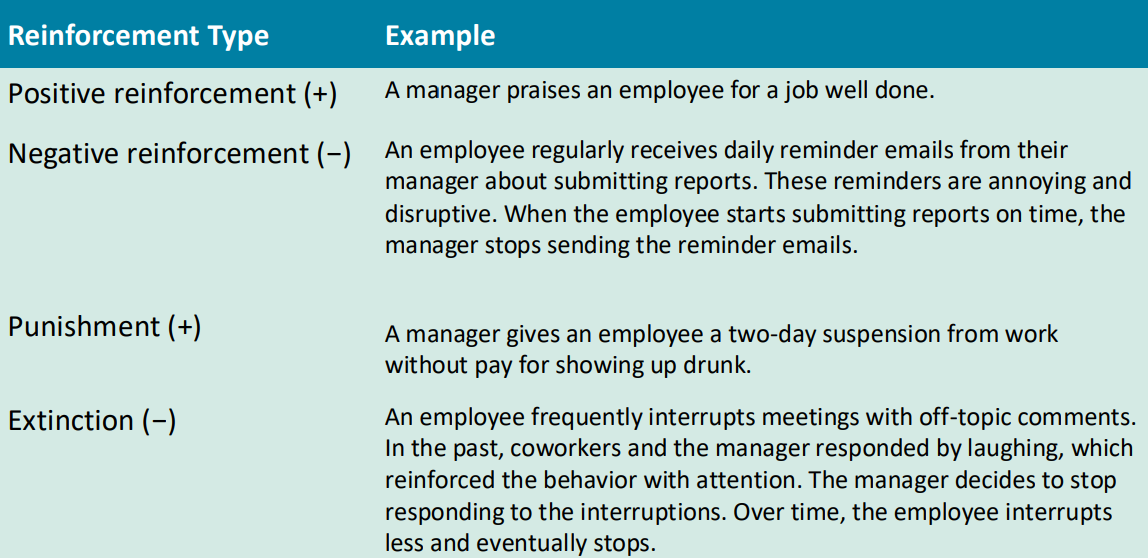
Positive Reinforcement: Following a response with something pleasant.
Does not mean positive, it just means adds.
Negative Reinforcement: Following a response with the termination or withdrawal of something unpleasant.
This does not mean bad it just means takes away. Strengthens behavior because it takes something away.
Punishment: Causing an unpleasant condition to eliminate an undesirable behaviour.
Extinction: Eliminating any reinforcement that maintains a behaviour (positive or negative)
Continuous Reinforcement
A desired behaviour is reinforced each time it is demonstrated. This means a reward is given after each desired behavior. This can enforce fast learning of new behavior with rapid extinction. However, on the contrast to this, rapid extinction can lead to a lower performance.
Example: Compliments.
One of the two major types of reinforcement schedule.
Intermittent Reinforcement
(Two Elements - RI)
A desired behaviour is reinforced often enough to make the behaviour worth repeating, but not every time it is demonstrated. Schedule can be based on ratio or interval.
Ratio schedules: Depend on how many responses the subject makes.
Reinforced after performing a certain number of a specific type of behaviour.
Interval schedules: Depend on how much time has passed since the previous reinforcement.
Reinforced on the first appropriate behaviour and after a particular time has elapsed.
Associated with first instance and speciifc time period.
Four Types of Intermittent Schedules of Reinforcement
Intermittent reinforcement can also be classified as fixed or variable.
When these factors are combined, four types of intermittent schedules of reinforcement result:
Fixed-interval schedule: Reward at fixed time intervals (same time, every time).
Variable-interval schedule: Reward given at variable time intervals (different time, never sure when).
Fixed-ratio schedule: Reward given at fixed amounts of output (same amount of effort, every time).
Variable-ratio schedule: Reward given at variable amounts of output (different effort, unpredictable).
Two Types of Self-Regulation Strategies
Promotion focus: Doing activities to promote the learning of something (e.g. taking courses to improve job skills).
Prevention focus: Removing something to be able to focus on the intended goal (e.g. avoiding gossip to focus on job and contribute to overall workplace health).
Generally, people fall into one of two categories, although they could belong to both, promotion focus is one of those types.
Both strategies work toward goal accomplishment, but in different ways.
Fixed-interval schedule
Rewards are given after a set (fixed) amount of time. You know when (intervals) the reward is coming, regardless of how much work you do right before it.
This includes average and irregular performance with rapid extinction (decrease in performance). People tend to slow down after the reward, and increase performance as the reward gets closer.
Examples: Weekly paycheques, pay is not tied to daily output, effort often increase near the end of a pay period (e.g. more shifts taken).
Variable-Interval
Rewards are given after unpredictable (variable) amounts of time (intervals). You don’t know when the reward is coming, only that it will come eventually.
Moderately high and stable performance with slow extinction (decrease in performance). Leading to steady performance and resistance to extinction.
Examples: Praise or bonuses given at unpredictable time, employees stay consistently productive, effort doesn’t spike or drop suddenly.
Fixed-ratio
A reward is given after a set (fixed) amount of output (effort).
You know exactly how much work you need to do to get the reward.
Producing high performance that develops quickly but extinguishes (decreased performance) rapidly when rewards stop, people notice when something stops almost immediately.
Examples: Piece rate pay, paid per article written, commission per sale with a fixed amount, bonuses for every 10 clients signed.
Variable Ratio
Reward is given after a random amount of output (effort). You don’t know how many actions it will take before the reward appears (slow extinction - decrease in performance).
Examples: This is the strongest type, it is why gambling and social media are so addictive, commissioned sales is another example.
Social Cognitive Theory (& 3 Components)
OSS
Emphasizes the role of cognitive processes in regulating people’s behavior.
This theory assumes that people learn from observing the behaviours of others and can also regulate their own behavior. Components include:
Observational learning: The process of imitating others behavior.
Self-efficacy: Beliefs people have about their abilities to perform.
Self-regulation: Use of learning principles to regulate one’s own behavior. Promotion and prevention focus are examples.
Rapid Extinction
Behavior stops fast when after reward is given.
Fixed schedules → rapid extinction, after receiving what is expected.
Extinction refers to the reduction of a learned behavior when reinforcement is removed.
Slow Extinction
Behavior continues even without rewards.
Variable schedules → slow extinction, after the reward is received.
Extinction refers to the reduction of a learned behavior when reinforcement is removed.
 Note
Note  Flashcards (24)