Unit 4 PSYCH: Social Psychology and Personality
 Studied by 0 people
 Call Kai
 Learn
Learn Practice Test
 Spaced Repetition
 Match
Match Flashcards
 Knowt Play
1/24

There's no tags or description
Looks like no tags are added yet.
Name | Mastery | Learn | Test | Matching | Spaced | Call with Kai |
|---|
No analytics yet
Send a link to your students to track their progress
25 Terms
arousal
the state of being physiologically alert, awake, and responsive to stimuli. a state of excitement or energy expenditure linked to an emotion.
Drive-Reduction Theory
motivation as the push to reduce internal tension from unmet biological needs (like hunger, thirst) by engaging in behaviors that restore balance, or homeostasis, back to an optimal internal state
need —> drive —> behavior
Example:
Need: nutrients (stuff from food)
Drive: hunger
behavior: eating
big idea here is homeostasis
mostly involved with survival
arousal theory
individuals are motivated to act in ways that maintain an optimal level of physiological arousal (alertness, excitement) rather than just reducing tension
Pullen explanation: constantly seeking the “sweet spot of arousal” to not be anxious or nervous or bored. everyone has different optimal levels of arousal. YOLO in a nutshell
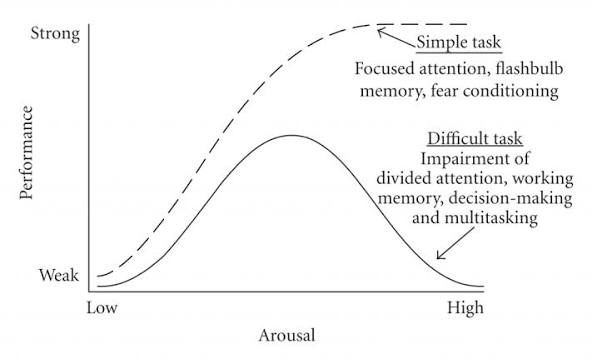
optimal arousal
Yerkes-Dodson Law
performance increases with physiological or mental arousal (stress) but only up to a point
Pullen: you perform best in your optimal level of arousal. athletes: tennis, if they are in their optimal level of arousal, they will be at their peak or best potential for performance. if they are too confident and see it as not challenging enough, they also will not perform well. there is a sweet spot that maximizes it
Self-Determination theory
posits that human motivation is driven by the innate need for growth and the satisfaction of three psychological needs: autonomy (choice), competence (mastery), and relatedness (connection).
tied to the workplace mostly
Pullen:
autonomy: individual having control over work that they are doing (more control —> more motivation)
competence: are they able to actually do that task (is it in their ability level or wheelhouse) (feel competent —> more motivation)
relatedness: relationships and collaboration with others (have connections at work —> more motivation)
also involves intrinsic and extrinsic motivation
intrinsic motivation
performing a behavior because the act itself is inherently satisfying, enjoyable, or personally rewarding, rather than for external benefits like money or praise, focusing on internal factors such as personal growth, interest, and fulfillment
extrinsic motivation
the drive to engage in a specific behavior or activity to earn external rewards (e.g., money, grades, praise) or to avoid punishment
incentive theory
behavior is motivated by the desire to attain external rewards (positive incentives) and avoid punishments (negative incentives).
Instinct theory
posits that behavior is primarily driven by innate, unlearned, and genetically programmed patterns (instincts) universal to a species, aimed at ensuring survival
does not apply to humans
Pullen: Sea turtles live by their own instincts. humans have the rooting reflex but animals have instincts
fits in survival theory as well
Lewin’s motivational conflicts
It's Kurt Lewin's idea that motivation arises from tension when we face choices, categorized into three main types: Approach-Approach (two good options), Avoidance-Avoidance (two bad options), and Approach-Avoidance (one option with both good and bad parts)
Approach-Approach: two desirable options
Avoidance-Avoidance: one option with good and bad to it
Approach-Avoidance: two undesirable options
sensation-seeking theory
the pursuit of novel, complex, and intense sensations and experiences, along with the willingness to take physical, social, legal, and financial risks for the sake of such experiences
Pullen: i think it’s stupid. the level of need for experiences
Experience seeking: looking for new experiences - not intense or extreme - just new experiences to your life —> an experience you have not had yet
Thrill or Adventure seeking: same as above but more danger centered —> chasing the adrenaline rush (skydiving, bungee jumping etc)
Disinhibition: disconnect from society - be away from other people
Boredom Susceptibility: some people are predisposed to be bored more easily which makes them seek out ways to avoid this boredom
main motivators
the internal (needs, desires) and external (incentives, rewards) forces that energize, direct, and sustain human behavior toward a specific goal:
hunger, sex and social belonging
hunger
a complex physiological and psychological drive to consume food, acting as a motivated state to maintain energy homeostasis
Pullen: hypothalamus (makes you feel hungry), pituitary gland (hormones and rest of body)
leptin: makes you feel full
ghrelin: causes you to eat more because you feel hungry
Hypothalamus parts
Lateral —> Let’s eat (hungry)
Ventromedial —> Vomit (full)
External factors of hunger:
Presence of food: if it is there (free pizza example)
time of day: certain time frames where eating is taking place or is normed to take place
Social gatherings: you may show up at a party where you are full but still eat because there is food there
Sexual Response Cycle
a four-stage model describing the physical/physiological responses during sexual activity: excitement, plateau, orgasm, and resolution
Pullen:
Excitement —> initial arousal of genitals
Plateau —> the actual happening of it
Orgasm —> heightened sense or climax
Resolution —> body returns to normal state and men enter a refractory period
Eat Plenty Of Radishes
Achievement
the successful attainment of a goal, or the mastery of skills and knowledge in a specific area
Pullen:
Humans crave a sense of belonging —> paired with belonging
do a thing for social belonging
Humans require and crave a sense of belonging, base level to help with survival and pass along genes
highly motivated individuals set challenging but attainable goals
Achievement also aligns directly with our Intrinsic vs Extrinsic motivations
goal setting (SMART)
a structured, evidence-based framework for effective goal-setting in psychology, ensuring objectives are Specific, Measurable, Achievable, Relevant, and Time-bound
Pullen:
Big picture goals to start —> high standards, but attainable
Keep yourself accountable by including others
Have short term goals that slowly build to the big picture
set yourself up for success
psychodynamic theory of personality (freud)
asserts that personality and behavior are shaped by unconscious drives, inner conflicts, and early childhood experiences (add more later)
compensation
a defense mechanism (often unconscious) where an individual covers up, develops, or exaggerates a weakness, frustration, or feelings of inadequacy in one life area by seeking to excel or overachieve in another
making up for failures in one area through success in others
rationalization
a defense mechanism involving the creation of false but plausible excuses to justify unacceptable behaviors, thoughts, or feelings
creating logical excuses for emotional or irrational behavior
regression
a psychoanalytic defense mechanism where an individual, facing anxiety or stress, reverts to an earlier, more immature stage of development to seek comfort and safety
reverting to childish behaviors
denial
a psychoanalytic defense mechanism where an individual refuses to acknowledge or accept consciously painful facts, realities, or feelings
the refusal to acknowledge or accept unwanted beliefs or actions
sublimation
the unconscious, mature process of transforming unacceptable impulses, such as aggressive or sexual drives, into socially acceptable, productive, or creative behaviors
the channeling or redirecting of sexual or aggressive feelings into a more socially acceptable outlet
projection
a psychoanalytic defense mechanism where individuals unconsciously attribute their own unacceptable thoughts, feelings, or impulses onto another person or group
when a person attributes feelings or beliefs to another person when they are actually the person’s own beliefs or feelings
 Note
Note  Flashcards (248)