Action potential
 Call Kai
 Learn
Learn Practice Test
 Spaced Repetition
 Match
Match Flashcards
 Knowt Play
1/17

There's no tags or description
Looks like no tags are added yet.
Name | Mastery | Learn | Test | Matching | Spaced | Call with Kai |
|---|
No analytics yet
Send a link to your students to track their progress
18 Terms
Neurons definition
when do we use action potential
propagation, otherwise its usually nerve impulse
nerve impulses
neurons send messages electrochemically (means the chemicals cause an electrical impulse)
chemicals in the body are ‘electrically charge’ when they have an electrical charge called ions
ions are sodium, potassium, calcium, chloride
there are also negatively charged protein molecules
nerve cells are surrounded by a membrane that allow some ions to pass through and blocks the passage of other ions-semi permeable membrane
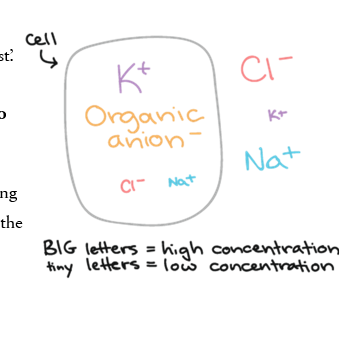
baseline-resting membrane potential
if its big, it has a larger concentration
the inside of the neuron is negative relative to the outside (membrane potential is -70mV)
potassium crosses through the membrane easily
chloride and sodium have a difficult time crossing
negatively charged protein molecules inside the neuron cannot cross the membrane
maintaining RMP (maintaining resting membrane potential) sodium potassium pump
Both Na+ and K+ can ‘leak’ through their respective channels.
Over time, this will reduce the potential difference (-70mV will become closer to 0mV)
Therefore, we need a way of increasing the potential difference
This is done using a sodium potassium pump
It moves 3 Na+ out of the cell and 2 K+ into the cell.
It requires energy as it is moving against the concentration gradient.
Low to high needs energy
steps of maintain RMP
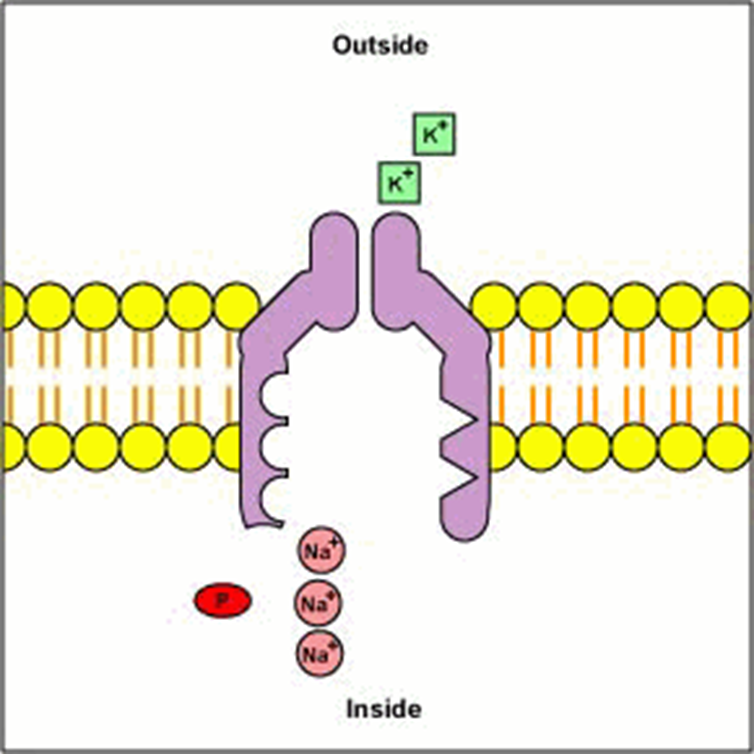
Step 1 – (3) Na+ binds to protein on intracellular side
Step 2 – ATP binds one phosphate to the protein
Step 3 – Protein changes shape
Step 4 – Na+ is released into extracellular fluid
Step 5 – (2) K+ binds to protein on extracellular side
Step 6 – Phosphate group is removed from protein
Step 7 – Protein changes shape
Step 8 – K+ is released into intracellular fluid
stimulating a neuron
stimulated by receptor cells—contain special sodium channels that are ligan-gated (respond to chemical change)
the ligand-gated channels open
causes sodium ions to diffuse into the cell (down concentration gradient
causes a depolarisation of the membrane potential
if the membrane depolarises to -55mV (threshold value)
stimulates the voltage-gated sodium channels nearby and starts an action potential
stimulating a neuron—depolarisation (neuron more positve than it was—less negative)
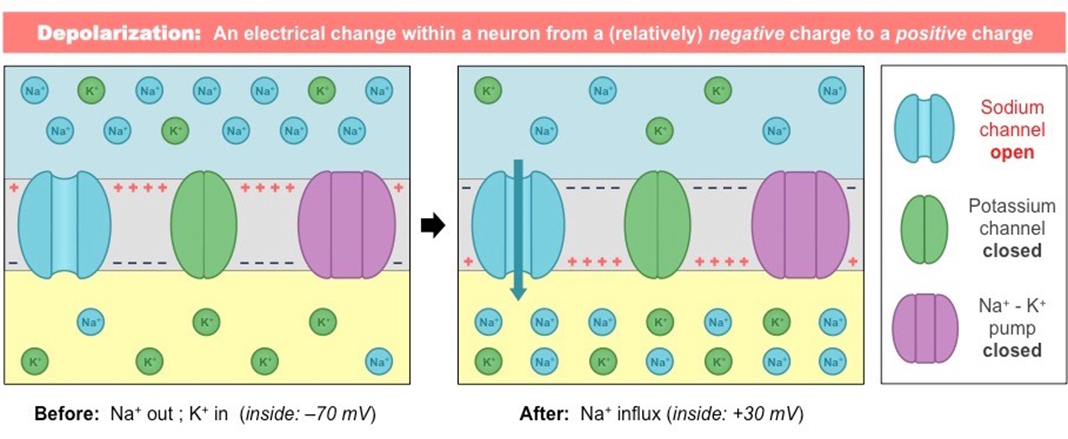
– when the membrane potential moves towards 0. (becomes less polar)When threshold value (-55mV) is reached after a strong enough stimulus, the following occurs
•Voltage gated sodium channels are opened
•Sodium ions (Na+) diffuses into the axon, down concentration gradient
Causes depolarisation as membrane potential moves towards 0mV (reaching +30mV will always be positive but can be other numbers)
stimulating a neuron—repolarisation
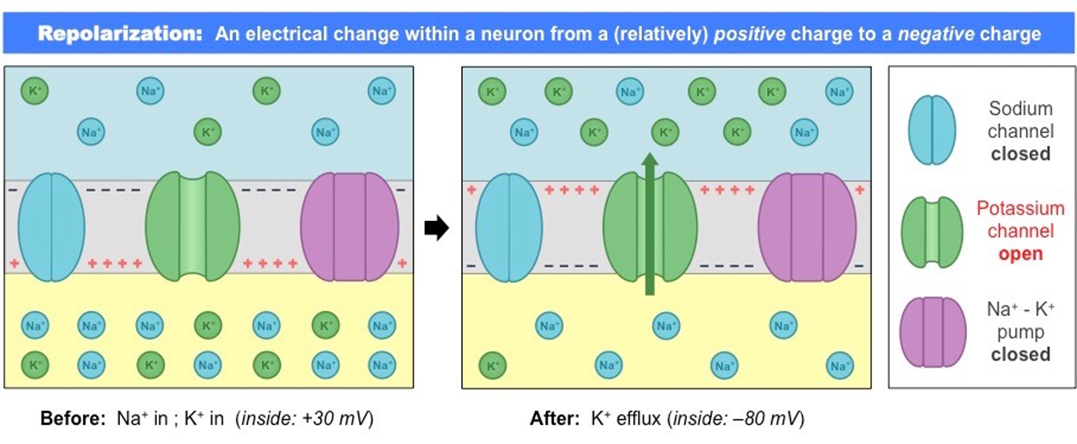
When the membrane potential moves away from 0. (becomes more polar)
When membrane is depolarised, the following occurs
•Sodium channels close (and will remain closed until membrane is repolarised)
•Voltage gated potassium channels (K+) are opened
•Causing potassium ions to diffuse out of the axon
Causes repolarisation (inside axon becomes more negative) causing potential to move towards -70mV
action potential
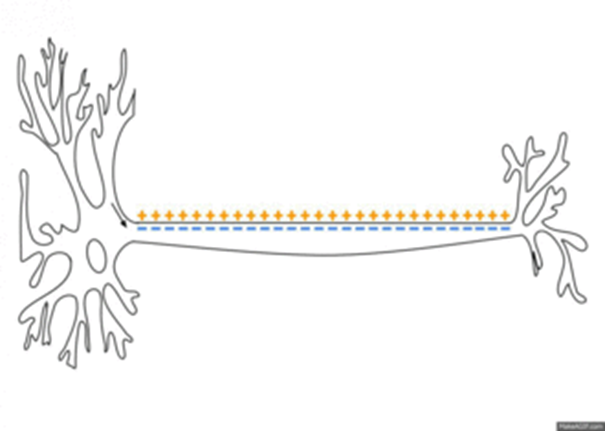
An action potential occurs when a neuron sends information down an axon.
the resting membrane potential changes at all points along the cell membrane
Action Potential - hyperpolarisation
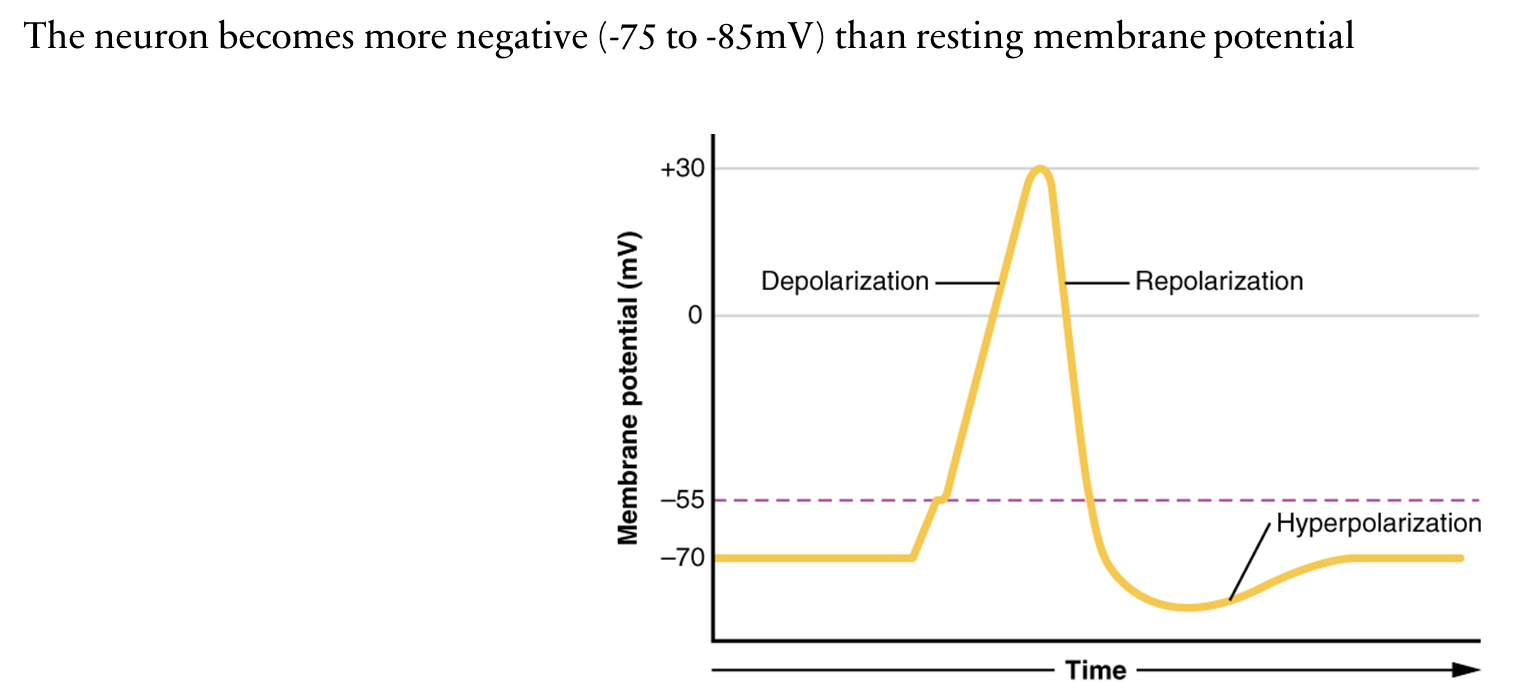
•Due to potassium channels staying open for longer
•
•Letting more potassium ions exit the cell.
•
•The sodium-potassium pump will work to restore the resting membrane potential at -70mV
The neuron becomes more negative (-75 to -85mV) than resting membrane potential
Action potential-refractory periods
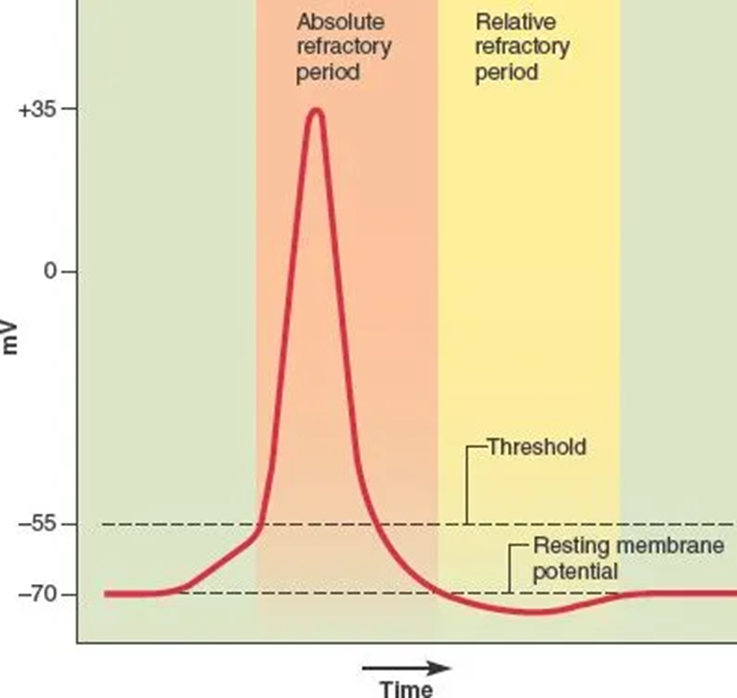
Absolute refractory period: during this time, no action potentials can be created, this is due to the fact that sodium channels remain closed after depolarisation and relative refractory period: during this time a stimulus that is considerably larger than the the threshold can cause an action potential. the absolute refractory period ensures action potentials can only travel in one direction
Action potentials – all or nothing
Like muscles, action potentials are not graded, it either happens or it doesn’t.(a larger stimulus will still only cause one action potential)
This means that intensity of nerve impulses is determined by
•Frequency – which is determined by strength of stimulus and its ability to cause a new action potential during relative refractory period
•Number of receptors stimulated
Action potentials – myelinated neurons
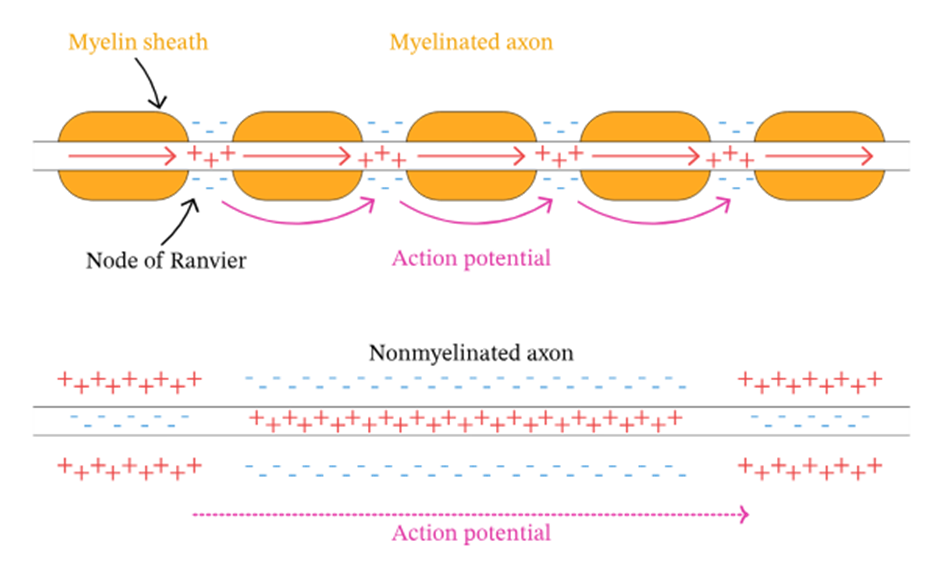
In a myelinated neuron The voltage-gated sodium channels of myelinated neurons are confined to the gaps in the myelin sheath called nodes of Ranvier.
•
•The in rush of sodium ions at one node creates just enough depolarisation to reach the threshold of the next.
In this way, the action potential jumps from one node to the next (1mm) – called saltatory propagation
Results in much faster propagation of the nerve impulse than is possible in nonmyelinated neurons.
Synapses / neuromuscular junctions
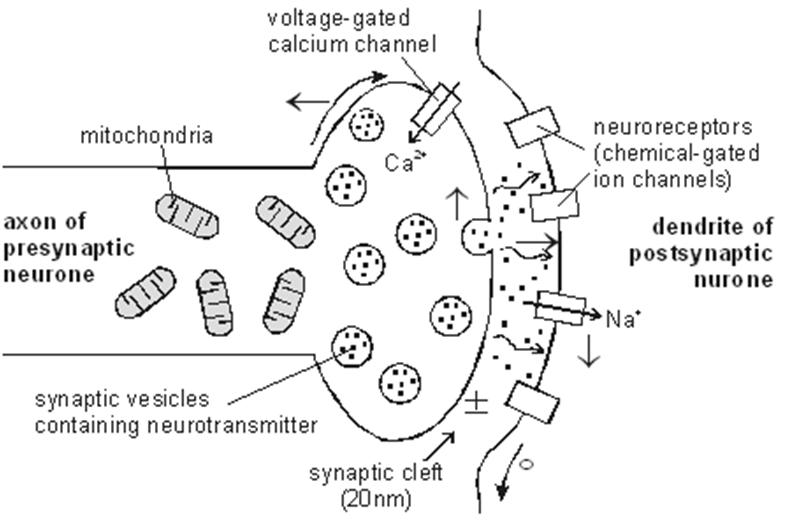
•Junction between two neurons is called a synapse
•Junction between a neuron and skeletal muscle is called a neuromuscular junction
•An AP cannot cross the synapse, so the impulse is carried by chemicals called neurotransmitters
•
Synapses
•At the end of the pre-synaptic neuron there are voltage gated calcium channels.
•When AP reaches the synapse, the channels open
•Calcium ions flow into the cell
•
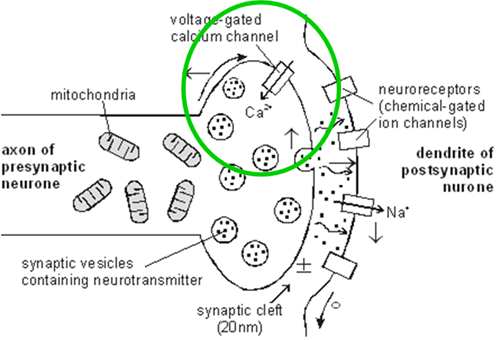
Calcium ions cause synaptic vesicles to migrate to and fuse with the cell membrane
Neurotransmitters are released via exocytosis
Neurotransmitters diffuse across the synaptic cleft
Calcium ions cause synaptic vesicles to migrate to and fuse with the cell membrane
Neurotransmitters are released via exocytosis
Neurotransmitters diffuse across the synaptic cleft
synapses neurotransmitters binding to neurorecepters in te
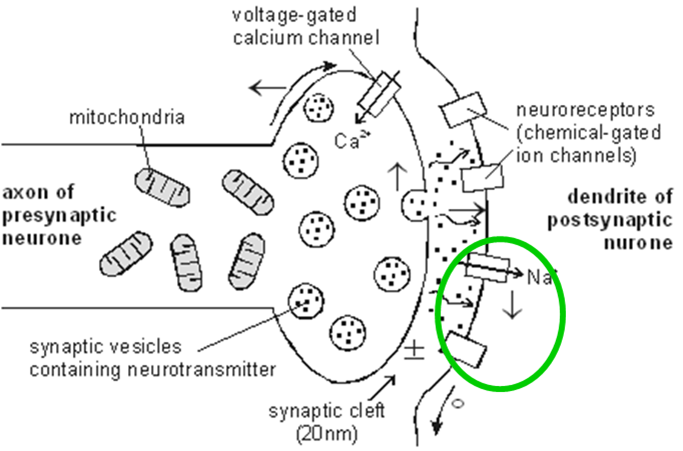
•Neurotransmitter binds to neuroreceptors in the post-synaptic membrane
•Chemically gates sodium channels open,
•Na+ flow into postsynaptic neuron
•If threshold is reached, it will cause depolarisation
•AP initiated in post-synaptic neuron
•
synapses function and neurotransmitters
Function
•Prevents impulses travelling in the wrong direction as impulses can only cross a synapse in one direction
•Allows each neuron to connect to a vast number of other neurons, allowing greater variety
Neurotransmitters
•Neurotransmitters are broken down by a specific enzyme in the synaptic cleft.
•Breakdown products are absorbed by the pre-synaptic neuron
•Used to re-synthesise more neurotransmitter
•
•

