Parasitology Week 2/2!!
 Studied by 0 people
 Call Kai
 Learn
Learn Practice Test
 Spaced Repetition
 Match
Match Flashcards
 Knowt Play
1/45

There's no tags or description
Looks like no tags are added yet.
Name | Mastery | Learn | Test | Matching | Spaced | Call with Kai |
|---|
No study sessions yet.
46 Terms
TUESDAY:
helminths:
nematodes: roundworms
cestodes: tapeworms
trematodes: flukes
NEMATODES:
-largest group that infect humans
-disease is proportional to worm burden
-rarely directly fatal
-can be gut, filarial (microfilariae), and zoonotic
gut nematodes
-usually eggs are seen but not always
•Enterobius vermicularis (pinworm)
•Trichuris trichiura (whipworm)
•Ascaris lumbricoides
•Hookworms
•Strongyloides stercoralis
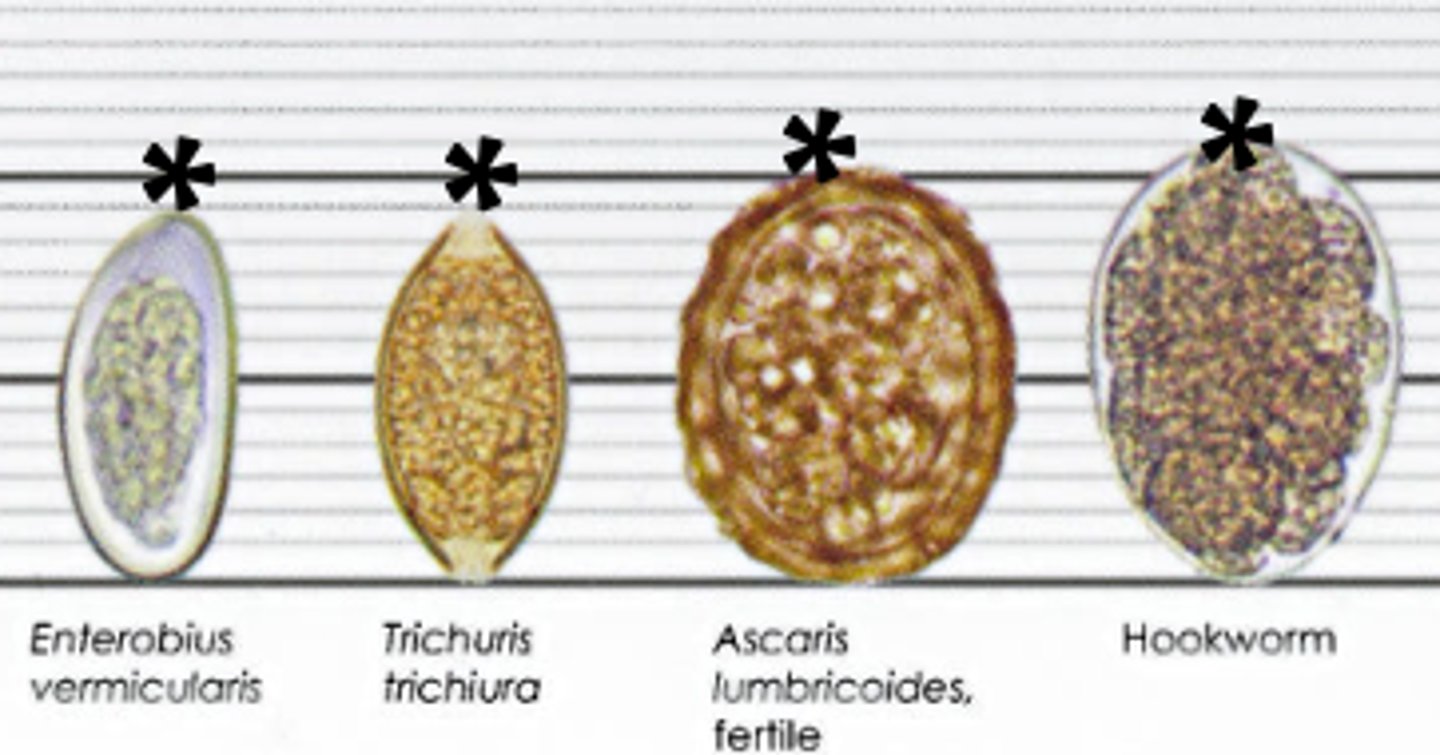
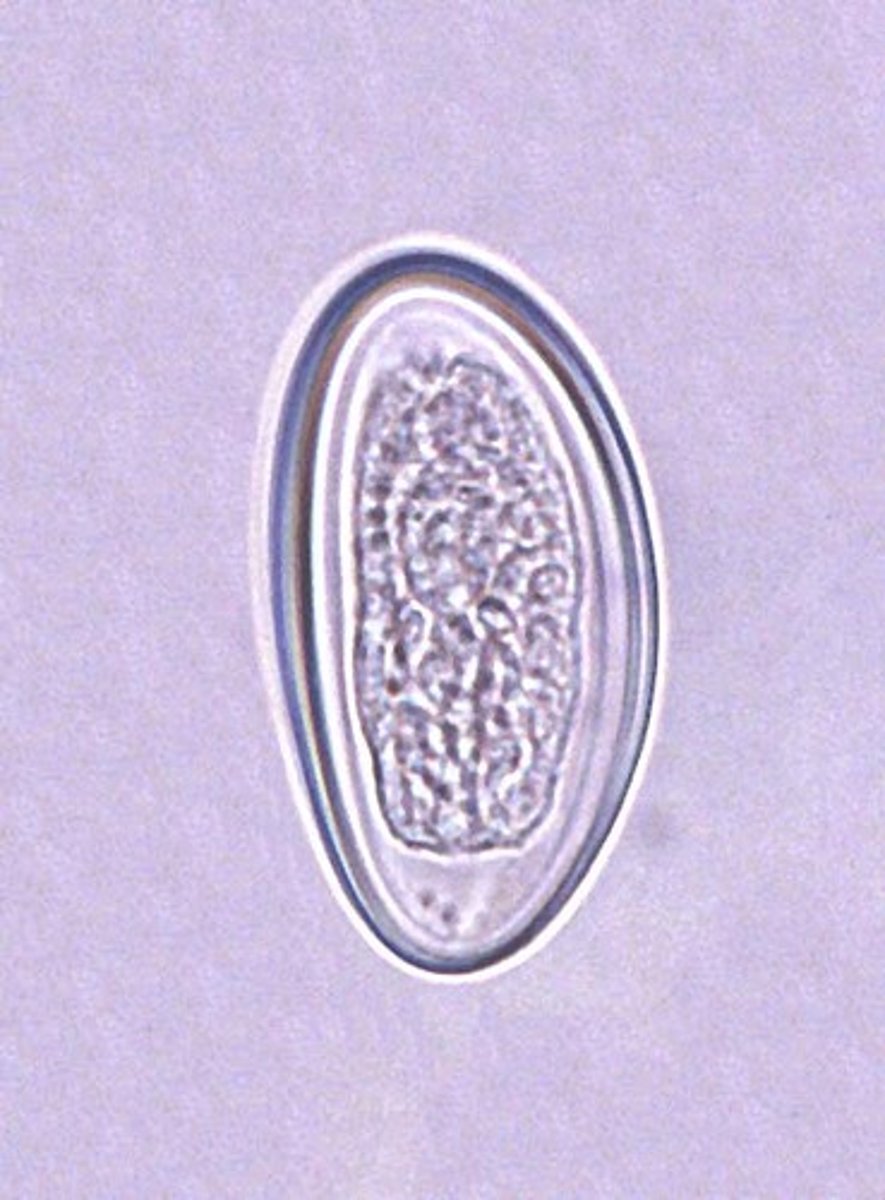
enterobius vermicularis
-common name
-disease cause
-clinical features
-life cycle
-egg morphology
-adult worm morophology
-PINWORM
-life cycle: EGGS IN --> EGGS OUT (egg is ingested and goes to SI where matures and the females travels all the way to the anus to lay eggs leading to itching; eggs mature in 4-6 hours)
-worms don't attach meaning they could accidently go to the wrong places (sometimes vaginal)
-very common in children
-'glue covered eggs' causes itching (itchy anus)
-Noctural PRURITIS ANI is the most common symptom
-rarely see adults in stool
-SCOTCHTAPE method to look for eggs (since O&P looks at stool and eggs not in stool)
ADULTS female: pointed tail about 1cm long
EGGS: medium size that are oval but flattened on one end, kinda like a D
-the eggs can develop into infective stage WIHTOUT NEEDING SOIL!!!
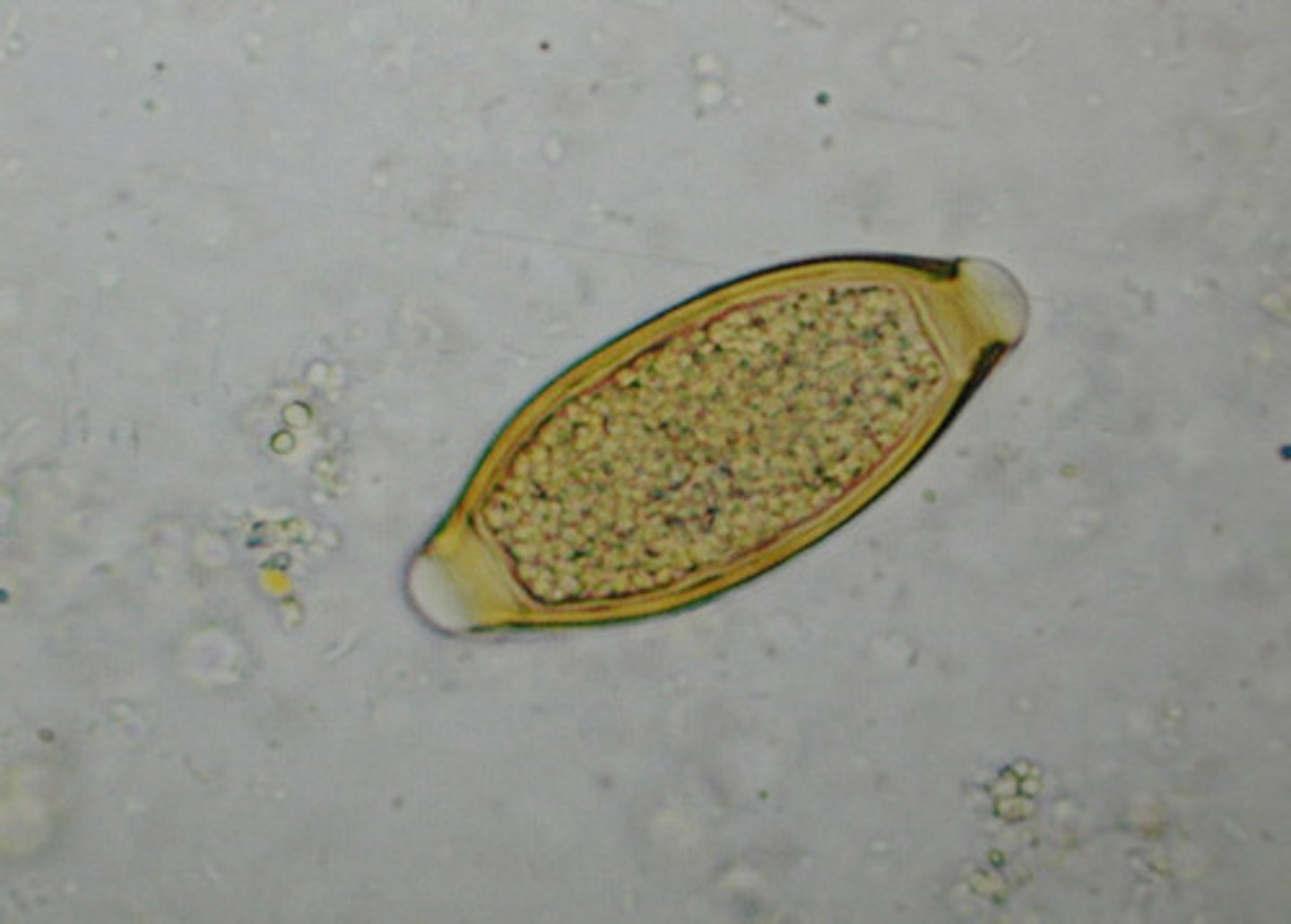
trichuris trichuria
-common name
-disease cause
-clinical features
-life cycle
-egg morphology
-adult worm morophology
-gut
-WHIPWORM
-NOW WE ADD LIFE CYCLE TWIST: need soil incubation! meaning they don't mature in the human body
-meaning poor hygiene. poop has larvae, it matures in poop on ground, then ground poo is ingested again!
-bc of 'night soil' meaning poo used as a good fertilizer
-or pica!
-life cycle: eggs in, eggs out to mature in the soil.
-eggs hatch in the SI and live in the secum but these attach and don't do migration!
-worms insert head into mucosa of intestine and feed on tissue juices
-mostly asymtomatic but can cause trichuris colitis or trichuris dysentery syndrome (blood diarrhead if sever infection) bc they attach and burrow into intestine
-RECTAL PROLAPSE IS HUGE!!!
-the eggs can develop into infective stage NEEDING SOIL!! (from using night soil for fertilization or pica)
EGG: mucoid bipolar plugs and very oval shape
ADULT: head is thin part (like a whip) bc that parts goes into intestine!
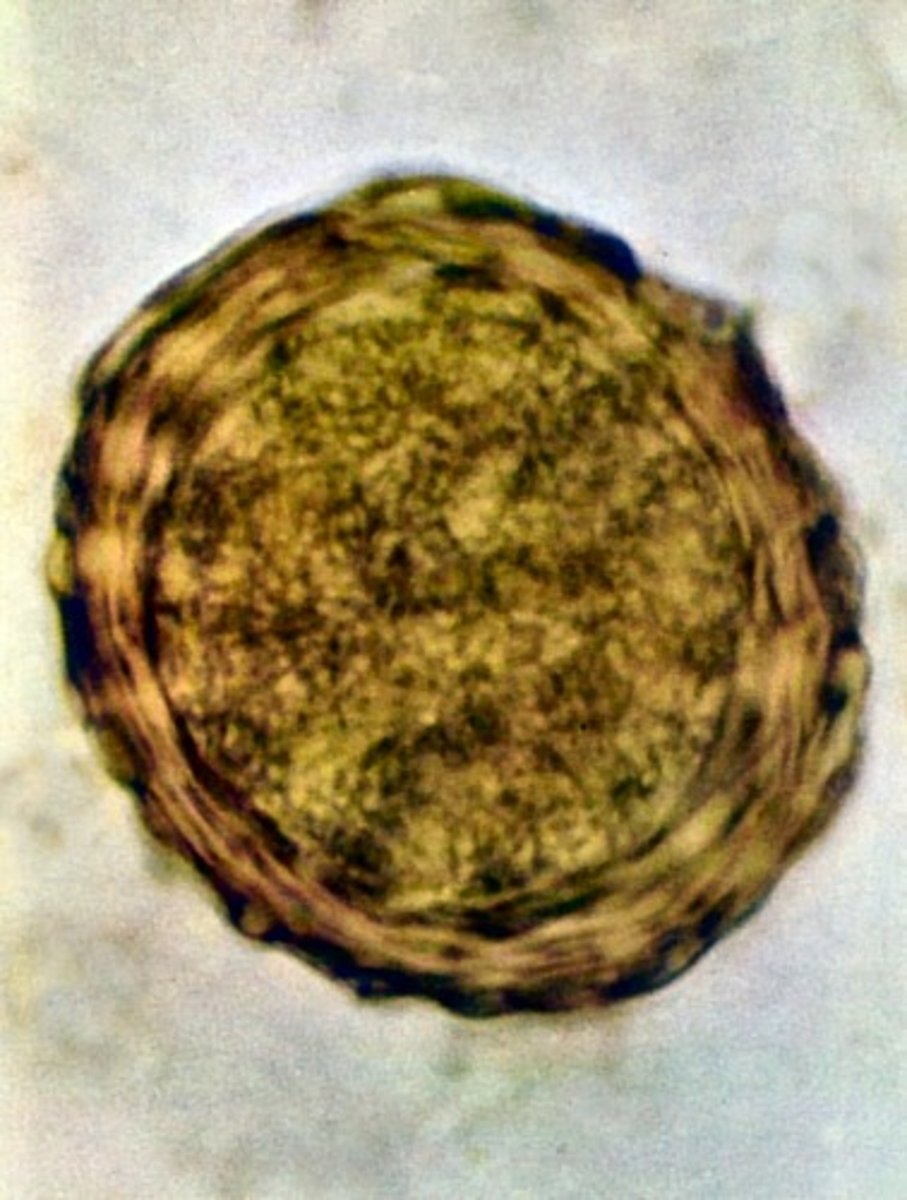
ascaris lumbricoides
-common name
-disease cause
-clinical features
-life cycle
-egg morphology
-adult worm morophology
-gut
-now they have soil too and have a lung migration stage!
-go to wall of bowel to the blood up to the lungs where they are coughed up and then swallowed into intestine and then mature.
-not attachement but swim upstream to prevent being passed
-the eggs can develop into infective stage NEEDING SOIL!!(from using night soil for fertilization or pica)
-lung migration stage!!
-worms don't attach, they actively move upstream to prevent being passed
-mostly asymptomatic
PHASES:
1) lungs: Loeffler's syndrome (dry cough, asthma, fever)
2) intestine: diarrhea, discomfort
3) Ectopic infection: appendix, pacrease, bile ducts (bc they don't burrow and swim, they can swim to the wrong place leading to those things)
-INTESTINAL OBSTRUCTION IS THE BIG THING BC OF HOW BIG THE WORMS ARE!
both can be found in stool:
EGG: mammilations
WORM: look like a nature worm!
-these eggs have mammillations meaning a curvy border!!!! whether fertilized or not. they can lose the mammilations sometimes and be called decorticated
hookworm
-common name
-disease cause
-clinical features
-life cycle
-egg morphology
-adult worm morophology
-gut
-the eggs can develop into infective stage NEEDING SOIL!!(from using night soil for fertilization or pica)
-lung migration stage!!
-LARVAE! SKIN PENETRATION! (so now swallowed but through skin penetration in the feet usually)
-Necator americanus or ancylostoma duodenale infect humans
-egg in feces --> matures in larvae --> penetrates SKIN! --> grows in small intestine!
-hooks onto intestinal wall after getting coughed up and swallowed
-Skin: larval penetration by the hookworm leads to a rash called GROUND ITCH!
-Lungs: Loeffler's syndrome
-Intestine: cause blood loss when they bite into mucosa
-modern day vampires bc they penetrate skin and then go to SI where they feed on our blood leading to anemia!!!
WORMS: necator: 2 blades,
ancylostoma (vampire one): 2 pairs of cutting teeth
EGGS: identical; BIGGEST EGG! and more clear outside than Ascaris (next biggest)
strongyloides stercoralis
-common name
-disease cause
-clinical features
-life cycle
-egg morphology
-adult worm morophology
-gut
-the eggs can develop into infective stage NEEDING SOIL!!(from using night soil for fertilization or pica)
-lung migration stage!!
-SKIN PENETRATION!
-ONGOING AUTOINFECTION!
-threadworm!!
-larvae penetrate skin and then go to gut
-we don't see egg in stool, only ever larvae!!!!! larvae in stool, always thing strongyloides
-THEREFORE ALSO CAUSES GROUND ITCH BC THROUGH SKIN!
SKIN: itchy dermatitis from penetration
LUNG: loeffler's syndrome
Intestine: burrow and damage mucosa leading to bloody diarrhea and chronic cholitis
-infection can go on for 10-20 years; hyperinfection in immunocompromised is very dangerous!
-since we need up to 7 exams to see larvae, we do the agar culture method instead
EGG:
WORM:
*only larvae is seen, never the egg
*but can take up to 7 exams soooo
-agar culture method!
*put stool on agar and the migrating larvae out of the stool will move the bacteria too and you'll see tracks
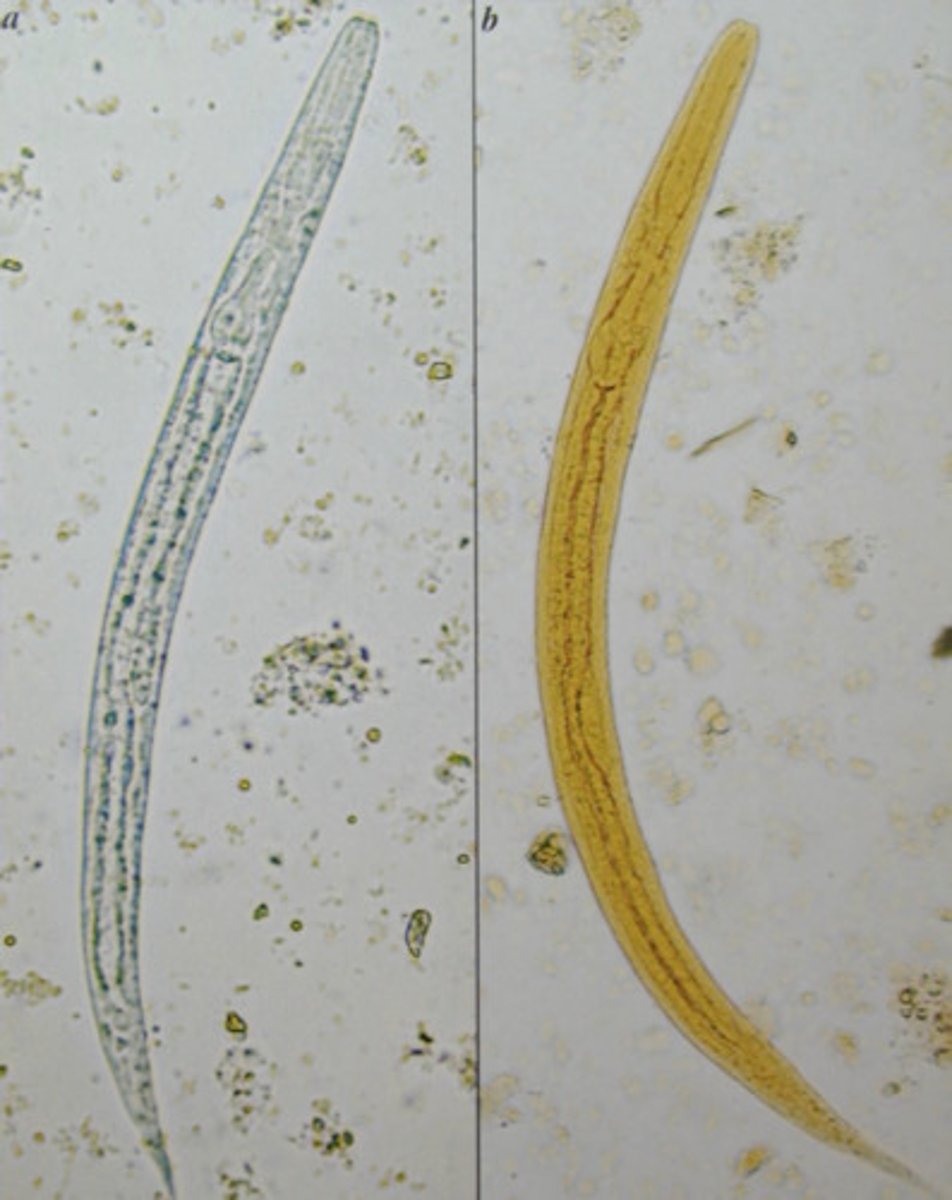
anisakiasis
-zoonotic
-undercooked fish (cod)
-larvae cannot mature in humans so instead it burries into our SI tissue and causes a ton of pain
-sometimes they die, sometimes they curl and wait to be eaten by another host (which doesn't happen for us)
-violent abdominal pain
trichinella spiralis
-common name
-disease cause
-clinical features
-life cycle
-egg morphology
-adult worm morophology
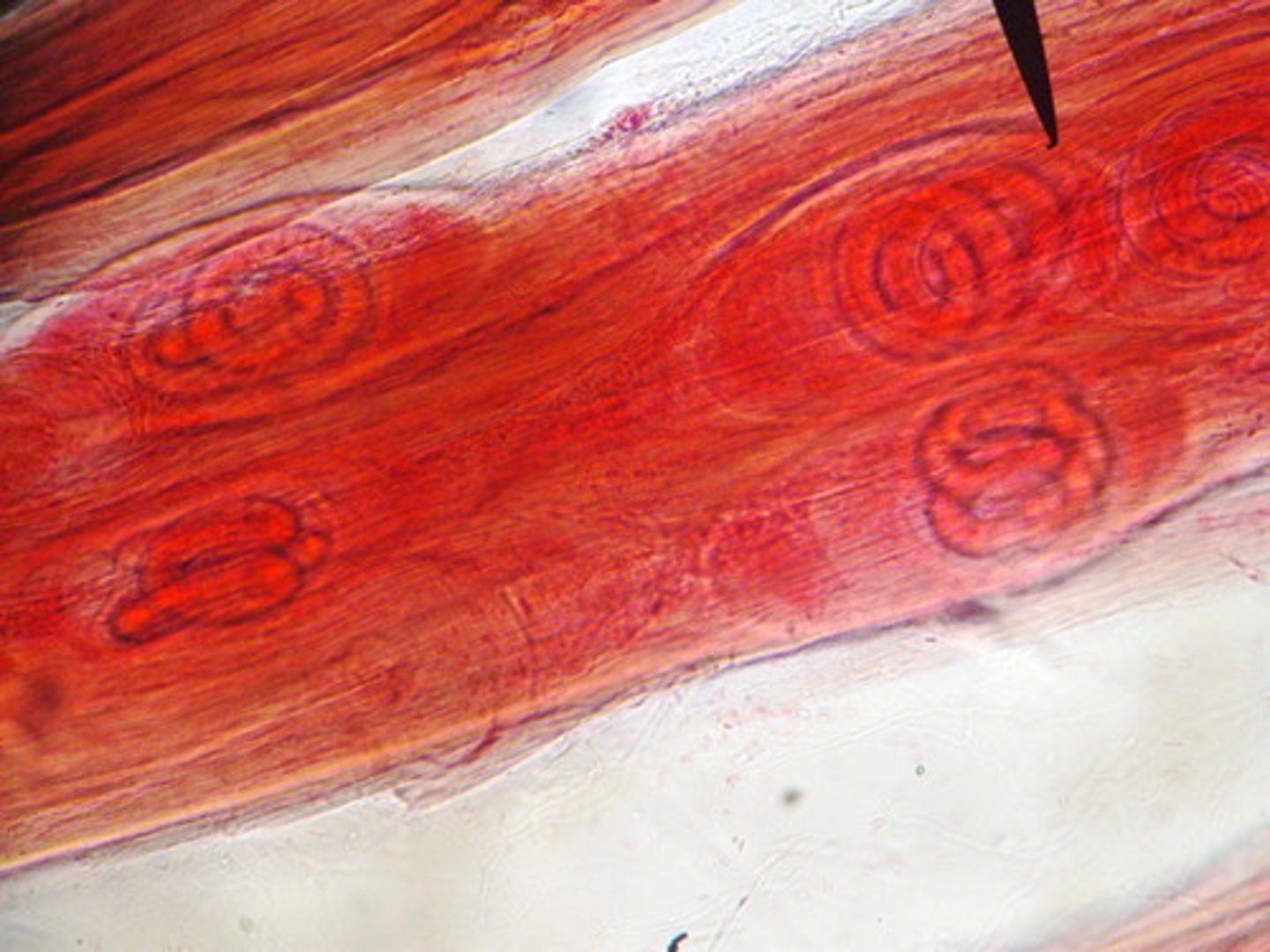
-zoonotic nematode
-undercooked meat like pork and bear
-larvae released into intestine and mature and go into circulation
-can be asymptomatic if light
-larvae migrate into MUSCLE tissue! leading to CNS involvement and myocarditis!
-Muscle Encystment leads to myalgia and weakness
*we look at muscle tissue!
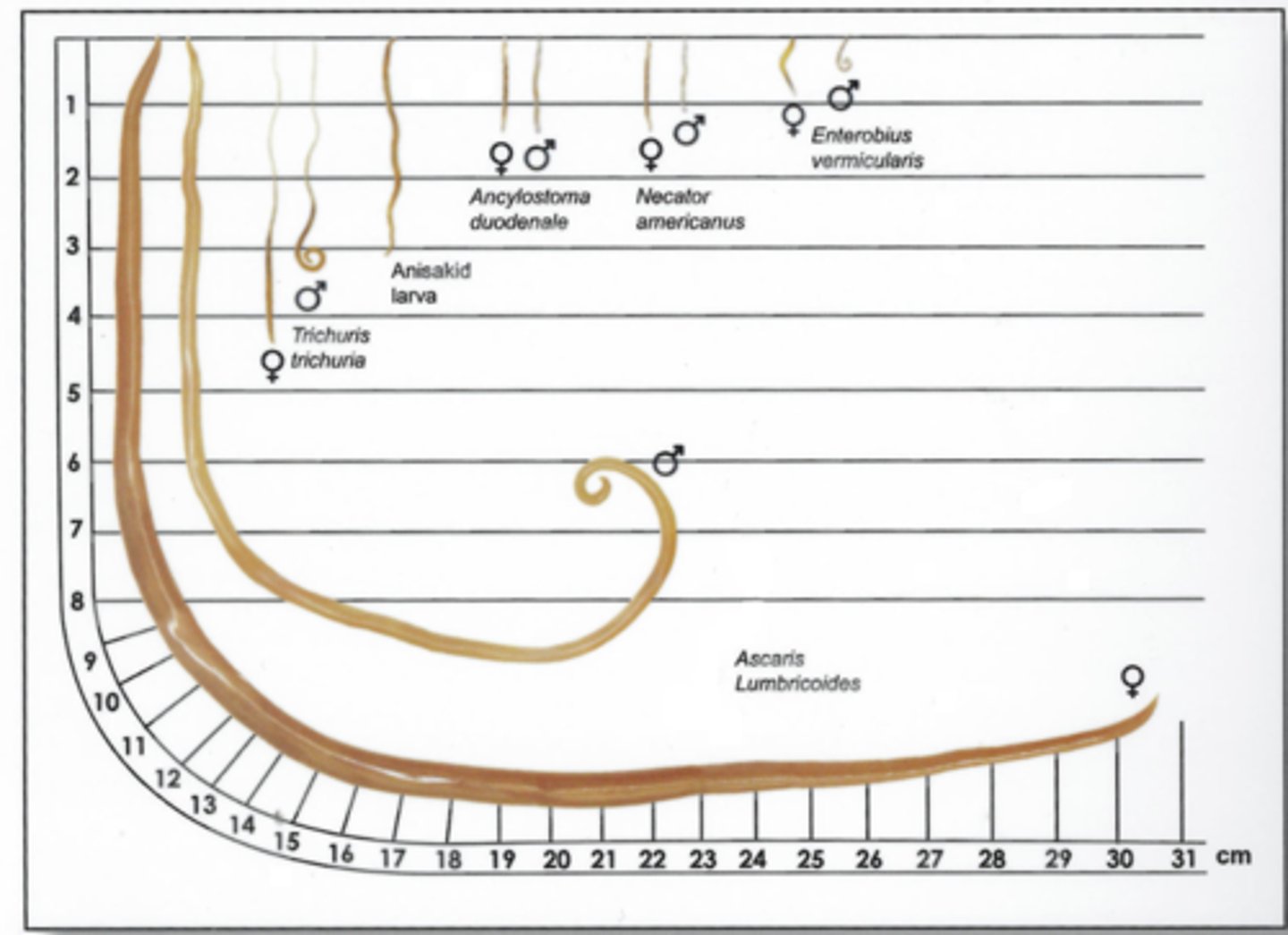
Identify various conditions associated with fecal-oral transmission of the nematodes
e.g. use of night soil for fertilization
scotch tape/swube method for E. vermicularis
-already mentioned
Baermann's concentration technique or agar culture to detect Strongyloides
Agar Culture Method:
-nutrient agar plate
-look for tracks made by the migrating larvae as they drag bacteria with them
· Which nematodes have a soil maturation phase?
· Which nematodes have a larval migration phase through the lungs?
· Which nematode is diagnosed by finding rhabditiform larvae in the stool?
· Which nematode is acquired through ingestion of contaminated meat?
· Which nematode has an auto-infective stage?
· Which nematodes infect humans via skin penetration?
Moving on to WEDNESDAY: CESTODES
· Taenia solium
· Taenia saginata
· Diphyllobothrium latum
· Dipylidium caninum
· Hymenolepsis nana
· Echinococcus spp.
TAPEWORMS!!! aka cestodes
General Cestodes/Tapeworm Info
-most are in the intestine as adult worms and different forms appear in different hosts
-stool can show eggs and or proglottids
-CYSTICERCOSIS and ECHINOCOCCOSIS are caused by the lARVAL tapeworms when we are the intermediate host!!! which is rare.
-and so we use serology and looking at the larvae in tissue form so this is the exception.
IF YOU EVER SEE HOOKLETS IN AN EGG: it's some kind of tapeworm
Cestode Morphology
-long, flattened ribbonlike worms
-no gut or body cavity (absorbs nutrients through skin)
-ADULT: scolex (head), neck, body (made of proglottids)
*these are self-contained hermaphroditic reproductive units that are joined to the remainder of the body by a common cuticle, nerve trunks, and excretory canals
**meaning each proglottid produces its own eggs
Taenia in general
-humans are the definitive host (sexual repro) for both types
-Adult in the gut
-we can also be the intermediate host for SOLIUM only which is the larval stage in the tissues (most dangerous form of the disease called cysticercosis)
-solium: pork
Saginata: beef
-if we gets the eggs that means it's solium and it's called cysticercosis (not just taeniasis)
-animals always have cysticercosis but we usually eat the worm form and not the larvae so we don't usually get it but could!
ASYMPTOMATIC!!!!
-can look at eggs or proglottids
-HOOKLETS!

TAENIA SOLIUM
-common name
-disease condition and clinical features
-general life cycle
-morphology of egg
-morphology of WORM (scolexes/proglottids)
-pork tapeworm
-raw undercooked pork
-adult in the small intestine
-can lead to cysticercosis or neurocysticercosis
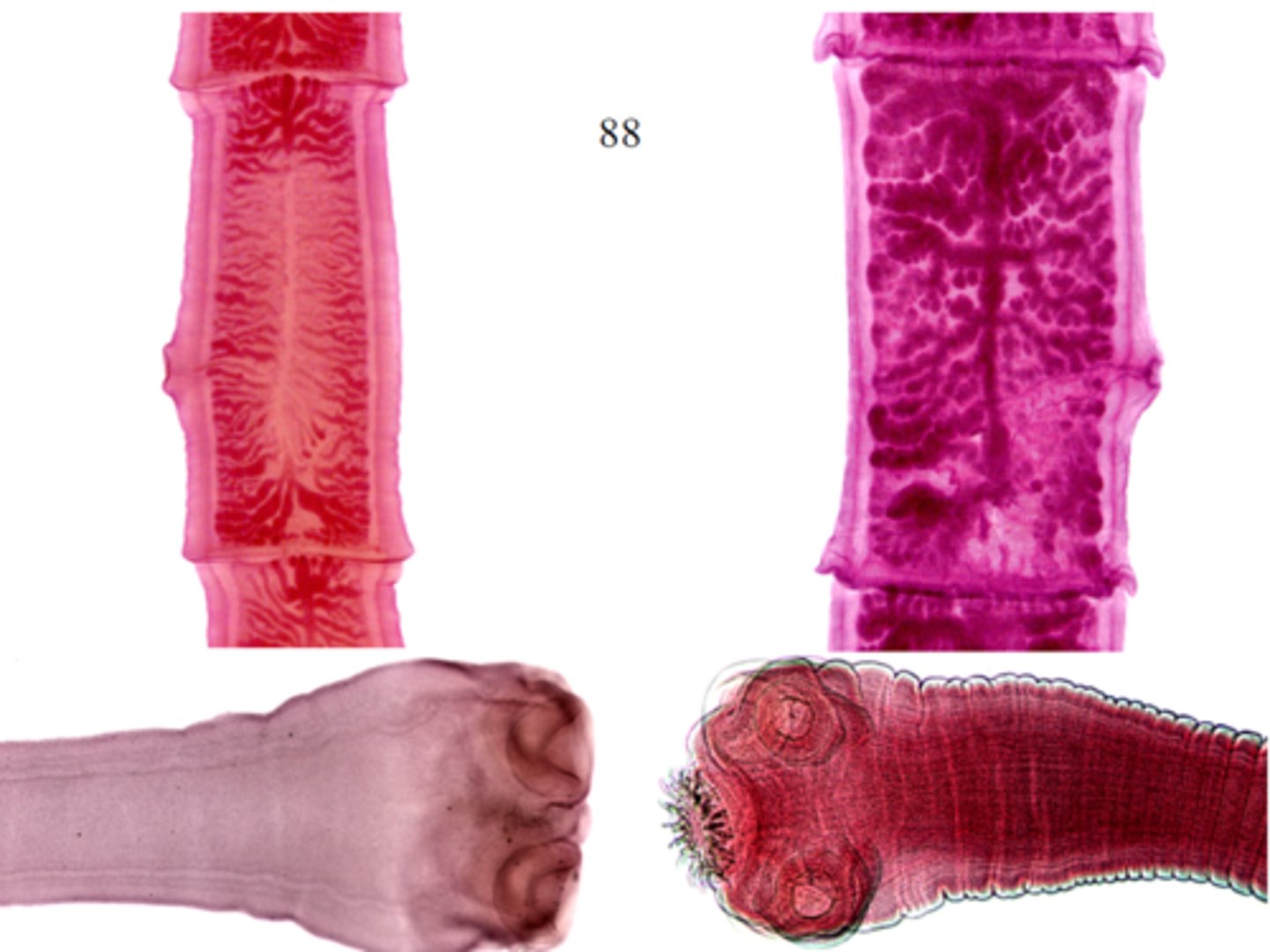
-SOL: 4 suckers, ARMED scolex meaning has hooks!!!!, LESS than 13 lateral uterine branches!!
-sag looses its hooks!
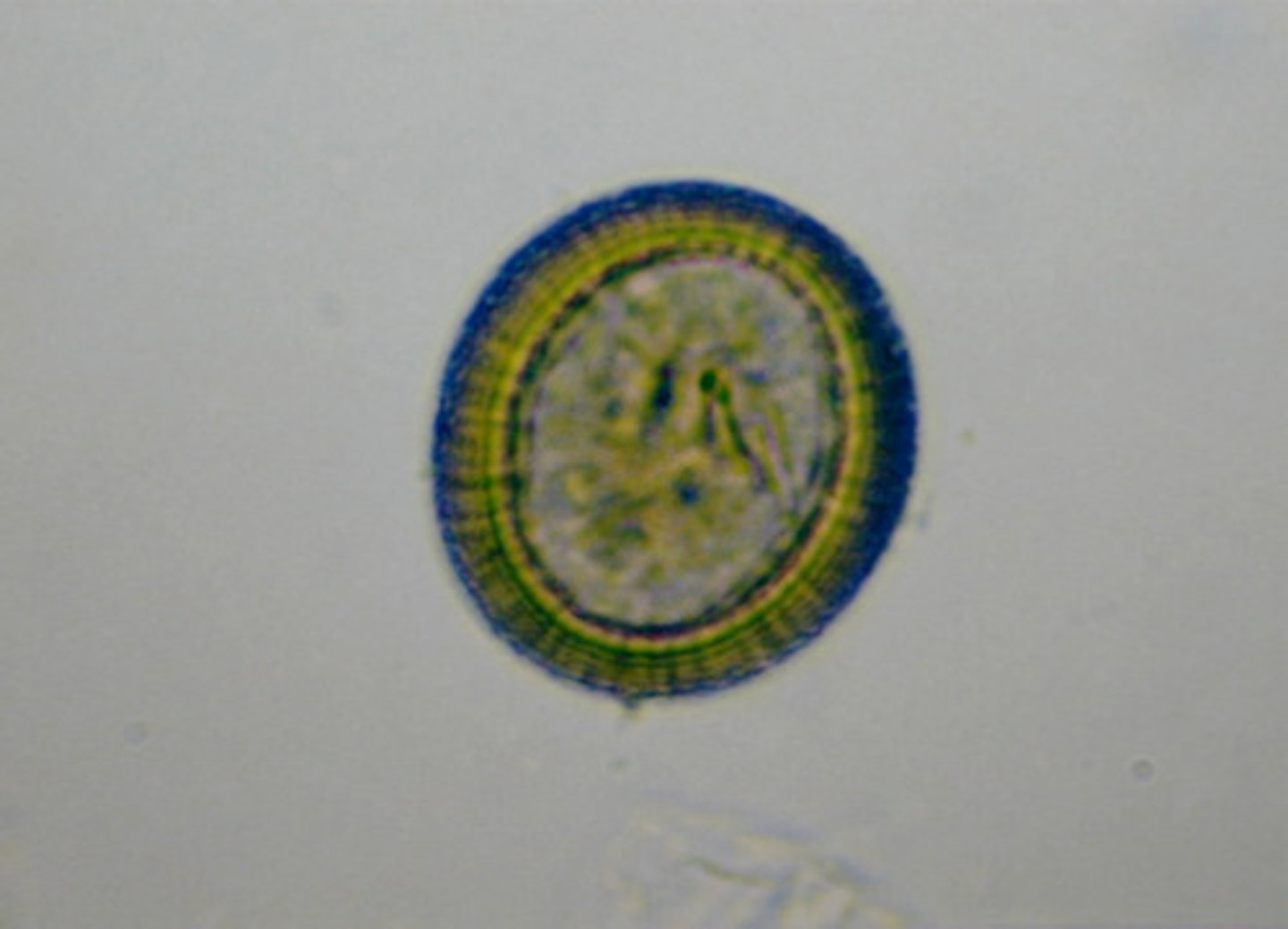
-eggs are identical!!!
-you can differentiate proglottids by INDIA INK
*inject into lateral genital pore
*count # of primary lateral uterine branches on 1 side of the uterine stem (<13 here)
-if you eat infected meat with larvae, you'll get adult tapeworm in gut
-if you eat the eggs you'll get the larvae which creates cysticercosis
SUM:
-taeniasis and cysticercosis
-pork tapeworm (under cooked pork)
EAT INFECTED MEAT: get taeniasis
EAT EGGS: get cysticercosis
TAENIA SAGINATA
-common name
-disease condition and clinical features
-general life cycle
-morphology of egg
-morphology of WORM (scolexes/proglottids)
-beef tapeworm (raw or undercooked beef)
-the adult worm is what we see in small intestine
-rare in the US
-mostly asymptomatic (abdominal pain, discomfort, diarrhea, nausea)
-sometimes the proglottids can obstruct the appendix or ducts in the body
-you can sometimes see the proglottids on the stool surface, underwear or bed sheets
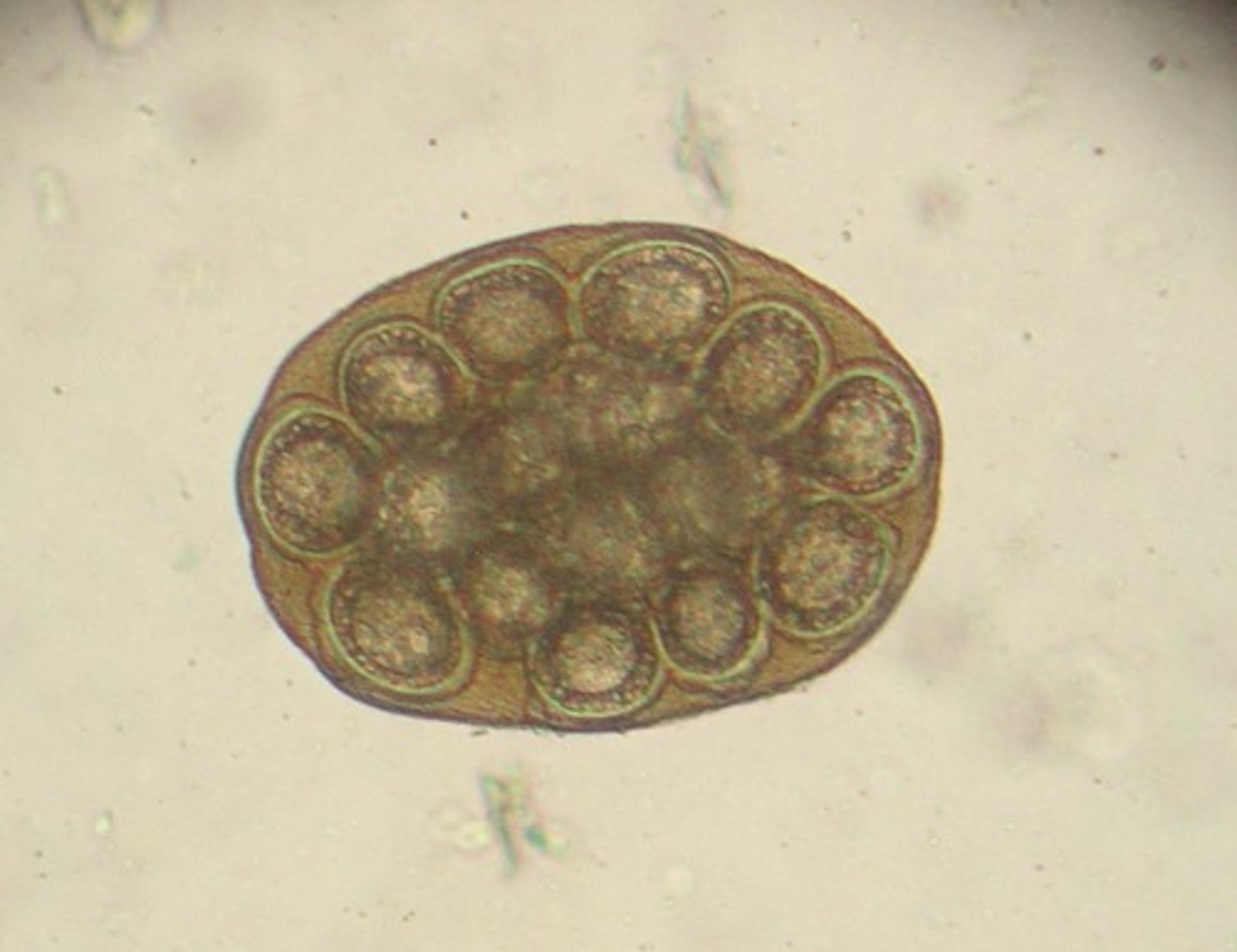
solium and saginata look the EXACT SAME By egg (these also look lik echinecoccus eggs but humans wouldn't pass those cause we only get the larvae form which is hydatid cysts)
-SAG: 4 suckers, UNARMED rostellum, MORE than 13 lateral uterine branches!!
-loooses its hooks so just 4 suckers
SUM:
-only adult form: taeniasis
-beef tapeworm
-ingestion of raw beef
-adult worm in small intestine
Cysticercosis
-tissue infection (CNS, muscles, eyes)
-varied symptoms but LUMPS UNDER SKIN, confusion, blurry vision
-look for larvae in the nodule or do serum/CSF immunoassay
-only by T.solium
DIPHYLLOBOTHRIUM LATUM
-common name
-disease condition and clinical features
-general life cycle
-morphology of egg
-morphology of WORM (scolexes/proglottids)
-broad fish tapeworm
-LONGEST human tapeworm (up to 50 feet)
-proglottids are broader than longer aka the name
-undercooked fish!
-mature proglottide has a dark rosette in the center which represents the egg-filled uterus (called 'rosette uterus')
-elongated, spoon shaped scolex(head)
-two sucking grooves
-no suckers like Taenia
-NO HOOKLETS!
-causes epigastric pain, cramping, vomiting, weight loss, and obstruction
-can take up 80-100% of the B12 leading to megaloblastic anemia which can have neurological manifestations like numbess and loss of vibration sense
*CAUSES DIPHYLLOBOTHRIASIS
size 60 um
-look for eggs in feces or proglottids and their eggs
-there is a cap (operculum) on the top of the egg which opens to release coracidia in the water! which means on the other side is the abopercular knob like the button to open the submarine hatch
-spoon shaped scolex, has operculum and abopercular knob (submarine opening opened by the button or abo)
-operculum are indentations in the cell wall and the abo is the knob at one end
-inactivated by freezing at -10 for 24 hours!!!! common in sushi but usually dead!
-fish tapeworm
-raw fish
-B12 deficiency
DIPHYLIDIUM CANINUM
-common name
-disease condition and clinical features
-general life cycle
-morphology of egg
-morphology of WORM (scolexes/proglottids)
-double-pored dog tapeworm
-infects dogs but comes in humans from eating flea
-mostly asymptomatic
-can see proglottids in feces, diapers (mainly children) and can be motile
*look like a rice grain or cucumber seed)
-look for egg packets in proglottid or stool
Hymenolepiasis
-caused by H. nana or H. diminuta (not really in humans tho)
HYMENOLEPIS NANA
-common name
-disease condition and clinical features
-general life cycle
-morphology of egg
-morphology of WORM (scolexes/proglottids)
-dwarf tapeworm
-frequent in humans (most common cestode infection)
-mostly asymptomatic
-look for eggs in stool
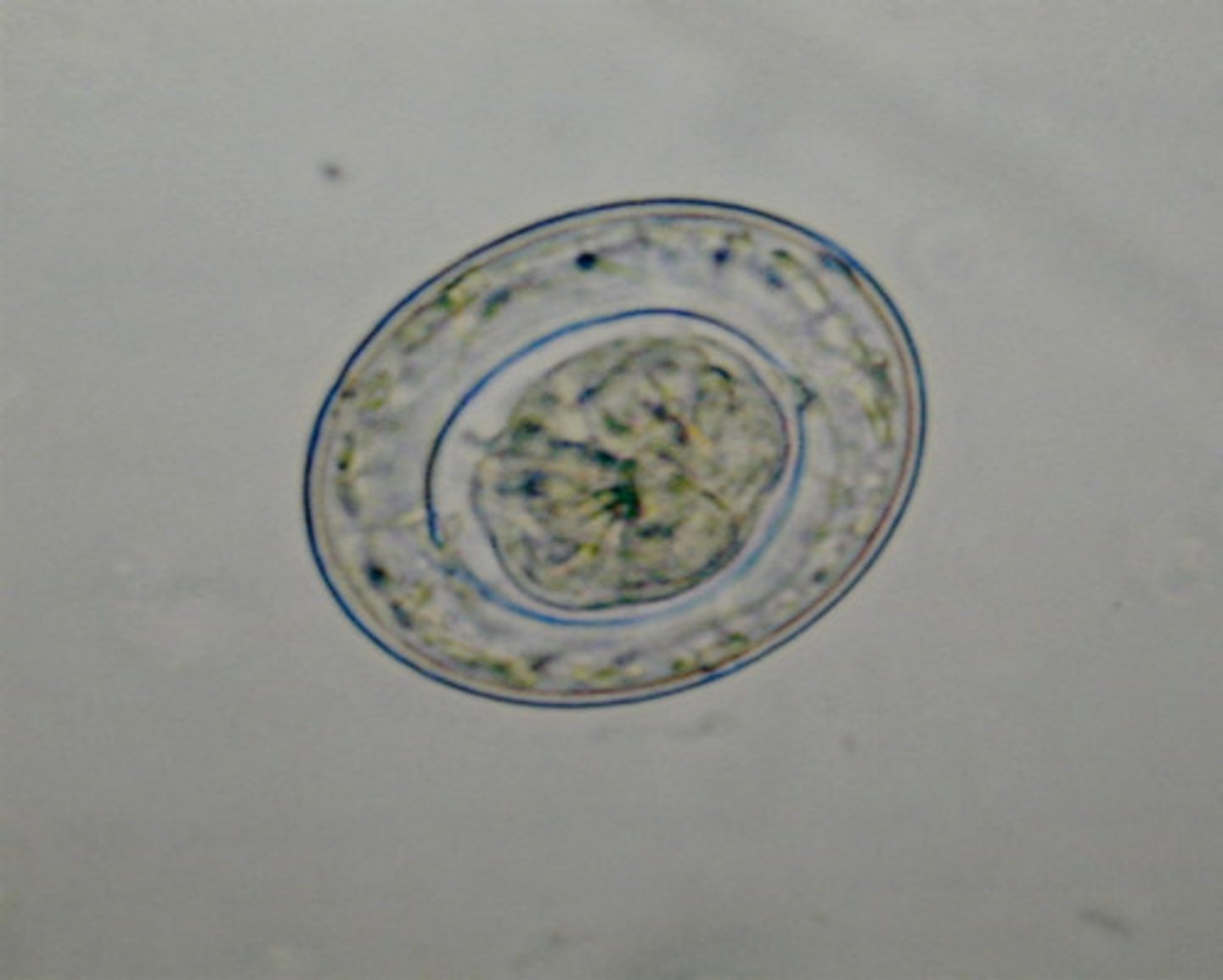
-the eggs have polar filaments
Hymenolepis diminuta (rat tapeworm not common in humans)
ECHINOCOCCUS spp.
-common name
-disease condition and clinical features
-general life cycle
-morphology of egg
-morphology of WORM (scolexes/proglottids)
-E. granulosus: cystic hydatid disease (sheep/dog intermediate host)
-E. multilocularis: alveolar hydatid disease (rat intermediate host)
-neither really seen in humans
-has protoscolex (immature scolex) meaning immature heads that are all like in one big sac!!!
-PASTORAL INFECTION: dog eat sheep
-SYLVATIC INFECTION: wolves vs coyotes
GRANULOSUS: cystic
-slowing enlarging cysts usually to the liver
-what we saw iin the video
MULTILOCULARIS: alveolar
-rapid growing, destructive
-usually in the liver but can go to lungs
EGG: protoscoleces with hooklets
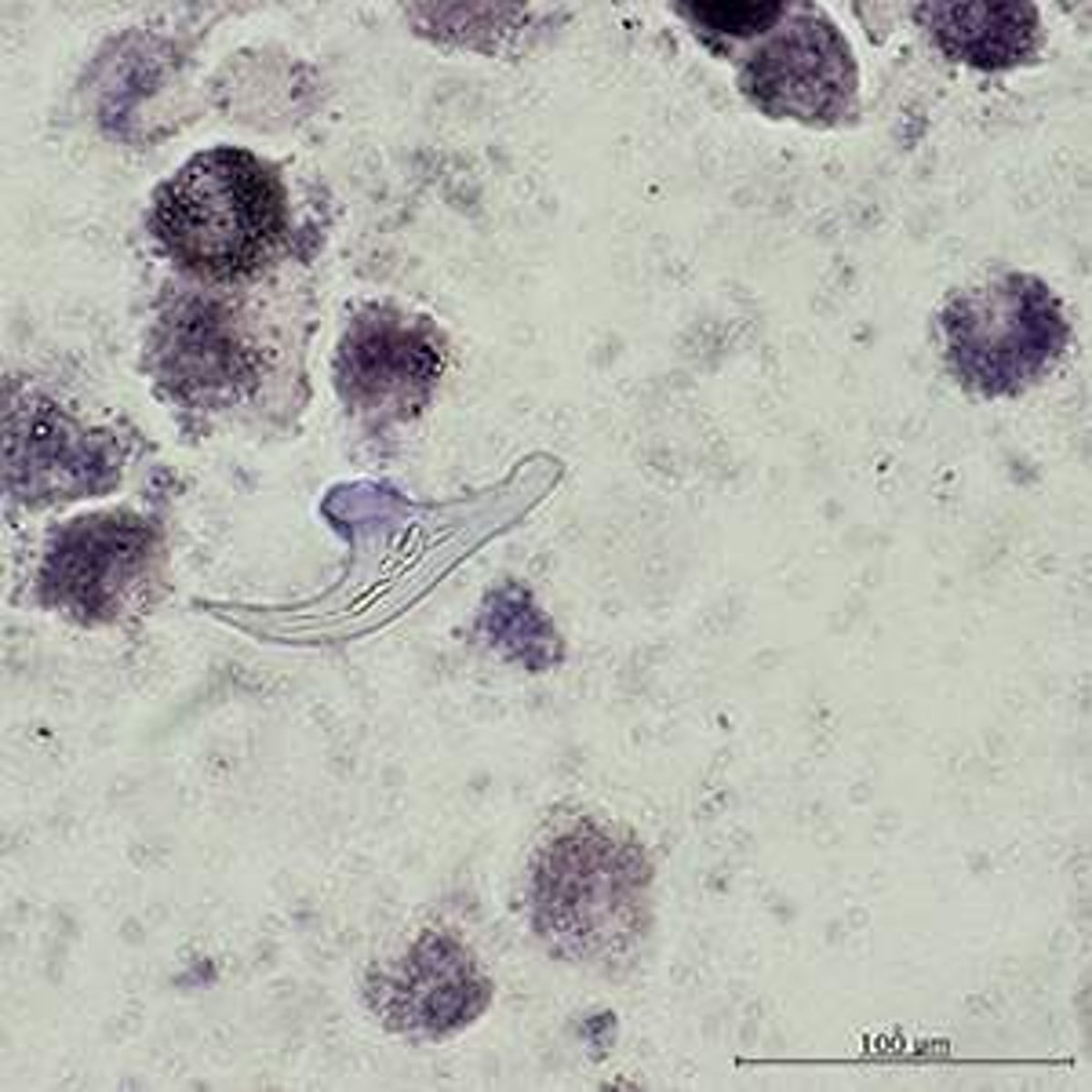
-can see free hooklets/shark teeth
-PROTOSCOLICES!!!
a. Which tapeworm has proglottids that are broader than they are long?
b. Which tapeworm head has an armed rostellum?
c. Which tapeworm head has two long sucking grooves?
d. Which tapeworm has a centrally located rosette shaped uterine structure in the proglottid?
Identify the morphologic characteristics of a hydatid cyst.
-echinecoccus eggs look just like taenia soliium/saginata but only the larvae form would be seen in humans for echinecoccus which is called the cysts (hydatid cysts)
-all of the cestodes except 2, live in the intestines and cause disease
**the two exceptions are cysticercosis and echinococcosis
-D. latum causes megaloblastic anemia due to vitamin B-12 deficiency
· Which cestode(s) can humans serve as either a definitive host or intermediate host?
· Describe how humans become infected and develop cysticercosis.
· Describe how humans become infected and develop echinococcosis.
· Humans become infected with the dog tapeworm by accidental ingestion of an infected arthropod (e.g. flea)
THURSDAY: Starting Trematodes Lecture
· Schistosoma spp.
· Clonorchis sinensis
· Fasciola hepatica
· Fasciolopsis buski
· Paraganimus spp.
trematodes are the flukes!
•Blood flukes
•Schistosoma spp.
•Liver flukes
•Clonorchis sinensis
•Fasciola hepatica
•Intestinal fluke
•Fasciolopsis buski
•Lung fluke
•Paragonimus westermani
-bilaterally symmetrical
-flat, leaf-like adults
-all hermaphro except schistosomes
-asexual in snails --> THEY ALL COME FROM SNAILS!!!
-we are the definitive host!!! and the snail is the intermediate
SCHISTOSOMA spp
-general characteristics
-common name
-disease and clinical features
-key life cycle
-egg form
-blood flukes
-get more by skin penetration!!!! in the water!
-hepatic: mansoni and japonicum
-urinary: haematobium --> BLADDER CANCER 2/2 that can cause cancer!
-early stage: hypersensitivity leading to pruritic rash
-penentration of the skin and it goes to the liver and causes fever and headache
-SWIMMERS ITCH: schistosome cercarial dermatitis
-chronic: granulomatous and fibrotic reactions to the eggs obstructing blood floow and severe tissue damage
HAEM:
-bladder mucosa, hematuria, bladder carcinoma, renal failure
-EGG SPIKE IS AT THE BOTTOM
MANSONI:
-bowel mucosa ulcerated
-eggs cause hepatosplenomegaly
-NO EGG SPIKE: ROUND EGG! for japonicum
-EGG SPIKE IS TO ONE SIDE: mansoni = murder
-skin penetration!!
CLONORCHIS SINENSIS
-general characteristics
-common name
-disease and clinical features
-key life cycle
-egg form
-oriental or chinese liver fluke
-mostly asymptomatic but if burden high can cause CHOLANGITIS or CHOLANGIOCARCINOMA! or diarrhea
-get from fish ingestion
-adult likes our BILE DUCTS! leads to those 2 things above
-1/2 of the liver flukes!!!! this one goes through the bile duct though so leads to those 2 things above
-still see in stool
-smallest egg that we see only 30 um long!!!
-has opercular and abopercular knob!!
-1/2 that causes cancer!!!!!!!!!!
-30um
FASCIOLA HEPATICA
-general characteristics
-common name
-disease and clinical features
-key life cycle
-egg form
-zoonosis of sheep/cattle
-acute disease bc it's in the liver leads to hepatomegaly, fever
-chronic disease goes to bile duct leading to jaundice
-HIGH EOSINOPHILS (all worms tho idk)
-ingestion of water plant containing metacercariae
-adult in liver and bile duct
-liver scarring and inflammation
-liver fluke 2/2
-sheep and cattle!!
-ingestion of water plant!!!
-cercariae form free flowing in water!!!
-causes more damage than the other liver fluke
-causes inflammation and scarring
FASCIOLOPSIS BUSKI
-general characteristics
-common name
-disease and clinical features
-key life cycle
-egg form
-intestinal fluke
-live in small intestine
-symptoms are according to how many are present but sometimes asymptomatic or can lead to diarrhea and stunted growth
-they have an OPERCULUM!!!!
-ingestion of water plant with metacercariae
-eggs in stool dx
-water chestnuts and other plants!!!
-largest egg at 4-7cm long of 120-150 um
-BOWEL!!!!! smalll intestine!!!
-water plant!!!!!!!
PARAGANIMUS spp.
-general characteristics
-common name
-disease and clinical features
-key life cycle
-egg form
-westermani: the lung fluke
-coffee bean shaped worm?
-has a 2nd intermediate host: the snail and the CRAB
-drunked crabs eating
-cough, hemoptysis (coughing up blood)
-ectopic CNS involvement (seizures, meningitis)
-this has no abopercular knob but just a thickening!
-CRAB, lung mass, cough of blood and eggs since it goes to the lung
-from the crab!!
-lung fluke!!
-can cause bloody cough
-shouldered but no abopercular knob (just thickening)
90um egg
Summary
•Pork
•Trichinella spiralis
•Taenia solium
•Fish and seafood
•Anisakis/Pseudoterranova
•Diphyllobothrium latum
•Clonorchis sinensis
•Paragonimus westermani
•Beef
•Taenia saginata
o Which one is associated with cancer of the bile duct?
o ….bladder cancer?
· Which fluke causes swimmers itch?
· Fasciolopsis buski – large intestinal fluke
· Fasciola hepatica – sheep liver fluke
SIZE IS SUPER IMPORTANT. SLIDE 41 ISH HAS A GOOD SIZE COMPARISON. NOTE THESE DOWN FOR PRACTICAL AND EVEN EXAM!
BOTH OF HTESE ARE 120 um and pretty identical!!!!!
· Identify the intermediate host that is common to all of the trematodes.
· Explain where the asexual stage of the trematode life cycle takes place.
· Describe how humans become infected with a trematode.
· Name the 2nd intermediate host(s) of the various trematode life cycles.
· Reseacrh and identify the 3 parasites that infect humans via skin penetration (schistosomes, hookworms, strongyloides)
· Investigate which metacercariae excyst in the duodenum and then migrate into the lungs and mature into adults and lay eggs that are coughed up into the sputum and/or swallowed and excreted in feces?
· Investigate which trematodes live in the mesenteric venules around the bladder? ...and the intestinal tract?
-snail!
-we are the definitive host so sexual!!
-mostly water contamination some skin penetration!
-snails and sometimes plants are intermediate hosts
-SKIN PENETRATION: hookworms, strongyloides, schistosomes
-paragonimus!!!
-bladder: schistoma haem
-intestinal gtract: fasciolopsis buski
Name all the parasites that have operculated eggs.
•Clonorchis sinensis 30 µm
•Diphyllobothrium latum 60 µm
•Paragonimus westermanni 90 µm
Fasciola/Fasciolopsis 120 um
Identify which trematode has a "shouldered" operculum?
C. sinensis
P. westermani
Explain the purpose of the operculum
it's where the larvae leaves when mature from the egg!
Identify the Schistosoma species based on the location of the spine:
· Rudimentary - jap
· Terminal - other!
· Lateral - man
Investigate which of the trematodes is not hermaphroditic?
schistosomes!
 Note
Note  Flashcards (113)