Cardio vascular system
 Studied by 1 person
 Call Kai
 Learn
Learn Practice Test
 Spaced Repetition
 Match
Match Flashcards
 Knowt Play
1/75

There's no tags or description
Looks like no tags are added yet.
Name | Mastery | Learn | Test | Matching | Spaced | Call with Kai |
|---|
No analytics yet
Send a link to your students to track their progress
76 Terms
Pulmonary circuit
Carries deoxygenated blood to the lungs and oxygenated blood back to the heart
Systematic circuit
Carried oxygenated blood to the body and deoxygenated blood back to the heart
Oxygenated blood
Blood rich in oxygen and poor in carbon dioxide
Deoxygenated blood
Blood poor in oxygen and rich in carbon dioxide
Conduction system
Five structures that pass electrical impulses through the cardiac muscle in a coordinated fashion
Myogenic
Generates its own electrical impulses
Diastole
Relaxation phase of the heart
Systole
Contraction phase of the heart
ECG meaning
Electrocardiogram
What is ECG for
Monitoring heart rate and Checking heart defects
Bradycardia
Resting heart rate under 60bpm
Stroke volume
Volume of blood ejected from heart in one beat
Venous return
Amount of blood returning to atria
Heart rate
Amount of beats per minute
Calculation to find a persons HR max
220-age
Cardiac output
amount of blood pumped out of the heart per minute
The conduction system sequence
SA node
AV node
Bundle of His
Bundle branches
Purkyne fibres
SA node
Internal pacemaker that generates electrical impulses
AV node
Collects and delays cardiac impulse to allow atrial systole
Bundle of His
In the septum and it Feeds impulse from atria to the ventricles
Bundle branches
Splits impulse into the base of each ventricle
Rest Stroke volume for athletes
100ml
Stroke volume =
Stole volume = end diastolic volume - end systolic volume
Rest SV untrained
70ml
SV sub max untrained
100-120ml
SV max untrained
100-120ml
Resting Heart rate for athletes is
50bpm
SV submax athlete
160-200ml
SV max athlete
160-200
Rest HR untrained
70-72bpm
HR submax untrained
100-130bpm
HR submax athlete
95-120
HR max untrained
220-age
HR max athlete
220-age
Untrained rest CO (Q)
5 L/min
Untrained submax CO
10-15 L/min
Untrained max CO
20-30 L/min
Trained resting CO
5 L/min
Trained sub max CO
15-20 L/min
Trained max CO
30-40 L/min
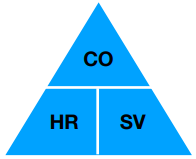
Cardiac output =
Q=SVxHR
CO and SV plateau at higher intensities because
Of the heart rate limiting factor which limits the amount of filling rate
Starlings law
An increased venous return will increase the stoke volume due to greater stretch on the ventricle walls and a harder contraction
Calculation triangle
Couch potato
Sedentary individual
HR response to exercise
Rise bc of adrenaline
Rapid increase to pump oxygenated blood to muscles
plateau because oxygen supply meets oxygen demand
Rapid decrease in recovery
Slowly decreases but remains above resting HR
HR controlled by
Autonomic nervous system
ANS parts
Sympathetic increases HR by accelerator nerve
Parasympathetic decreases HR by vagus nerve
Where is cardiac control centre located
Medulla oblongata
Neural receptors
Chemoreceptors
Propioreceptors
Baroreceptors
Chemoreceptors
Detect changes in chemicals
pH
O2
CO2
Propioreceptors
Detect movement
Baroreceptors
Detect blood pressure in aorta
Intrinsic
Temperature
Venous return
Temperature effect on HR
Increase in temp increases blood viscosity and speed of nerve impulses which increases HR
Increase venous return on heart rate
Increases HR because increased stretch on ventricles increases stroke volume
Hormonal mechanism
adrenaline
Adrenaline
Increases ventricle contraction force and increases speed of nerve impulses which increases HR
Venous return mechanisms
Gravity
Pocket valves
Skeletal muscle pump
Respiratory pump
Smooth muscle in veins
Pocket valves
Only allow blood flow one way to prevent black flow through veins
Skeletal muscle pump
Squeezes veins and forces blood back to Heart
Smooth muscle in veins
Squeezes veins and pumps blood through them and encourages blood flow
Blood pooling
When blood accumulates in the extremities muscles will squeeze the vein to force the blood out
Result of blood pooling immediately after exercise
Fainting or light headed
How does an active cooldown reduce blood pooling
Maintains venous return by keeping skeletal muscle pump and respiratory pump working and active
How does increased venous return affect performance in sport
Maintains or increases sport performance
What controls VSM
Sympathetic nervous system
Which two receptors give feedback on whether blood flow should be altered
Chemoreceptors
Baroreceptors
What part of the medulla oblongata is responsible for the VSM
the vasomotor control centre (VCC)
VSM meaning
Vascular shunt mechanism
What is the vascular shunt mechanism
Controls the redistribution of blood flow from one area of the body to another
What is controlled sympathetically to make the vascular shunt mechanism work
Arterioles
Pre-capillary sphincters
Arterioles at muscles
Open during exercise and closed during recovery
Arterioles at other organs
Closed during exercise and open during recovery
Pre-capillary sphincters at muscles
Open during exercise and closed during recovery
Pre-capillary sphincters at other organs
Closed during exercise and open during recovery
 Note
Note  Flashcards (63)