BSCI202: Blood Pressure and Pulse
 Call Kai
 Learn
Learn Practice Test
 Spaced Repetition
 Match
Match Flashcards
 Knowt Play
1/33

Name | Mastery | Learn | Test | Matching | Spaced | Call with Kai |
|---|
No analytics yet
Send a link to your students to track their progress
34 Terms
The cycle of contraction and relaxation of both atria and ventricles
Cardiac cycle
Contraction of the atria (atrial systole) or the ventricles (ventricular systole)
Systole
Relaxation of the atria (atrial diastole) or the ventricle (ventricular diastole)
Diastole
Blood delivered into atria via veins; 80% of blood flows passively into the ventricles (also in diastole)
Atrial diastole
Last 20% of blood left in atria delivered to the ventricles by atrial systole
Atrial systole
What begins shortly after atrial systole or when ventricular contraction begins?
Pressure rises
Cycle repeats
Ventricular diastole
1st heart sound; closure of the AV valves
Lub
2nd heart sound; closure of the SL valves
Dub
An abnormal heart sound; indicates a defect in one of the valves
Heart murmur
Surges of pressure in arteries (as heart pushes blood out during the cardiac cycle); equivalent to the heart rate
Pulse
Number of beats per minute (bpm)
Heart rate
Normal range for resting heart rate
60-100 bpm
Average resting heart rate
70-76 bpm
How long does the average heart beat lasts?
0.8 seconds
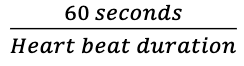
This formula determines what?
Heart Rate
Pressure exerted against walls of the arteries
Blood pressure
Pressure exerted against the walls of the arteries during ventricular systole
Systolic blood pressure (SBP)
Pressure exerted against the arterial wall during ventricular diastole
Diastolic blood pressure (DBP)
Blood pressure is measured using a what?
Sphygmonanometer
What is the unit used in blood pressure?
mmHg
What is the normal blood pressure?
120/80
What is 120 in 120/80 mmHg?
Systolic blood pressure (SBP)
What is 80 in 120/80 mmHg?
Diastolic blood pressure (DBP)
The first sound heard in the stethoscope (crackling or knocking sound) when taking blood pressure; indicates the systolic pressure
Sounds of Korotkoff
The amount of force exerted on circulating blood by the vasculature
Total peripheral resistance (TPR)
The amount of blood pumped by the left ventricle during the contraction
Stroke volume (SV)
Average SV
70mL
The amount of blood pumped by the heart in one minute
Cardiac output (CO)
How to calculate cardiac output?
SV x HR
How to calculate for blood pressure?
CO x TPR
The difference between systolic and diastolic blood pressure (SBP - DBP)
Pulse pressure
The average pressure in a patient’s arteries during one cardiac cycle; represents the force generated by the heart during contraction; considered a better indicator of perfusion to vital organs than SBP
Mean arterial pressure (MAP)
How to calculate MAP?
DBP + pulse pressure/3

