Exam 3 Self-Care
 Call Kai
 Learn
Learn Practice Test
 Spaced Repetition
 Match
Match Flashcards
 Knowt Play
1/53

There's no tags or description
Looks like no tags are added yet.
Name | Mastery | Learn | Test | Matching | Spaced | Call with Kai |
|---|
No analytics yet
Send a link to your students to track their progress
54 Terms
Accuracy: _________, how close to the _________ (test vs _________, test vs _________ of disease)
Precision: _________, how close each reading is _________, _________ or _________
validity, actual value, gold standard, presence/absence, reliability, to the next, repeatability, reproducibility
True Positive (TP): tests are _________ (_________ accurate and/or precise)
True Negative (TN): tests are _________ (_________ accurate and/or precise)
False Positive (FP): tests are _________ (_________ accurate and/or precise)
False Negative (FN): tests are _________ (_________ accurate and/or precise)
always correct, is, always correct, is, subject to error, is not, subject to error, is not
Sensitivity: (Number of people _________ disease that test _________) / (Total number of people _________ disease)
Formula: _________
Specificity: (Number of people _________ disease that test _________) / (Total number of people _________ disease)
Formula: _________
with, positive, with, TP / (TP + FN), without, negative, without, TN / (TN + FP)
Positive Prediction Value (PPV): Number of people _________ disease that test _________ / Total number of people that test _________
Formula: _________
Negative Prediction Value (NPV): Number of people _________ disease that test _________ / Total number of people that test _________
Formula: _________
with, positive, positive, TP / (TP + FP), without, negative, negative, TN / (TN + FN)
250 people in a population of 1000 have a particular disease. A test can correctly find 200 of the 250 affected people. This same test also identifies 100 of the healthy people as having the disease. Find the sensitivity, specificity, PPV, and NPV of this test.
Positive w/condition → _________
Negative w/condition → _________
Positive w/o condition → _________
Negative w/o condition → _________
Test’s Sensitivity = _________
Test’s Specificity = _________
PPV = _________
NPV = _________
200, 50, 100, 650, 80.0%, 86.7%, 66.7%, 92.9%
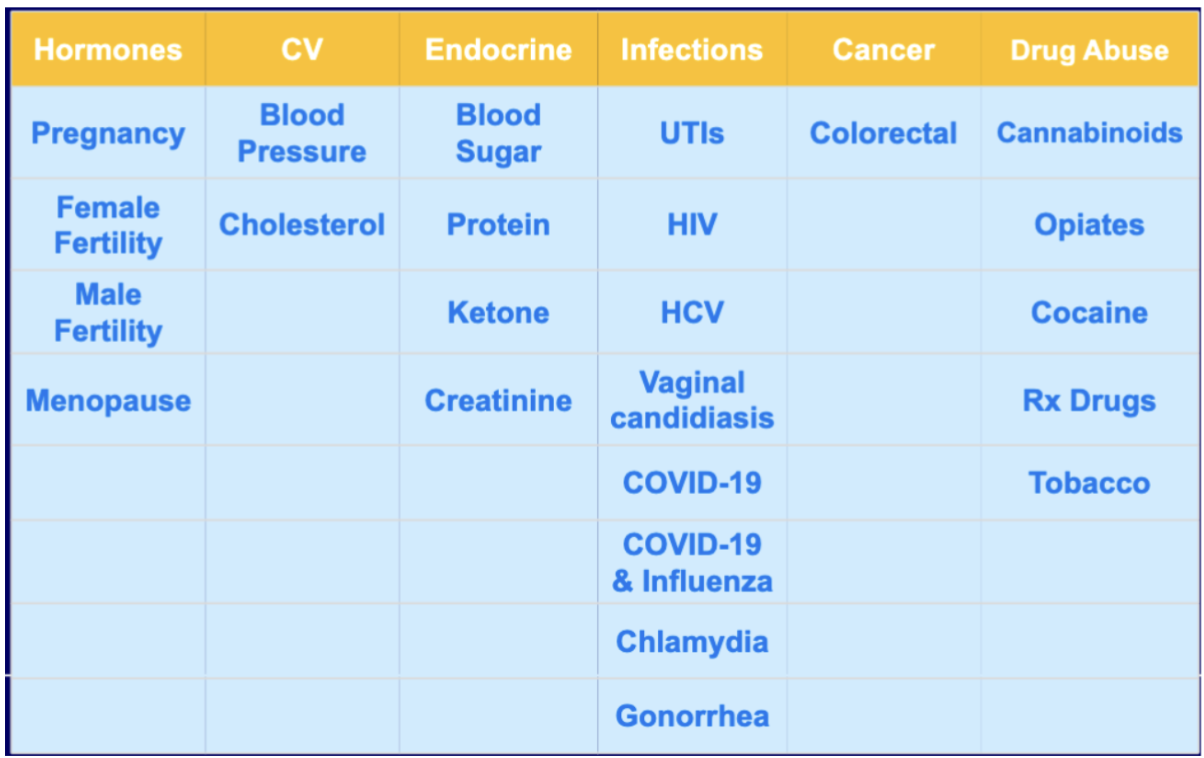
Pregnancy Detection Kits
Detects _________ (hCG) in the _________
Hormone produced by placenta _________ fertilization of ovum
Generally detectable in urine _________ weeks after conception
hCG _________ in concentration during pregnancy
Max levels at ~__ weeks post-conception
Presence of hCG in _________ is diagnostic for pregnancy
Pregnancy cannot be detected _________ implantation/fertilization
Several tests allow for testing before missed period
human chorionic gonadotropic hormone, urine, after, 1-2, increases, 6, urine, before
Urinary Ovulation Tests
Goal: determine _________ ovulation will occur to _________ time sexual intercourse
Ovulation occurs ~_________ hours _________ surge
To maximize the chance of pregnancy, intercourse should occur within __ hours
when, better, 24-48, after, 24
Detection of Fertility
Testing start determined by patient’s _________
Use average cycle length over past __ cycles
If 3–4 day variation in cycle, use _________ cycle length
Women should begin testing _________ days prior to their expected ovulation date (~mid-cycle)
cycle length, 3, shortest, 2-4
Basal Thermometer
Utilizes a thermometer designed to measure _________
A _________ in temperature signals that ovulation has occurred (ranges from __°F to __°F)
Ex. Digital Thermometer
Can deliver results in _________
Some monitor a _________ of temperature readings
May require _________
Ex. Digital Sensors
Can store _________
Predict cycle _________ and _________ by memory
Types: _________, _________, _________, _________
basal temperature, rise, 0.4, 1, under a minute, multitude, calibration, cycle information, duration, ovulation, skin patch, armband, wristband, ring
Fecal Occult Blood Tests (FOBT)
FOBT identify hidden _________ in _________
Main use: help to screen for _________ (CRC)
_________ years of age
Positive _________
_________
_________
_________ (_________ fiber, _________ fat)
FOBT can also detect the presence of various _________
Active _________
_________
Anal _________
_________
_________ of medications
Guaiac-based
Toilet tests (analyzes toilet tank water for the presence of blood)
Ensure it’s free of _________, _________
Flush toilet _________ prior to testing
Surface _________
_________ GI bleeds
Fecal immunochemical-based
_________ antibody test (human hemoglobin)
“_________” blood
_________ bleeds
blood, stool, colorectal cancer, 45-75, family history, intestinal polyps, IBD, diet, low, high, GI disorders, ulcers, Crohn’s Disease, fissures, hemorrhoids, overuse, cleansers, deodorizers, twice, bleeding, lower, stool wipe, matrix, upper GI
HIV Home Test
Determines if HIV is present in the _________
Detects HIV _________ (_________) or _________ (_________)
May take between _________ to _________ for AB development
At-home tests (_________)
Detects HIV-1/2 AB’s
Sensitivity ___%
Specificity ___%
Results available _________
Swab upper and lower _________ once
After collection, place in test tube, mixed with reagent
Results available in __ minutes (invalid after __ min)
Mail-in tests (_________)
Detects HIV-1/2 ABs ± (_________)
_________ antigen
Accuracy ≥ ___%
Register product with company
Perform _________ in usual manner
Mailed to testing facility after collection
Results available in _________ days
blood, antibodies, AB, antigens, P24, 3 weeks, 6 months, saliva, 92, 99.98, in-home, gums, 20, 40, blood, more or less, P24, 99, fingerstick, 2-7
KNOW IMAGE
Pregnancy Detection Kits
If testing on the _________ of missed period
Accuracy is generally ~90%
If testing _________ after a missed period
Accuracy is generally ~97%
Majority of home pregnancy tests are advertised as being “99% _________”
Individual methods of testing may _________ accuracy
first day, one week, accurate, reduce
Urinary Ovulation Tests
Most kits detect a surge in _________ (_________)
Hormone secreted by _________
Helps _________ develop and mature
Some kits also detect _________ (E3G)
Rises and falls similar to _________ pattern
luteinizing hormone, LH, anterior pituitary gland, ovarian follicles, estrone-3-glucuronide, LH
Detection of Fertility
LH surge shown through change in _________ or _________, _________ (smiley face)
Positive result means ovulation should begin in _________ days
5 and 10-day kits are available with _________ monitoring showing _________ predictability:
5-day kit: __% predictability
10-day kit: __% predictability
Positive test: Result line is _________ color or _________ than control
Negative test: Baseline _________ in urine; will not show positive result until ~__ to __ mIU are detected
Digital test sets LH reference range
Surpassing reference range generates _________ result
Some tests a smiley face indicates a _________ result
color, color intensity, indicator, 1-2, longer, greater, 80, 95, same, darker, LH, 25, 40, positive, positive
Basal Thermometer
Temperature may be taken _________, _________, or _________; use same location for _________
Temperature must be taken each _________
Women should have intercourse _________ after temperature increase is noted
orally, rectally, vaginally, accuracy, morning before arising from bed, as soon as possible
Fecal Occult Blood Tests (FOBT)
_________-based
Test toilet water _________ to testing stool sample
Place test pad in water and observe for _________ coloring
Use another toilet if color change occurs
Place test pad in toilet bowel _________ bowel movement
Appearance of _________ color after __ min is a positive result
Repeat the test for the next __ bowel movements
If all results are negative, perform QA check of test pads using chemical package
_________-based
Retain small amount of stool on toilet paper _________ bowel movement
Collect stool sample using wand from collection tube and screw back in place, shake
Apply 3 drops from collection tube into testing well, read results in __ minutes
A red line at “__” indicates the test is _________, a red line at “__” indicates a _________ test result
Immunochemical tests have no _________ constraints
Immunochemical tests have higher _________ 0.42–0.94 vs. 0.13–1 with Guaiac-based, with comparable _________ 0.4–1 vs. 0.69–0.99 with Guaiac-based
Immunochemical tests are more _________ for malignant neoplasia than benign neoplasia, and overall have a higher _________ for advanced malignant neoplasia
Despite superiority of immunochemical tests, guaiac tests are still _________ due to _________ morbidity from CRC
Guaiac, prior, blue, after, blue/green, 2, 2, fecal immunochemical, after, 5, C, functioning properly, T, positive, food/supplement, sensitivity, specificity, sensitive, sensitivity, recommended, reduced
HIV Home Test
__ general home testing kits are available
HIV blood tests
Some combine with _________ testing
Positive samples _________ and _________
Results reviewed and/or patient consulted by _________
Results available on secure online platform
Treatment options may also be provided
Risk factors for HIV
_________ who have sex with _________ (_________)
_________ sex with _________ individuals
Greater than __ sexual partner since _________ HIV test
Sharing _________ for injection drug use
Exchanging sex for _________
Having been diagnosed or treated for _________, _________, and/or _________
Having sex with persons who match the criteria above or persons who have an undisclosed sexual past
Consider _________ since _________ infection
Consider retesting if initial test is _________
2, STI, re-screened, confirmed, medical expert, Men, Men, MSM, anal/vaginal, HIV infected, 1, last, syringes/needles, drugs/money, sexually transmitted diseases, hepatitis, tuberculosis, time, possible, negative
Pregnancy Detection Kits
False Positive:
Previous _________ within __ weeks
_________ interval within __ weeks
Use of _________ medications
False Test:
_________ testing/_________ hCG
_________ hCG produced: _________, _________ pregnancies (~500,000 mIU/mL)
miscarriage, 8, postpartum, 8, fertility, early, low, excess, cancers, multi-embryo
Detection of Fertility
False Positives
_________ medications
_________
_________
Polycystic ovarian syndrome (_________)
Past _________ (< _ months)
False Negatives
_________ too _________ to detect
Testing too _________ or too _________ in cycle
Naturally _________ surge
Fertility, oral contraceptives, perimenopause, PCOS, pregnancy, 2, LH concentration, low, early, late, short LH
Basal Thermometry
Measuring basal temperature is a simple method of detecting _________
Recording and interpreting results may be _________
Changes in _________ may occur due to many factors (EMFI)
_________
_________
_________
_________
Eating, drinking, talking, etc should be _________ until after measurement is taken
ovulation, difficult, temperature, emotions, movement, fever, infections, delayed
Fecal Occult Blood Tests (FOBT) for CRC
False Positives
Other medical conditions associated with _________
_________, _________, _________
Consumption of (_________ tests only):
_________ vegetables
Foods with high levels of _________
_________
Vitamin __, __
Using _________ (_________ tests only)
False Negatives
No _________ present
bleed risk, NSAIDs, aspirin, corticosteroids, guaiac, green, peroxidase, red meat, C, Fe, toilet bowl cleaners, guaiac, active bleeding
HIV Home Testing
Blood tests
Laboratory _________
Insufficient amount of _________ on testing card
Insufficient levels of _________ and/or _________ present
_________ since _________
_________
Saliva Tests
Swabbing top/lower gum _________
_________, _________, or using _________ (__ min before use)
Presence of _________, _________
error, blood, AB, antigen, time, infection, immunosuppression, more than 1 time, eating, drinking, oral care products, 30, dentures, retainers
Pregnancy
Consider waiting at least one week after the date of the _________ for testing
Test the _________ morning's urine or limit fluid intake _________ hours prior to testing at other times
If test is negative, test again in _________ if menstruation has not yet begun
Refer to physician if test is positive
Discontinue select medications
_________
Category D, X (B? C?)
Recommend _________ supplementation
missed period, first, 4-6, 1 week, Teratogenic, folic acid
Detection of Fertility
Collect urine sample in the _________
LH surge starts in the _________
Concentration of urine is _________
Start testing _________ days prior to expected _________
Lie testing device on flat surface and wait up to __ min before reading results
Discontinue testing once _________ is detected
AM, morning, greater, 2-4, ovulation date, 5, LH surge
Basal Thermometer
Consistently use one location for temperature taking to ensure _________
Take temperature readings at the _________ time each _________
Do not _________ while taking temperature
Do not _________, _________, or _________ for __ minutes before taking temperature
An _________ in temperature indicates that _________ has occurred
accuracy, same, morning, move, eat, drink, talk, 30, increase, ovulation
Fecal Occult Blood Tests (FOBT)
Do not test when _________
Increase _________ intake _________ days prior to testing
Perform/complete __ consecutive tests to increase _________ detection rates, even if first __ results are negative
Avoid _________, _________ for _________ days prior to testing to limit _________ from other sources
Avoid eating _________, _________ vegetables, _________ 2 to 3 days prior to testing (_________ tests)
Avoid the use of toilet bowl cleansers or deodorizers prior to testing (_________ tests)
actively bleeding, fiber, 2-3, 3, positive, 2, NSAIDs, aspirin, 2-3, bleeding, red meat, green, Iron/Vitamin C, guaiac, guaiac
HIV Home Testing
Recommend simplistic and straightforward tests
Recommend tests with a _________ to verify _________ and _________
Refer patients with _________ issues for tests that require a _________ sample
Ensure proper _________ for _________ tests, if ocular disability ask someone else to read test
control, functioning, accuracy, clotting, blood, lighting, color changing
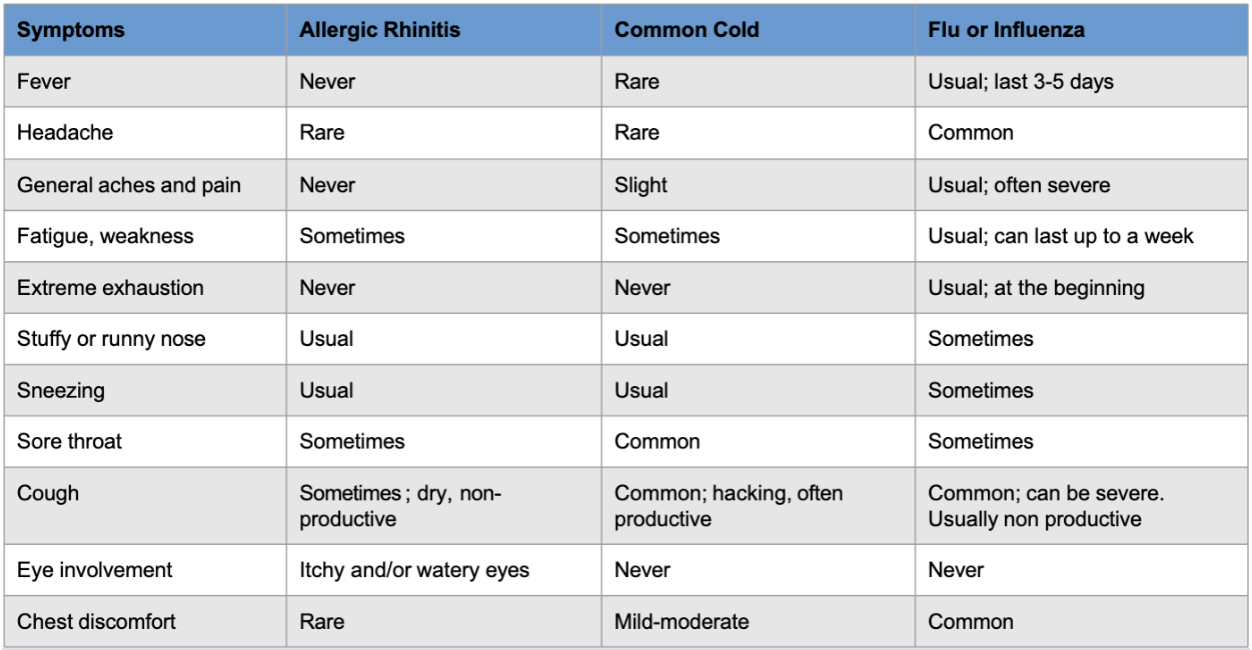
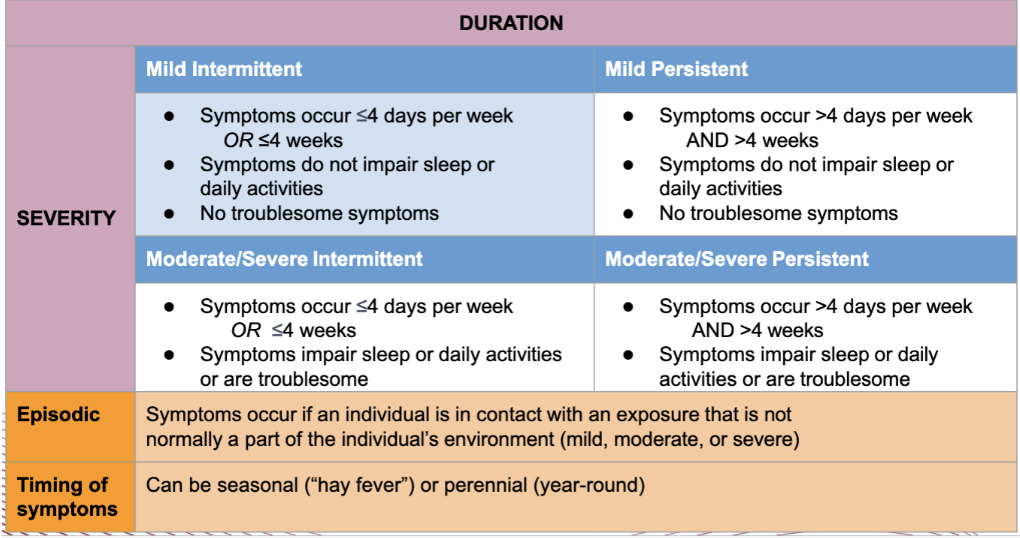
Signs and Symptoms of Allergic Rhinitis
Ocular symptoms
_________, _________ eyes
_________ eyes
_________ eyelids
_________ discharge
Nasal Symptoms (PPRC)
_________ sneezing (sudden, intense)
_________ (_________) nose/palate
_________
Nasal _________
Systemic symptoms (CiFIM)
_________
_________
_________
_________
red, irritated, itchy, puffy, watery, paroxysmal, Pruritius, itchy, rhinorrhea, congestion, cognitive impairment, fatigue, irritability, malaise
KNOW IMAGE
KNOW IMAGE
Exclusion Criteria
Children <__ years
_________ or _________ women
Symptoms of _________
Symptoms of _________, _________, _________, or other infection
Symptoms of undiagnosed or uncontrolled _________ (e.g., wheezing, shortness of breath), _________, or other _________ respiratory disorder
12, pregnant, lactating, nonallergic rhinitis, otitis media, sinusitis, bronchitis, asthma, COPD, lower
Nonpharmacologic Interventions for Allergic Rhinitis
Allergen Avoidance Measures
House Dust Mites
Pollen
Mold (_________)
Cockroaches
Pollutants (_________)
Nasal Wetting Agents
Relieve nasal mucosal _________ and _________
Process also aids in the removal of _________, _________, or _________ mucus from the nose
Nasal wetting agents (e.g., _________, _________, _________ spras, gels)
No significant adverse effects have been noted with use of nasal wetting agents
lower household humidity, air quality, irritation, dryness, dried, encrusted, thick, saline, propylene, polyethylene glycol
More Nonpharmacologic Interventions for Allergic Rhinitis
Nasal Irrigation Agents
Nasal irrigation with _________ (isotonic or hypertonic) delivered using a syringe or Neti pot
It is used to hold _________ (saline solution) what is poured into one nostril and drained out of the other nostril, Mild _________ or _________
Safe for _________ and _________
Only use _________, _________, or _________ tap water (that is brought to room temperature)
Rinse device after each use and let air dry
Do not share device
Allergic Conjunctivitis
_________
Applying _________ to the eyes _________x daily
warm saline, salt water, stinging, burning, children, pregnant women, distilled, sterile, boiled, artificial tears, cold compresses, 3-4
Intranasal Corticosteroid (INC)
Most effective treatment for most symptoms of _________ (_________ weeks for full therapeutic effect)
MOA: _________ multiple cell _________, and stop the “allergic cascade” → decrease _________
ADEs: Nasal _________, _________, _________, and _________
_________ Doses → headache, dizziness, nausea, and vomiting
Long-term use → changes in _________, _________, _________, increased risk of _________, and _________ in children
allergic rhinitis, 1-2, inhibit, mediators, inflammation, discomfort, sneezing, cough, pharyngitis, high, vision, glaucoma, cataracts, infection, growth inhibition
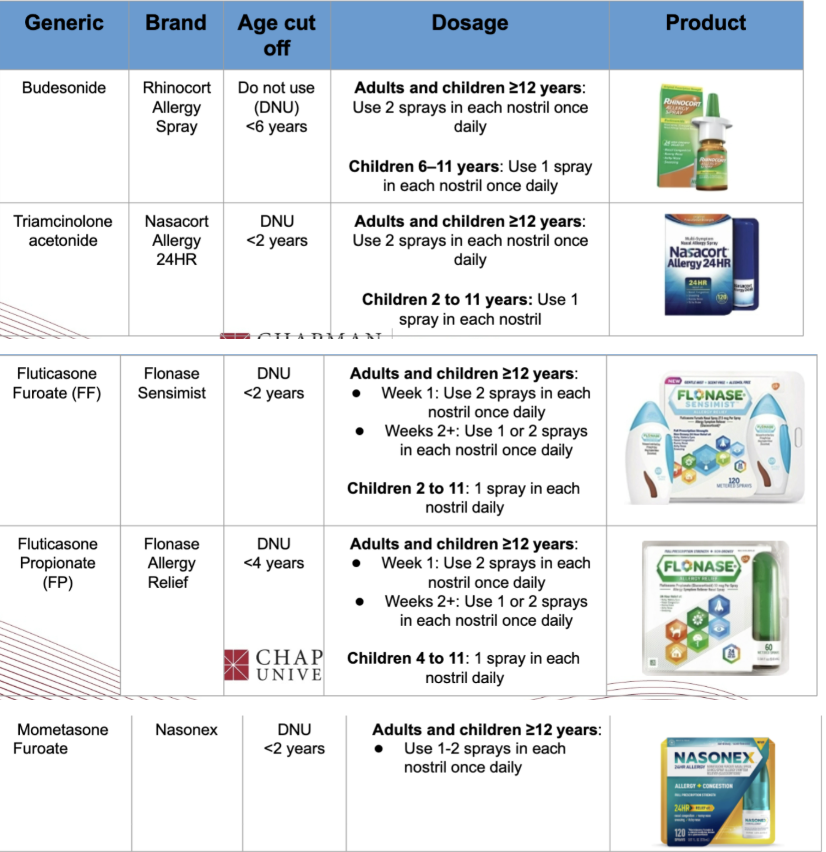
These medications are exampled of _________.
Intranasal Corticosteroid (INC)
Systemic Antihistamines (AH)
Systemic antihistamines are used to relieve symptoms of _________, _________, and _________
_________ onset of action and _________ ability to achieve full benefits
MOA: compete with _________ at central and peripheral _________ receptor sites. _________ the _________ interaction and subsequent mediator _________
Decreased _________, _________, _________, and _________
Decreased _________ in CNS
Increased _________
Decreased _________ and _________ impairment
Increased _________
sneezing, rhinorrhea, itching, quick, quick, histamine, H1, prevents, histamine-receptor, release, inflammation, itching, sneezing, rhinorrhea, neurotransmission, sedation, cognitive, psychomotor, appetite
1st Gen Anithistimines
_________ antihistamines are highly _________ molecules that readily cross the _________
Very _________, readily _________, and relatively _________
Exposure to risks of _________ effects and should be used with caution
Duration of action is _________ (dosing q___h dosing)
ADEs: _________ (sleepy), anticholinergic effects (dry mouth, blurred vision, urinary retention, constipation), _________ impairment
CIs: _________ or _________ + _________
sedating, lipophilic, BBB, effective, available, inexpensive, anticholinergic, short, 4-6, somnolence, cognitive, newborns, premature infants, lactating women
1st Gen Anithistimines
Precautions:
Narrow-angle _________
Acute _________
Stenosing (blocking) _________
Symptomatic _________ (enlargement, BPH)
_________ neck and pyloroduodenal obstruction
Concomitant use of _________ (e.g., rasagiline, selegiline, hydrazine, isocarboxazid)
Patients with _________ respiratory tract diseases (e.g., emphysema, chronic bronchitis, asthma)
People whose activities require _________
_________
_________ (sensitive to light)
glaucoma, asthma exacerbation, peptic ulcer, benign prostatic hyperplasia, bladder, MAO inhibitors, lower, mental alertness, elderly, photosensitizing
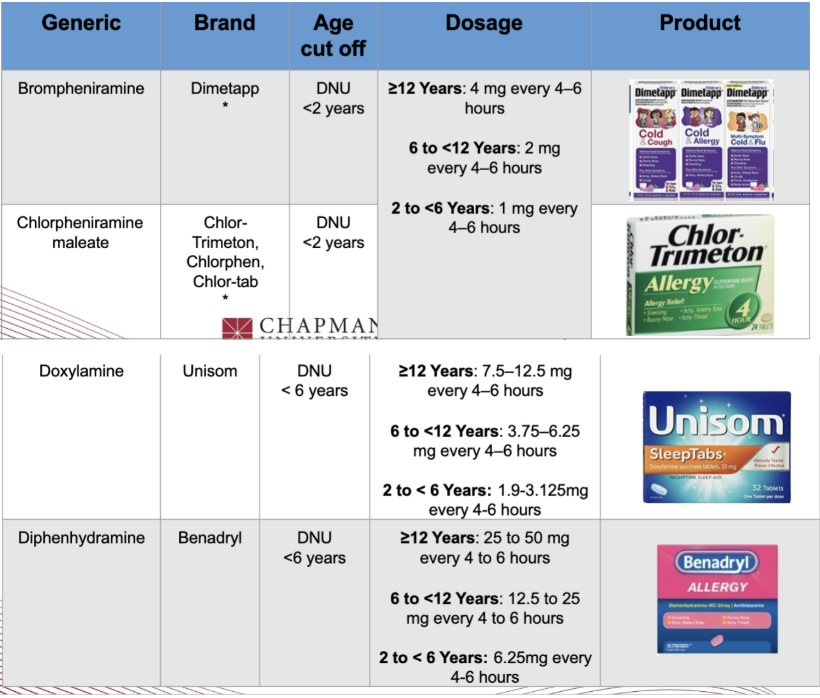
These medications are examples of _________.
1st Gen Antihistamines
2nd Gen Antihistimines
Second generation AH are considered _________ sedating than first generation AH and generally _________ over first generation AH based of _________ and _________
_________ readily cross the BBB
Peripherally _________
Chemical class differences make it reasonable to suggest _________ to a different class
ADEs: _________ can still be seen in certain second-generation AH
Least Sedating: _________ + _________
Moderately Sedating: _________ + _________
Most Sedating: _________
less, preferred, safety, efficacy, Do not, selective, switching, somnolence, Loratadine, Fexofenadine, Cetirizine, Levocetirizine, 1st Gen AH
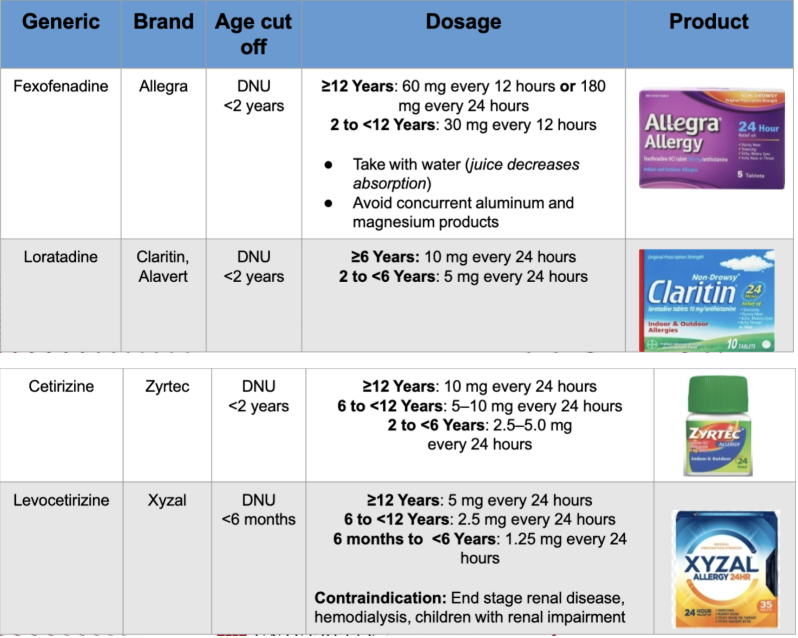
These medications are examples of _________.
2nd Gen Antihistamines
Azelastine Hydrochloride 0.15% (Astepro)
June 2021 _________ to _________
Approved for OTC use in ≥__years old
Indicated for allergic rhinitis
MOA: _________ receptor antagonist that blocks _________ of histamine from cells involved in allergic response
OTC dosing
Ages 6-11: __ spray in each nostril BID
Ages 12+: __ sprays in each nostril _________ or __ sprays in each nostril _________
SEs: _________ or _________ irritation, _________, _________ or _________, _________, _________, _________, _________ taste, _________, _________
Astepro, Rx, OTC, 6, H1, release, 1, BID, 1-2, BID, 2, QD, nose, throat, sneezing, burning, stinging, drowsiness, headache, cough, bitter, dry mouth, nosebleed
Mast Cell Stabilizers
Cromolyn Sodium (_________)
MOA: _________ agent that stabilizes mast cells, thereby _________ mediator release
Dosing:
> 2 years of age: __ spray in each nostril _________ times daily at regular interval
Initial drug of choice in _________ and _________ (less systemic absorption)
ADEs: _________, _________ and _________
NasalCrom, anti-inflammatory, preventing, 1, 3-6, pregnant women, breastfeeding, sneezing, nasal stinging, burning
Combo Products
Adv: _________, Improve patient _________, One med for variety of _________
Disadv: Difficult to recommend for patients with _________, Additional medications to the regimen may increase _________, Taking potentially _________ medications
simple dosing, adherence, symptoms, coexisting medical conditions, ADEs, unnecessary
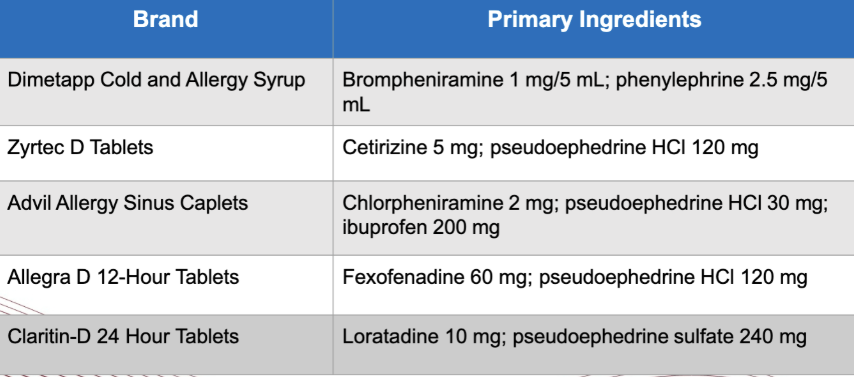
These medications are examples of _________.
Combo Products for Allergic Rhinitis
Allergic Conjunctivitis
Ketotifen Fumarate
Indicated for allergic conjunctivitis in those __ years of age and _________
Dosing: one drop into affected eye(s); _________ dosing
MOA: _________ histamine H1 antagonist that exerts its effects by inhibiting release of histamine from mast cells
SEs: _________, _________, change in _________, eye _________
Pheniramine
Used in combination with _________; indicated for allergic conjunctivitis in those __ years of age and _________
Dosing: 1-2 drops into affected eye(s); up to _________
MOA: _________ histamine H1 antagonist that exerts its effects by inhibiting release of histamine from mast cells
SEs: _________, eye _________
Olopatadine
July 2020 now OTC for __ years and _________
Indicated for allergic conjunctivitis
MOA: _________ histamine H1 antagonist that exerts its effects by inhibiting release of histamine from mast cells
0.2% & 0.7%: One drop in each eye _________
0.1% available as well _________ dosing
SEs: headache, blurred vision, change in taste, eye irritation
3, older, BID, selective, headache, blurred vision, taste, irritation, naphazoline, 3, older, QID, non-selective, blurred vision, irritation, 2, older, selective, QD, BID
KNOW IMAGE
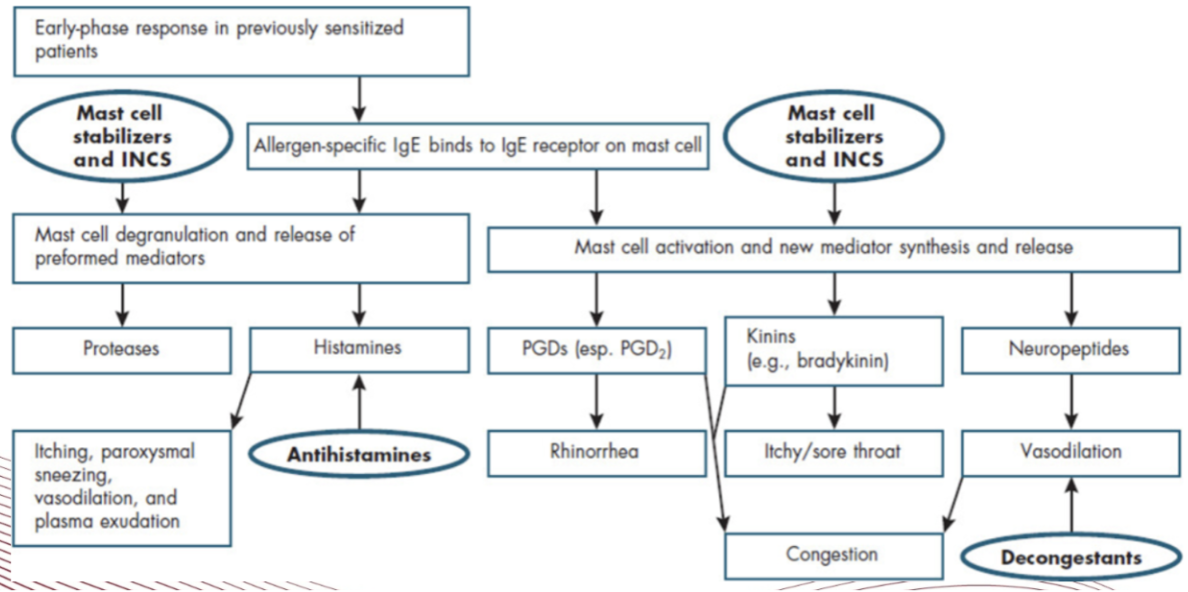
KNOW
Counseling for INCs
Before use:
_________ gently and remove cap
_________ the pump in the air for the first time it is used OR when you have not used it for awhile
Using the spray:
_________ your nostrils
_________ one nostril
Start to breathe in through nose, while pressing firmly and quickly down
Repeat for other nostril
Breath out through your mouth
Wipe clean
Do not _________ after
shake, prime, clear, close, blow your nose
Counseling for AH
Patients with _________ allergic rhinitis should initiate _________ before being exposed to known allergens
_________ allergic rhinitis should take _________ on a _________
intermittent, therapy, persistent, antihistamines, regular basis
Counseling for Mast Cell Stabalizers
_________ for therapeutic effect
_________ for maximal therapeutic benefit
3-7 days, 2-4 weeks
Counseling for Decongestants
_________-term use (no more than _________)
short, 5 days
FOLLOW-UP
Assess in _________
Monitor if symptoms are improved, under control
Monitor for adverse drugs reactions
If nonadherent, educate patient to continue therapy, assess in _________
Refer to PCP:
If symptoms have worsened during treatment
Self-care measures do not improve symptoms after _________
S/sx of _________ develop
3-4 days, 1-4 weeks, 1-2 weeks, bacterial infection

