RADS 2100 Mosby's Challenge #2
 Call Kai
 Learn
Learn Practice Test
 Spaced Repetition
 Match
Match Flashcards
 Knowt Play
1/199

There's no tags or description
Looks like no tags are added yet.
Name | Mastery | Learn | Test | Matching | Spaced | Call with Kai |
|---|
No analytics yet
Send a link to your students to track their progress
200 Terms
Linear energy transfer
1. The amount of radiation deposited per unit length of tissue traversed by incoming photons is called:
a. Tissue exposure
b. Linear deposition of energy
c. Linear energy transfer
d. Effective dose limit
Long-term somatic effects
2. Cataractogenesis, life span shortening, embryologic effects, and carcinogenesis are examples of:
a. Short-term somatic effects
b. Genetic effects
c. Acute radiation syndrome
d. Long-term somatic effects
Decreases contrast in the radiographic image
3. Compton interaction:
a. Increases contrast in the radiographic image
b. Results in scattering of the incident electrons
c. Decreases recorded detail in the radiographic image
d. Decreases contrast in the radiographic image
Sievert
4. Gray t multiplied by a radiation weighting factor equals:
a. Air kerma
b. Becquerel
c. Sievert
d. Graya
a
5. Effective dose limit (EfD):
a. Is the level of radiation that an organism can receive and probably sustain no appreciable effects
b. Is a safe level of radiation that can be received with no effects
c. Should be absorbed annually to maintain proper immunity to radiation
d. Is 500 mSv per year for the general public
Is highly ionizing
6. Radiation with a high LET:
a. Has low ionization
b. Is highly ionizing
c. Carries a low quality factor
d. Equates with a low RBE
Linear-nonthreshold
7. Radiation protection is based on which dose-response relationship?
a. Linear-threshold
b. Nonlinear-nonthreshold
c. Linear-nonthreshold
d. Nonlinear-threshold
Law of Bergonié and Tribondeau
8. Which of the following states that the radiosensitivity of cells is directly proportional to their reproductive activity and inversely proportional to their degree of differentiation?
a. Inverse square law
b. Law of Bergonié and Tribondeau
c. Reciprocity law
d. Ohm's law
Indirect effect
9. Which of the following causes about 95% of the cellular response to radiation?
a. Direct effect
b. Law of Bergonié and Tribondeau
c. Target theory
d. Indirect effect
Direct effect
10. When radiation strikes DNA, which of the following occurs?
a. Direct effect
b. Law of Bergonié and Tribondeau
c. Target theory
d. Indirect effect
Doubling dose
11. The amount of radiation that causes the number of genetic mutations in a population to double is called the:
a. Threshold dose
b. Doubling dose
c. Mutagenic dose
d. Genetic dose
Sievert, becquerel, graya, gray t
12. The SI units of equivalent dose, activity, air kerma, and absorbed dose are, respectively:
a. Roentgen, rad, rem, curie
b. Rad, coulomb per kilogram, curie, becquerel
c. Rem, curie, roentgen, rad
d. Sievert, becquerel, graya, gray t
Artificially produced radiation
13. Medical x-rays are an example of:
a. Natural background radiation
b. Artificially produced radiation
c. Nonionizing radiation
d. Ionizing, natural background radiation
5.0 mSv
14. The effective dose limit for a fetus for the entire gestational period is:
a. 5.0 mSv
b. 0.5 mSv
c. 0.05 mSv
d. 50 mSv
Results in absorption of the incident photon
15. The photoelectric effect:
a. Results in absorption of the incident photon
b. Results in absorption of the incident electron
c. Produces contrast fog on the radiographic image
d. Is the same as brems radiation
50 mSv
16. The annual effective dose limit for radiographers is:
a. 10 mSv
b. 100 mSv
c. 50 mSv
d. 100 mSv
Mean marrow dose
17. The average dose to active bone marrow as an indicator of somatic effects on a population is called:
a. Doubling dose
b. Bone dose
c. GSD
d. Mean marrow dose
Erythema
18. An early tissue reaction that may occur during prolonged interventional procedures is:
a. Interruption of mitosis
b. Sterility
c. Erythema
d. Early cataract formation
0.50-mm Pb equivalent
19. A lead apron of at least what thickness should be worn while being exposed to scatter radiation?
a. 0.25-mm Pb equivalent
b. 0.50-mm Pb equivalent
c. 0.50-mm Al equivalent
d. 0.10-mm Al equivalent
0.50-mm Pb equivalent
20. Use of a thyroid shield of at least what thickness should be used for fluoroscopy?
a. 0.10-mm Pb equivalent
b. 0.50-mm Pb equivalent
c. 0.50-mm Al equivalent
d. 0.10-mm Al equivalent
1⁄16-inch lead equivalent
21. How thick are primary protective barriers?
a. 1⁄32-inch lead equivalent
b. 1⁄16-inch aluminum equivalent
c. 1⁄32-inch concrete
d. 1⁄16-inch lead equivalent
7 feet
22. Primary protective barriers, if in the wall, must extend to a height of at least:
a. 5 feet
b. 6 feet
c. 7 feet
d. 10 feet
The ceiling
23. Secondary protective barriers must extend to a height
of:
a. 5 feet
b. 6 feet
c. The ceiling
d. 10 feet
0.25-mm Pb equivalent
24. The protective curtain hanging from the fluoroscopy tower must be at least:
a. 0.50-mm Pb equivalent
b. 0.25-mm Al equivalent
c. 0.10-mm Pb equivalent
d. 0.25-mm Pb equivalent
0.25-mm Pb equivalent
25. The Bucky slot cover must be at least:
a. 0.50-mm Pb equivalent
b. 0.25-mm Al equivalent
c. 0.10-mm Pb equivalent
d. 0.25-mm Pb equivalent
Lithium fluoride
26. Thermoluminescent dosimeters use what type of energy to indicate dose?
a. Dilithium crystals
b. Lithium fluoride
c. Flux capacitors
d. Bromide crystals
Visible light
27. TLDs are heated and release what type of energy to indicate dose?
a. Laser
b. Visible light
c. X-rays
d. Gamma rays
10 μSv
28. Optically stimulated luminescence (OSL) dosimeters provide readings as low as:
a. 1 μSv
b. 10 μSv
c. 50 μSv
d. 100 μSv
Aluminum oxide
29. The recording material in a OSL dosimeters is:
a. Dilithium
b. Lithium fluoride
c. Aluminum oxide
d. Silver halide
Laser
30. The energy stored in an OSL dosimeter is released when the dosimeter is exposed to:
a. Heat
b. White light
c. Laser
d. Ultrasound
3 months
31. OSL dosimeters may be worn for up to:
a. 1 month
b. 1 week
c. 3 months
d. 1 year
An unlimited number of times
32. OSL dosimeters may be scanned and reanalyzed:
a. Only once
b. Monthly
c. Five times
d. An unlimited number of times
High kVp, low mAs
33. For optimal radiation protection, what type of exposure technique should be used?
a. Low kVp, high mAs
b. Small focal spot
c. All manual techniques
d. High kVp, low mAs
a,d
34. For optimal radiation protection of the radiographer performing mobile radiography, what should always be done? (select 2)
a. Use a 6 foot exposure switch cord to its maximum length
b. Stand at a 25-degree angle from the patient
c. Stand at a 45-degree angle from the patient
d. Wear a lead apron
At least 12 inches
35. The minimum source-to-skin distance for portable radiography is:
a. At least 12 inches
b. At least 15 inches
c. At least 72 inches
d. At least 40 inches
Never
36. How often is added filtration adjusted by the radiographer?
a. After several exposures
b. Daily
c. As part of weekly quality control
d. Never
Dosimeter
37. What report does a radiographer consult and initial to verify occupational dose received?
a. PACS
b. Dosimeter
c. Radiation
d. Annual dose report
Somatic
38. What are radiation effects that manifest themselves in the person being irradiated?
a. Genetic
b. Exposed cell
c. Somatic
d. Molecular
Natural
39. What type of background radiation is radon?
a. Man-made
b. Radioactive water
c. Natural
d. Natural form of electromagnetic waves
Differential absorption of the x-ray beam by the body
40. The photoelectric effect is responsible for:
a. The brightness of the image
b. Producing scatter radiation
c. Differential absorption of the x-ray beam by the body
d. Spatial resolution
Air kerma
41. The unit of measurement that is determined by measuring ions produced in air as radiation passes through it is the:
a. Becquerel
b. Gray
c. Air kerma
d. Sievert
Gamma rays
42. One (1) is the radiation weighting factor (WR) for:
a. Neutrons
b. Gamma rays
c. Cosmic rays
d. Radon
Z
43. Atomic number is represented by the letter:
a.M
b.A
c.Z
d.Q
A
44. Atomic mass is represented by the letter:
a.M
b.A
c.Z
d.Q
Improve radiation protection
45. The primary purpose of filtering the x-ray beam is to:
a. Increase contrast
b. Improve radiation protection
c. Soften the beam for proper imaging
d. Remove short-wavelength rays
Water
46. Considering probability, x-ray photons will probably strike:
a. The nucleus
b. RNA
c. DNA
d. Water
Radiolysis
47. X-ray photons depositing their energy in the water of the cytoplasm may cause:
a. Electrolysis
b. Radiolysis
c. Radioactivity
d. Pair production
Hydrogen peroxide
48. Free radicals may recombine to form:
a. DNA
b. Hydrogen peroxide
c. Sulfuric acid
d. New cytoplasm
0.50-mm lead equivalent
49. What is the thickness of a thyroid shield that should be worn during fluoroscopy?
a. 0.10-mm lead equivalent
b. 0.50-mm lead equivalent
c. 0.50-mm aluminum equivalent
d. 0.10-mm aluminum equivalent
Secondary protective barrier
50. For shielding purposes, what is the x-ray control booth considered?
a. Secondary protective barrier
b. Primary protective barrier
c. Equivalent to a lead apron
d. A tertiary protective barrier
An ionization chamber between the IR and the patient
51. An ionization chamber circuit places:
a. A photomultiplier tube between the IR and the patient
b. An ionization chamber beneath or behind the IR
c. An ionization chamber between the patient and the x-ray tube
d. An ionization chamber between the IR and the patient
Four silicon-based semiconductors
52. Full-wave rectification uses:
a. A single semiconductor
b. Four silicone-based semiconductors
c. The x-ray tube as a semiconductor
d. Four silicon-based semiconductors
41
53. A full-wave rectified, three-phase, 12-pulse x-ray machine produces approximately ____% more average photon energy than a full-wave rectified, single- phase x-ray machine.
a. 35
b. 50
c. 41
d. 100
Cathode
54. According to the anode heel effect, the intensity of radiation is greater at the ________ side of the x-ray tube.
a. Anode
b. Central x-ray
c. Neither side, the beam is of uniform intensity
d. Cathode
Minimum reaction time
55. The amount of time needed for an AEC to terminate the exposure is called:
a. Exposure latitude
b. Minimum reaction time
c. Chamber response time
d. Electronic time
B
56. Where is the electron beam focused?
a.A
b.B
c.C
d.D
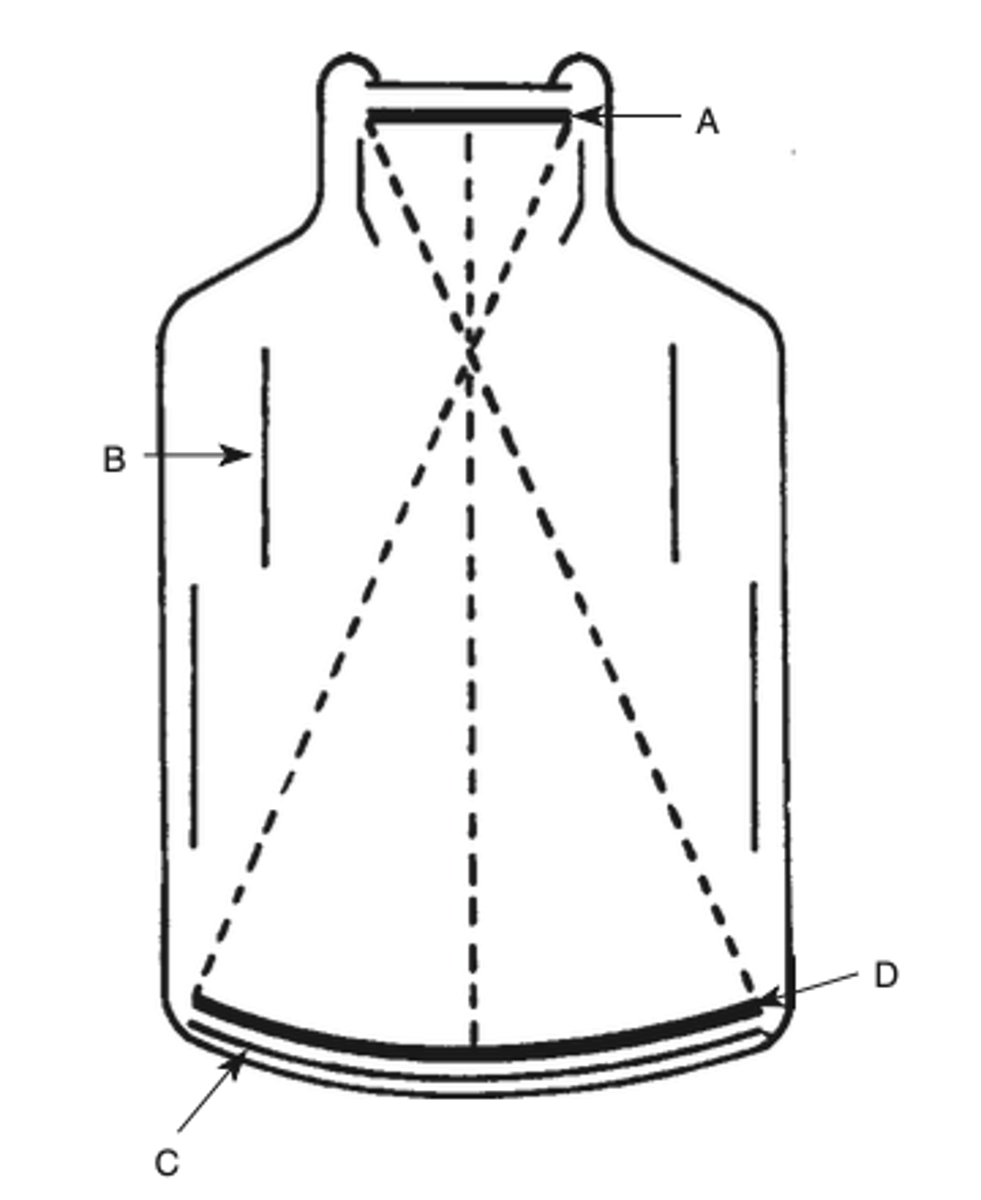
D
57. Where is light energy converted to electrons?
a.A
b.B
c.C
d.D
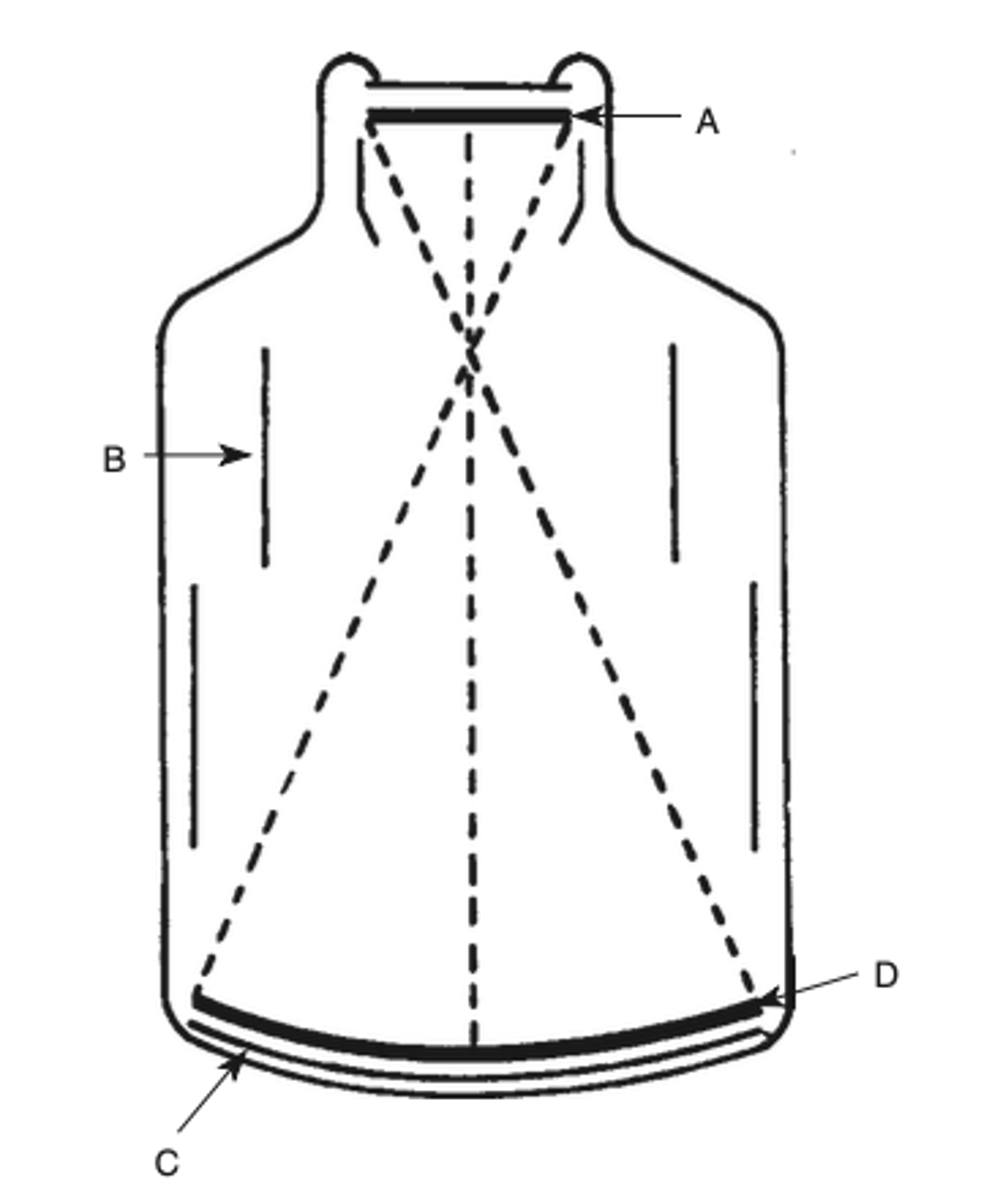
A
58. From where is the visible image distributed to viewing or recording media?
a.A
b.B
c.C
d.D
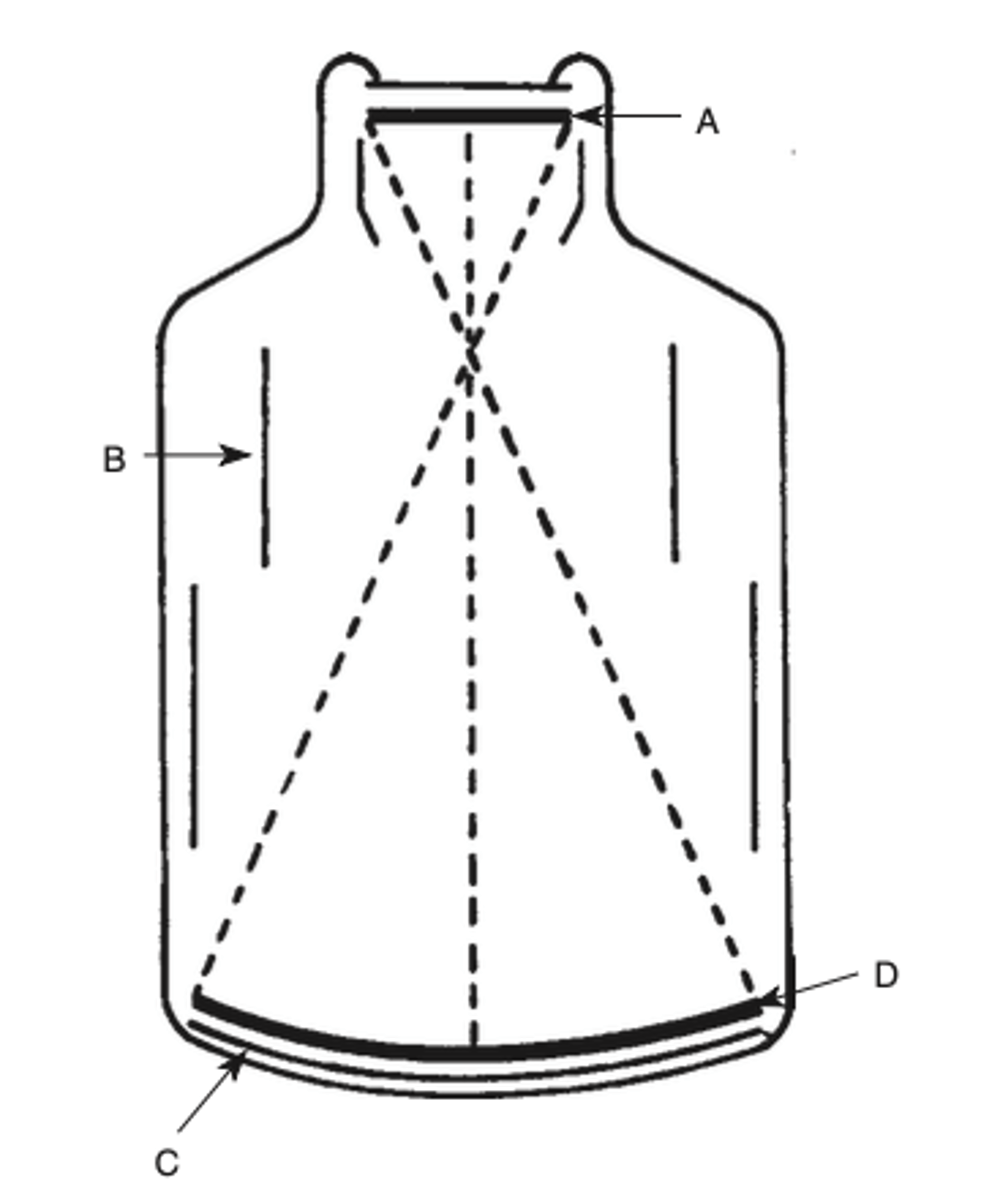
C
59. Where is x-ray energy converted to visible light?
a.A
b.B
c.C
d.D
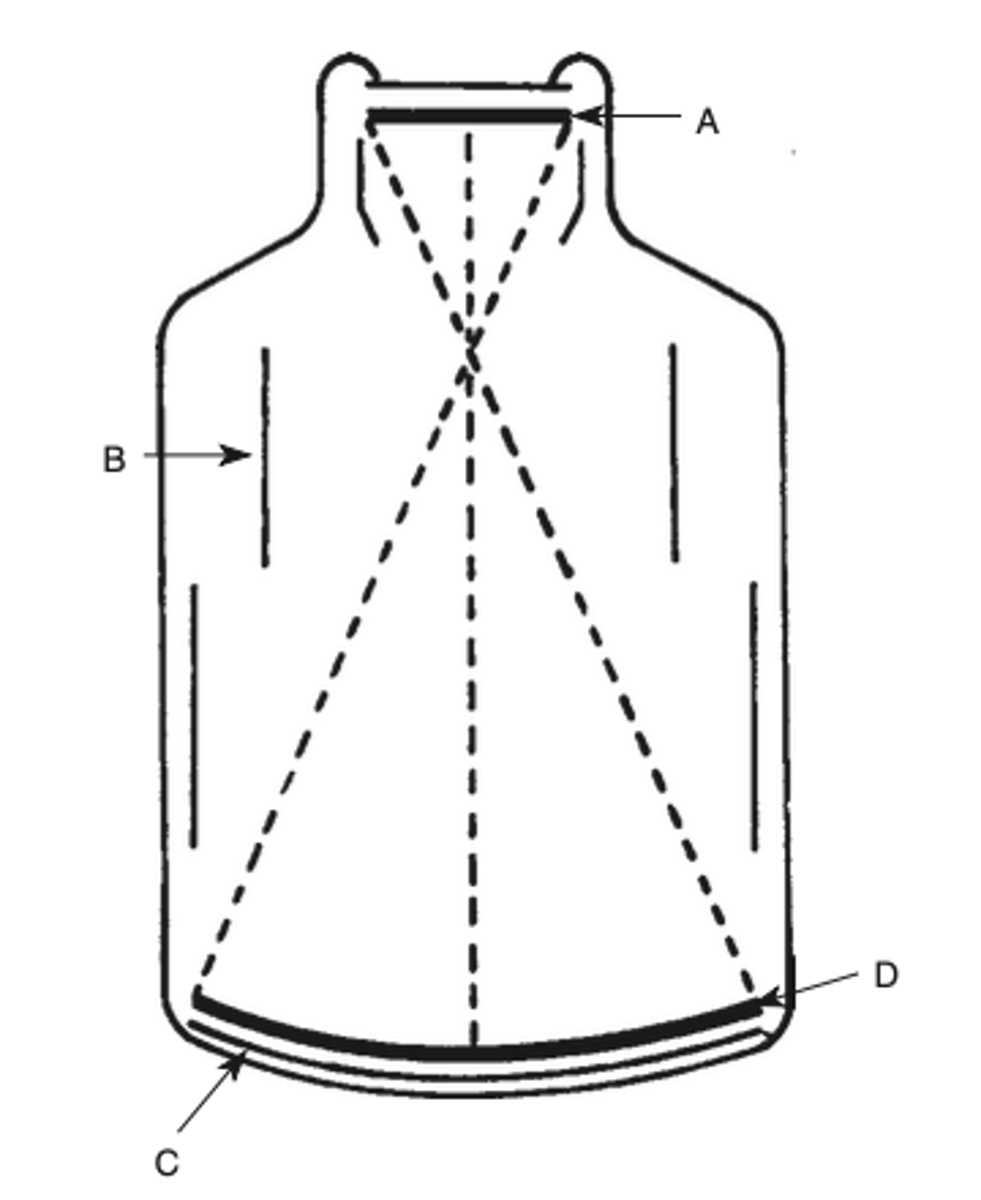
Use of a digital dosimeter to determine exposure linearity
60. A particular x-ray room is "shooting dark." The problem arises when a change is made from 200 to 300 mA using fixed kVp techniques at 0.16 seconds. Which of the following would lead to an accurate diagnosis of the problem?
a. Resolution test pattern
b. Measurement of HVL
c. Use of a digital dosimeter to determine exposure reproducibility
d. Use of a digital dosimeter to determine exposure linearity
Use of a digital dosimeter to determine exposure reproducibility
61. An outpatient radiographic room is used primarily for tabletop radiography of the extremities. On a particularly busy afternoon, the radiographers find that similar exposure techniques on successive patients result in substantially different radiographs. Which of the following would lead to an accurate diagnosis of the problem?
a. Contrast test pattern
b. Measurement of HVL
c. Use of a digital dosimeter to determine exposure reproducibility
d. Use of a digital dosimeter to determine exposure linearity
Half-value layer
62. X-ray beam quality is expressed in terms of:
a. Half-value layer
b. Exposure linearity
c. Exposure reproducibility
d. mAs
± 8⁄10 inch
63. The accuracy of collimation at a 40-inch SID must be:
a. ± 4 inches
b. ± 8⁄10 inch
c. ± 1 inch
d. ± 1⁄10 inch
Within 10%
64. The accuracy of kVp at 80 kVp must be:
a. Within 5%
b. Within 10%
c. Within 15%
d. Within 20%
Effective focal spot
65. The apparent size of the focal spot as viewed by the image receptor is called the:
a. Actual focal spot
b. Target angle spot
c. Anode heel effect
d. Effective focal spot
Bremsstrahlung
66. Which of the following interactions is the primary source of diagnostic x-rays?
a. Photoelectric effect
b. Bremsstrahlung
c. Compton
d. Pair production
d
67. Which set of exposure factors would produce the greatest receptor exposure?
a. 100 mAs, 70 kVp, 0.5-mm focal spot, 60-inch SID
b. 200 mAs, 60 kVp, 1.2-mm focal spot, 60-inch SID
c. 100 mAs, 70 kVp, 1.2-mm focal spot, 60-inch SID
d. 300 mAs, 90 kVp, 0.5-mm focal spot, 60-inch SID
b
68. Which set of exposure factors would produce the lowest receptor exposure?
a. 80 mAs, 85 kVp, 40-inch SID, 1.2-mm focal spot
b. 40 mAs, 60 kVp, 40-inch SID, 0.5-mm focal spot
c. 160 mAs, 70 kVp, 40-inch SID, 1.2-mm focal spot
d. 160 mAs, 90 kVp, 40-inch SID, 0.5-mm focal spot
Pb strips and Al interspacers
69. The components of a grid are:
a. Pb strips and Pb interspacers
b. Al strips and Pb interspacers
c. Pb strips and Al interspacers
d. Pb strips and cardboard interspacers
Air, fat, water, muscle, bone
70. Which of the following lists of substances that make up the human body best places them in increasing order of density?
a. Air, fat, water, muscle, bone
b. Bone, muscle, water, fat, air
c. Air, fat, muscle, water, bone
d. Air, fat, water, muscle, bone, tooth enamel
The available gray scale of an imaging system
71. Bit depth describes:
a. The available gray scale of an imaging system
b. Window level
c. Spatial resolution
d. Optimum exposure needed for an imaging system
Decrease kVp by 15%
72. If it is necessary to reduce exposure by half, and it is impossible to do so by changing mAs, the radiographer may:
a. Reduce SID by half
b. Double SID
c. Decrease kVp by 15%
d. Decrease kVp by 50%
Wide
73. The dynamic range for digital imaging is:
a. Wide
b. Narrow
c. Unrelated to diagnostic imaging
a
74. Dynamic range is defined as:
a. The range of exposures over which a detector can acquire image data
b. Exposure latitude
c. Window width
d. Window level
b
75. Modulation transfer function (MTF) is:
a. The controlling factor of contrast resolution
b. A measure of the ability of the imaging system to
preserve signal contrast as a function of the spatial
resolution
c. A function of exposure
d. A function of pixel density
Bit depth
76. 2n (where n equals the number of bits) defines:
a. Pixel density
b. Shades of gray
c. Bit depth
d. Detector element size
Absorbs x-ray energy and emits part of that energy as visible light
77. A scintillator:
a. Absorbs x-ray energy and emits part of that energy as visible light
b. Absorbs x-ray energy and emits that energy as electrons
c. Converts visible light into electrons
d. Converts electrons into visible light
Subject contrast
78. The magnitude of the signal differences in the remnant beam refers to:
a. Subject contrast
b. IP contrast
c. Window level
d. Spatial resolution
Algorithm
79. A term used to describe the mathematical formula used by the computer to reconstruct the image is:
a. Bit depth
b. Algorithm
c. Mathematical function
d. Exposure equation
Wireless DR plate
80. When speed is essential in completing an imaging examination, the preferred IR is:
a. CR
b. DR
c. Wireless DR plate
Picture element
81. Pixel is an acronym meaning:
a. Detector element
b. Picture element
c. Volume element
d. Bit element
Moiré pattern
82. Improper use of grids with a digital imaging system may cause an artifact known as:
a. Moiré pattern
b. Grid cutoff
c. Motion artifact
d. Quantum mottle
PACS
83. An integrated system of images and information is called:
a. DICOM
b. DDR
c. CR/DDR
d. PACS
Undesirable fluctuations in brightness
84. Image noise may be described as:
a. Undesirable fluctuations in brightness
b. Undesirable fluctuations in contrast
c. Inadequate spatial resolution
d. A function of mAs
Brightness
85. The measurement of the luminance of a monitor is called:
a. Density
b. Contrast
c. Brightness
d. Detail visibility
b
86. Grid radius is:
a. The total amount of lead in a grid
b. The range of SIDs that may be used with a focused grid
c. The objective plane
d. H/D
Quantum noise
87. Visibility of an object's edge may be limited by:
a. Speed class
b. Modulation transfer function
c. Contrast resolution
d. Quantum noise
Potential speed class
88. Detective quantum efficiency indicates:
a. Patient dose
b. Potential speed class
c. Spatial resolution
d. Contrast resolution
Linear
89. Digital receptors have what kind of response to exposure?
a. Nonlinear
b. Linear
c. Curvilinear
d. Hyperlinear
Increases
90. If the angle on the anode is decreased, what effect is there on spatial resolution?
a. Increases
b. Decreases
c. No appreciable effect
Increases
91. If mAs is increased four times, what is the effect on receptor exposure?
a. Increases
b. Decreases
c. No appreciable effect
Decreases
92. If SID is increased, what is the effect on IR exposure?
a. Increases
b. Decreases
c. No appreciable effect
Increases
93. If OID is decreased, what is the effect on spatial resolution?
a. Increases
b. Decreases
c. No appreciable effect
Light into a charge
94. A photodiode converts:
a. AC to DC
b. Light into a charge
c. Electrons into light
d. MRI signal into PACS data
Decrease
95. If kVp is increased, what happens to attenuation of the beam in the patient?
a. Increase
b. Decrease
c. No appreciable effect
Increases
96. In a conversion from a non grid to a 12:1 grid, what
happens to image contrast?
a. Increases
b. Decreases
c. No appreciable effect
Increases
97. If SID is decreased from 60 inches to 30 inches, what happens to magnification?
a. Increases
b. Decreases
c. No appreciable effect
Decreases
98. If the IR is moved from tabletop to Bucky, what happens to spatial resolution?
a. Increases
b. Decreases
c. No appreciable effect
Decreases
99. If there is a decrease in source-to-object distance, what happens to spatial resolution?
a. Increases
b. Decreases
c. No appreciable effect
Grid frequency
100. The amount of lead in a grid is referred to as:
a. Grid frequency
b. Grid ratio
c. Grid radius
d. Grid cleanup ability

