Week 6 - Social Identity
 Studied by 0 people
 Call Kai
 Learn
Learn Practice Test
 Spaced Repetition
 Match
Match Flashcards
 Knowt Play
1/52

There's no tags or description
Looks like no tags are added yet.
Name | Mastery | Learn | Test | Matching | Spaced |
|---|
No study sessions yet.
53 Terms
What defines a group?
A group is defined as two or more individuals who cooperate and are interdependent, influencing each other based on shared goals and needs.
What is the minimal group paradigm?
Discrimination between ingroups and outgroups, where ingroups are perceived as 'us' and outgroups as 'them'.
What are the properties of a group (Johnson and Johnson, 1987)
•A collection of individuals who are interacting with one another.
•A social unit of 2 or more individuals who perceive themselves as belonging to a group.
•A collection of individuals who are interdependent – depend on each other, different to a crowd
•A collection of individuals who join together to achieve a goal e.g. sports team to win a competition – mutual goal
•A collection of individuals who are trying to satisfy a need through their joint association – need to be valued in the group
•A collection of individuals whose interactions are structured by a set of roles and norms – sometimes clearly defined
•A collection of individuals who influence each other – whether consciously or not, social influence, manipulation
What is ingroup bias?
Ingroup bias is the tendency to favor one's own group, which can enhance self-worth, especially when the ingroup achieves success.
What is the difference between ingroups and outgroups?
•Ingroup – “Us” – a group of people who share a sense of belonging, a feeling of common identity
•Outgroup – “Them” – a group that people perceive as distinctively different from or apart from their ingroup
How is social identity defined?
Social identity is defined as the part of an individual's self-concept derived from their group memberships, including the emotional significance attached to those memberships.
What is social categorisation?
Process of classifying individuals into different social groups based on characteristics such as ethnicity or appearance.
What is a prototype in social identity theory?
A prototype is a cognitive representation of the typical or ideal defining features of a social category.
What does the meta-contrast principle state?
The meta-contrast principle states that individuals categorise people based on similarities within a group compared to differences between groups.
What is ethnocentrism?
The belief that one's own group is central to everything, often leading to the exaggeration of differences in outgroups.
-> Any misbehaviour from the ingroup can be 'blinded' when ethnocentrism is high
What is the Prisoner's Dilemma?
The Prisoner's Dilemma is a scenario where two suspects must decide whether to confess or remain silent, with the best outcome being mutual non-confession.
–If one confesses and the other doesn’t, the confessor will be granted a lower sentence
–If both confess, each will receive a moderate sentence
–If neither confesses, each will receive a lighter sentence – mutual non-confession is the best outcome
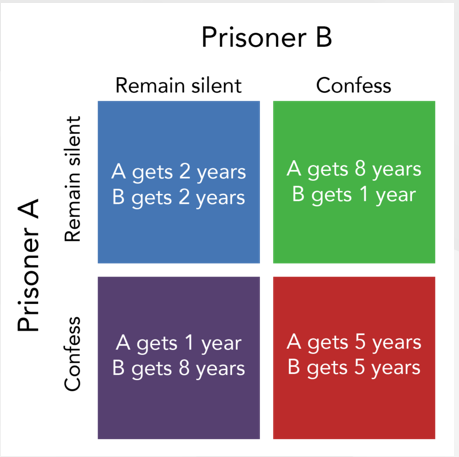
What did Dawes (1991) find in his studies on the Prisoner's Dilemma?
Dawes found that not cooperating leads to worse outcomes for both parties, highlighting the importance of trust and communication.
What is intergroup behavior?
Interactions between members of different groups, influenced by their group identifications.
What was the aim of Sherif's summer camp study (1953-61)?
The aim was to study group dynamics and intergroup relations by observing boys divided into two groups competing and cooperating.
What occurred during the first week of Sherif's summer camp study?
Boys formed friendships and group identities
Unaware of the other group's existence.
Group identity established - group name and flag
What was the outcome of the second week in Sherif's study?
Introduced competition, leading to conflict, ingroup favouritism, and negative perceptions of the outgroup.
Groups became interdependent
Each group developed its own norms, hierarchy, and identity.
Camp was divided into 2 groups which split up friendships
What happened in the third week of Sherif's study?
Groups engaged in non-competitive activities, which reduced aggression but did not eliminate hostility.
•Reduction in amount of in-group favouritism; however, the hostility was still high
.Competition led to strong intergroup hostility, ethnocentrism, and ingroup solidarity.
Conflict escalated so much that some experiments ended early.
What are superordinate goals?
Superordinate goals are shared objectives that require cooperation between groups to achieve, which can reduce conflict and improve relations.
What occurred in the 4th phase of Sherif’s study?
Groups introduced to shared goals they could only achieve together (superordinate goals)
Cooperation toward these superordinate goals reduced conflict and improved intergroup relations.
What is the difference between social identity and personal identity?
Social identity is based on group memberships, while personal identity is based on individual traits and relationships.
What role do roles and norms play in group interactions?
Roles and norms structure interactions within a group, influencing behaviour and expectations among members.
How does social influence manifest in group settings?
Social influence in groups can occur consciously or unconsciously, affecting members' behaviors and attitudes.
What is the significance of communication in social dilemmas?
Communication is crucial in social dilemmas as it fosters trust and cooperation, enabling better outcomes for all parties involved.
What is the impact of competition on intergroup relations?
Competition can lead to heightened hostility, ethnocentrism, and ingroup solidarity, complicating intergroup dynamics.
How can ingroup solidarity affect behavior?
Ingroup solidarity can lead to increased willingness to help members of one's own group while fostering negative attitudes towards outgroup members.
What is the relationship between social identity and self-concept?
Social identity contributes to self-concept by providing a framework through which individuals view themselves in relation to their group memberships.
What is the role of stereotypes in ethnocentrism?
Stereotypes contribute to ethnocentrism by exaggerating differences and fostering negative perceptions of outgroups.
What is the relationship between intergroup competition and prejudice?
Prejudice, discrimination, and ethnocentrism arise as a result of real intergroup conflict.
What does Realistic Conflict Theory propose?
The nature of goal relations among individuals and groups determines interindividual and intergroup relations; mutual goals promote cooperation, while mutually exclusive goals lead to competition.
(Sherif, 1966)
What is and was the outcome of the Trucking Game experiment by Deutsch & Krauss? *
Two participants play a game where they work for separate trucking companies that transport goods from one place to another. They can use their own private roads, but there is also a much shorter shared route that has the drawback of having a one-lane section.
Participants rarely took turns using the shared route due to mutual mistrust, leading to suboptimal outcomes.
What is the Commons dilemma? *
A social dilemma where cooperation benefits all, but competition harms all.
What is the Free-rider effect?
Gaining benefits from group membership while avoiding the costs incurred by other members.
What are the three components of prejudice according to Allport?
Cognitive (beliefs about a group), Affective (strong negative feelings), and Conative (intention to act towards a group).
What did Zimbardo's Stanford prison experiment reveal about roles?
Participants complied with expected roles, leading to brutal behavior from guards and emotional disturbance in prisoners.
What are 3 task or social related factors associated with roles?
1.Division of labour
2.Indicate how members relate to one another – leader more in charge than someone who doesn't have a role
3.Give members a place within the group
What is the Intergroup Emotions Theory?
In-group context appraisals of personal harm or benefit produce mainly positive in-group and negative out-group emotions. (Mackie & Smith, 2002)
→ people feel emotions because of their group, and those feelings affect how they act toward other groups
What is deindividuation?
A loss of self-awareness and evaluation apprehension that can occur in group settings.
What factors can lead to deindividuation in crowds?
Large group size, physical anonymity, and arousing activities can cause individuals to abandon normal restraints.
What did Le Bon (1895; 1965) suggest about crowds?
According to Le Bon (1895; 1965), crowds produce primitive and homogeneous behaviour because:
–members are anonymous: may lose a sense of personal identity
–ideas and sentiments spread rapidly and unpredictably through a process of contagion
–unconscious antisocial motives (‘ancestral savagery’) are released through suggestion (a process akin to hypnosis).
What is the role of leadership in promoting cooperation?
Effective leadership is seen as part of the group and serves group interests rather than just being charismatic.
What is stigma in social psychology?
Stigmatised individuals possess attributes that convey a devalued social identity in a given context.
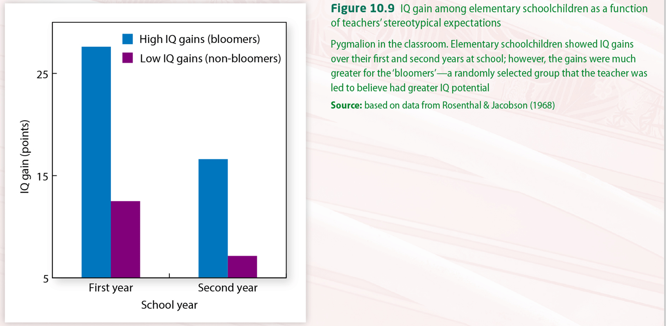
What did the Pygmalion in the Classroom study demonstrate?
Expectations can influence student performance, particularly when labeled as 'bloomers'.
What is the backlash effect in gender roles?
Women in male-stereotypical jobs are rated less competent when their success is ambiguous compared to men.
•Previous success was clear – rated equally competent
•Previous success ambiguous – males rated more competent
•Previous success was clear – males rated as more likeable
•Previous success ambiguous – rated equally likeable
What is tokenism in the workplace?
The practice of hiring individuals based on their demographic characteristics rather than their abilities, leading to perceptions of preferential treatment.
How does group identification influence behaviour?
A strong shared identity can transform self-interest into collective interest, fostering trust and cooperation.
What are the criticisms of the deindividuation theory?
Critics argue it oversimplifies group behaviour by portraying groups as mindless and ignores the role of social identity.
What is the significance of communication in conflict resolution?
Direct or indirect communication can reduce conflict and enhance cooperation among competing groups.
What does the term 'social identity' refer to?
The part of an individual's self-concept derived from their membership in social groups.
What is the impact of privatisation on social identity?
Privatisation undermines social identity and increases selfish behavior.
→ when individuals seek personal self-esteem independently of their group, downplaying the importance of group membership.
What did Rabbie & Horwitz (1969) find about competitive intergroup behaviour?
Competitive behaviour can emerge even when goal relations between groups are not interdependent.
→ To investigate whether ingroup bias can occur when groups are formed on a minimal and meaningless basis, with no personal interaction or real conflict.
What role do structural solutions play in social dilemmas?
Structural solutions like quotas and permits can enforce cooperation but require strong authority, which is often lacking.
What is the effect of visibility and controllability on stigma?
Visibility and controllability of stigmatised attributes influence how individuals are perceived and treated.
When is deindividuation most common?
–Group size (large)
–Physical anonymity - e.g. rioters wearing masks
–Arousing and distracting activities
-> When a categorisation becomes psychologically salient, people's perception of themselves and others becomes depersonalised
 Note
Note  Flashcards (52)