BSCI201- Exam #2
 Call Kai
 Learn
Learn Practice Test
 Spaced Repetition
 Match
Match Flashcards
 Knowt Play
1/315

There's no tags or description
Looks like no tags are added yet.
Name | Mastery | Learn | Test | Matching | Spaced | Call with Kai |
|---|
No analytics yet
Send a link to your students to track their progress
316 Terms
Skin and accessory skin structures
What are the two divisions of the integumentary system?
Skin
What is the largest organ OF the body?
Liver
What is the largest organ IN the body?
Thin
Any part of the skin except the palm/soles = ____ skin
0.5; 4.0
The thickness of skin varies from ___mm in THIN skin to ___mm in THICK skin.
Palms and the soles
What parts of the body is covered by thick skin?
Epidermis; dermis
Skin is composed of the superficial ____ and the deeper ____.
Skin appendages
Accessory skin structures = ________ ________
Accessory structures of the skin
Sweat (sudoriferous) glands, sebaceous ( oil) glands, hair/hair follicles, and nails are all…
Stratum Corneum, Stratum Lucidum, Stratum Granulosum, Stratum Spinosum, Stratum Basale
What are the strata of the epidermis in order from superficial to deep?
Stratum Lucidum
What strata of the epidermis is only present in thick skin?
Stratum Basale
What is the deepest strata of the epidermis?
Stratum Corneum
What is the superficial strata of the epidermis?
Stratum Granulosum
What strata of the epidermis contains granules?
Stratum Spinosum
What strata of the epidermis contains tonofilaments?
Stratum corneum, stratum granulosum, stratum spinosum, and stratum basale
What are the four strata of the epidermis in thin skin?
Merkel cells
At the epidermal-dermal junction associate with free nerve endings to form Merkel Discs, which act as Touch receptors.
Melanocytes
Produce the pigment melanin contained in melanosomes. When you go out into the sun, these cells make extra melanin to protect you from getting burned by the sun's ultraviolet, or UV, rays = tanning.
Keratinocytes
Are mitotically active producing cells for the superficial layers hence, the stratum basale is also known as the stratum Germinativum.
Stratum Basale
The deepest stratum. A single layer of cells including Keratinocytes, Melanocytes, Merkel cells. Acts as the germinal layer for new skin cells.
Melanin
Acts as a chemical shield to protect the nuclei of the keratinocytes from the harmful effects of UV radiation in sunlight. Gives skin its color.
Melanosomes
Accumulate on the superficial surface of the keratinocytes in the stratum basale.
Albinism
Genetic condition in which melanin is not synthesized.
Due to the lack of melanin which protects the skin from UV radiation.
Why are albinos more susceptible to developing skin cancers?
Stratum Spinosum
Several layers of cells that are connected by desmosomes, contain intermediate filaments called tonofilaments, and have Langerhan cells that act as macrophages to engulf and digest pathogens.
Desmosomes
Hold cells together which cause the cells to appear “spiny” during histological preparation.
Tonofilaments
Composed of keratin and resist tension placed on the skin.
Langerhans’ cells
Epidermal dendritic cells – in the stratum spinosum act as macrophages (because the epidermis is avascular, macrophages are not present in the epidermis) to engulf and digest pathogens via phagocytosis.
Stratum Granulosum
Composed of 3-5 layers of cells. Cells contain 2 types of granules called Lamellated granules and keratohyaline granules.
Lamellated granules
Membrane-bound organelles found in keratinocytes of the epidermis, specifically within the stratum granulosum that contain Glycolipids.
Glycolipids
What are the lipids that make the epidermis water-proof?
Keratohyaline granules
Contain the tough, insoluble protein, Keratin, which makes the epidermis tough and abrasive- resistant.
Stratum Lucidum
Thin, translucent layer of dead cells that thickens the epidermis and is present only in thick skin – palms, soles.
Stratum Corneum
Superficial layer of the epidermis, composed of 20-30 layers of dead, flat cells. Include cornification and this layer is replaced every three to four weeks.
Cornification
Dead cells are impregnated with glycolipids and keratin to provide a tough, durable, water-proof “coat”.
Dermis
Consists of the superficial papillary layer and the deep reticular layer.
Papillary layer of the dermis
Composed of areolar CT. The surface has peg-like projections called dermal papillae – house blood capillaries, nerve endings, and Meissner’s corpuscles which act as touch receptors.
Dermal Paillae
House blood capillaries, nerve endings, and Meissner’s corpuscles which act as touch receptors.
Dermal Ridges
In thick skin, the surface of the papillae are supported by mounds called ____ ____ which form impressions on the epidermal surface called the epidermal ridges.
Epidermal Ridges
Friction ridges – increase friction and enhance gripping. Genetically determined and unique to an individual and is therefore the basis for finger-printing.
Reticular layer of the dermis
Deeper layer accounting for 80% of the dermis. Composed of dense irregular CT and contains the touch receptors for deep pressure called Pacinian corpuscles. It includes cleavage lines which are areas with less collagen bundles.
Pacinian corpuscles
Located in the reticular layer of the dermis and they respond to deep pressure placed on the skin.
Cleavage (tension) lines
Areas of the reticular layer with less collagen bundles.
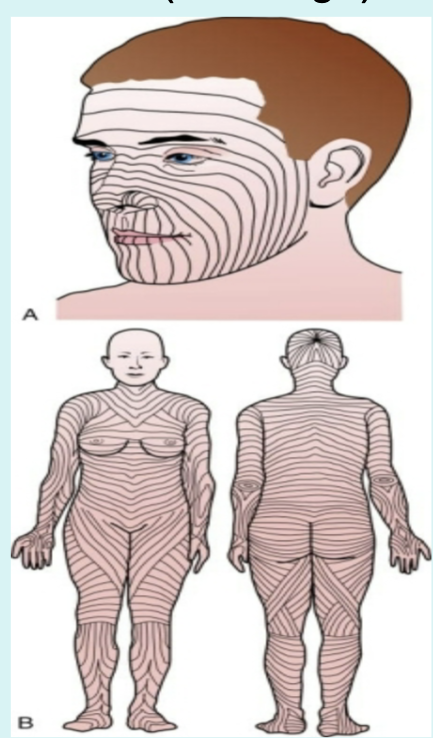
Parallel
Incisions made _____ to the cleavage lines gape less, lower infection rate and therefore heal faster with less scar formation.
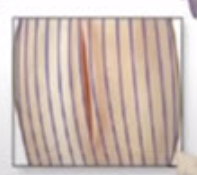
Across
Incisions made _____ cleavage lines gape, higher infection rate and therefore take longer to heal with less scar formation.
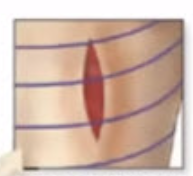
Striae
Stretch Marks - are a type of skin scarring that appear as lines, stripes, or bands on the skin.
Merkel Discs
Epidermal-dermal junctions; act as light touch. Is the functional unit, consisting of the Merkel cell combined with an associated afferent nerve ending.
Meissener’s Corpuscles
In the papillary layer of the dermis and act as touch receptors. Rapidly adapting, specialized mechanoreceptors located in the hairless skin, particularly in the fingertips, lips, and palms.
Root hair plexus
Wrapped around the base of a hair follicle called the hair bulb and it’s stimulated when the hairs bend; act as touch.
Basale; dermis
Accessory structures of the skin are all derived from the stratum _____ of the epidermis but reside in the ______: where they can get nutrients.
Sweat glands
Also known as sudoriferous glands. Simple (coiled) tubular multicellular exocrine glands. 2 types: Eccrine and Apocrine.
Eccrine sweat glands
3 million of these per person and are abundant in the palms, soles and forehead. They secrete sweat for thermoregulation when body temperature rises. They use the merocrine mode of secretion, hence, they are also known as merocrine sweat glands
Eccrine sweat glands
What are the most abundant sweat glands in the body?
Acid mantle
The combination of acidic pH of sweat and dermicidin on the surface of the skin to retard microbial growth.
A hypotonic filtrate of blood
What type of filtrate is sweat?
About 99%
What percentage of sweat is water?
Why sweating helps cool the body
Since water has a high heat of vaporization, heat from the body is used to evaporate water from surface of skin dropping body temperature back to normal).
Antibodies
What immune component is found in sweat?
Vitamin C
What vitamin is present in sweat?
Sodium chloride (NaCl)
What salt is commonly found in sweat?
Metabolic wastes
What types of wastes are found in sweat?
Dermicidin
What antimicrobial protein is found in sweat?
4-6 (acidic)
What is the typical pH range of sweat?
Apocrine sweat glands
2000 of them located in the anogenital and axillary (armpits) areas and they become active after puberty when they are stimulated by the sex steroid hormones. They secrete a viscous, yellowish fluid onto hair follicles via merocrine mode of secretion. Secretion is associated with body odor hence, these are also known as “ODORIFEROUS” glands.
Ceruminous and mammary glands
What are the two specialized sweat glands?
Ceruminous glands
Specialized sweat glands located in the lining of the external ear canal; they secrete a bitter substance called cerumen (earwax) which prevents entry of foreign objects such as, insects and water, into the ear.
Mammary glands
Specialized sweat glands located in breasts; secrete milk to feed the young.
Sebaceous glands
Also known as Oil glands. Simple (branched) alveolar multicellular exocrine glands that are found all over the body except the palms/soles. They secrete an oily substance called sebum into hair follicles and via pores to the surface of the skin which softens and lubricates hair and skin. They secrete via the holocrine mode of secretion.
Whiteheads
Sebum accumulated in the ducts of the sebaceous glands.
Blackheads
Popped whiteheads that result in oxidation and darkening.
Acne
Inflammation of sebaceous glands caused by bacteria.
Pili
Hairs = ____
Shaft and root
What are the two regions of hair?
Shaft
Region of hair exposed above the skin.
Root
Region below the skin enclosed by the hair follicle.
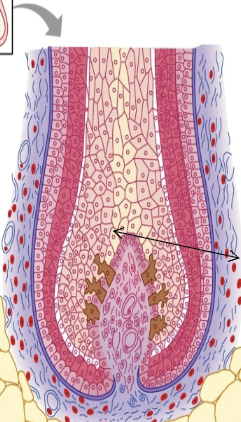
Shaft and root
What is produced by cells in the matrix inside hair follicles?
Hair matrix
What is this a picture of?
Hirsutism
A common condition in women involving excessive growth of dark, coarse hair in male-pattern areas like the face, chest, and back, typically driven by high androgen levels.
Alopecia
Hair loss, commonly characterized by thinning hair, bald patches, or total hair loss on the scalp or body.
Protection and insulation
What is the function of hair?
Thermoregulation
The biological process by which the body maintains an optimal internal core temperature (roughly or in humans) by balancing heat production and loss.
Nails
Made of tightly packed, hard, keratinized epidermal cells. They consist of a body, a root, lunula, hyponychium, and Eponychium or cuticle.
Nail body
Portion of the nail that is visible.
Free edge
Part of the nail that extends past the distal end of the digit.
Nail root
Portion of the nail buried in a fold of skin.
Lunula
Means little moon- crescent shaped area of the nail (visible part of the nail matrix).
Hyponychium
Secures the nail to the fingertip- thickened stratum corneum.
Enponychium or cuticle
Narrow band of epidermis- growth of nails is in the nail matrix.
Nails
____ are scale-like modification of the epidermis.
Protein; keratin
Fingernails and toenails are composed of dead cells impregnated with a tough protective ____ called ____.
Basal Cell Carcinoma, Squamous Cell Carcinoma, and Melanoma
What are the three main types of skin cancer?
Basal Cell Carcinoma
Involves the proliferation of keratinocytes in the stratum basale. The least malignant and most common type of skin cancer ( 80% ); grows slowly.
Squamous Cell Carcinoma
Involves the cells in the stratum spinosum. Second most common type of skin cancer; grows rapidly.
Melanoma
Proliferation of the melanocytes; most aggressive type of skin cancer, highly metastatic and resistant to chemotherapy; least common.
Burns
Tissue damage by intense heat, radiation, electricity and chemicals such as acids. Classified based on severity.
First-degree burns
Damage is confined to only the epidermis; associated with redness, swelling and pain; heal in 3day without medical intervention. Ex. Sunburn.
Second-degree burns
Damage to the entire epidermis and the papillary layer of the dermis; associated with blisters (fluid collection at the epidermal-dermal junction), swelling, redness and pain; heal in 3-4 weeks if infection is prevented.
Third-degree burns
Damage to the entire skin= damage to the entire epidermis and dermis including all nerve endings hence, the burn site is not painful; subjected to infections and fluid loss; medical intervention involving grafting, fluid, protein and ion replacement are required for healing.
By the percentage of total body surface area (TBSA) damaged
How is the extent of a burn wound measured?
The Rule of Nines
What method is used to estimate the percentage of body surface burned?

