Chapter 25 Seedless Plants
 Call Kai
 Learn
Learn Practice Test
 Spaced Repetition
 Match
Match Flashcards
 Knowt Play
1/12

There's no tags or description
Looks like no tags are added yet.
Name | Mastery | Learn | Test | Matching | Spaced | Call with Kai |
|---|
No analytics yet
Send a link to your students to track their progress
13 Terms
Introduction: Seedless plants
Kingdom Plantae
more than 300,000 species of plants
260,000 are seed plants. Seedless plants represent a small fraction
Most seedless plants require a moist environment for reproduction
Mosses, ferns, conifers and flowering plants belong to the plant kingdom
Plant Adaptations to life on land
tolerance to dryness: Mosses are very tolerant
Structural support that is not just buoyancy by water
Gametes are protected from desiccation
Colonization of environments with high humidity: Ferns are seen at the bottom of the temperate forests
Resistance to desiccation: Cacti
Adaptation Continued: 4 major adaptation for success
alternation of generation (sporophyte and gametophyte)
apical meristem tissue in roots and shoots
waxy cuticle to resist desiccation (not all mosses have it)
cell walls with lignin to support structures off the ground
Alternation of Generation
All sexually reproductive organisms have both haploid and diploid cells in their life cycles
Haplontic - dominant haploid stage
Diplontic - dominant diploid stage
Alternation of Generation describes a life cycle in which an organism has both haploid and diploid multicellular stages.
Plants are haplodiplodontic
sporophyte stage is barely noticeable in seedless plants: liverworts and ferns
Alternate name for land plants is embryophytes
Sporangia in Seedless plants
sporophyte of seedless plants is diploid: results from syngamy which is the fusion of 2 gametes
Sporangia means spore in a vessel (reproductive sac in which spores are formed)
Diploid sporocytes undergo meiosis to produce haploid spores
Spores are released and spread across the environment, where the haploid spore could germinate in a hospitable environment
It will generate a multicellular gametophyte by mitosis
Homosporous
plants produce only one type of spore, and the resultant gametophyte produces both male and female gametes on the same individual (Nonvascular plants are homosporous, with the gametophytes being dominant)
Heterosporous
plants produce 2 types of spores , (males are called microspores and females are called megaspores). Seedless vascular plants and seed plants are heterosporous
Sporopollenin
is a tough polymer that protects the spores of seedless plants - resistant to chemicals and biological degradation
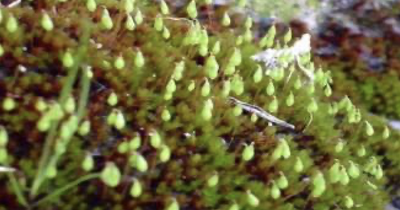
Spore
producing sacs called sporangia grow at the ends of long, thin stalks in this photo of the moss Bryum capillare
Gametangia in Seedless plants
found in the multicellular haploid gametophytes
they give rise to the gametes by mitosis
male gametangium (antheridium) produces flagellated sperm
Female gametangium (archegonium)
embryo develops inside the archegonium as the sporophyte
gametangia are very prominent in seedless plants
Apical Meristems
increase in length of shoots and roots through rapid cell division in a tissue known as apical meristem - a small mitotically active zone found at the shoot tip or root tip
is made of undifferentiated cells that continue to differentiate throughout the life of the plant
Elongation of shoots and roots allows plants to have more access to light, water, and minerals
Lateral meristem produces cells for the increase in diameter of tree trunks
Additional Land plant adaptations
Evolution of vascular tissues - Xylem and Phloem
Xylem conducts water and minerals absorbed from the soil up to the shoot
Phloem transports food derived from photosynthesis
development of shoots
root system for taking water and minerals and anchoring the plants
Waxy, waterproof cover known as cuticle protects the leaves and stems from desiccation
Stomata for the intake of carbon dioxide
Biosynthetic pathways gave rise to Flavonoids and other pigments to absorb UV wavelengths of light
Secondary metabolites: complex organic molecules such as alkaloids with noxious smells and unpleasant taste to deter animals
We have exploited the secondary metabolites for drugs, medication, or spices
Sweet and nutritious metabolites lured animals into providing valuable assistance in dispersing pollen grains, fruits or seeds
Evolution of Land Plants
Early era - Paleozoic has 6 periods: Cambrian, Ordovician, Silurian, Devonian, Carboniferous, and Permian
Ordovician: 500 mya when the land was colonized by the ancestors of the modern land plants
Oldest known vascular plants date back to the Devonian period
End of the Devonian era was marked by the emergence of ferns, horsetails and seed plants which populated the landscape, giving rise to trees and forest
This luxuriant vegetation helped to enrich the atmosphere with oxygen
Plants established early relationship with fungi forming mycorrhizae

