Biological Membranes
 Call Kai
 Learn
Learn Practice Test
 Spaced Repetition
 Match
Match Flashcards
 Knowt Play
1/18

There's no tags or description
Looks like no tags are added yet.
Name | Mastery | Learn | Test | Matching | Spaced | Call with Kai |
|---|
No analytics yet
Send a link to your students to track their progress
19 Terms
Describe biological membranes
Cells / organelles have a phospholipid bilayer
Plasma membranes have a partially permeable membrane and are the site of chemical reactions , role in cell communication
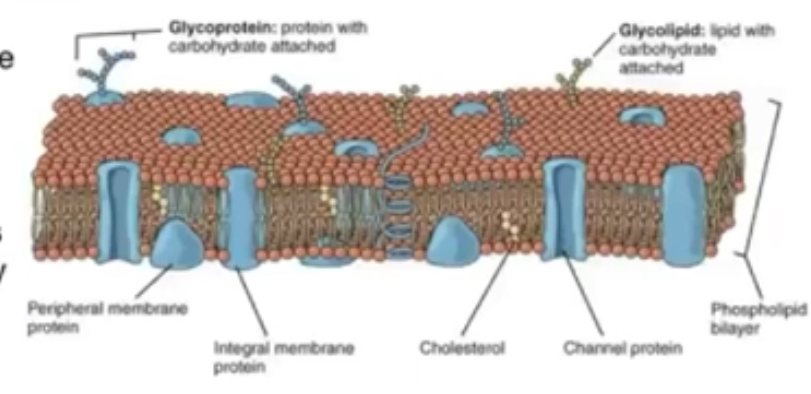
What is the fluid mosaic model:
Plasma membrane described a fluid mosaic model due to movement of phospholipids, proteins, glycoproteins and glycolipids
Arrangement of proteins within the phospholipids
Describe the phospholipid and cholesterol features of fluid mosaic model
Phospholipid: acts as a bilayer due to hydrophilic heads attracted to water and hydrophobic tails repelled by water
Cholesterol is in some membranes, this restricts lateral movement of other molecules Useful = makes membrane less fluid at high temperatures and prevents water and ions leaking out of cell
Describe the protein features of the fluid mosaic model
Extrinsic (peripheral) proteins mechanical support, make glycoproteins and glycolipids. Function = cell recognition, act as receptors
Intrinsic (integral) proteins = protein carriers/ channels involved in transport of molecules across membranes
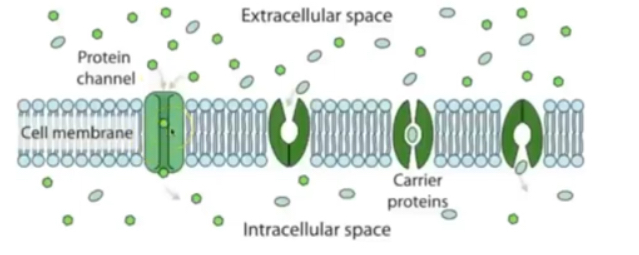
Protein channel form tubes filled water to enable water soluble ions to diffuse
Carrier proteins = bind to other ions and larger molecules, like glucose and amino acids, and change shape ro transport them to other side of membrane
Factors that affect membrane structure and personality
Temperature = increase kinetic energy of phospholipids, so they move more Increases fluidity of membrane and permeability and structure starts to break. Now particles can cross membrane easier
Too high = denatures carrier and channel proteins
Solvents = organic solvents (alcohol)dissolve phospholipid bilayer in membranes, damage causes fluidity of membrane to increase, and is more permeable
What are the six movements of transport across membranes
Simple diffusion
Facilitated diffusion
Osmosis
Active transport
Endocytosis
Exocytosis
Describe simple diffusion:
Net movement of molecules from area of high concentration to area of low concentration until equilibrium is reached
Doesn’t require energy (ATP)
Molecules must be lipid soluble and small to diffuses across membrane
Describe facilitated diffusion
Passive process, down concentration gradient through proteins
Movement of ions and polar molecules transported across membranes using protein channel / carrier proteins
Osmosis
Movement of water from area of high water potential to area of lower water potential across a partially permeable membrane
What are the different types of solutions?
Isotonic = water potential of solution is same in solution and the cell within the solution (normal)
Hypotonic = water potential of solution is more positive (closer to 0) than a (swelling)
Hypertonic = water potential of solution is more negative than the cell
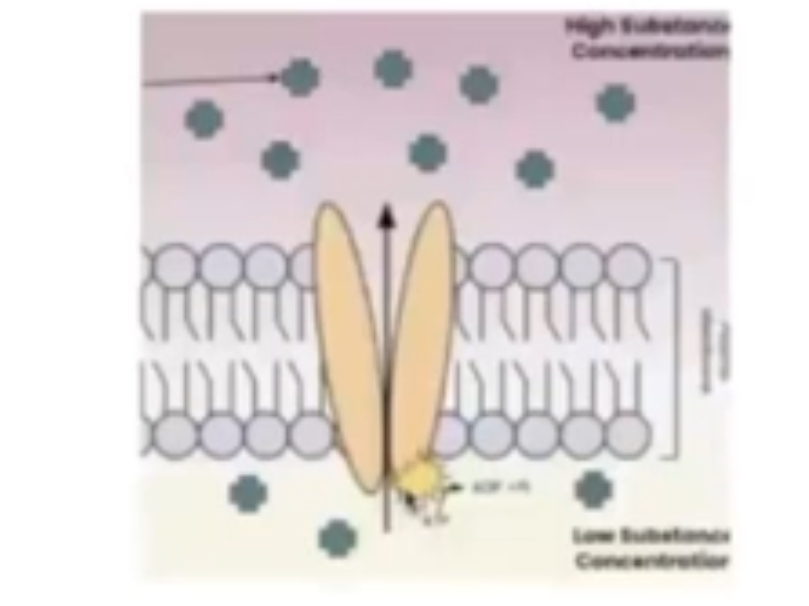
Describe active transport
Movement of molecules and ions from area of low concentration to area go higher concentration (against concentration gradient) using ATP and carrier proteins
Talk about how active transport is selective
Only certain molecules can bind to receptors site on carrier proteins = selective
ATP binds to protein on inside of membrane and is hydrolysed to ADP and Pi
Then protein changes shape and open towards the inside of the membrane
Molecule released on other side of membrane
Pi molecule is released from protein, protein reverts to original shape
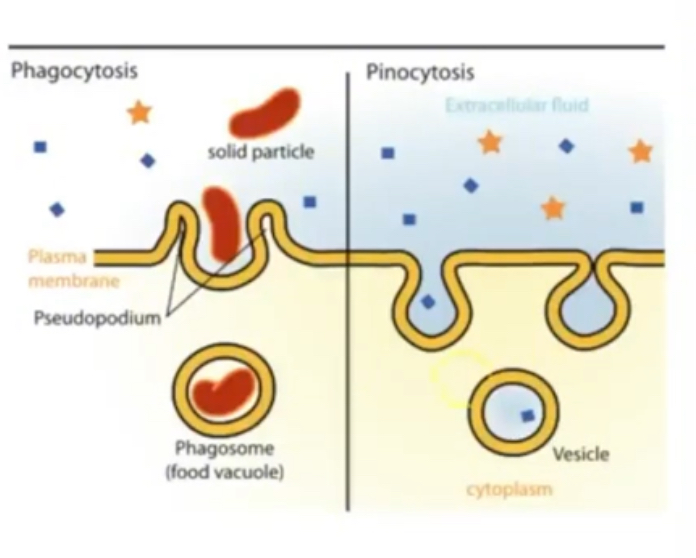
Describe process of endocytosis:
Type of active transport - bulk transport of molecules into a cell
Cell surface membrane bends inwards around molecule to form a vesicle Vesicle pinches off and moves within cytoplasm
Why can endocytosis be classed as phagocytosisi or pinocytosis?
Phagocytosis = when it is a solid particle being taken in Pinocytosis = when a liquid is being taken in
Requires energy from ATP for cell to engulf and change shape around material
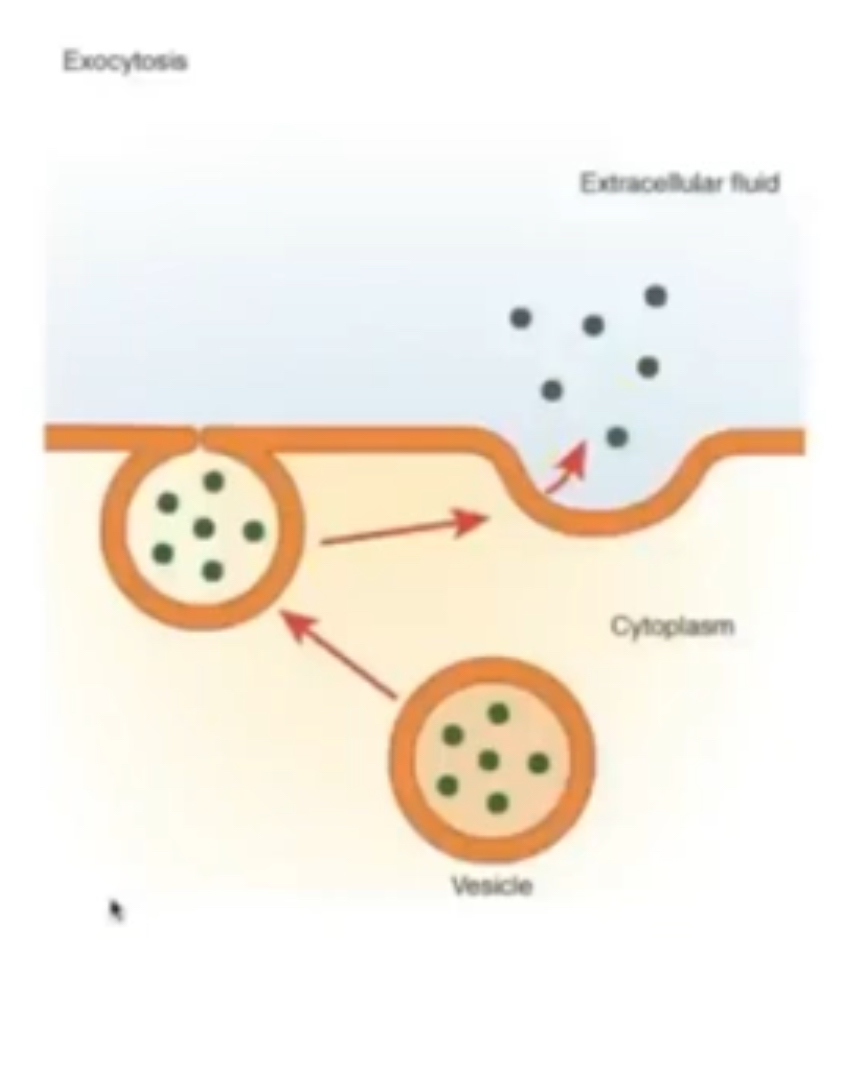
Describe Exocytosis
Bulk transport of molecules out of a cell
Vesicles move toward cell surface membrane, fuse with membrane and the content of the vesicle is release out of cell
Required energy because ATP needed to move vesicle along cytoskeleton