W10 Building High-Performing Entrepreneurial Teams
 Studied by 0 people
 Call Kai
 Learn
Learn Practice Test
 Spaced Repetition
 Match
Match Flashcards
 Knowt Play
1/8

Earn XP
Description and Tags
Flash cards for Building High-Performing Entrepreneurial Teams
Name | Mastery | Learn | Test | Matching | Spaced | Call with Kai |
|---|
No study sessions yet.
9 Terms
Why do teams matter in Entrepreneurship?
Teams are important in entrepreneurship because they greatly increase the chances of success. Research shows that teams have a 3× higher success rate than solo founders, and 85% of new ventures are created by teams. Teams bring together different skills and perspectives, helping entrepreneurs solve problems more effectively. Understanding real team formation—choosing partners with complementary abilities and shared goals—also prepares students for creating strong, sustainable ventures in the future.
Explain the key factors involved in entrepreneurial team formation and how team composition affects venture outcomes.
Entrepreneurial team formation is the process through which founders come together to start a venture. Unlike corporate teams, these teams are small, self-selected, and formed organically as founders choose both the business opportunity and the right partners.
Effective team formation depends on three key factors:
Skills & Competencies:
Teams need members with technical expertise, functional experience, and complementary capabilities that fill important gaps in the venture.Interpersonal Fit:
Trust, shared values, and good communication styles help the team work smoothly and avoid unnecessary conflict.Opportunity Recognition:
Founders must share an entrepreneurial mindset and the ability to identify and evaluate market opportunities.
Team composition strongly influences venture success. Diverse teams offer more creativity and innovation but may face more conflict, while homogeneous teams make quicker decisions but lack skill variety. The goal is to find the balance that best fits the needs of the specific venture.
What are the three Core Team Formation Strategies?
Resource-Seeking Strategy: is when a team looks for people who can provide skills they don't already have. Instead of choosing friends or random partners, the team identifies what abilities are missing—like marketing, finance, or technical skills—and then recruits someone who can fill that gap. This helps the venture have the right mix of knowledge to solve problems and reach its goals.
Interpersonal Attraction Strategy: is when teams form based on friendship, trust, and existing relationships. People choose teammates who are similar to them or who they already know well—such as friends, family, or coworkers. This makes working together easier and helps avoid conflict, but it can also mean the team has less variety in skills.
Dual Strategy Approach: both smart planning and natural connections. First, they plan what skills the business needs (like finance, marketing, or tech). Then, they stay open to adding people they already know or meet along the way if those people fit the team. By mixing both methods, the team gets the right skills while also keeping trust and easy communication. In simple words, they plan the team they want, but also stay flexible about who joins.
Explain how team heterogeneity, team size, and industry context influence entrepreneurial team effectiveness.
Entrepreneurial team effectiveness depends on multiple factors, including team diversity, size, and the industry environment.
Team heterogeneity—having members with different skills and backgrounds—improves creativity, problem-solving, and innovation. Although diversity can increase conflict, it is especially valuable in entrepreneurial settings where flexibility and broad market understanding are important.
Team size also matters. Larger teams can handle more information, perform complex tasks, and access wider networks. However, they face greater coordination challenges. In uncertain environments, larger teams often perform better because they can manage multiple demands.
Industry context shapes which type of teamwork is best. In high-tech industries with high uncertainty, diverse teams and strong human capital provide an advantage. In low-tech industries, more homogeneous teams may perform better because shared knowledge and efficiency are more important.
How does Social Identity Theory explain team behavior in entrepreneurial ventures, and what effects does strong group identification have on team performance?
Social Identity Theory (SIT): People define part of who they are through the groups they belong to. This shapes their attitudes and behavior, increases teamwork, but can also cause bias against outsiders.
Self-Categorization Theory (SCT): When team identity becomes important, members follow group norms and focus more on team goals than personal goals.
In entrepreneurial teams:
Strong identification with the venture increases motivation, commitment, and team cohesion.
Team members are more willing to work harder, innovate, and help others.
Example: In a social enterprise fighting food insecurity, team members may work extra hours and share ideas because the mission feels personal to them.
What is Organisational Identification (OID)?
What is Workgroup Identification (WID)?
How do nested identities influence performance in entrepreneurial teams?
Organisational Identification (OID)
When a person feels connected to the whole organisation
They believe in the mission and values
Leads to higher motivation, job satisfaction, and commitment
People are less likely to quit
Helps everyone work toward the same goals
Workgroup Identification (WID)
When a person feels strongly connected to their own team
Improves teamwork, trust, and innovation
People feel safe to share ideas
Problem: If team loyalty is too strong, it can cause conflict with other teams
Nested Identities (NID)
When a person identifies with both their team and the organisation
Creates balance between teamwork and company goals
Improves cooperation across teams
Helps the organisation adapt and succeed
Very short exam summary
OID connects employees to the organisation, WID connects them to their team, and NID balances both to improve teamwork and overall success.
How can entrepreneurial teams manage multiple nested identities, and what are the strategic implications for team performance and innovation?
Multiple (Nested) Identities in Entrepreneurial Teams
Team members identify with themselves, their team, and the whole organization
Balancing Workgroup Identification (WID) and Organizational Identification (OID):
Reduces stress
Improves well-being
Improves communication and leadership
Boundary Spanners
People who connect different teams or groups
Help share information and ideas
Reduce silos (teams working alone)
Increase innovation and collaboration
Risks of Strong WID Only
Can cause conflict between teams
Reduces flexibility and adaptability
Creates resistance to change or new ideas
HRM Strategies for Entrepreneurs
Encourage identification with both team and organization
Recognize and reward positive contributions
Watch for over-identification with one group
Develop boundary spanners to improve teamwork
Very short conclusion (exam)
Managing multiple identities helps entrepreneurial teams stay innovative, adaptable, and aligned with organizational goals.
case study
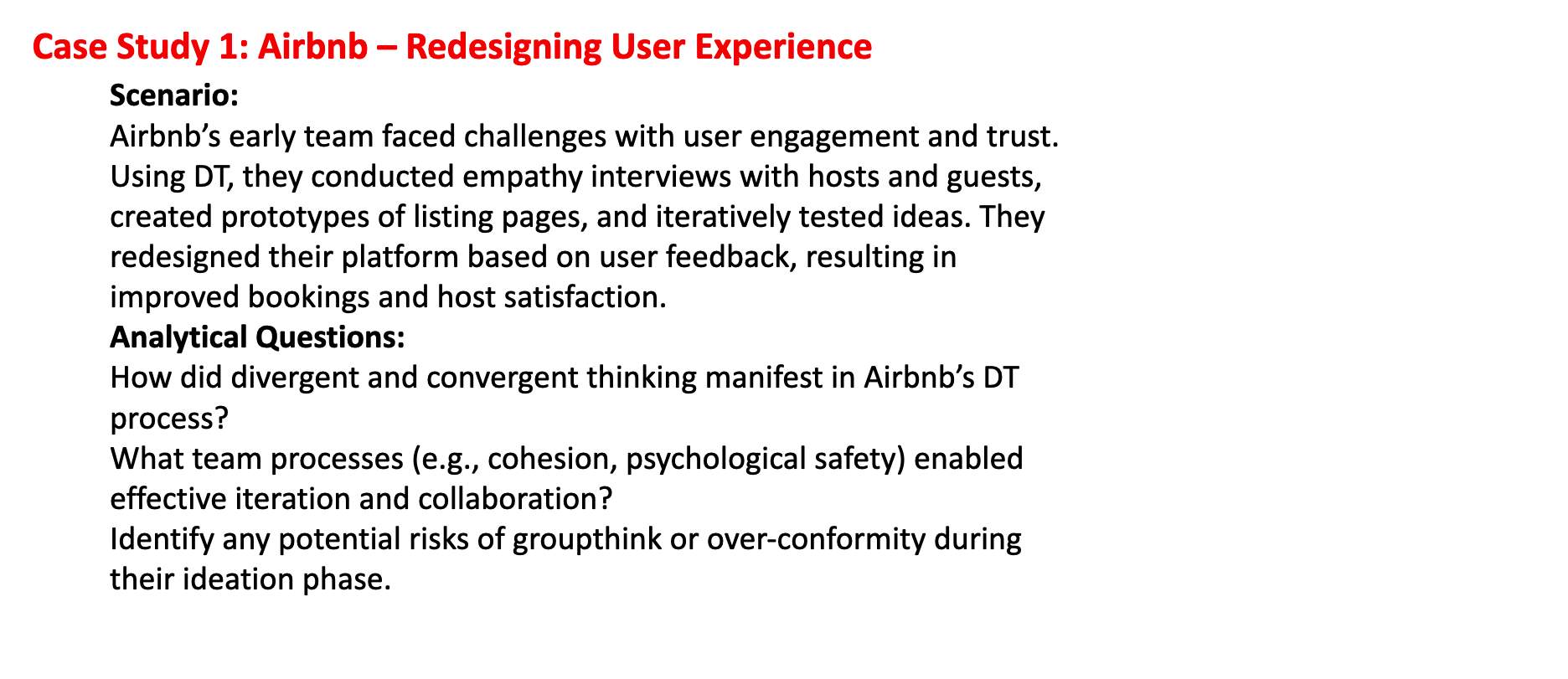
Divergent thinking: Airbnb’s team explored many ideas during empathy interviews and when generating multiple concepts for listing pages. They considered a wide range of user needs, problems, and potential solutions.Convergent thinking: The team narrowed these ideas by creating prototypes, testing them with users, and selecting the solutions that best improved bookings and host satisfaction. This iterative testing helped them focus on the most effective designs.
Airbnb’s team likely relied on:
Cohesion: Strong teamwork and shared commitment to solving user problems.
Psychological safety: Team members felt safe sharing ideas, feedback, and critiques without fear of judgment.
Open communication: Continuous dialogue during testing and iteration helped quickly identify and resolve issues.
These processes allowed the team to iterate rapidly and improve the platform based on real user feedback.
Potential risks included:
Groupthink: Team members might suppress dissenting opinions to maintain harmony, which could limit creative solutions.
Over-conformity: Relying too heavily on dominant ideas could prevent exploration of alternative designs.
Confirmation bias: The team might favor feedback that confirms their initial assumptions, ignoring critical insights.
Awareness of these risks is important to ensure diverse ideas are considered and innovation is maximized.
case study
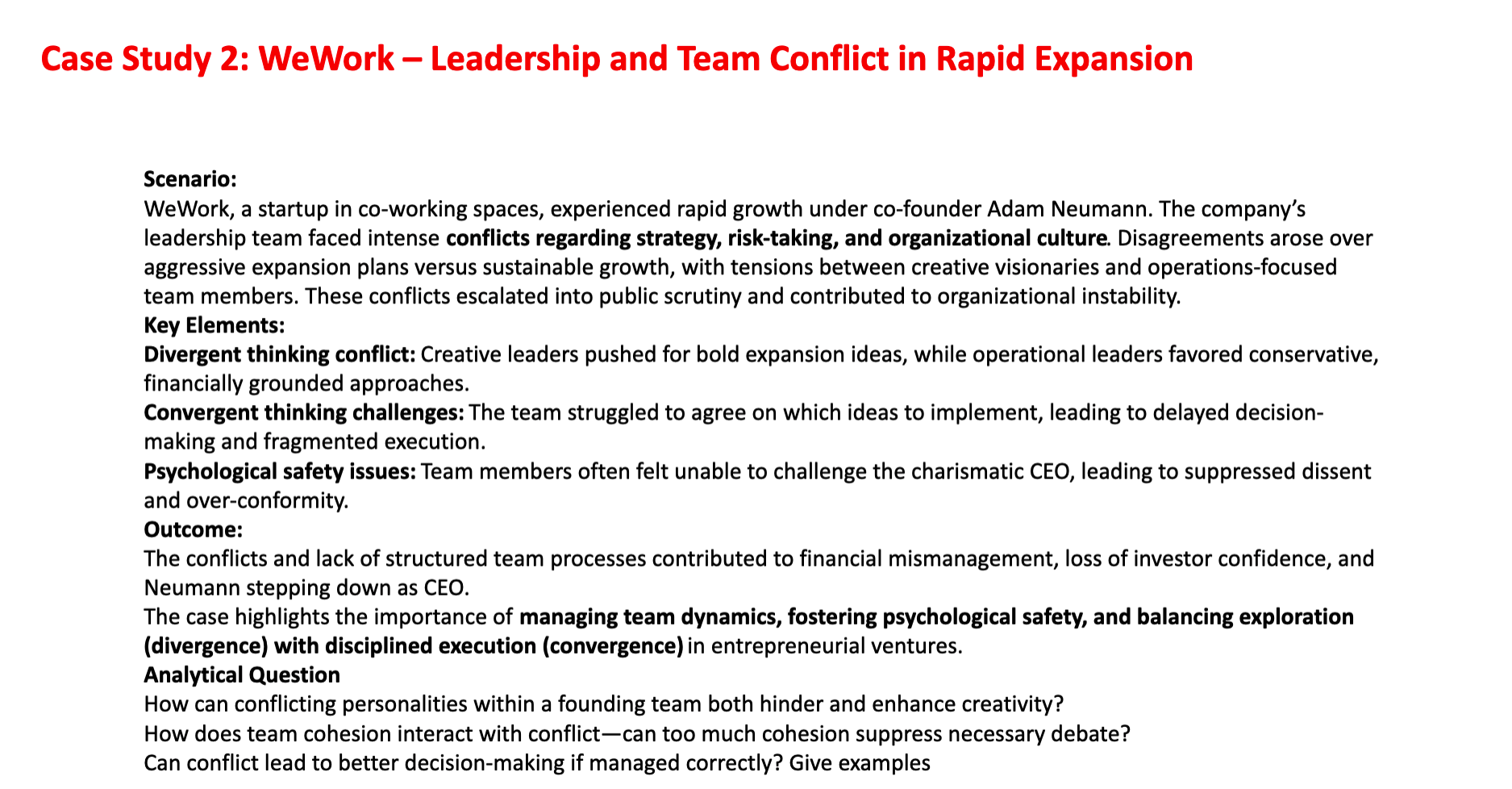
Conflicting personalities can enhance creativity by bringing diverse perspectives and challenging assumptions, leading to innovative ideas—e.g., WeWork’s creative leaders pushed bold expansion concepts. However, conflict can hinder creativity if it escalates into tension or personal disputes, causing stress, poor collaboration, or delayed decisions, as seen when operational leaders resisted risky strategies.
High team cohesion encourages trust and smooth collaboration but too much cohesion can suppress debate. Members may avoid expressing dissenting opinions to maintain harmony. In WeWork, psychological safety was low, and the charismatic CEO’s influence discouraged challenges, which allowed risky or unbalanced strategies to go unexamined.
Yes, conflict can improve decision-making when managed constructively. Divergent views encourage teams to consider multiple options and evaluate risks carefully. For example, in a balanced founding team, creative leaders proposing bold expansions and operational leaders providing financial caution could combine insights to create innovative yet feasible strategies. Proper facilitation and psychological safety ensure debates remain productive rather than destructive.
 Note
Note  Flashcards (113)