Tectonic movements

0.0(0)
Studied by 0 people
call kaiCall Kai
learnLearn
examPractice Test
spaced repetitionSpaced Repetition
heart puzzleMatch
flashcardsFlashcards
GameKnowt Play
Card Sorting

1/7

encourage image

There's no tags or description

Looks like no tags are added yet.

Last updated 6:27 PM on 3/26/26
Name
Mastery
Learn
Test
Matching
Spaced
Call with Kai

No analytics yet

Send a link to your students to track their progress

8 Terms

1
New cards

What is seafloor spread

Seafloor spread is where tectonic plates pull laterally a part at mid-ocean ridges, magma then rises to fill the gap forming new oceanic crust. This proves earth’s crust is continually being created. Leads to formation of ridges such as mid-Atlantic ridge.

Note:

older rock found further away from ridge.
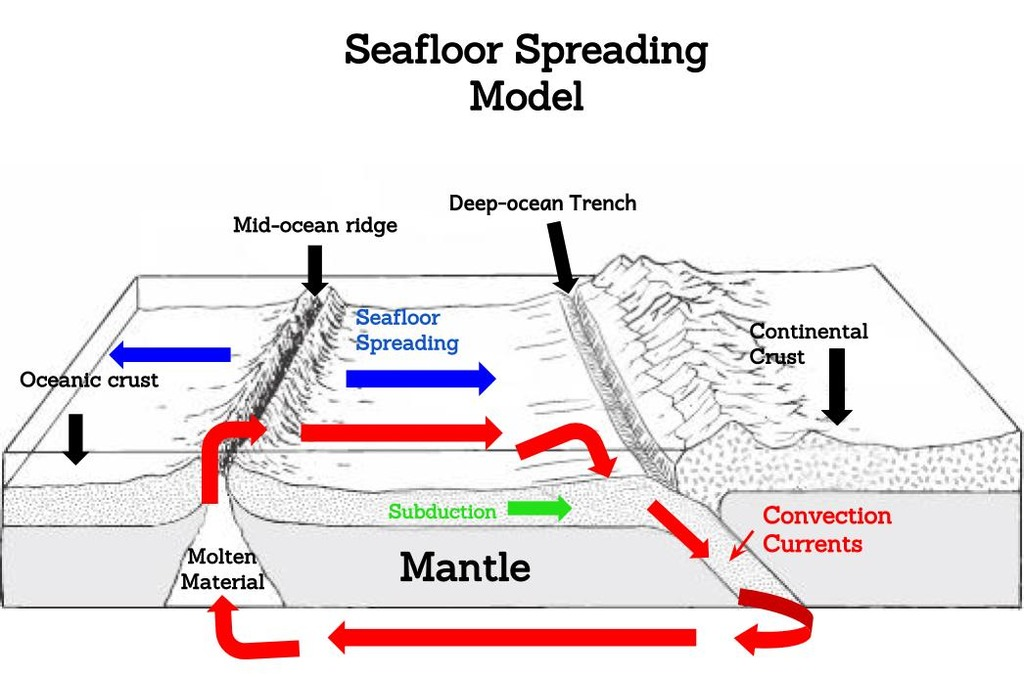
<p>Seafloor spread is where tectonic plates pull laterally a part at mid-ocean ridges, magma then rises to fill the gap forming new oceanic crust. This proves earth’s crust is continually being created. Leads to formation of ridges such as mid-Atlantic ridge.</p><p>Note:</p><p>older rock found further away from ridge.</p>
2
New cards

At what rate does the crust grow a year

Around 2-16cm a year the same rate at which your fingernails grow

3
New cards

Why do continental plates subduct underneath the oceanic plates

Continental plates aren’t as dense as oceanic plate so does not sink into the asthenosphere

4
New cards

What is palaeomagnetism

  1. Magma erupts on ocean floor at constructive plate boundaries as they are moving apart

  2. Iron minerals with iron-rich basaltic rocks are aligned to the magnetic field of the earth and become polarised

  3. Earth’s polarity reverses approximately every 400,000 years, which results in a series of magnetic stripes in alternating polarity within rocks

  4. Pattern mirrored on both sides of ridge, suggesting sea floor is spreading away from boundary
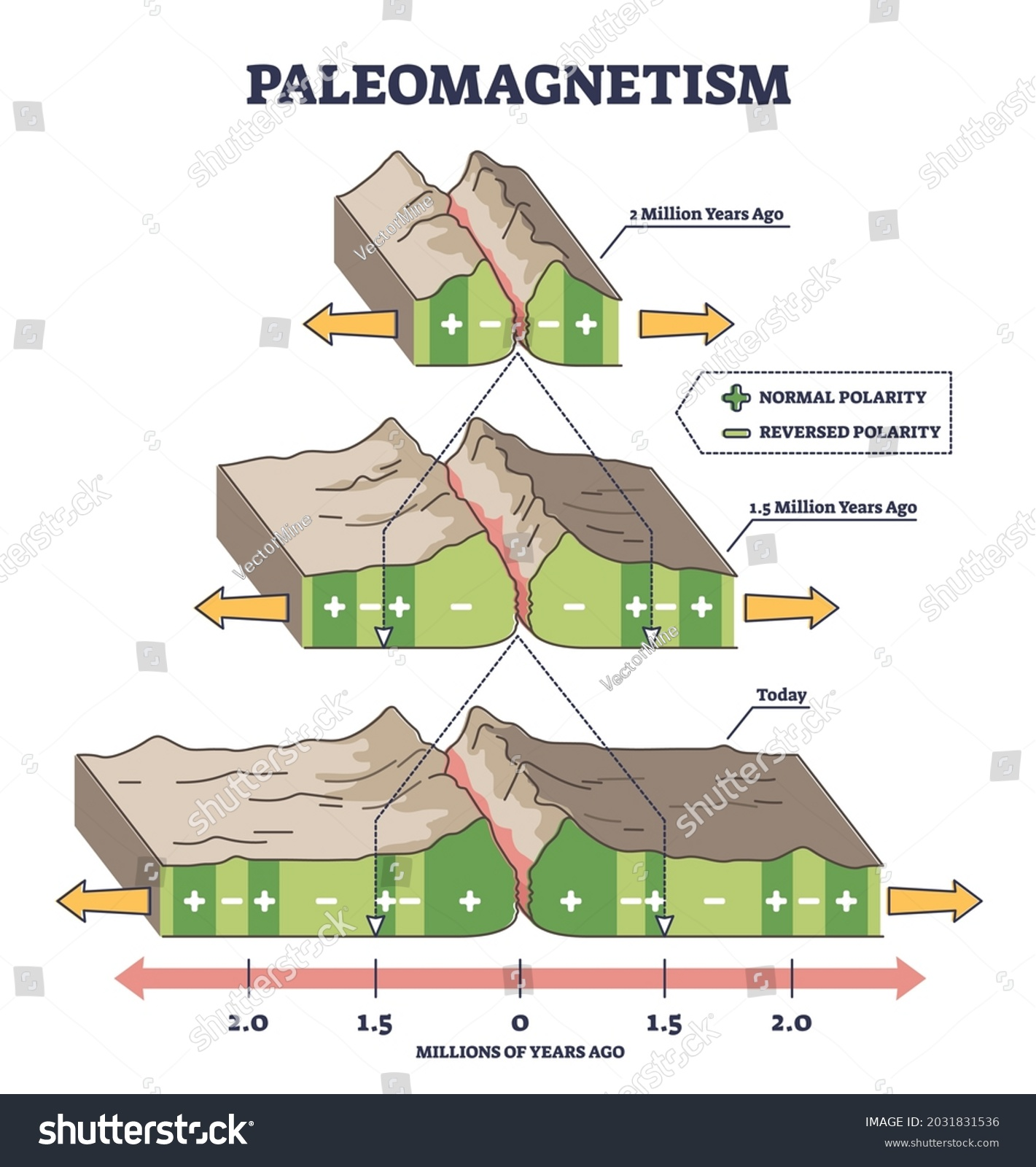
<ol><li><p>Magma erupts on ocean floor at constructive plate boundaries as they are moving apart </p></li><li><p>Iron minerals with iron-rich basaltic rocks are aligned to the magnetic field of the earth and become polarised</p></li><li><p>Earth’s polarity reverses approximately every 400,000 years, which results in a series of magnetic stripes in alternating polarity within rocks</p></li><li><p>Pattern mirrored on both sides of ridge, suggesting sea floor is spreading away from boundary</p></li></ol><p></p>
5
New cards

How convection currents work

  1. Earth’s core releases heat energy, heating up rocks in lower mantle which means they are less dense than the cooler rock above in the mantle

  2. Warmer rock rises, whilst cooler rock in upper mantle begins to sink. Movement of rocks means convection currents formed within mantle

  3. As mantle heats up from convection currents these currents warm the crust. The heat drives tectonic movement

OUTDATED though
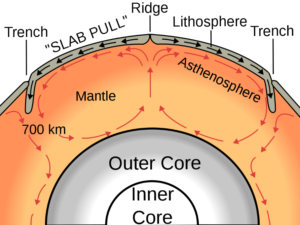
<ol><li><p>Earth’s core releases heat energy, heating up rocks in lower mantle which means they are less dense than the cooler rock above in the mantle</p></li><li><p>Warmer rock rises, whilst cooler rock in upper mantle begins to sink. Movement of rocks means convection currents formed within mantle</p></li><li><p>As mantle heats up from convection currents these currents warm the crust. The heat drives tectonic movement</p></li></ol><p></p><p>OUTDATED though</p><p></p>
6
New cards

What is ridge push

  1. Newly formed crust is hotter and less dense than older oceanic crust so rises forming the elevated ridge

  2. So height of mid ocean ridge is higher than surrounding ocean floor so gravitational force cause lithosphere to slide away from ridge towards subduction zone-this is called ridge push

  3. As plates spread they get older and denser and sink slightly
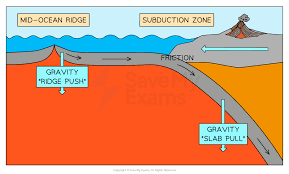
<ol><li><p>Newly formed crust is hotter and less dense than older oceanic crust so rises forming the elevated ridge </p></li><li><p>So height of mid ocean ridge is higher than surrounding ocean floor so gravitational force cause lithosphere to slide away from ridge towards subduction zone-this is called ridge push</p></li><li><p>As plates spread they get older and denser and sink slightly</p></li></ol><p></p>
7
New cards

What is slab suction

  1. As oceanic plate sinks into mantle it drags surrounding mantle with it

  2. This creates downward flow of mantle generating weak suction force which sucks overlying plates together

8
New cards

What is slab pull

The force at subduction zones where a cold dense oceanic plate sinks deep into mantle pulling rest of plate into lithosphere driving tectonic movement

Explore top notes

Explore top flashcards

flashcards
Chemistry test 2
20
Updated 873d ago
0.0(0)
flashcards
UTS FINALS
33
Updated 809d ago
0.0(0)
flashcards
La progrès et la recherche
80
Updated 37d ago
0.0(0)
flashcards
Niemiecki - 7.03
65
Updated 380d ago
0.0(0)
flashcards
AQA GCSE GERMAN - UNIT 2
131
Updated 1289d ago
0.0(0)
flashcards
preterite vocab march 2
31
Updated 1121d ago
0.0(0)
flashcards
Review: Science Exam
58
Updated 1208d ago
0.0(0)
flashcards
Chemistry test 2
20
Updated 873d ago
0.0(0)
flashcards
UTS FINALS
33
Updated 809d ago
0.0(0)
flashcards
La progrès et la recherche
80
Updated 37d ago
0.0(0)
flashcards
Niemiecki - 7.03
65
Updated 380d ago
0.0(0)
flashcards
AQA GCSE GERMAN - UNIT 2
131
Updated 1289d ago
0.0(0)
flashcards
preterite vocab march 2
31
Updated 1121d ago
0.0(0)
flashcards
Review: Science Exam
58
Updated 1208d ago
0.0(0)



