Unit I - EM Spectrum
 Call Kai
 Learn
Learn Practice Test
 Spaced Repetition
 Match
Match Flashcards
 Knowt Play
1/15

Earn XP
Name | Mastery | Learn | Test | Matching | Spaced | Call with Kai |
|---|
No analytics yet
Send a link to your students to track their progress
16 Terms
Types of EM waves
EM waves with different wavelengths have different properties
7 types (depending on wavelength) but types merge to form continuous spectrum
All types of EM radiation are transverse waves and travel at same speed through free space
Order of EM spectrum
Radioactive Monkeys Invade Venus Using X-ray Guns
Radio waves
Microwaves
Infrared
Visible light
Ultraviolet
X-rays
Gamma rays
(in order of increasing frequency and decreasing wavelength

Visible light
ROY G BIV
Red
Orange
Yellow
Green
Blue
Indigo
Violet
(in order of increasing frequency and decreasing wavelength)
Radio wave uses
Broadcasting + communications
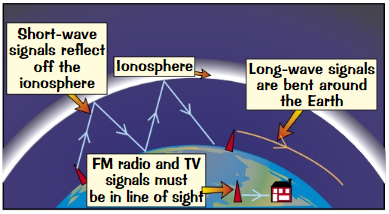
Long-wave radio can be transmitted a long way because long wavelengths are bent around curved surface of Earth
Short-wave radio signals can be received at long distances from transmitter because they’re reflected from ionosphere (layer of Earth’s atmosphere)
Radio waves used to TV and FM radio broadcasting have very short wavelengths
To get reception, you must be in direct sight of transmitter
Microwave uses
Cooking + satellite transmission
Satellite communication uses microwaves
For satellite TV, signal from transmitter is transmitted into space, where it’s picked up by satellite receiver dish orbiting Earth
Satellite transmits signal back to Earth where it’s received by satellite dish on groundMobile phone calls also travel as microwaves from phone to nearest trasmitter
Microwaves used for cooking
Microwaves absorbed by water molecules in food
They penetrate a few cm into food before being absorbed
Energy is conducted/convected to other parts of food
Infrared uses
Heating + night-vision equipment
IR radiation is also known as heat radiation
Electrical heaters radiate IR to keep us warmIR is given out by all objects - hotter object = more IR radiation
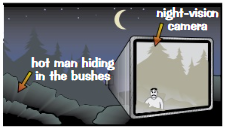
IR radiation given out by objects can be detected in dark by night-vision equipment
Equipment turns it into electrical signal, which is displayed on screen as picture, allowing things in dark to be seen
Visible light for optical fibres
Can be used for communication using optical fibres - which carry data over long distances as pulses of light
Optical fibres work by bouncing waves off the sides of very narrow core
Pulse of light enters fibre at certain angle at one end and is reflected repeatedly until it emerges at other end
Optical fibres are used for telephone and broadband internet cables

Visible light for photography
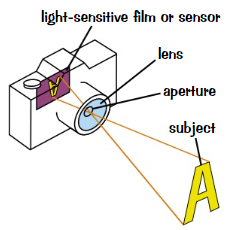
Cameras use lens to focus visible light onto light-sensitive sensor
Lens aperture controls how much light enters camera
Shutter speed determines how long the sensor is exposed to light
By varying aperture + shutter speed, photographer can capture as much/as little light as they want in photo
Ultraviolet uses
Fluorescent lamps
Fluorescence is a property of certain chemicals, where UV radiation is absorbed and visible light is emitted
Fluorescent lights use UV radiation to emit visible light
Safe to use because nearly all UV radiation is absorbed by phosphor coating on inside of glass which emits visible light insteadFluorescent lights are more energy-efficient than filament bulbs
X-ray uses
Observing internal structure of objects/materials
Including bodies - which is why they’re useful in medicine
To make X-ray image, X-rays are directed through object/body onto detector plate
Brighter bits are where fewer X-rays get throughRadiographers in hospitals take X-ray photos to help doctors diagnose broken bones
X-rays easily pass through flesh but not denser material like bones/metal
Gamma uses
Sterilising medical equipment:
Sterilise by killing all microbes
This is better than boiling plastic instruments, which may be damaged by high temp
Sterilising food:
Sterilise by killing all microbes
Keeps food fresh for longer, without freezing or cooking to preserve
Food is not radioactive afterwards, so is safe to eat
Higher frequency EM radiation is…
more dangerous (usually)
because it has more energy
Microwave dangers
Have similar frequency to vibrations of many molecules - so can increase these vibrations
Resulting in internal heating - the heating of molecules inside things
Microwaves heat human body tissue internally
Microwave ovens need shielding to prevent microwaves from reaching user
Infrared dangers
IR frequency range can make surface molecules of any substance vibrate - like microwaves, this has heating effect
IR has higher frequency, so carries more energy than microwave
If human body is exposed to too much infrared, can cause skin burns
Protect yourself using insulating materials to reduce amount of IR reaching skin
Ultraviolet dangers
Can damage surface cells and cause blindness
Some frequencies of UV are ‘ionising’ - carry enough energy to knock electrons off atoms
Can cause cell mutation/destruction and cancerProtect yourself by wearing sunscreen with UV filters when out in sun, and stay out of strong sunlight to protect skin from UV radiation
Gamma dangers
Very high-frequency waves (such as gamma) are also ionising, and carry more energy than UV rays
So can be much more damaging and can penetrate further into body
Ionising radiation so can cause cell mutation, leading to tissue damage/cancer
Radioactive sources of gamma rays should be kept in lead-lined boxes when not in use
When people need to be exposed to them, e.g. medical treatment, exposure time should be as short as possible

