Metabolic Allometry
 Call Kai
 Learn
Learn Practice Test
 Spaced Repetition
 Match
Match Flashcards
 Knowt Play
1/18

There's no tags or description
Looks like no tags are added yet.
19 Terms
Balanced Growth Equation
Ingestion = assimilation + excretion
Assimilation = somatic or individual growth + reproductive growth + respiration
Ingestion
represents the demands the organism puts on the environment
What you eat
Respiration
represents the rate of resource use to meet environmental demands
Breathing and using resources
Production
(new tissue) = assimilation - respiration
Quantifying Energy Flow
• Material budget
– Food in
– Feces etc. out
• Heat production
• O 2 or CO 2 exchange
– Measures aerobic
respiration
Metabolic Measurements
-BMR
-SMR (RMR)
-FMR
-Maximum metabolic rate - burst activity
-Sustainable maximum metabolic rate
BMR
Basal metabolic rate
– Minimal metabolic rate for fasting, non-reproducing, resting
animal under no thermal stress. Minimal cost of survival
SMR/RMR
Standard or resting metabolic rate
Minimal rate under specified thermal conditions
FMR/DEE
Field metabolic rate/Daily Energy Expenditure
—cost of life in real world
• Importance: estimate
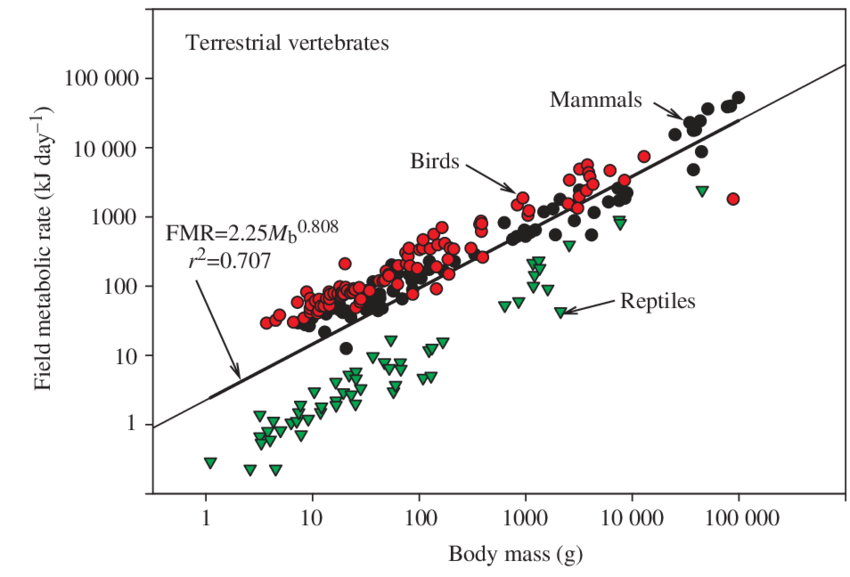
Metabolic Rates Vary with Body Size
As body size increases, MR increases
Logarithmic Transformations of Power Functions
• MR = a M^b (a=constant, b=exponent, M=mass)
• Log MR = log a + b log M
• The exponent b becomes the slope of a straight line
• Transformation spreads out small values
• Make calculation of the best-fitting curve easier.
Why M^0.75? Could it be a “Surface Law”?
• Rate of heat loss ∝ surface area
• For objects of similar shape
– surface area ∝ volume 2/3 = volume 0.67
(Volume³ vs SA²)
– If density is constant, mass ∝ volume
• In resting mammal, heat production by metabolism = heat loss
• Therefore – BMR should be proportional to M0.67 , an ok fit to
measured data.
But the “Surface Law” has Problems
• Shapes and densities of animals differ
• Rates of heat loss vary across body surface, differ between
animals, and often change with adjustments in blood flow or
insulation.
• Measured exponents are usually higher than 0.67
• Metabolic scaling is similar in organisms that do not use
metabolic heat production to keep temperature constant.
Vertebrate Metabolic Scaling
Most vertebrates
near β = 0.75
(root of phylogeny
@ β = 0.78)
Why are Metabolic Rates ∝ M^0.75?
• The “surface law” is based on attractive but specious reasoning.
• Other hypotheses abound
– Within-species patterns @ 2/3 and between @ ¾? (NO!)
– Differences in body temperature?
– Nutrient supply through network of vessels (an energy flow model)
• WBE model best current explanation
What Does Metabolic Scaling Mean to Vertebrate Biology?
• Larger animals always use energy faster than smaller animals.
• Calculate mass-specific metabolic rate, by dividing animal’s
total metabolic rate by its body mass.
Mass-Specific Metabolic Rate
• For endotherms (birds and mammals)
– MR= 4.77M 0.75 where mass is in kg and MR in watts
• So mass-specific metabolic rate (W/kg)
• Mass-specific metabolic rate is the cost of supporting one
unit mass of tissue.
• Mass-specific metabolic rates get lower as body size
increases.
• Mice spend more per gram than rabbits, and rabbits more
per gram than cows.
• Of course, rabbits weigh more than mice, so the total
expenditure for a rabbit is more than that of the mouse, and
a cow uses a lot more energy than one rabbit.
Productivity = Assimilation - Respiration
• Small mammals utilize much more energy than an equal mass of a large mammal.(burning through energy quickly)
• HOWEVER, large mammals can survive without food for longer periods of time!
Assimilation Definition
Taking what you eat, digesting it and using it in body