MRI Physics Chapter 4 Gradient-echo pulse sequences
 Studied by 0 people
 Call Kai
 Learn
Learn Practice Test
 Spaced Repetition
 Match
Match Flashcards
 Knowt Play
1/588

Earn XP
Description and Tags
After reading this chapter, you will be able to: Explain how gradient-echo sequences differ from spin-echo. Describe how gradient-echoes are created. Analyze the steady state and why it is important in gradient-echo pulse sequences. Understand the mechanisms of common gradient-echo pulse sequences. Apply what you have learned to understand how images of different weighting are created using gradient-echo pulse sequences.
Name | Mastery | Learn | Test | Matching | Spaced | Call with Kai |
|---|
No analytics yet
Send a link to your students to track their progress
589 Terms
How do gradient echo sequences differ from spin echo sequences?
Use gradients rather than RF pulses to rephase magnetic moments
What effect does using a smaller flip angle have on the NMV?
Increases longitudinal magnetization recovery
Which characteristic defines gradient echo (GRE) pulse sequences?
Gradient rephasing and variable flip angles
What causes spins in the vector to rephase in a GRE sequence?
Application of a gradient
What is the function of a spoiler in MRI?
To dephase residual transverse magnetization
What parameters are used for T2 weighting in GRE sequences?
Small flip angle, long TR, long TE
Which GRE sequence maintains residual transverse magnetization through rewinding?
Coherent GRE
What is the purpose of incoherent GRE sequences?
Minimize the effects of residual transverse magnetization
How does reverse-echo gradient echo differ from traditional GRE sequences?
Captures true T2-weighted images
What is the main advantage of balanced GRE sequences?
Shorter scan times with fewer flow artifacts
Gradient echo sequences use variable flip angles instead of the 90° flip angle used in spin echo sequences
True/False
True
Residual transverse magnetization is eliminated in coherent GRE sequences.
True/False
False
Rewinder gradients are used to rephase transverse magnetization in GRE sequences.
True/False
True
Echo planar imaging (EPI) is primarily used to reduce physiological motion artifacts
True/False
True
Spoilers are gradients that rephase the spins in a vector.
True/False
False
Reverse-echo gradient echo sequences capture true T2 contrast data.
True/False
True
Balanced gradient echo sequences are only used in cardiac imaging.
True/False
False
Incoherent GRE sequences use RF spoiling to dephase residual transverse magnetization.
True/False
True
Steady State
Condition where energy in equals energy out, maintaining stable magnetization levels.
Residual Transverse Magnetization
Magnetization left over from previous RF pulses in steady-state conditions.
Coherent GRE
Maintains residual magnetization coherence through rewinding
Incoherent GRE
Dephases residual transverse magnetization to minimize its effect on contrast.
Reverse-Echo Gradient Echo
Captures true T2 contrast using rewinder gradients.
Balanced GRE
Reduces flow artifacts using balanced gradient systems.
Actual TE
time between the echo and the next RF pulse in reverse-echo gradient-echo pulse sequences.
Balanced gradient-echo
pulse sequence characterized by a balanced gradient scheme that corrects for flow. Alternating RF pulses with varying phase angles prevent saturation and maintain the steady state.
Bipolar gradient
gradient with two lobes, positive and negative. Often used to dephase and then rephase magnetic moments to produce a gradient-echo.
Blurring
result of T2* decay during the course of the EPI acquisition.
Coherent gradient-echo
pulse sequence characterized by a rewinder gradient. All transverse magnetization (FID and stimulated echo) is rephased so all types of weighting are possible.
Echo-planar imaging
single-shot or multishot acquisition that fills k-space with data from gradient-echoes.
Effective TE
TE selected in TSE. Used to weight the image as accurately as possible given that echoes with different TEs are used to determine image weighting.
Ernst angle
flip angle that generates the highest signal intensity in a tissue with a given T1 recovery time and in a given TR.
Gradient
a linear change of the magnetic field strength.
Gradient-echo
echo produced as a result of gradient rephasing.
Gradient-echo-EPI (GE-EPI)
gradient-echo sequence with EPI readout.
Gradient spoiling
use of gradients to dephase magnetic moments – the opposite of rewinding.
GRASE
gradient-echo and spin-echo.
Hahn echoes
echoes formed when any two 90° RF pulses are used in steady state sequences.
Half FOV ghosts
seen in EPI where a ghost of the real image appears shifted in the phase direction by one half of the FOV.
Hybrid sequences
combination of fast spin-echo and EPI sequences where a series of gradient-echoes are interspersed with spin-echoes.
Incoherent gradient-echo
pulse sequence that spoils the residual transverse magnetization so that the FID makes the most contribution to image contrast. Used for T1 weighting.
Isocenter
center of the bore of the magnet in all planes.
Phase-locked circuit
used in incoherent or spoiled gradient-echo sequences to enable the receiver coil to lock onto the most recently transmitted transverse magnetization. Residual magnetization that has a different phase angle is ignored.
Polarity
direction of a gradient, i.e. which end is greater than B0 and which is lower than B0. Depends on the direction of the current through the gradient coil.
Ramped sampling
where sampling begins before the frequency-encoding gradient reaches its maximum amplitude.
Residual transverse magnetization
transverse magnetization left over from previous RF pulses in steady state conditions.
Reverse-echo gradient-echo
pulse sequence characterized by a rewinder gradient that repositions the stimulated echo so that it is read by the system. True T2 makes a significant contribution to image contrast because the residual transverse magnetization contains mainly T2 contrast data.
Rewinders
gradients that rephase.
RF spoiling
use of a digitized RF phase-lock circuit to transmit and receive at a different phase every TR. Residual transverse magnetization is differentiated from new transverse magnetization by its phase value.
Signal-to-noise ratio (SNR)
ratio of signal relative to noise.
Spin-echo–EPI (SE-EPI)
spin-echo sequence with EPI readout.
Spoilers
gradients that dephase.
Steady state
condition where the TR is less than T1 and T2 relaxation times of tissues. Also defined generically as a stable condition that does not change over time.
T2*
dephasing due to magnetic field inhomogeneities.
T2* weighting
used in gradient-echo sequences to indicate T2 weighting. Recognizes that T2* decay makes a large contribution to image contrast.
T2 decay
loss of transverse magnetization as a result of spin–spin relaxation.
Magnetic isocenter
center of the bore of the magnet in all planes.
As the NMV is moved through a smaller _______in the excitation phase of the pulse sequence, it does not take as long for the NMV to achieve full relaxation once the RF excitation pulse is removed.
angle
As a relatively large ___________is used in spin-echo pulse sequences, most of the _________is still in the transverse plane when the 180° RF rephasing pulse is applied.
flip angle, magnetization
A gradient is applied to ________(in phase) magnetization (all the magnetic moments are in the same place at the same time).
coherent
Is this the correct definition of T2* weighting?
used in gradient-echo sequences to indicate T2 weighting. Recognizes that T2* decay makes a large contribution to image contrast.
yes
To avoid full ______of their longitudinal _____, the flip ______ is large and the TR short so that the fat and water vectors are still in the process of recovering when the next RF excitation pulse is applied.
recovery, magnetization, angle
The same is true in gradient-echo pulse sequences except that T2 is termed T2* to reflect the fact that magnetic field _______are not compensated for by gradient rephasing.
inhomogeneities
To maximize differences in T2* decay times, the TE is long so that fat and water _______have had time to dephase.
vectors
Time taken for 63% of the transverse magnetization to decay.
T2 decay time
In practice, echo production is so rapid that the tails of ________signals merge with stimulated echoes resulting in a continuous signal of varying amplitude.
FID
The extrinsic contrast parameters (TR, TE, and flip angle) are selected to generate the ______state and to enhance T2* contrast.
steady
The effect of ______transverse magnetization is seen from the high signal from water in the stomach.
residual
Pulse sequence characterized by a rewinder gradient. All transverse magnetization (FID and stimulated echo) is rephased so all types of weighting are possible.
Coherent gradient-echo
Incoherent or spoiled gradient-echo pulse sequences begin with a variable _________RF excitation pulse and use gradient ______ to produce a gradient-echo.
flip angle, rephasing
Reverse-echo gradient-echo pulse sequences allow the combination of a short TR and a long TE so that true T2 ______is achieved at the same time as a short scan time.
weighting
________ gradient-echo is a sequence that was first used in the 1980s before other fast sequences such as turbo or fast spin-echo were developed.
Coherent
What is the definition of "Incoherent gradient-echo"?
Pulse sequence that spoils the residual transverse magnetization so that the FID makes the most contribution to image contrast. Used for T1 weighting.
In most gradient-echo pulse sequences, the TR and the flip angle are selected to maintain the ______state rather than to control T1 contrast.
steady
The resultant gradient-echo is dominated by the stimulated echo and therefore demonstrates better T2 ________than conventional gradient-echo sequences.
weighting
As previously described, every RF pulse regardless of its net magnitude contains _______that have sufficient magnitude to rephase spins and produce a stimulated echo.
energies
Higher flip angles and shorter TRs are used than in_______gradient-echo producing a higher SNR and shorter scan times.
coherent
_______is avoided, and fat and water, which have T1/T2 _______times approaching ________, return a higher signal than tissues that do not.
saturation, relaxation, parity
Sampling begins before the frequency-encoding gradient reaches its _______ amplitude.
maximum
Ramped sampling
where sampling begins before the frequency-encoding gradient reaches its maximum amplitude
As each gradient-echo is acquired rapidly, there is relatively little______shift in the frequency direction.
chemical
Either PD or T2* _______is achieved by selecting either a short or long effective TE, which corresponds to the time interval between the RF excitation pulse and when the center of k-space is filled.
weighting
Echo planar imaging (EPI) is a rapid acquisition ______that begins with a sequence of one or more RF pulses and is followed by a series of gradient-echoes.
technique
Half FOV ghosts
seen in EPI where a ghost of the real image appears shifted in the phase direction by one half of the FOV
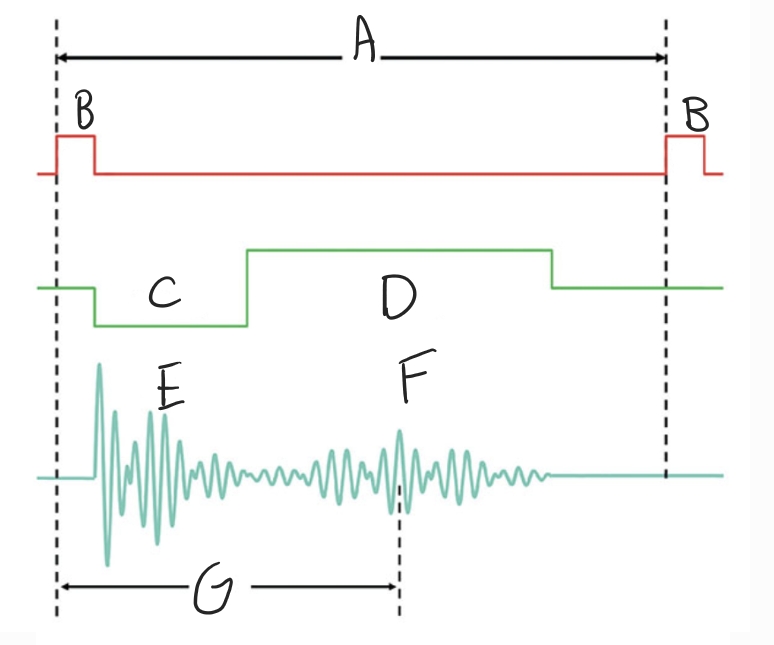
What is A
TR
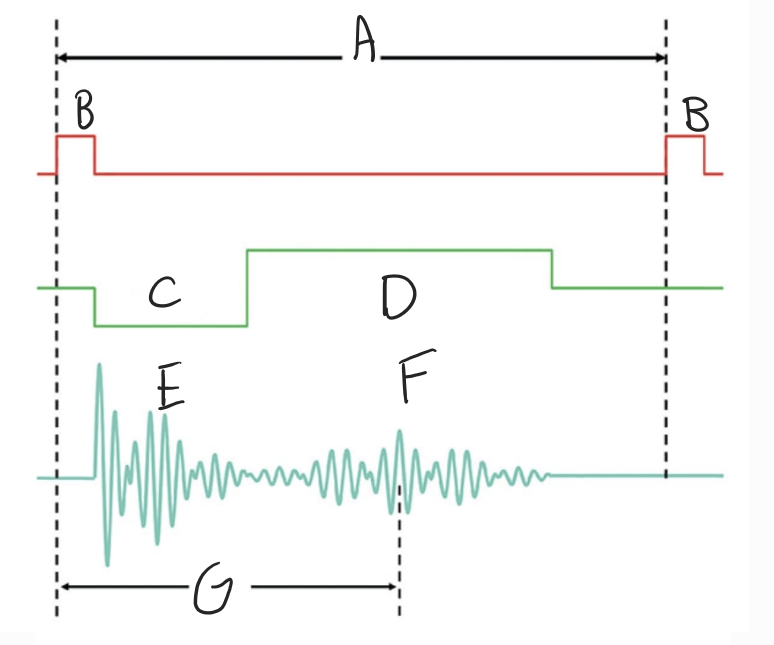
What is B
RF

What is C
Dephase

What is D
Rephase
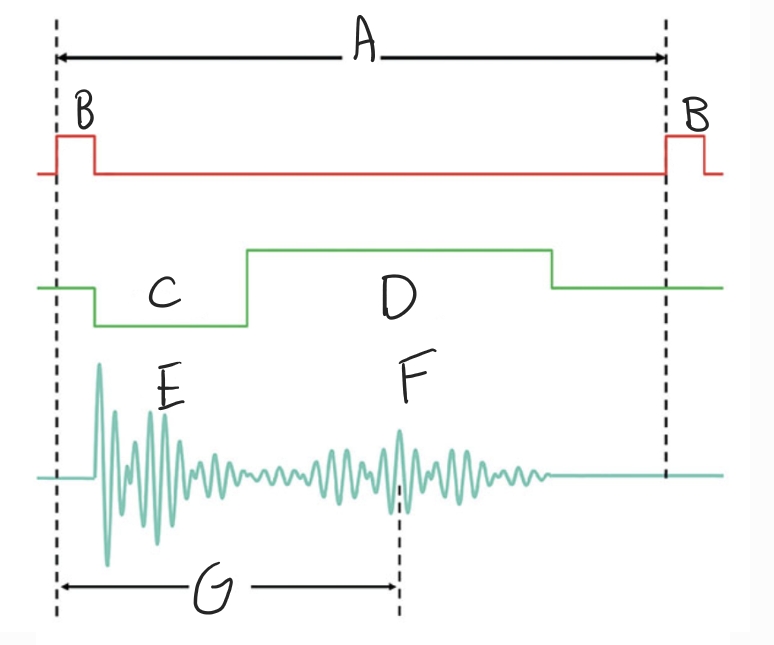
What is E
FID

What is F
Echo
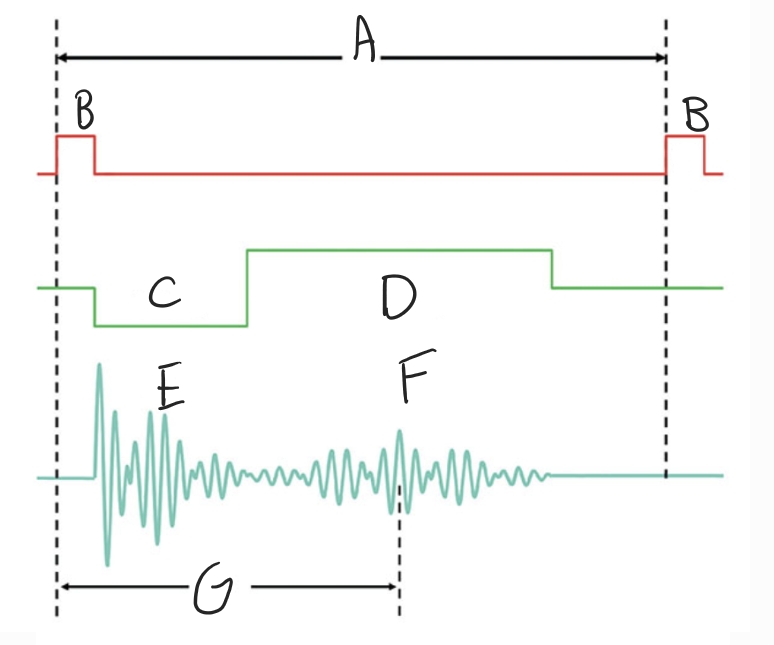
What is G
TE
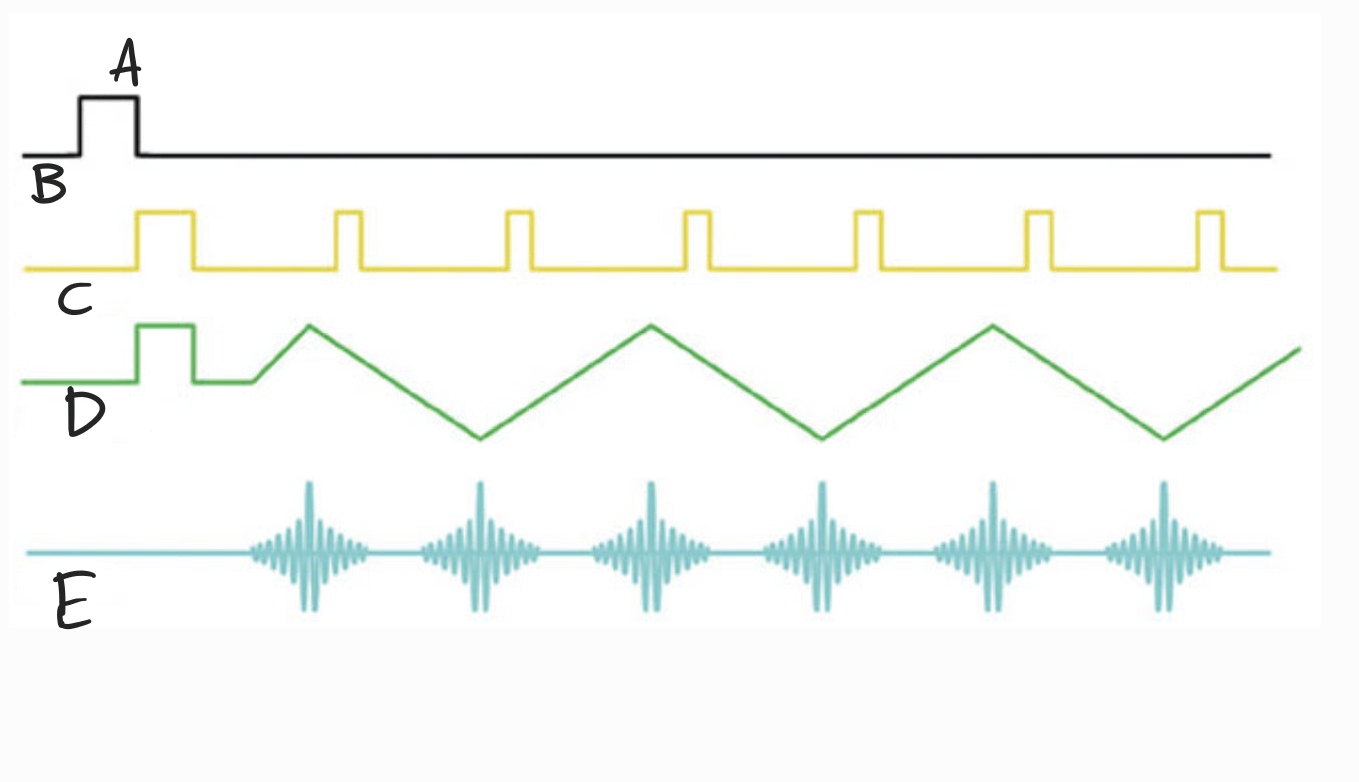
What is A
P
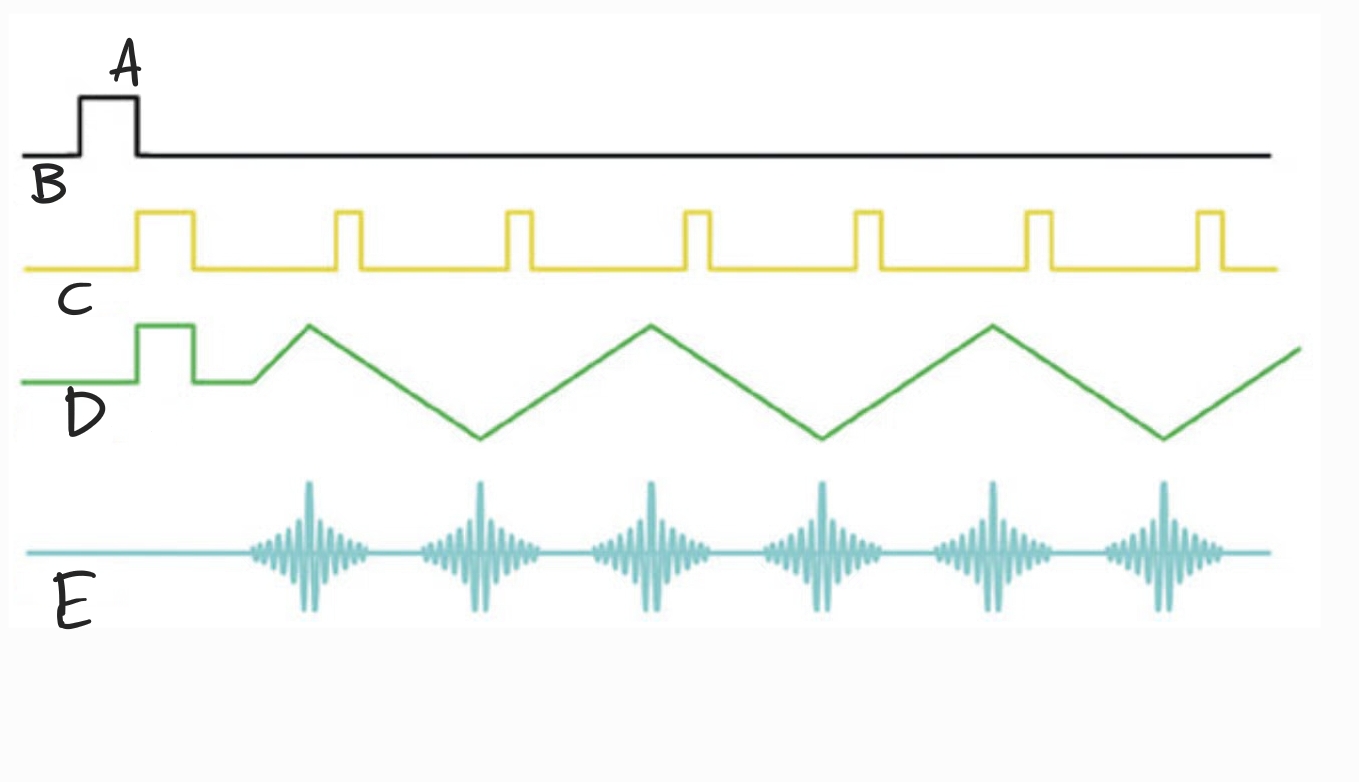
What is B
RF
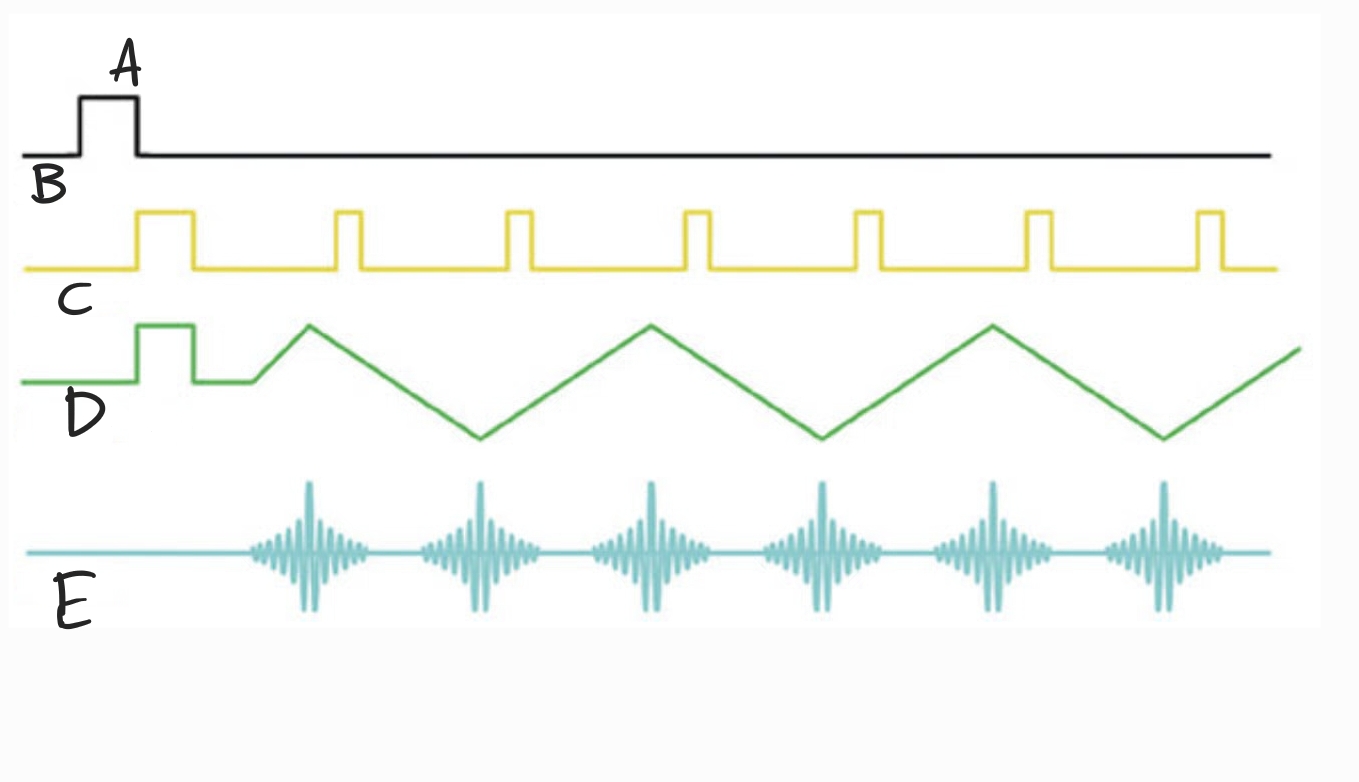
What is C
Phase
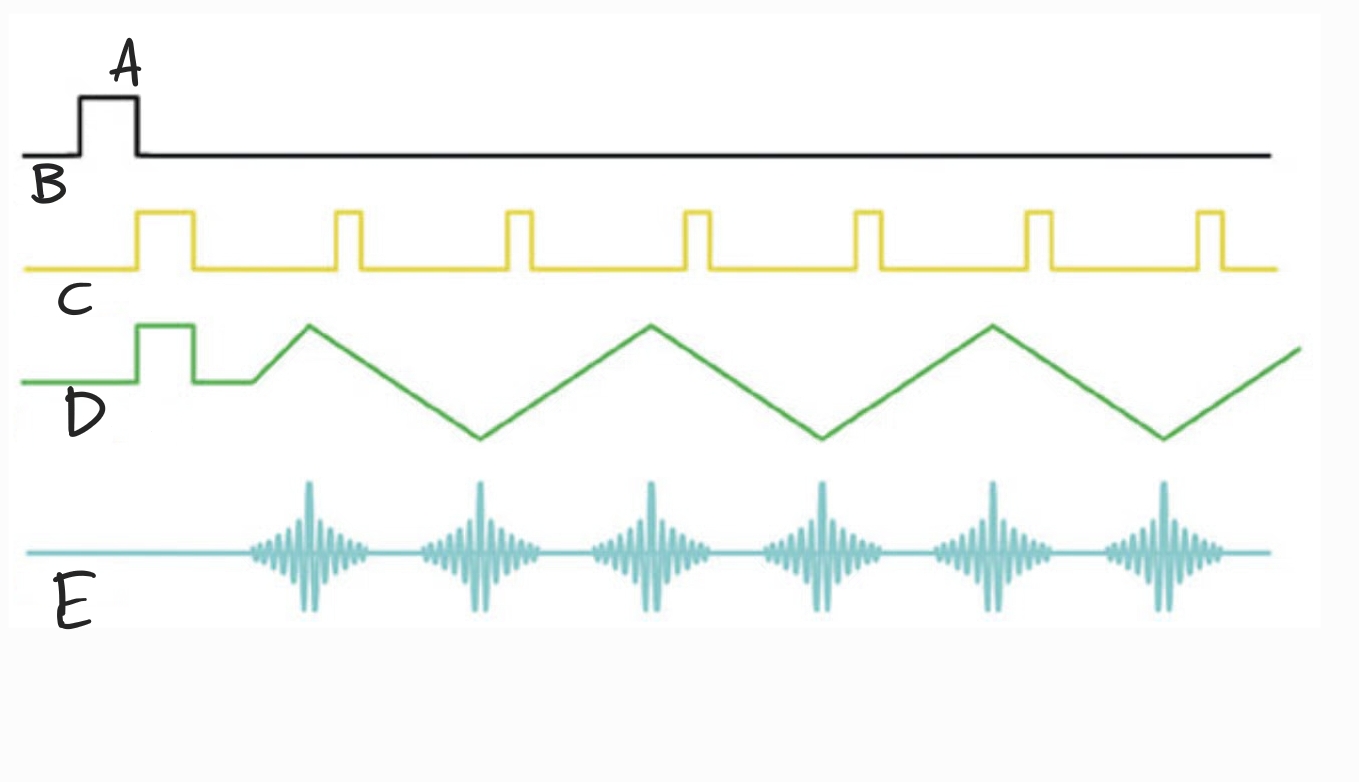
What is D
Frequency
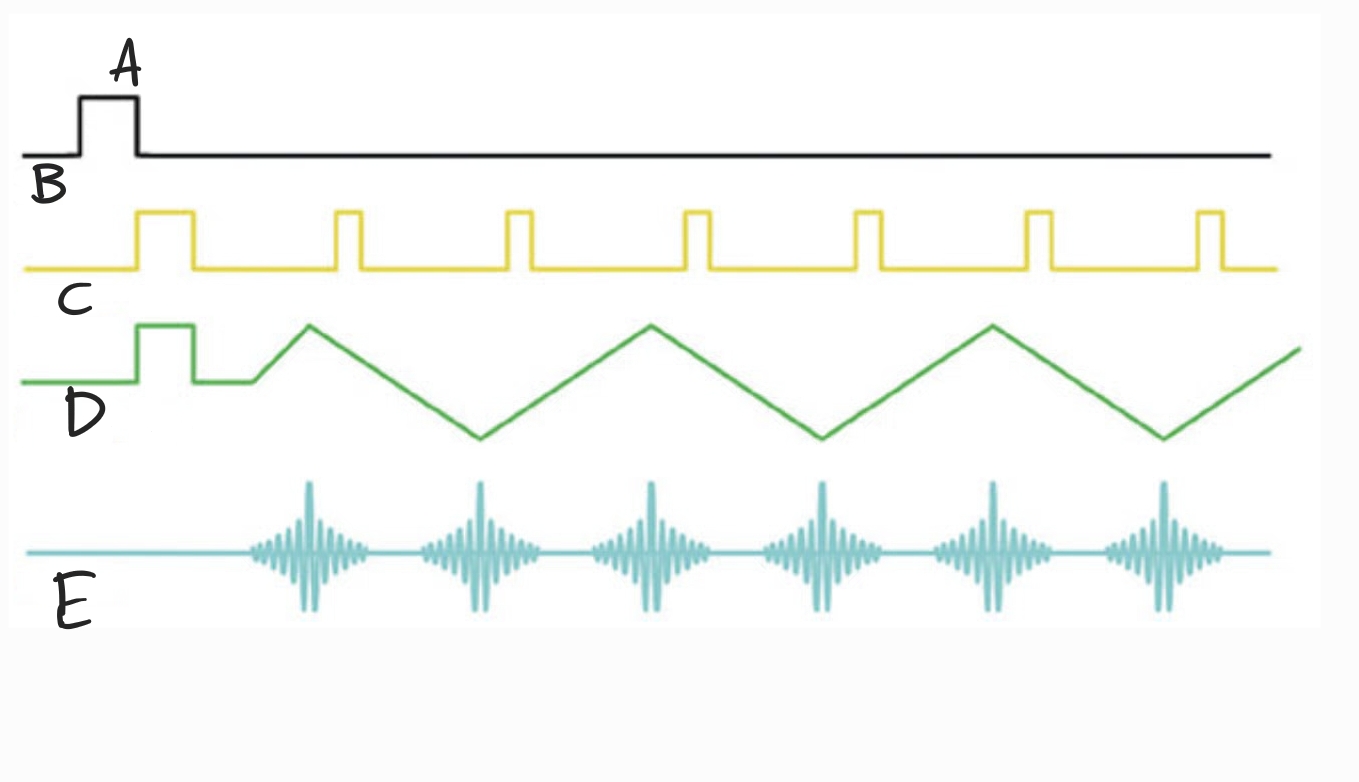
What is E
Signal

What is A
90
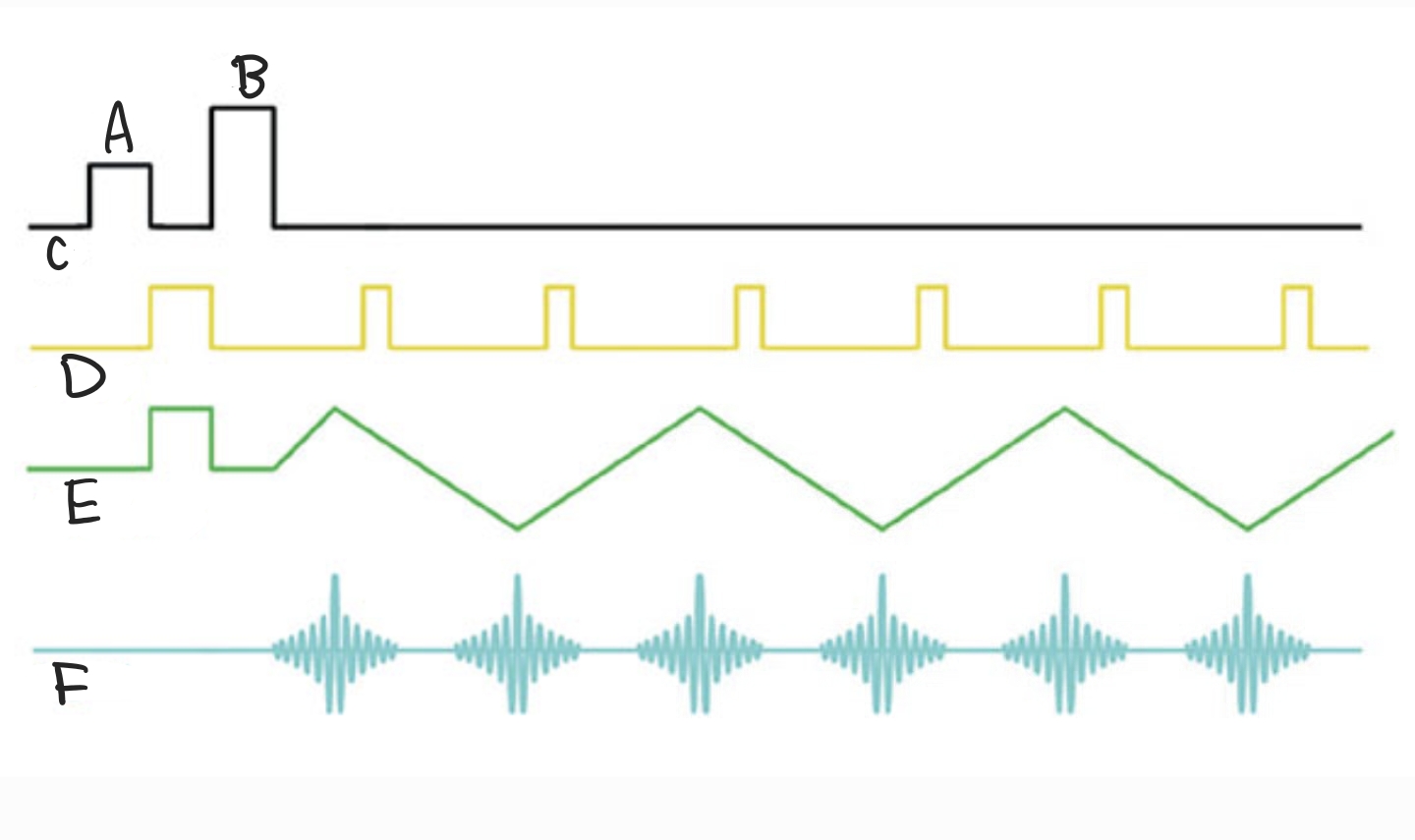
What is B
180
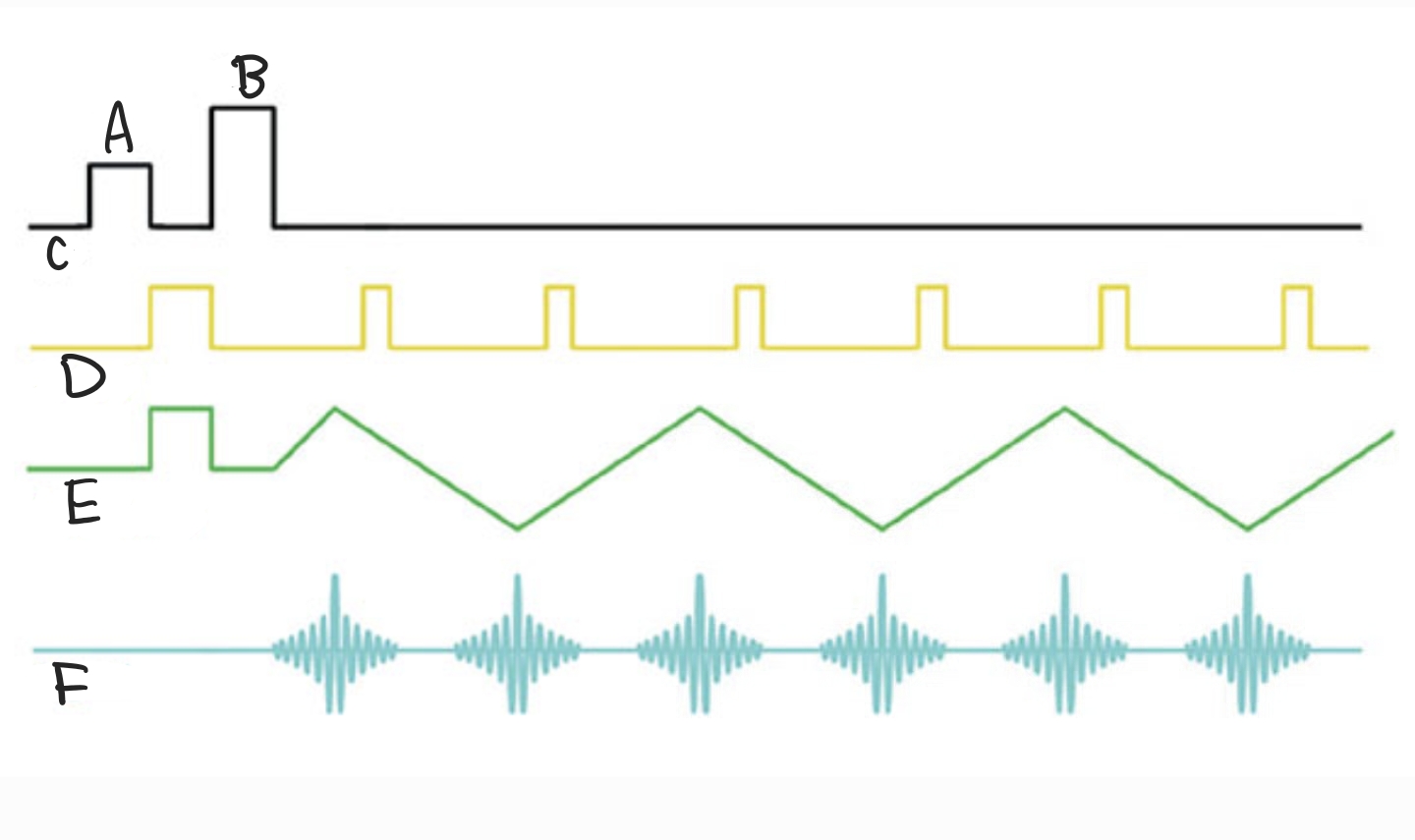
What is C
RF
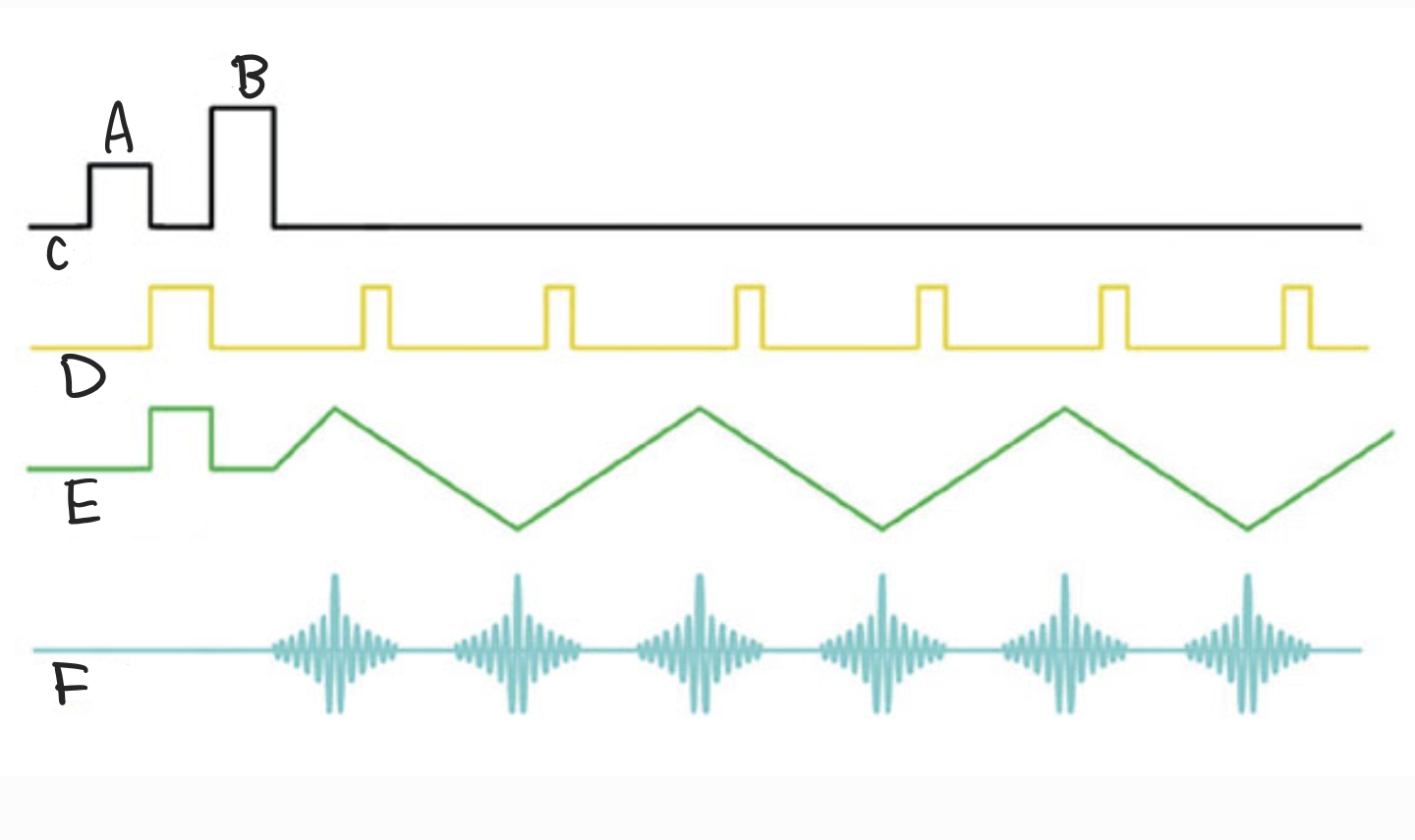
What is D
Phase
 Note
Note  Flashcards (21)