ESS topic 3
 Call Kai
 Learn
Learn Practice Test
 Spaced Repetition
 Match
Match Flashcards
 Knowt Play
1/29

There's no tags or description
Looks like no tags are added yet.
Name | Mastery | Learn | Test | Matching | Spaced | Call with Kai |
|---|
No analytics yet
Send a link to your students to track their progress
30 Terms
Biodiversity
is the total diversity of living systems and exists at several levels. It is a result of habitat, species, and genetic diversity
Habitat diversity
the range of different habitats in an ecosystem or biome which is associated with variety of ecological niches
Species diversity
the variety of species per unit area that includes numbers of species present and their relative abundance
Genetic diversity
The gene diversity within one species or all species within an area. Occurs because of genetic mutations which can result in beneficial altered genes
Theory of evolution
the cumulative changes in the genetic composition of a species over many successive generations and explains how these changes give rise to completely different species to the common ancestor
Natural selection
process by which individuals with traits better suited to their environment are more likely to survive, reproduce, and pass on those advantageous traits to the next generation. This mechanism drives evolutionary change and is fundamental to the development of biodiversity.
Species evenness
the relative abundances of all species.
Endemic species
species not found anywhere else
Direct Threats to biodiversity
overharvesting, poaching, and illegal pet trade
CITES
Convention on International Trade in Endangered Species, which acts to prevent illegal trade in wildlife
Indirect Threats to biodiversity
Pollution, habitat destruction, climate change, and introduction of invasive species
Invasive species
species introduced to an area and then have to compete with endemic (native species) which can lead to extinction of the native species.
IUCN Red List
a book that assesses the conservation status of particular species to highlight plant and animals threatened with extinction
Factors used to determine Red List conservation status
Number of individuals, Reduction in population size, Geographical range, distribution, breeding potential
Known threats of species
degree of habitat fragmentation, quality of habitat
IUCN examples
Falkland Island wolf (extinct), Iberian Lynx (critically endangered), American Bald Eagle (Improved by intervention)
The tragedy of the commons
a paper which explains how short-term interest of the individual can lead to overconsumption of common natural resources at the expense of a broader society.
Economic arguments for conservation
often focuses on the value of ecotourism, genetic resources and commercial considerations of its natural capital. Species and habitat preservation also provide economic value as it maintains genetic diversity so that genetic resources will be available in the future.
Ecological for conservation
healthy ecosystems are more likely to provide ecosystem services such as pollination and flood prevention. For example, rainforests are vital to the hydrologic cycle and they stabilize the world’s most fragile soils by preventing erosion. Rare habitats should be conserved as they may contain endemic species that require specific habitats.
Aesthetic arguments for conservation
species and habitats are nice to look at and provide beauty and inspiration
Ethical arguments for conservation
include intrinsic and instrumental value of the species. Everyone has a responsibility to protect future generations and every species has the right to live
Social arguments for conservation
highlights the importance of goods and services for the well-being of humans, as many indigenous people rely on natural ecosystems
Conservation
means “keeping what we have” and aims to protect habitats and ecosystems, and hence species, from human-made disturbances such as deforestation
In-situ conservation
is the conservation of species in their natural habitat, which enables endangered species to be conserved in their native habitat.
Ex-situ conservation
the preservation of species outside their natural habitat, which includes captive breeding and reintroduction programmes.
Ex-situ and in-situ comparisons
species based conservation are that it attracts attention, and therefore funding for conservation and successfully preserves vulnerable species. Protected areas protect the whole ecosystem and the complex interrelationships that exist there
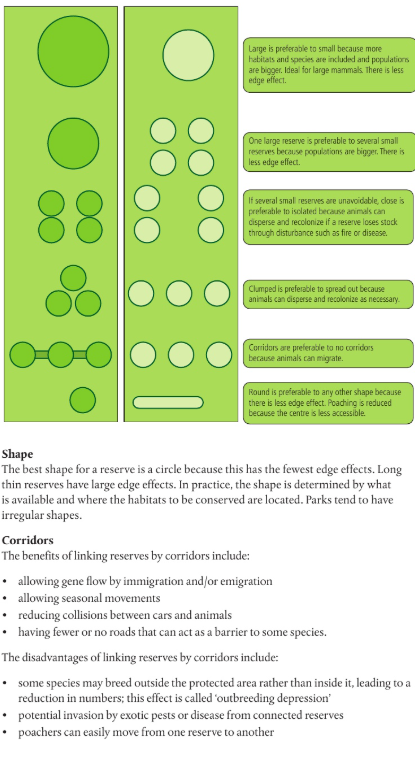
Edge effects
the edge of a protected area, there may be a change in abiotic factors, such as windier or warmer conditions compared to the interior. Edge effects may attract species not found in the deeper reserve and may attract exotic species from outside the reserve
Edge effects diagram
Buffer zones
managed or undistributed areas that can be identified around conservation areas
Rewilding
aims to restore ecosystems and reverse declines in biodiversity by returning an area to its natural processes and wildlife

