Ecology
 Studied by 26 people
 Call Kai
 Learn
Learn Practice Test
 Spaced Repetition
 Match
Match Flashcards
 Knowt Play
1/366

Earn XP
Description and Tags
finals practice
Name | Mastery | Learn | Test | Matching | Spaced | Call with Kai |
|---|
No analytics yet
Send a link to your students to track their progress
367 Terms
Define Ecology
The scientific study of interactions between organisms and their environment
the scientific study of interactions that determine the distribution (geographic location) and abundance of organisms.
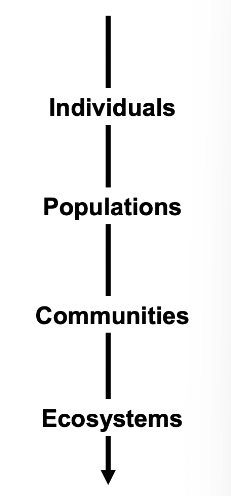
What is the Ecological Hierarchy (name each and describe them)
Organism - Single individual
Population - a group of individuals of a species that are living and interacting in a particular area.
Community - Association of populations of different species in the same area
Ecosystem - community of organisms plus the physical environment.
Biosphere - all living organisms on earth plus the environment in which they live.
Describe how energy works in an ecosystem
Energy moves through the ecosystem in a single direction
it cannot be recycled
nutrients are continuously recycled form environment to organism and back again.
Why are amphibians “biological indicators”
permeable skin: pollutant molecules can pass easily
eggs have no protective shell
spend part life in land, part in water (exposed to UV in both)
What are the steps in the scientific method?
Make observations and ask questions
use previous knowledge or intuition to develop hypotheses
evaluate hypotheses by experimentation, observational studies, or quantitative models
use the results to modify the hypotheses, pose new questions or draw conclusions about the natural world.
Ecological experiments
the spatial scale of ecology ranges from lab experiments, to small-scale field experiments, to large-scale experiments that alter major components of an ecosystem.
Two ways the physical environment influences an organism’s ecological success?
extreme conditions can exceed tolerance limits and impact survival.
availability of energy and resources impacts growth and reproduction
Why are plants good indicators of the environment?
They do not move.
Climate envelope
the range of conditions over which a species can occur (survive and reproduce)
Physiological ecology
the study of interactions between organisms and the physical environments that influence their survival and persistence.
physiological processes have optimal conditions for functioning
deviations from the optimum reduce the rate of process.
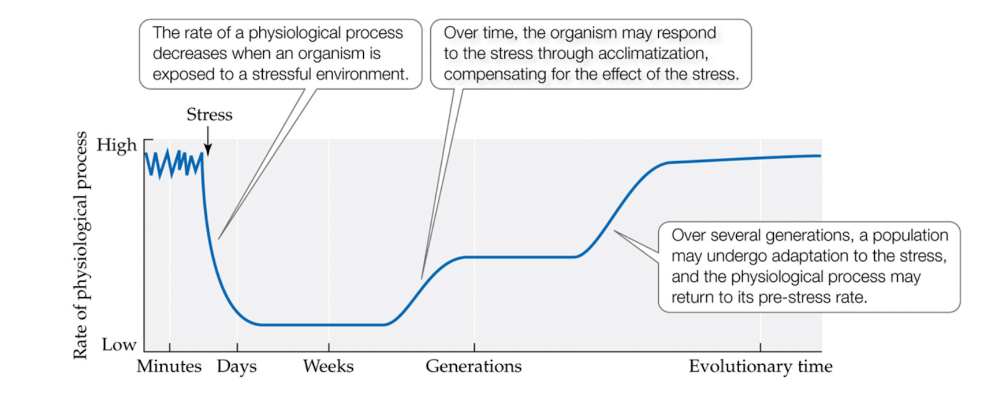
Stress
environmental change results in decreased rates of physiological processes, lowering the potential for survival, growth, or reproduction
acclimatisation
adjusting to stress through behaviour or physiology
usually short-term, reversible
How does adaptation work?
over time, natural selection results in the adaptation of a population to environmental stress. Individuals with traits that enable them to cope with stress are favoured. Over time these genetic traits become more common.
True or False, adaptation and acclimatization are not similar
False, they are in fact similar because both processes involve a change that lowers stress.
the ability to acclimatise represents a type of adaptation.
adaptation is long term, acclimatization is short.
Ecotypes
populations with adaptations to unique environments.
can eventually become separate species as population diverge and become reproductively isolated.
Environmental temperature
large variation throughout the biosphere, survival and function of an organism is tied to their internal temperature.
Dormancy
Where some organisms can survive periods of extreme heat or cold by entering a state of dormant, in which little or no metabolic activity occurs.
What are enzymes?
Protein-based molecules that catalyze biochemical reactions
have narrow temperature ranges for optimal function where they stay structurally stable.
What happens to an enzyme at high temperatures?
Enzyme function is destroyed and they lose their structural integrity (denatured)
How does temp affect properties of cell membranes?
Cell membranes are made of two layers of lipid molecules
at low temps, these lipids can solidify, embedded proteins cannot function, cell leaks metabolites
plants that thrive at low temps have higher proportions of unsaturated lipids (double bonds).
Ectotherms
regulate body temperature through energy exchange with the environment.
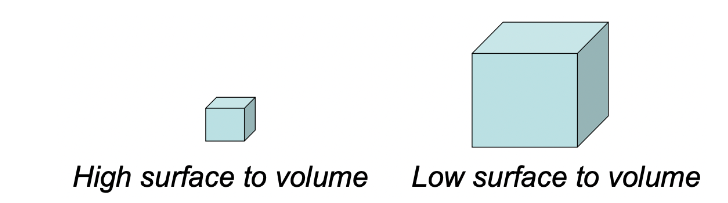
their surface area-to-volume ratio is important in exchanging energy with the environment.
higher surface area= more contact with environment
smaller= less contact but also ness control of internal temp.
Endotherms
rely primarily on internal heat generation - mostly birds and mammals
can maintain internal temps near optimum for metabolic functions
extend geo range.
Cryonics
the preservation of bodies by freezing, in hopes of reviving them later on
freezing water is limited to outside of cells
ice-nucleating proteins outside cells serve as sites of slow, controlled ice formation
inside are solutes with lower freezing points.
Thermoneutral zone
range of environmental temps over which a constant basal metabolic rate can be maintained
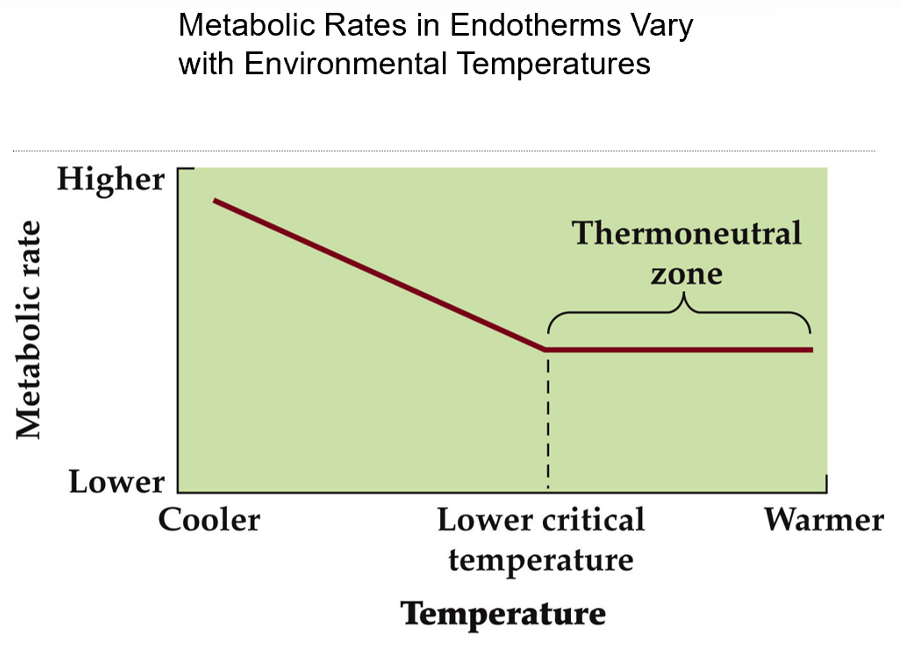
Lower critical temperature
when heat loss is greater than metabolic production; body temp drops and metabolic heat generation increases.
Torpor
a dormant state where body temp and basal metabolic rates are low, which conserves energy
energy reserves needed to come out of torpor
larger animals can stay dormant longer as they can store more energy
Hibernation
long periods of torpor (dormancy) that become possible for animals that can store more energy
Conduction
transfer of energy from warmer to cooler molecules
Convection
heat energy is carried by moving water or air
Evapotranspiration
heat loss that occurs through transpiration and surface evaporation
Transpiration
important evaporative cooling method for leaves
evaporation of water from inside the plant
Can be controlled by guard cells surrounding leaf openings called stomates
T/F: transpiration is a good mechanism when soil water supply is limited
False, transpiration needs a lot of water so when it becomes limited it is not a good mechanism
will cause the leaves to die.
Pubescence
hairs on leaf surfaces that reflect solar energy, lowering the amount of solar radiation absorbed by the leaf’s surface.
can also lower effectiveness of convective heat loss, creating a trade-off
Boundary layer
a zone of turbulent flow due to friction next to a leaf’s surface
Autotrophs
assimilate radiant energy from sunlight
Heterotrophs
Obtain their energy by consuming organic compounds from other organisms
Holoparasites
plants that have no photosynthetic pigments and get energy from other plants (heterotrophs)
Photosynthesis
(most autotrophs) sunlight provides the energy to take up CO2 and synthesize organic compounds.
Chemosynthesis
Energy from inorganic compounds is used to produce carbohydrates.
What are the two major steps in photosynthesis?
light reactions: light harvested, used to split water and provide electrons to make ATP and NADPH
Dark reactions: CO2 is fixed in Calvin cycle carbohydrates synthesized.
What does photosynthetic rate determine?
supply of energy, which in turn influences growth and reporduction
Light response curve
Shows the influence of light levels on photosynthetic rate
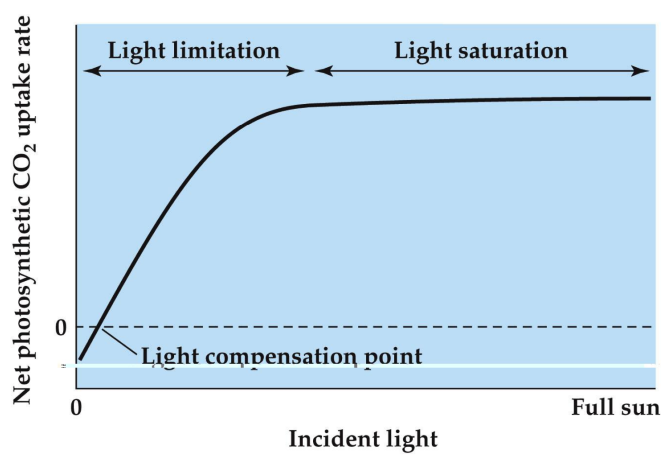
Light compensation point
Where CO2 uptake is balanced by CO2 loss by respiration
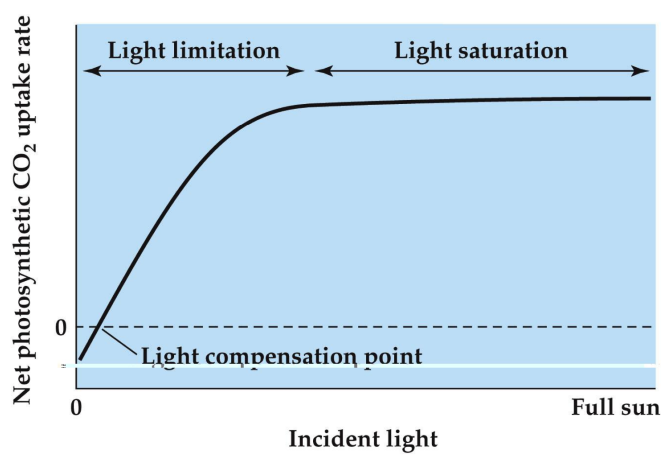
Saturation point
when photosynthesis no longer increases as light increases
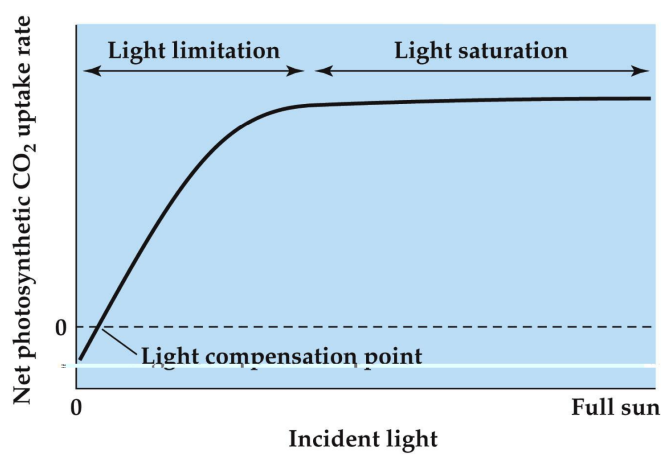
T/F leaves at high light intensity are thinner
False, they are thicker and have more chloroplasts
What are the two ways temp. influences photosynthesis
it effects on the rates of chemical reactions
influences the structural integrity of membranes and enzymes
T/F most enzymes are made of nitrogen
true
T/F nitrogen levels affect photosynthesis levels
true
Why don’t plants allocate more nitrogen to their leaves to increase photosynthetic rate
supply of nitrogen is low, compared to demand. Also needed for other things such as growth and metabolic function
increasing nitrogen conc. increases chances herbivores will eat leaves. As they are usually nitrogen starved.
Rubisco
the key enzyme for carbon fixation, can catalyze two competing reactions:
carboxylase reaction for photosynthesis
oxygen reaction for photorespiration
Evolution
Viewed as the genetic change (allele frequencies), over time or as a process of descent with modification.
populations evolve, individuals do not.
T/F natural selection, genetic drift, and gene flow can cause allele frequencies in a population to change over time.
True
T/F natural selection is the only evolutionary mechanism that consistently causes adaptive evolution
True
Inherited traits
traits passed onto offspring
Basic principles of genes
genes are made of DNA that encode for protiens
A gene can have alleles that create different versions of the protein coded for.
the genotype represents two copies of each gene, one inherited from mother and one from father.
Evolution regarding descent
shared ancestry and shared characteristics
evolution regarding modification
the accumulation of differences
Natural selection
individuals with certain genetically determined characteristics survive and reproduce more successfully than other individuals.
can be responsible for the “modification" part of evolution
increases advantageous alleles.
Four processes that influence evolution
mutations
natural selection
genetic drift
gene flow
Mutations
cause the allele frequency in a population to change over time.
a change in the DNA of a gene
arise during events such as copying errors during cell division, mechanical damage, exposure to mutagens etc.
VERY RARE, but needed for evolution
Recombination and independent assortment of chromosomes
offspring have different combinations of alleles that differ from their parents.
mutations provide the raw material, this rearranges the raw material into new combinations
3 types of natural selection
directional selection
stabilising selection
disruptive selection
Directional selection
individuals at one phenotypic extreme are favoured over other individuals
ex: large favoured over small individuals
Stabilizing selection
individuals with an intermediate phenotype are favoured
ex: mid-sized individuals favoured
Disruptive selection
individuals with either of the extreme phenotype are favoured
ex: small and large individuals favoured over mid-sized.
Genetic drift
occurs when chance events determine which alleles are passed to the next generation.
significant only for small populations
causes allele frequency to fluctuate randomly.
Fixation
an allele that occurs in a population at frequency of 100%
Gene flow
allele move between populations via movement of individuals or gametes.
populations become more similar
4 ways genetic drift are related to effects on evolution
causes allele frequency to fluctuate randomly over time in small populations.
reduced the genetic variation, making individuals genetically similar
increases frequency of harmful allele
increases genetic differences between populations because random events may increase allele frequency in one pop. and be lost in another.
Adaptations
features that evolve by natural selection and improve an organism’s ability to survive and reproduce in its environment.
4 long term patterns of evolution shaped by large-scale processes
speciation
extinction
mass extinction
adaptive radiation
speciation
the process by which one species splits into two or more species
most commonly occurs when a barrier prevent gene flow between pop of species
genetic barrier
when a new population becomes established from the parental population, or when isolation is induced by continental drift
ecological barrier
when a barrier to gene flow is established between populations, they will diverge genetically overtime.
adaptive radiation
repeated speciation events increases the number of species ina group
Reproductive barrier
caused by geographic and ecological barrier
Evolutionary tree
branching diagram representing the evolutionary history of a group
mass extinction
large proportions of earths species were driven to extinctions in a relatively short period of time.
Life history
consists of an individual’s major events related to its growth, development, reproduction, and survival
life history events are adaptations
allocation
the relative amounts of energy or resources that an organism devotes to different functions
phenotypic plasticity
a single genotype may produce different phenotypes under different environmental conditions
fitness
the genetic contribution of an organism’s descendents to future generations determined by reproductive rates of the parents and the survival rates of both the parents and offspring
isogamy
production of equal sized gametes
anisogamy
the production of different sized gametes (most common for multicell organisms)
trade off
allocate limited energy or resources to one function at the expense of another.
parental care
invest time and energy to feed and protect offspring
T/F: life cycles are simple
False, very very complex
complex life cycle
at least two distinct stages that differ in their habitat
Dispersal
The movement of organisms from their birthplace
provides advantages, such as reducing competition in an area
Semelparous Species
Reproduce only once
Iteroparous species
have the capacity to reproduce multiple times
r-selection
selection for high population growth rates
k-selection
selection for slower rates of increase, which occurs in populations that are approaching K (carrying capacity)
The meaning behind K
The carrying capacity or stable population size for their environment.
What are the 3 plant life history patterns?
Competitive (low-stress, low-disturbance)
Ruderal (low-stress, high- disturbance
Stress tolerant (high-stress, low-disturbance)
Behavioural ecology
The study of the ecological and environmental basis of animal behaviour
What does ‘proximate causes’ mean in behavioural ecology?
(immediate) how the behaviour occurs
What does ‘ultimate causes’ mean in behavioural ecology
why the behaviour occurs, the evolutionary and historical reasons
T/F: evolution is the basis for adaptive behaviour
true, natural selection favours individuals whose behaviours make them efficient in activities that aid in their survival.
 Note
Note  Flashcards (52)