AP African American Studies Review
 Studied by 10 people
 Call with Kai
 Learn
Learn Practice Test
 Spaced Repetition
 Match
Match Flashcards
 Knowt Play
1/40

Earn XP
Description and Tags
Combination of Tests 1B and 2A
Name | Mastery | Learn | Test | Matching | Spaced | Call with Kai |
|---|
No study sessions yet.
41 Terms
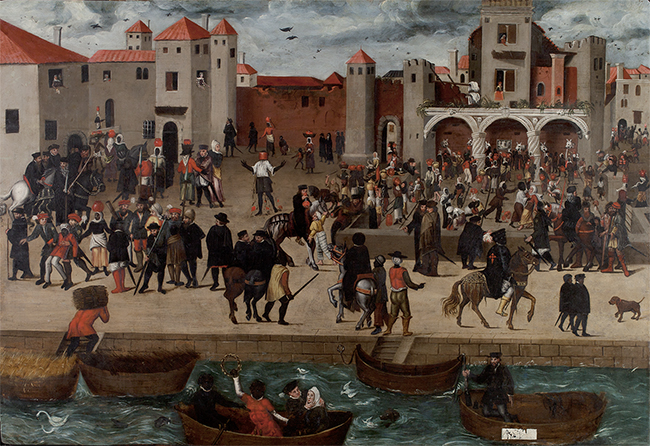
The Africans found in Europe at this time could best be described as…
A.) missionaries
B.) revolutionaries
C.) plantation owners
D.) elites in society
D.) elites in society
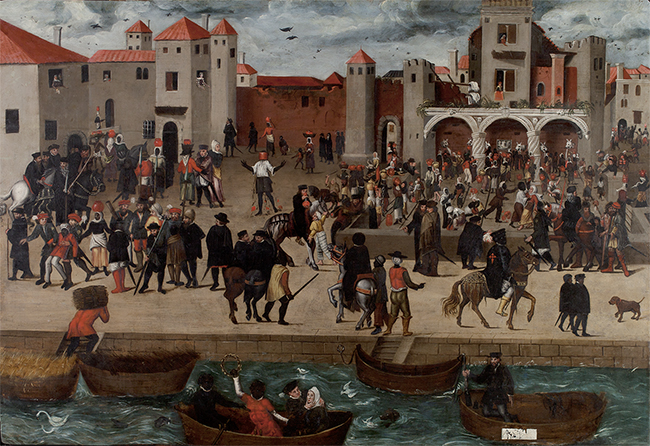
Which of the following best explains the presence of Africans in the painting?
A.) The Portuguese increased their demand for enslaved African people in their South American colony.
B.) The decline of the ancient Ghana Empire led to African migrations into southern Europe.
C.) The Portuguese engaged in regular commercial and political exchange between West and West Central African kingdoms.
D.) The European dominance over Indian Ocean trade networks made it a center for trade.
C.) The Portuguese engaged in regular commercial and political exchange between West and West Central African kingdoms.
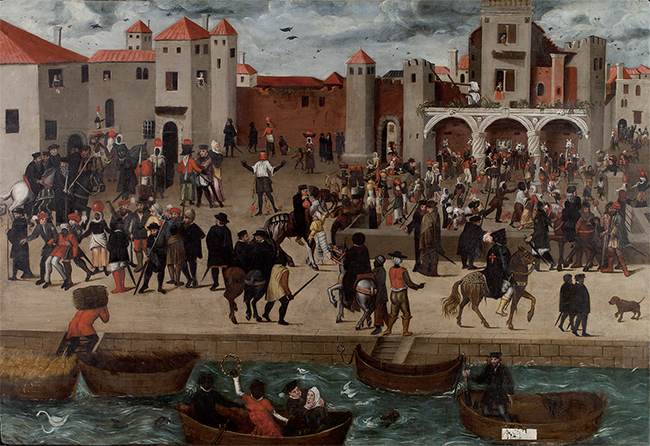
The scene depicted in the painting best supports which of the following arguments about social interactions between Europeans and Africans during the sixteenth century?
A.) The social exchanges between African and European kingdoms influenced the spread of the Islamic faith across Northern Europe.
B.) Explorers influenced the European view that Africa was a source for enslaved labor rather than a source of knowledge and learning.
C.) African people in Europe were employed in a wide variety of jobs and interacted directly with European peoples of other racial and ethnic groups.
D.) The blending of European Christian and indigenous African belief systems was a strategy Europeans employed to justify their presence in African kingdoms.
C.) African people in Europe were employed in a wide variety of jobs and interacted directly with European peoples of other racial and ethnic groups.
“When Ibn Battuta first visited Cairo in 1326, he undoubtedly heard about the visit of Mansa Musa (King of Mali from 1307 to 1332). Mansa Musa had passed through the city two years earlier making his pilgrimage to Mecca with thousands of slaves and soldiers, wives and officials. One hundred camels each carried one hundred pounds of gold. Mansa Musa performed many acts of charity and ‘flooded Cairo with his kindness.’ So much gold spent in the markets of Cairo actually upset the gold market well into the next century. Mali's gold was important all over the world. In the later Medieval period, West Africa may have been producing almost two-thirds of the world's supply of gold! Mali also supplied other trade items—ivory, ostrich feathers, kola nuts, hides, and slaves. No wonder there was talk about the Kingdom of Mali and its riches! And no wonder Ibn Battuta, still restless after his trip to Al-Andalus, set his mind on visiting the sub-Saharan kingdom.”
Which of the following claims about the growth and sustained success of the Mali Empire is most accurate?
A.) Access to Indian Ocean trade networks provided the wealth needed for growth.
B.) The use of crossbred African horses contributed to the empire’s ability to extend its power.
C.) The arrival of Portuguese explorers shifted the trade routes in the empire’s favor.
D.) The development of Ge’ez script allowed for more efficient military communication.
B.) The use of crossbred African horses contributed to the empire’s ability to extend its power.
“When Ibn Battuta first visited Cairo in 1326, he undoubtedly heard about the visit of Mansa Musa (King of Mali from 1307 to 1332). Mansa Musa had passed through the city two years earlier making his pilgrimage to Mecca with thousands of slaves and soldiers, wives and officials. One hundred camels each carried one hundred pounds of gold. Mansa Musa performed many acts of charity and ‘flooded Cairo with his kindness.’ So much gold spent in the markets of Cairo actually upset the gold market well into the next century. Mali's gold was important all over the world. In the later Medieval period, West Africa may have been producing almost two-thirds of the world's supply of gold! Mali also supplied other trade items—ivory, ostrich feathers, kola nuts, hides, and slaves. No wonder there was talk about the Kingdom of Mali and its riches! And no wonder Ibn Battuta, still restless after his trip to Al-Andalus, set his mind on visiting the sub-Saharan kingdom.”
Which of the following claims best summarizes the significance of the pilgrimage described in the excerpt?
A.) The display of wealth encouraged merchants to seek out trading opportunities with the Mali Empire.
B.) The visit to Egypt led to its conquest and the inclusion of Northeast Africa in the Sudanic empires.
C.) The pilgrimage caused the trade routes to immediately shift from the Sahara Desert to the Atlantic Ocean.
D.) The pilgrimage marked the fall of the Empire of Ghana and the rise of the Mali Empire.
A.) The display of wealth encouraged merchants to seek out trading opportunities with the Mali Empire.
“When Ibn Battuta first visited Cairo in 1326, he undoubtedly heard about the visit of Mansa Musa (King of Mali from 1307 to 1332). Mansa Musa had passed through the city two years earlier making his pilgrimage to Mecca with thousands of slaves and soldiers, wives and officials. One hundred camels each carried one hundred pounds of gold. Mansa Musa performed many acts of charity and ‘flooded Cairo with his kindness.’ So much gold spent in the markets of Cairo actually upset the gold market well into the next century. Mali's gold was important all over the world. In the later Medieval period, West Africa may have been producing almost two-thirds of the world's supply of gold! Mali also supplied other trade items—ivory, ostrich feathers, kola nuts, hides, and slaves. No wonder there was talk about the Kingdom of Mali and its riches! And no wonder Ibn Battuta, still restless after his trip to Al-Andalus, set his mind on visiting the sub-Saharan kingdom.”
Which of the following claims is best supported by the information in the excerpt?
A.) West Africa was a center of learning.
B.) Islam was introduced to West Africa through trade.
C.) The Mali Empire’s power was based on the use of steel weapons.
D.) West Africa exported a variety of goods to other regions.
D.) West Africa exported a variety of goods to other regions.
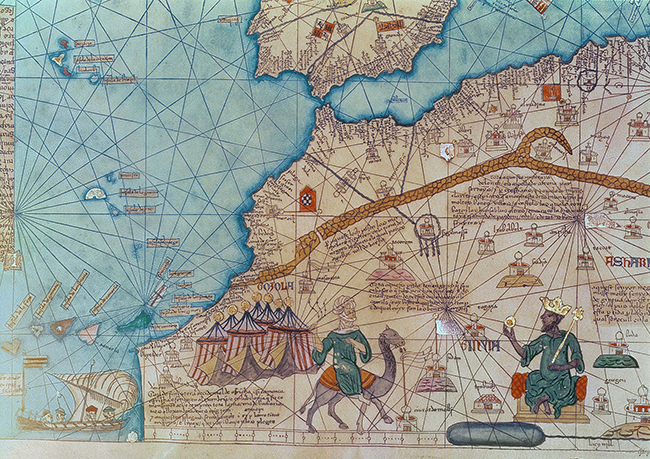
Which of the following best explains the importance of griots to the Mali Empire?
A.) They traded with merchants in Timbuktu for manufactured goods, which increased the wealth of the Mali Empire.
B.) They served as jurists in the imperial courts of the Mali Empire, which helped to develop a more sophisticated legal system.
C.) They served as generals in the army of the Mali Empire and were immortalized in thirteenth-century equestrian figures.
D.) They preserved the history and culture of the Mali Empire, which helped to maintain its traditions through generations.
D.) They preserved the history and culture of the Mali Empire, which helped to maintain its traditions through generations.
“In 1641 a Dutch fleet composed of twenty-two warships with good land troops appeared in the port of Luanda. The Portuguese defended Luanda so badly that the town was taken, along with a goodly part of the kingdom.
Having learned of these advantageous events, Queen Njinga thought that the time had arrived for her to revenge herself against the Portuguese. She had always remembered in her heart how they had affronted her by proclaiming Ngola Arij the King of Ndongo. She sent the Dutch [her] ambassadors to congratulate them on their victories and to invite them to join their troops to hers so as to get rid of their common enemies once and for all.”
Which of the following claims did the author make in this excerpt?
A.) Ngola Arij was the legitimate ruler of Ndongo.
B.) Queen Njinga had great respect for the Portuguese.
C.) The Dutch pressured Queen Njinga into a military alliance.
D.) Portugal’s defense of their African territory was very weak.
D.) Portugal’s defense of their African territory was very weak.
“In 1641 a Dutch fleet composed of twenty-two warships with good land troops appeared in the port of Luanda. The Portuguese defended Luanda so badly that the town was taken, along with a goodly part of the kingdom.
Having learned of these advantageous events, Queen Njinga thought that the time had arrived for her to revenge herself against the Portuguese. She had always remembered in her heart how they had affronted her by proclaiming Ngola Arij the King of Ndongo. She sent the Dutch [her] ambassadors to congratulate them on their victories and to invite them to join their troops to hers so as to get rid of their common enemies once and for all.”
Which of the following is a similarity between Queen Njinga and Queen Idia?
A.) Both queens fought to suppress the slave trade.
B.) Both queens ruled the West African kingdom of Benin.
C.) Both rulers left a legacy that demonstrated the effectiveness of women as leaders.
D.) Both rulers established a tradition of nonviolence in their kingdoms.
C.) Both rulers left a legacy that demonstrated the effectiveness of women as leaders.
“In 1641 a Dutch fleet composed of twenty-two warships with good land troops appeared in the port of Luanda. The Portuguese defended Luanda so badly that the town was taken, along with a goodly part of the kingdom.
Having learned of these advantageous events, Queen Njinga thought that the time had arrived for her to revenge herself against the Portuguese. She had always remembered in her heart how they had affronted her by proclaiming Ngola Arij the King of Ndongo. She sent the Dutch [her] ambassadors to congratulate them on their victories and to invite them to join their troops to hers so as to get rid of their common enemies once and for all.”
Which of the following statements best describes the perspective of the source?
A.) An East African ruler discussing the Portuguese
B.) A European visitor discussing Queen Njinga
C.) A Portuguese military officer discussing the Dutch
D.) A visitor from Kongo discussing the Kingdom of Ndongo
B.) A European visitor discussing Queen Njinga
“Queen mothers often exercised considerable power. They helped enthrone and depose1 rulers...presided over court systems, and exercised state power in other ways....
A main avenue through which individual women exercised state power was by ruling, although most rulers of the period were men. Among the Mossi people of West Africa there was a legendary warrior queen, Iyennegi, who...is reported to have led a strong army in defense of Mossi lands....
During the early seventeenth century, a royal woman, Njinga...consolidated her power in the 1620s in the area of present-day Angola but was forced, due to Portuguese incursions, to move further eastward to Matamba. There she created woman-based rituals of state power and was able...to bequeath power to her sister. Njinga is heralded as a strong woman ruler and a heroine....
Women also exercised power through various roles in the state and community...they often held political offices that corresponded with those of men in a dual-sex political system.... In addition...women...were appointed to committees that provided checks and balances on the rulers’ power in centralized states or adjudicated2 important societal disputes among decentralized groups.”
Which of the following describes a legacy of women rulers in Africa?
A.) The leadership of African women led to the adoption of Islam in West and Central Africa.
B.) The rule of African women led to the strengthening of military power that would end the transatlantic slave trade.
C.) The leadership of women rulers in Africa led to diplomatic disputes in the Mediterranean region.
D.) The rule of African women became a symbol of leadership for women in the African diaspora.
D.) The rule of African women became a symbol of leadership for women in the African diaspora.
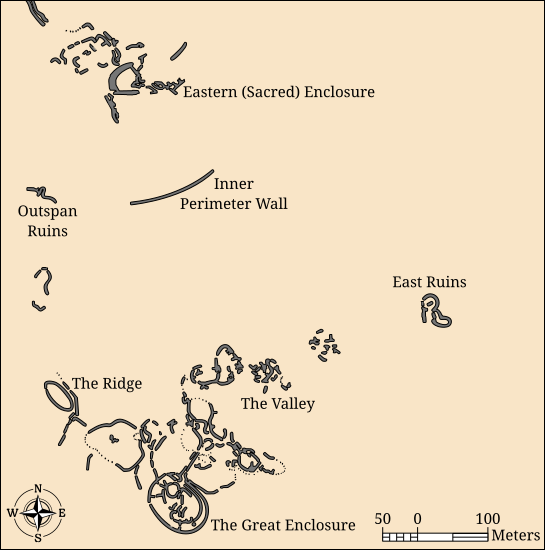
Which of the following claims can best be supported by the map?
A.) The Shona people constructed a sophisticated settlement.
B.) The merchants of the Swahili Coast became wealthy from trade.
C.) The people of Kongo practiced a complex syncretic religion.
D.) The Nok society developed an advanced artistic tradition.
A.) The Shona people constructed a sophisticated settlement.
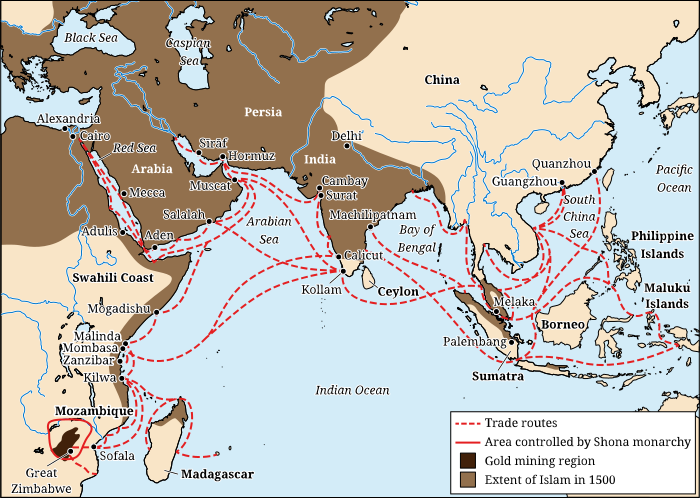
Which of the following conclusions can be drawn from the information included on the map?
Responses
A.) Cattle were exported from Africa to Asia.
B.) Great Zimbabwe traded gold with the Swahili Coast.
C.) Ivory was an important trade good for the Indian Ocean maritime trade.
D.) Most of the gold exchanged in the Indian Ocean came from West Africa.
B.) Great Zimbabwe traded gold with the Swahili Coast.
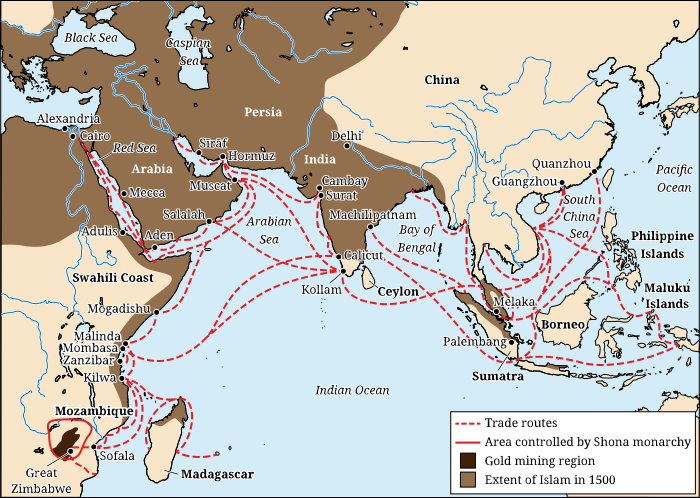
Which of the following statements best describes a pattern evident on the map?
Responses
A.) Trans-Saharan commerce brought North African traders, scholars, and administrators to West Africa, introducing Islam to the region.
B.) The Red Sea connected the Aksumite Empire to major maritime trade networks in the Mediterranean, linking it to the Roman Empire.
C.) The coastal location of East Africa’s city-states linked Africa to Arab, Persian, Indian, and Chinese trading communities.
D.) Portuguese and African trade increased the presence of Africans in Iberian port cities like Lisbon and Seville.
C.) The coastal location of East Africa’s city-states linked Africa to Arab, Persian, Indian, and Chinese trading communities.
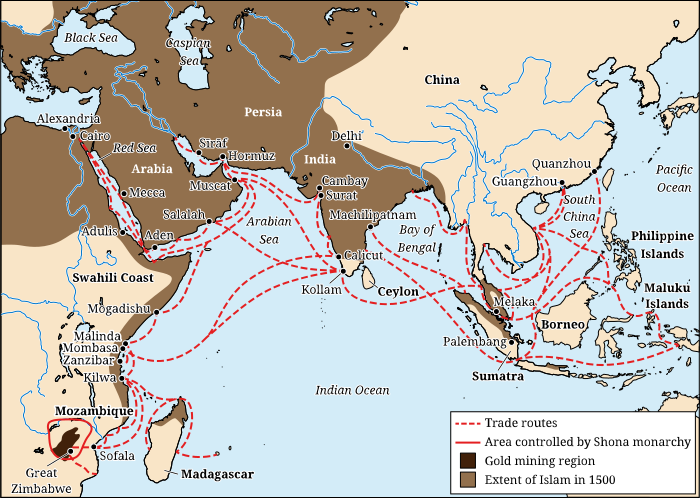
Based on the map, which of the following best explains the adoption of Islam by the Swahili city-states?
A.) The establishment of trade with China
B.) The conversion of Shona kingdoms to Islam
C.) Missionary efforts of West African Muslims
D.) Regular contact with Muslim merchants from other regions
D.) Regular contact with Muslim merchants from other regions
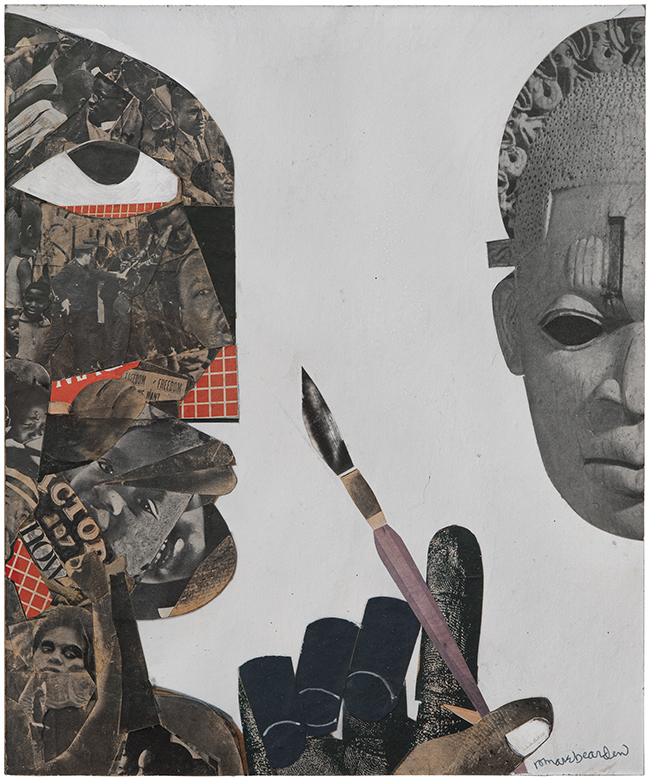
Which of the following best explains why the artist may have incorporated the image of Queen Idia’s mask into their artwork?
Responses
A.) To honor and celebrate the connection between Africa and Portugal
B.) To reconnect members of the Great Migration to their southern culture
C.) To create artwork that connects modern African Americans to Africa
D.) To create artwork that combines American feminism with traditional African subjects
C.) To create artwork that connects modern African Americans to Africa
“The first to receive baptism in the country were the Count of Soyo [uncle of the King of Kongo] and his son, who were baptized on Christmas Day of the year 1491.... A great many people...followed the example of their princes...[b]ut even though the majority of these [Africans] outwardly profess to be Christians, the greater number are still idolatrous in their hearts and secretly worship false gods, tigers, leopards, and wolves, imagining that in this way they will escape feeling the effects of their fury....[T]hey all have two strings in their bows—the Catholic religion and paganism, and when the saints do not answer their prayers, they invoke the fetishes. Yet to see them all covered with crosses and rosaries one would take them for sanctimonious people. When the Count of Soyo goes to mass, he dresses himself superbly and wears golden chains and collars of coral. He marches pompously to the sound of drums and horns, surrounded by guards among whom there are five or six musketeers who fire from time to time and others who carry flags and are followed by a great crowd of people.”
Which of the following best describes the perspective of the author?
Responses
A.) As a Dutch missionary, he is proud of the successful conversion of West Central Africa to Christianity.
B.) As a European Christian, he objects to the continuation of Indigenous religious traditions.
C.) As an Indigenous religious leader, he rejects the spread of foreign cultural influences.
D.) As an African geographer, he is pleased with the growing prosperity of West Central Africa.
B.) As a European Christian, he objects to the continuation of Indigenous religious traditions.
“The first to receive baptism in the country were the Count of Soyo [uncle of the King of Kongo] and his son, who were baptized on Christmas Day of the year 1491.... A great many people...followed the example of their princes...[b]ut even though the majority of these [Africans] outwardly profess to be Christians, the greater number are still idolatrous in their hearts and secretly worship false gods, tigers, leopards, and wolves, imagining that in this way they will escape feeling the effects of their fury....[T]hey all have two strings in their bows—the Catholic religion and paganism, and when the saints do not answer their prayers, they invoke the fetishes. Yet to see them all covered with crosses and rosaries one would take them for sanctimonious people. When the Count of Soyo goes to mass, he dresses himself superbly and wears golden chains and collars of coral. He marches pompously to the sound of drums and horns, surrounded by guards among whom there are five or six musketeers who fire from time to time and others who carry flags and are followed by a great crowd of people.”
Which of the following cultural practices provides the most useful context for understanding the development described by the author?
A.) Migration triggered by population growth contributed to cultural change.
B.) Linguistic diversity caused by trade led to the exchange of cultural traditions.
C.) Religious change and continuity fostered syncretism through cultural blending.
D.) Enslavement contributed to the diasporic process, which spread culture globally.
C.) Religious change and continuity fostered syncretism through cultural blending.
“The first to receive baptism in the country were the Count of Soyo [uncle of the King of Kongo] and his son, who were baptized on Christmas Day of the year 1491.... A great many people...followed the example of their princes...[b]ut even though the majority of these [Africans] outwardly profess to be Christians, the greater number are still idolatrous in their hearts and secretly worship false gods, tigers, leopards, and wolves, imagining that in this way they will escape feeling the effects of their fury....[T]hey all have two strings in their bows—the Catholic religion and paganism, and when the saints do not answer their prayers, they invoke the fetishes. Yet to see them all covered with crosses and rosaries one would take them for sanctimonious people. When the Count of Soyo goes to mass, he dresses himself superbly and wears golden chains and collars of coral. He marches pompously to the sound of drums and horns, surrounded by guards among whom there are five or six musketeers who fire from time to time and others who carry flags and are followed by a great crowd of people.”
Which of the following describes the most likely purpose of this source?
Responses
A.) To promote Christianity throughout the African diaspora
B.) To describe the culture of Africa to a European audience
C.) To encourage religious tolerance among Europeans in Africa
D.) To report on economic development in Africa to African leaders
B.) To describe the culture of Africa to a European audience
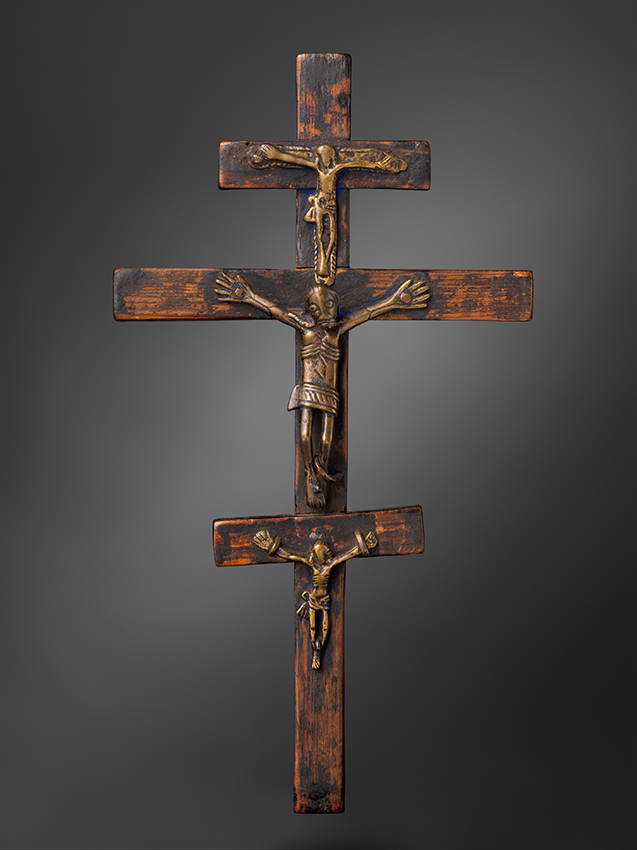
Which of the following best describes the context in which the triple crucifix was created?
A.) The Kingdom of Kongo traded directly with China and India so that Asian artistic styles blended with local traditions.
B.) The Kingdom of Kongo isolated itself and prohibited trade with parties outside of the kingdom for an extended time period.
C.) The movement of Bantu people into the Kingdom of Kongo brought new languages and technology to West Central Africa.
D.) The royalty and nobility of the Kingdom of Kongo voluntarily converted to Catholicism, and the faith gained mass acceptance.
D.) The royalty and nobility of the Kingdom of Kongo voluntarily converted to Catholicism, and the faith gained mass acceptance.
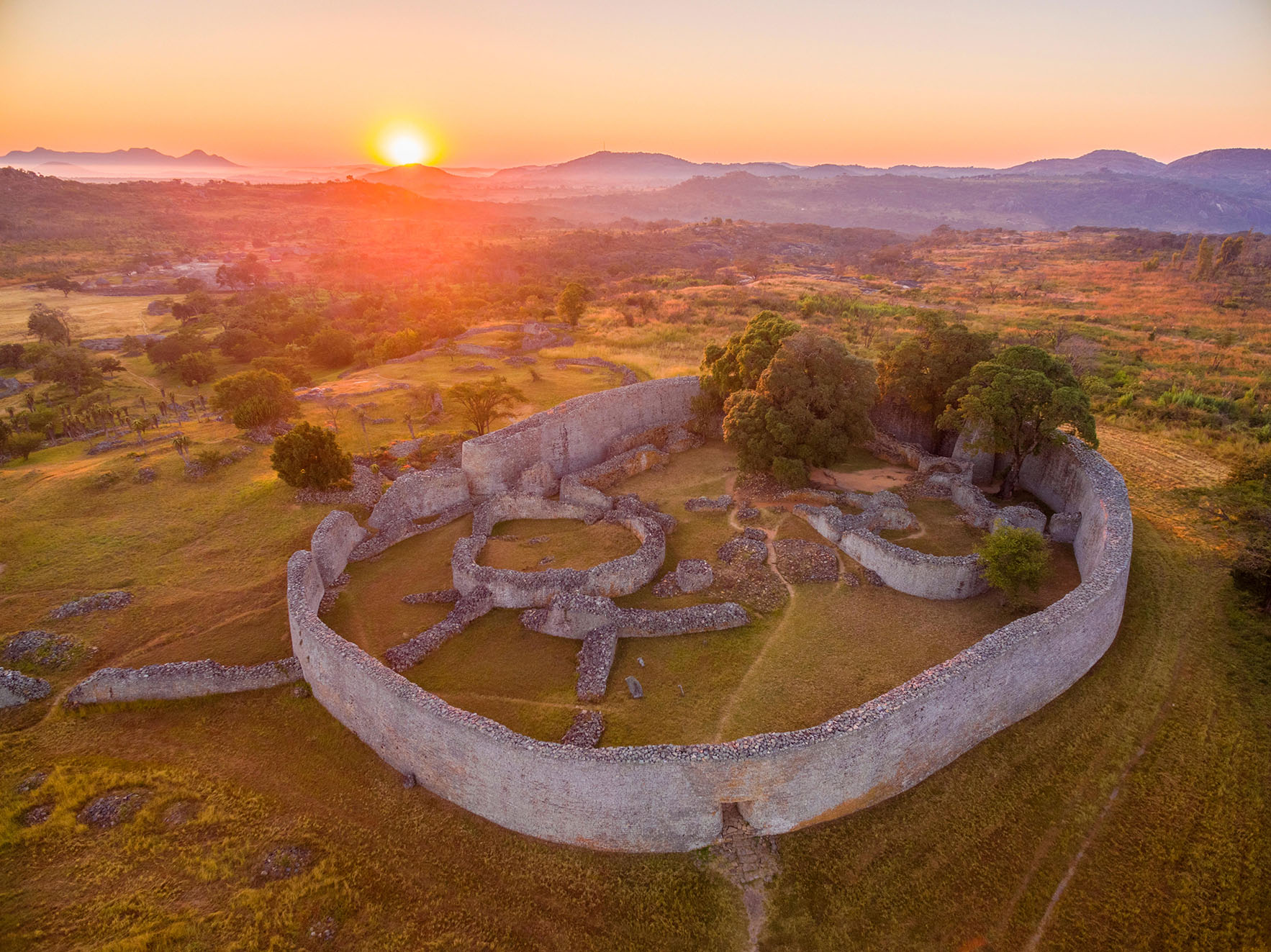
Photo of Great Zimbabwe - evaluate visual source: Part A
Respond to parts A, B, and C.
Describe one factor that contributed to the prosperity of a society in East or Southern Africa from 100 BCE to 1500 CE.
Describe one function of the stone architecture in the source.
Explain one way the architecture in the source challenges misconceptions about early Africa.
The response accomplishes the task set by part A of the question.
Part A: Describe one factor that contributed to the prosperity of a society in East or Southern Africa from 100 BCE to 1500 CE.
Examples that earn this point include but are not limited to the following:
Its inhabitants, the Shona people, became wealthy from their cattle resources.
The Kingdom of Zimbabwe was linked to the Swahili Coast trade, which extended to Asia.
Great Zimbabwe became wealthy from the gold trade.
The people of the Kingdom of Zimbabwe had a mixed economy of cattle herding and commercial pursuits.
The coastal location of the Swahili Coast city-states linked Africa’s interior to trading communities in Asia.
The Red Sea connected the Aksumite Empire to trade routes that linked Aksum to Rome and India.
The response accomplishes the task set by part B of the question.
Part B: Describe a function of the stone architecture in the source.
Examples that earn this point include but are not limited to the following:
The large stone architecture offered military defense for the people within the city.
The Great Enclosure was a site for religious and administrative activities within the Kingdom of Zimbabwe.
The silos in the structure provided grain storage for people in Great Zimbabwe.
Part C: Explain one way the architecture in the source challenges misconceptions about early Africa.
Examples that earn this point include but are not limited to the following:
The architecture and its complexity stand as an important symbol of the prominence of Great Zimbabwe and the people of early Africa; this demonstrates that Africa has a well-documented history that includes complex societies.
The stone architecture demonstrates the autonomy and agricultural advancements of the Shona kings, which provides evidence that Africa was not a place with an unknowable history.
The architecture’s stone-walled cities and enclosures were comparable to castles and similar structures found in Europe and Asia, proving that Africa also has a rich history.
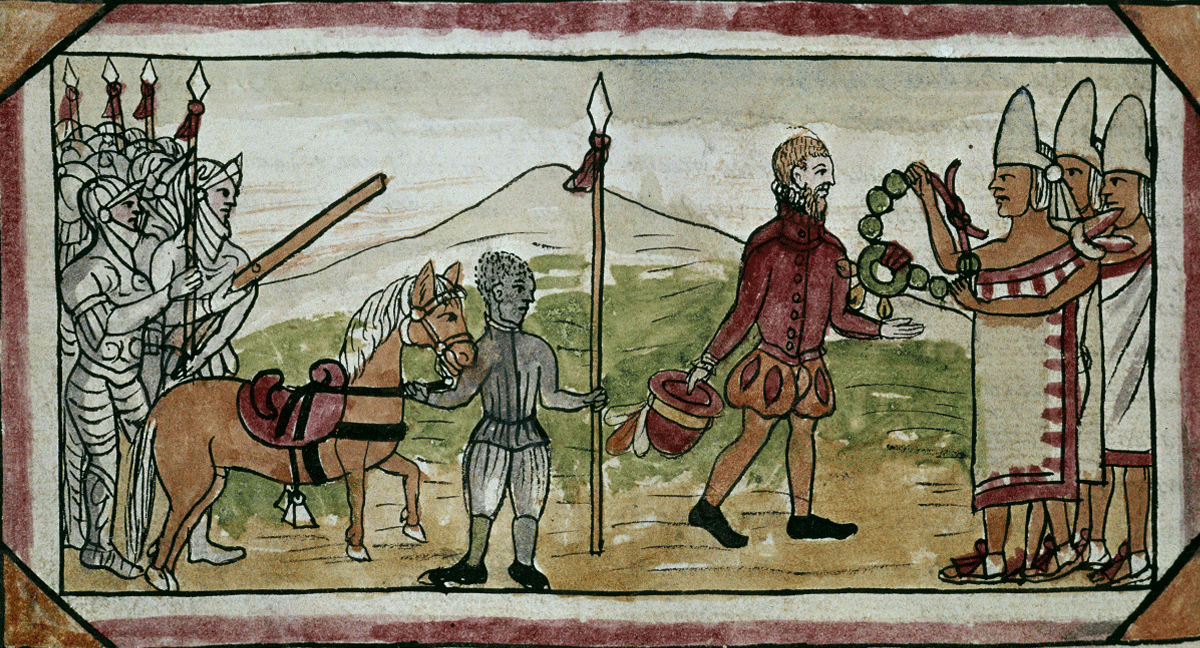
(Painting of Juan Garrido holding a pike and leading a horse during a European expedition in the Americas in 1533.)
Which of the following contexts is most helpful for understanding the development in the painting?
A.) As plantation laborers for Spanish settlers, Africans rarely rose above their designated status.
B.) Most of the Africans accompanying early Spanish conquistadors primarily acted as servants for Spanish elites.
C.) Africans referred to as Atlantic creoles used their familiarity with multiple cultures to gain social mobility.
D.) Africans resisted the transatlantic slave trade by forming revolts onboard slave ships.
B.) Most of the Africans accompanying early Spanish conquistadors primarily acted as servants for Spanish elites.
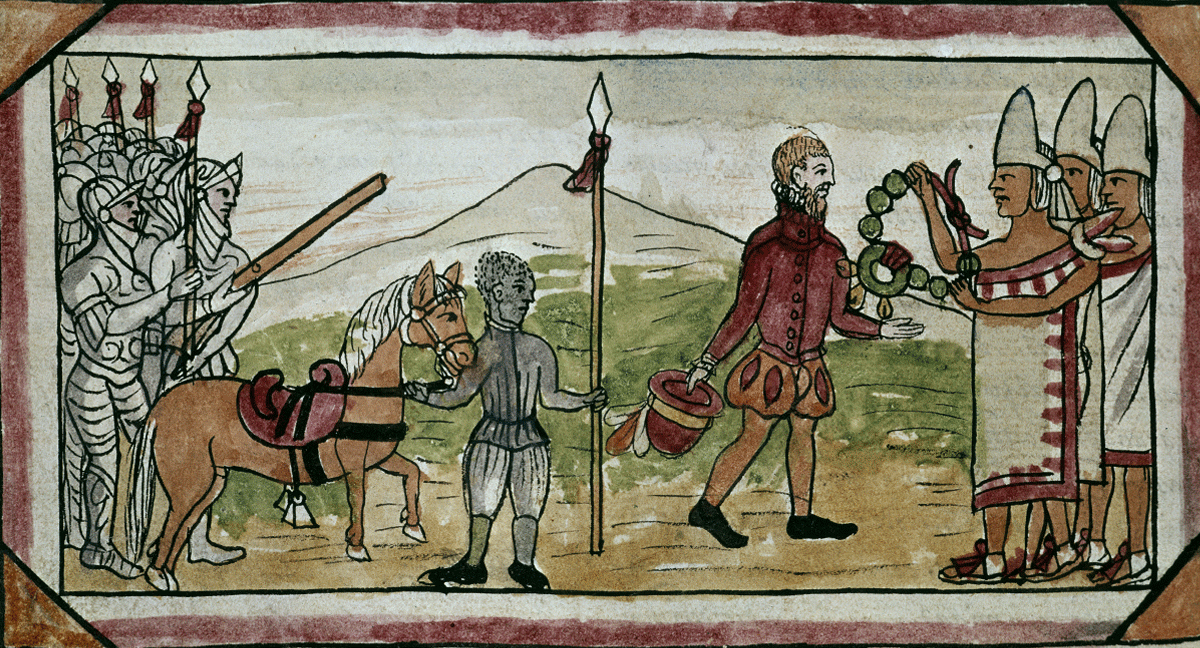
(Painting of Juan Garrido holding a pike and leading a horse during a European expedition in the Americas in 1533.)
Which of the following best describes a role played by Africans like Juan Garrido in the fifteenth and sixteenth centuries?
A.) They wrote early American slave narratives to advocate the end of slavery.
B.) They participated as conquistadors in European conquests in the Americas.
C.) They worked largely in mining and agriculture to produce profit for European enslavers.
D.) They gained their freedom in the Americas by allying with Indigenous populations against European colonizers.
B.) They participated as conquistadors in European conquests in the Americas.
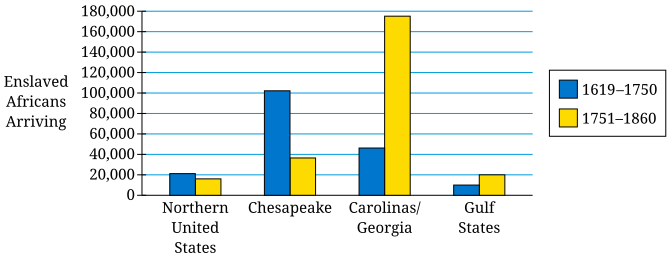
(New Arrivals of Enslaved Africans into Four Major Regions of the North American Mainland, Before and After 1750)
Which of the following is the most serious limitation of the graph regarding the importance of North America as a destination of enslaved persons over the course of the transatlantic slave trade?
A.) The graph does not provide data for the period after 1860.
B.) The graph does not give a breakdown of arrivals on British versus French versus Portuguese ships.
C.) The graph does not show how the numbers included in it compare with numbers for the rest of the Americas.
D.) The graph does not list the gender distribution of the enslaved persons arriving per each period.
C.) The graph does not show how the numbers included in it compare with numbers for the rest of the Americas.
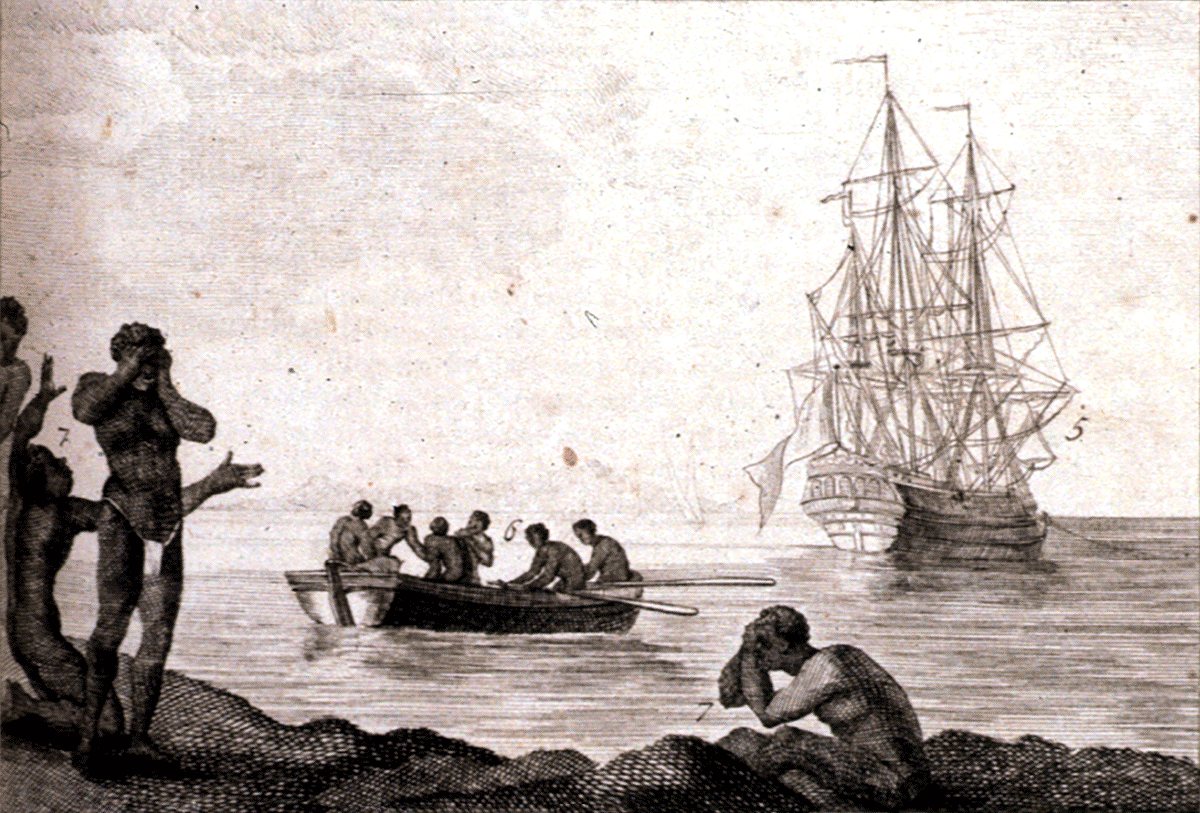
(Illustration from The Trade of America Through Marseille, or Explanation of the King’s Decrees, Regulating the Trade Which Takes Place From Marseille to the French Islands of America, Book Published in France, 1764)
Which of the following best describes an important effect of the transatlantic slave trade on the culture of the United States?
A.) The transatlantic slave trade limited enslaved African Americans’ cultural contributions to the fields of music and the performing arts.
B.) The transatlantic slave trade led to the widespread adoption of West African languages such as Wolof, Akan, and Yoruba by the majority of the enslaved population of the United States.
C.) The transatlantic slave trade contributed to a significant cultural diversity among enslaved African Americans due to the multiple combinations of African beliefs and practices in various communities.
D.) The transatlantic slave trade prevented enslaved African Americans from maintaining cultural practices and beliefs.
C.) The transatlantic slave trade contributed to a significant cultural diversity among enslaved African Americans due to the multiple combinations of African beliefs and practices in various communities.
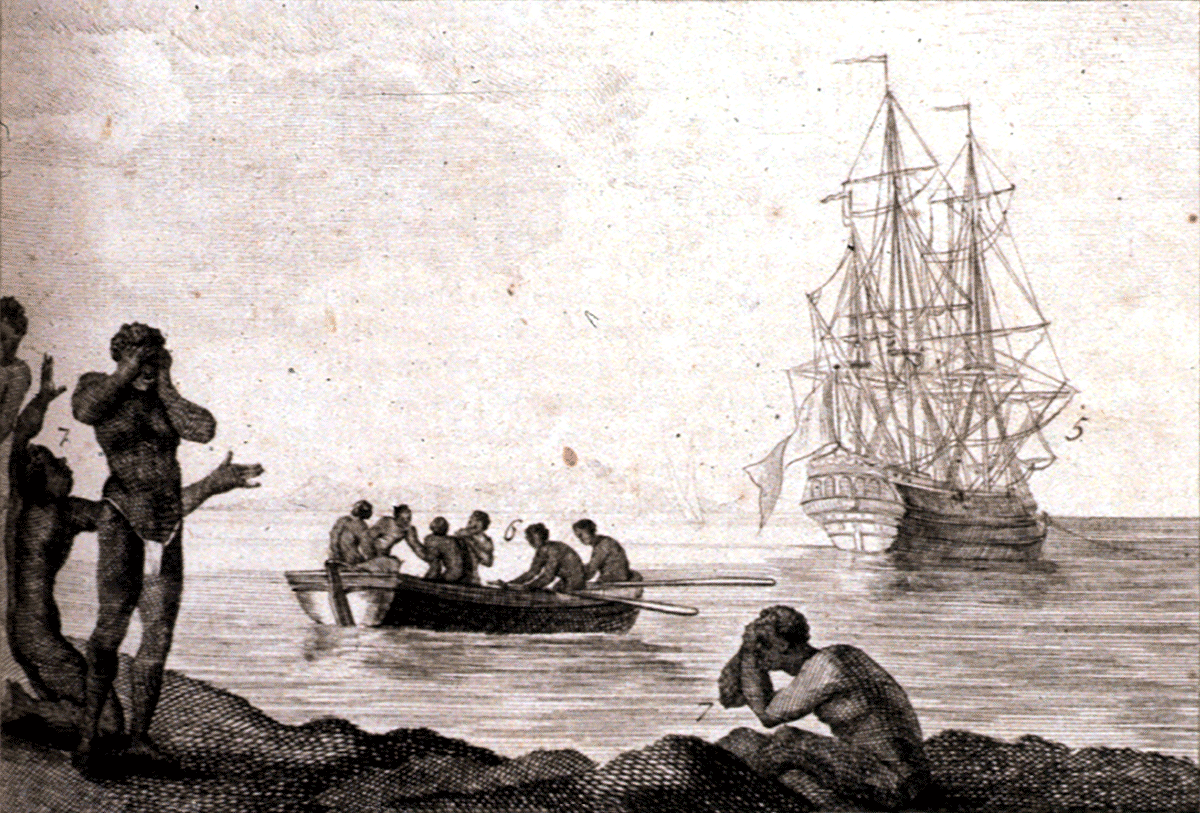
(Illustration from The Trade of America Through Marseille, or Explanation of the King’s Decrees, Regulating the Trade Which Takes Place From Marseille to the French Islands of America, Book Published in France, 1764)
The image could best be used to help illustrate which of the following about the transatlantic slave trade?
A.) Only a small minority of enslaved Africans were transported directly to mainland North America.
B.) The trade lasted for over 350 years, from the early 1500s to the mid-1800s.
C.) France was one of the top enslaving nations in the Atlantic world.
D.) African kingdoms played an important role in supplying enslaved persons for the transatlantic trade.
C.) France was one of the top enslaving nations in the Atlantic world.
“Esi had been in the women's dungeon of the Cape Coast Castle for two weeks. She spent her fifteenth birthday there. On her fourteenth birthday, she was in the heart of Asanteland, in her father's...compound. He was the best warrior in the village, so everyone had come to pay their respects to the daughter who grew more beautiful with each passing day. Kwasi Nnuro [one of the men wishing to marry Esi] brought sixty yams [as a gift]. More yams than any other suitor had ever brought before. Esi would have married him in the summer, when the sun stretched long and high, when the palm trees could be tapped for wine, climbed by the spriest children, their arms holding the trunk in a hug as they shinnied to the top....
When she wanted to forget the Castle, she thought of these things, but she did not expect joy. Hell was a place of remembering, each beautiful moment passed through the mind's eye until it fell to the ground like a rotten mango, perfectly useless, uselessly perfect.
A [white] soldier came into the dungeon and began to speak. He had to hold his nose to keep from vomiting. The women did not understand him. His voice didn't seem angry, but they had learned to back away at the sight of that uniform, that skin the color of coconut meat.”
Which of the following best describes the primary purpose of this excerpt?
Responses
A.) To demonstrate that before the nineteenth century, more enslaved Africans arrived in the Americas than people from any other region
B.) To highlight the cruel treatment white enslavers demonstrated toward their African captives during the Middle Passage
C.) To show how the Atlantic slave trade affected the distribution of various African ethnic groups throughout the American South
D.) To convey enslaved Africans’ suffering as they were being forcibly separated from their communities and subjected to inhumane conditions
D.) To convey enslaved Africans’ suffering as they were being forcibly separated from their communities and subjected to inhumane conditions
“Esi had been in the women's dungeon of the Cape Coast Castle for two weeks. She spent her fifteenth birthday there. On her fourteenth birthday, she was in the heart of Asanteland, in her father's...compound. He was the best warrior in the village, so everyone had come to pay their respects to the daughter who grew more beautiful with each passing day. Kwasi Nnuro [one of the men wishing to marry Esi] brought sixty yams [as a gift]. More yams than any other suitor had ever brought before. Esi would have married him in the summer, when the sun stretched long and high, when the palm trees could be tapped for wine, climbed by the spriest children, their arms holding the trunk in a hug as they shinnied to the top....
When she wanted to forget the Castle, she thought of these things, but she did not expect joy. Hell was a place of remembering, each beautiful moment passed through the mind's eye until it fell to the ground like a rotten mango, perfectly useless, uselessly perfect.
A [white] soldier came into the dungeon and began to speak. He had to hold his nose to keep from vomiting. The women did not understand him. His voice didn't seem angry, but they had learned to back away at the sight of that uniform, that skin the color of coconut meat.”
Which of the following best describes the part of the enslaved journey that Esi is experiencing in the passage?
A.) The initial capture and enslavement before being forced to march to the Atlantic coast
B.) The wait on the Atlantic coast before being boarded onto a ship
C.) The Middle Passage, in which enslaved Africans were transported across the Atlantic
D.) The final part of the journey, including being resold and shipped to plantations or other places of servitude
B.) The wait on the Atlantic coast before being boarded onto a ship
“From the beginning [of the voyage from West Africa to Cuba] there was manifest discontent among the slaves.... We had been at sea about three weeks...and there was so much merriment among the gangs [of enslaved people] that were allowed to come on deck, that my apprehensions of danger began gradually to wear away. Suddenly, however, one fair afternoon, a squall broke forth from an almost cloudless sky; and as the boatswain’s whistle piped all hands to take in sail, a simultaneous rush was made by the confined slaves... and amid the confusion of the rising gale, they knocked down the guard and poured upon deck.... Meantime, the women in the cabin were not idle. Seconding the males, they rose in a body....
I saw that, between the squall...and the revolt...we would soon be in a desperate plight, unless I gave the order to shoot. Accordingly, I told my comrades to...fire at once.
...The unharmed neither fled nor ceased brandishing their weapons.... But, being reinforced by the boatswain and carpenter, we took command of the hatches so effectually, that a dozen additional discharges... drove the refractory to their quarters below.”
Events such as the one described in the excerpt most directly contributed to which of the following developments?
A.) Some Atlantic creoles found opportunities for social mobility in the Americas after the Middle Passage.
B.) Activists used depictions of the dehumanizing conditions onboard slave ships to promote antislavery sentiment.
C.) Monetary incentives for African kingdoms to engage in warfare decreased because of the dangers of slave trading.
D.) The publication of slave narratives declined as many white Americans became less sympathetic to the stories of formerly enslaved people.
B.) Activists used depictions of the dehumanizing conditions onboard slave ships to promote antislavery sentiment.
“I grew up like a neglected weed,—ignorant of liberty, having no experience of it. Then I was not happy or contented: every time I saw a white man I was afraid of being carried away. I had two sisters carried away in a chain-gang,—one of them left two children. We were always uneasy. Now I've been free, I know what a dreadful condition slavery is. I have seen hundreds of escaped slaves, but I never saw one who was willing to go back and be a slave. I have no opportunity to see my friends in my native land. We would rather stay [there], if we could be as free there as we are here. I think slavery is the next thing to hell.”
Which of the following broader historical contexts best explains Tubman’s fear of “being carried away”?
A.) Enslaved African Americans were being sent to Africa by the American Colonization Society to build overseas colonies.
B.) Enslaved African Americans believed that resisting slavery would lead to a delay in gaining freedom through the Underground Railroad.
C.) Enslaved African Americans were taken from plantations to fight for the Union army during the Civil War.
D.) Enslaved African Americans were often forcibly sold by plantation owners as a part of the domestic slave trade.
D.) Enslaved African Americans were often forcibly sold by plantation owners as a part of the domestic slave trade.
“I grew up like a neglected weed,—ignorant of liberty, having no experience of it. Then I was not happy or contented: every time I saw a white man I was afraid of being carried away. I had two sisters carried away in a chain-gang,—one of them left two children. We were always uneasy. Now I've been free, I know what a dreadful condition slavery is. I have seen hundreds of escaped slaves, but I never saw one who was willing to go back and be a slave. I have no opportunity to see my friends in my native land. We would rather stay [there], if we could be as free there as we are here. I think slavery is the next thing to hell.”
Tubman’s testimony was part of a larger effort by abolitionists to highlight which of the following?
A.) The challenges of life for Black women during segregation
B.) The effects of Black Codes on the lives of newly freed African Americans
C.) The experiences of enslaved people in order to advance the cause of freedom
D.) The claims that African Americans would be unable to integrate into society
C.) The experiences of enslaved people in order to advance the cause of freedom
“The conventional interpretation of rice history in the [colonial] Americas assigns Europeans the role of ingeniously adapting a crop of Asian origin to New World conditions. This perspective, however, ignores the role of Africans in establishing a preferred food staple under slavery. The development of rice culture marked not simply the movement of a crop across the Atlantic but also the transfer of an entire cultural system, from production to consumption....
...[Rice cultivation was] a knowledge system long practiced in West Africa [that] was brought with slaves across the Atlantic....Its diffusion has been misunderstood and misinterpreted in ways that diminished the significance of the African origins of the crop and of the people who grew the rice, processed the grain, and prepared the food. Recovery of this African knowledge system promotes our understanding of rice history in the Atlantic basin and the African contribution to the Americas.”
Which of the following describes Carney’s primary argument in the excerpt?
A.) Europeans had been growing rice in southern Europe for many centuries before they later taught West Africans how to cultivate it.
B.) Rice cultivation originated in Asia, and Europeans learned how to cultivate this new crop and modify it for rice plantations in the Carolinas.
C.) Enslaved Africans successfully adapted skills, knowledge, and cultural practices of West African rice production to New World conditions.
D.) The introduction of rice cultivation to the Americas from Africa was notable only because it represented the movement of a crop across the Atlantic.
C.) Enslaved Africans successfully adapted skills, knowledge, and cultural practices of West African rice production to New World conditions.
“The conventional interpretation of rice history in the [colonial] Americas assigns Europeans the role of ingeniously adapting a crop of Asian origin to New World conditions. This perspective, however, ignores the role of Africans in establishing a preferred food staple under slavery. The development of rice culture marked not simply the movement of a crop across the Atlantic but also the transfer of an entire cultural system, from production to consumption....
...[Rice cultivation was] a knowledge system long practiced in West Africa [that] was brought with slaves across the Atlantic....Its diffusion has been misunderstood and misinterpreted in ways that diminished the significance of the African origins of the crop and of the people who grew the rice, processed the grain, and prepared the food. Recovery of this African knowledge system promotes our understanding of rice history in the Atlantic basin and the African contribution to the Americas.”
Which of the following was a long-term result of the historical process described in the excerpt?
Responses
A.) African ladinos increasingly became important intermediaries contributing to the growth of the United States domestic slave trade.
B.) The southern United States moved from an economy based on cotton production to one based on rice production.
C.) In the United States, the South and not the North benefited from enslaved people’s labor.
D.) The labor of enslaved people came to be foundational to the United States economy.
D.) The labor of enslaved people came to be foundational to the United States economy.
“[Article 15]. We forbid slaves to carry any weapon, or large sticks, on pain of whipping and of confiscation of the weapon to the profit of those who seize them; with the sole exception of those who are sent hunting by their master.
[Article 16]. We forbid slaves belonging to different masters to gather during the day or at night whether claiming [to do so] for a wedding or otherwise, whether on their master's property or elsewhere, and still less in the main roads or in faraway places, on pain of corporal punishment, which will not be less than the whip and the fleur de lys and which in cases of frequent violations and other aggravating circumstances may be punished with death: this we leave to the decision of judges. We [authorize] all our subjects, even those who are not officers of the state, to approach the offenders, to arrest them, and to take them to prison, even if there is not yet any decree against them.
[Article 17]. Masters who are convicted of having permitted or tolerated such assemblies composed of slaves other than those belonging to them will be condemned... to pay for all the damage that will have been done to their neighbors by these said assemblies and a fine of 10 ecus for the first time and double for repeat offenses.”
Which of the following most directly influenced the creation of policies such as those in the excerpt?
Responses
A.) Worry among enslavers that slavery was becoming less profitable.
B.) Fear among enslavers of slave uprisings and other forms of resistance to slavery.
C.) Enslavers’ concern for the safety and well-being of the enslaved persons under their control.
D.) Enslavers’ claims that slavery was a morally benign and economically necessary institution.
B.) Fear among enslavers of slave uprisings and other forms of resistance to slavery.
“[Article 15]. We forbid slaves to carry any weapon, or large sticks, on pain of whipping and of confiscation of the weapon to the profit of those who seize them; with the sole exception of those who are sent hunting by their master.
[Article 16]. We forbid slaves belonging to different masters to gather during the day or at night whether claiming [to do so] for a wedding or otherwise, whether on their master's property or elsewhere, and still less in the main roads or in faraway places, on pain of corporal punishment, which will not be less than the whip and the fleur de lys and which in cases of frequent violations and other aggravating circumstances may be punished with death: this we leave to the decision of judges. We [authorize] all our subjects, even those who are not officers of the state, to approach the offenders, to arrest them, and to take them to prison, even if there is not yet any decree against them.
[Article 17]. Masters who are convicted of having permitted or tolerated such assemblies composed of slaves other than those belonging to them will be condemned... to pay for all the damage that will have been done to their neighbors by these said assemblies and a fine of 10 ecus for the first time and double for repeat offenses.”
Which of the following best describes how the French Code Noir of 1685 relates to the practice of slavery in American societies in the period circa 1600–1900?
A.) The French Code Noir was an early example of the regulations that restricted enslaved persons’ freedoms which were adopted across a wide variety of enslaving societies in the Americas.
B.) The French Code Noir was the original source of slave laws and regulations used in British North American colonies, many of which adopted the Code Noir in its entirety.
C.) The French Code Noir was a unique legal document, which did not have any parallels in British or Spanish colonies, or in individual US states and jurisdictions.
D.) The French Code Noir, unlike other slave codes, used race as one of the main factors defining a person’s free or enslaved status.
A.) The French Code Noir was an early example of the regulations that restricted enslaved persons’ freedoms which were adopted across a wide variety of enslaving societies in the Americas.
“If any thing has ever been proved and demonstrated again and again, it is THE LAWFULNESS OF SLAVERY....
It has been proved that the [Latin] maxim, ‘partus sequitur ventrem’ – or that the offspring inherits the status of the parent, is a law of nature, reason, religion, and providence, and that no man has any rights but those to which he is born, or which belong to that condition in which God places him by the hand of his providence....
He that is born a slave, therefore, has no right to liberty, and can acquire none, so long as the right of his master to his service stands in the way.”
As noted in the passage, the concept of partus sequitur ventrem was used to justify which of the following practices?
A.) Determining a child’s citizenship by the state in which they were born
B.) Determining a child’s ability to be free from enslavement by their father’s wealth
C.) Determining a child’s enslaved status based on the status of the child’s mother
D.) Determining a child’s educational opportunities based on the occupation of their father
C.) Determining a child’s enslaved status based on the status of the child’s mother
“If any thing has ever been proved and demonstrated again and again, it is THE LAWFULNESS OF SLAVERY....
It has been proved that the [Latin] maxim, ‘partus sequitur ventrem’ – or that the offspring inherits the status of the parent, is a law of nature, reason, religion, and providence, and that no man has any rights but those to which he is born, or which belong to that condition in which God places him by the hand of his providence....
He that is born a slave, therefore, has no right to liberty, and can acquire none, so long as the right of his master to his service stands in the way.”
Which of the following best explains how the concept of partus sequitur ventrem served the interests of enslavers in the United States before the Civil War?
A.) It supported enslavers’ claims that legal rights should be based on one’s outward appearance.
B.) It perpetuated slavery over generations and determined the social position of racially mixed offspring.
C.) It enabled enslavers to prohibit the enslaved from gathering and learning to read.
D.) It led enslavers to embrace the notion that race is a social construct.
B.) It perpetuated slavery over generations and determined the social position of racially mixed offspring.
Lift Every Voice and Sing
Let our rejoicing rise
High as the listening skies,
Let it resound loud as the rolling sea.
Sing a song full of the faith that the dark past has taught us,
Sing a song full of the hope that the present has brought us.
Facing the rising sun of our new day begun,
Let us march on till victory is won....
Have not our weary feet
Come to the place for which our fathers sighed?
We have come over a way that with tears has been watered,
We have come, treading our path through the blood of the slaughtered,
Out from the gloomy past,
Till now we stand at last.
Which of the following claims can best be made about spirituals and hymns such as “Lift Every Voice and Sing”?
A.) They conveyed the assertion that African Americans should be accepted as equals.
B.) They encouraged African Americans to use music as a means of assimilation.
C.) They offered uplifting messages of redemption and deliverance.
D.) They were used to promote solidarity between African Americans and other oppressed groups.
C.) They offered uplifting messages of redemption and deliverance.
Steal Away to Jesus
Steal away, steal away, steal away to Jesus!
Steal away, steal away home,
I ain’t got long to stay here....
My Lord, He calls me, He calls me by the thunder,
The trumpet sounds within-a my soul,
I ain’t got long to stay here....
Green trees are a-bending, po’ sinner stand a-trembling,
The trumpet sounds within-a my soul,
I ain’t got long to stay here,
Oh, Lord, I ain’t got long to stay here.
Which of the following best describes a meaning of the lines “Steal away, steal away home, / I ain’t got long to stay here”?
Responses
A.) To mourn enslaved people who had been transported to the lower South
B.) To communicate information regarding locations of maroon communities
C.) To resist the dehumanizing condition of enslavement
D.) To alert enslaved people of opportunities to escape enslavement
D.) To alert enslaved people of opportunities to escape enslavement
“The...Colored citizens and Ministers [of New York City]...have not been inattentive to the course of the Colonization meetings [here].... The sole object of these meetings was to act on the interests of the colored people.... [But] none of that class were invited to take part in them, and they have been carried on without any reference whatever to their wishes or opinions....
The Colonization scheme was set on foot...by Slaveholders, with the view...of perpetuating their system of Slavery, undisturbed. From the first, no very high expectations seem to have been entertained, that an enterprise, so unnecessary, so unnatural,...bearing about it so little of hope, so much of despair, would [re]commend itself strongly to that class of the community to which it purported solely to be addressed. But little reliance appears to have been placed on obtaining their voluntary consent to exchange for...Africa, this, the country of their fathers for generations, and of their own nativity...where, notwithstanding they were called to suffer many ills brought on them by others, they might yet live in hope, that the dark cloud of Slavery which had so long obscured the free principles asserted by our governments, would one day pass away and permit these principles to shine in all their warmth and effulgence, if not on themselves, on a not very distant generation of their descendants....
We ask you...whether you ought longer...to press on us an enterprise that we have unremittingly rejected from the first?”
The source could best be used as evidence to support which of the following claims?
A.) Some African Americans expressed optimism for their future in the United States.
B.) Free African Americans felt a strong kinship with Africans because of their common heritage.
C.) Free African Americans in the North were disconnected from the issue of slavery in the South.
D.) Some African Americans worked with state governments in the colonization scheme.
A.) Some African Americans expressed optimism for their future in the United States.
“The...Colored citizens and Ministers [of New York City]...have not been inattentive to the course of the Colonization meetings [here].... The sole object of these meetings was to act on the interests of the colored people.... [But] none of that class were invited to take part in them, and they have been carried on without any reference whatever to their wishes or opinions....
The Colonization scheme was set on foot...by Slaveholders, with the view...of perpetuating their system of Slavery, undisturbed. From the first, no very high expectations seem to have been entertained, that an enterprise, so unnecessary, so unnatural,...bearing about it so little of hope, so much of despair, would [re]commend itself strongly to that class of the community to which it purported solely to be addressed. But little reliance appears to have been placed on obtaining their voluntary consent to exchange for...Africa, this, the country of their fathers for generations, and of their own nativity...where, notwithstanding they were called to suffer many ills brought on them by others, they might yet live in hope, that the dark cloud of Slavery which had so long obscured the free principles asserted by our governments, would one day pass away and permit these principles to shine in all their warmth and effulgence, if not on themselves, on a not very distant generation of their descendants....
We ask you...whether you ought longer...to press on us an enterprise that we have unremittingly rejected from the first?”
What evidence do the authors provide to show their opposition to the American Colonization Society?
A.) The American Colonization Society needed more input from white abolitionists in order to be taken seriously.
B.) The American Colonization Society needed more support from independent African states to be successful.
C.) The American Colonization Society was created by enslavers to force Blacks out of the United States.
D.) The American Colonization Society was founded before there was a law that abolished slavery in the United States.
C.) The American Colonization Society was created by enslavers to force Blacks out of the United States.
 Note
Note  Flashcards (61)