lecture 19 + chat questions
 Call Kai
 Learn
Learn Practice Test
 Spaced Repetition
 Match
Match Flashcards
 Knowt Play
1/33

There's no tags or description
Looks like no tags are added yet.
Name | Mastery | Learn | Test | Matching | Spaced | Call with Kai |
|---|
No analytics yet
Send a link to your students to track their progress
34 Terms
Which compound is responsible for dark red or purple pigments in plants?
Petunidin
Based on what we know about flavonoids in general, what do you think the bioavailability of anthocyanins consumed by humans will be?
low
What species name below is commonly referred to as the cranberry plant?
Vaccinium macrocarpon
Do you think the mechanism of action for anthocyanins will vary from flavonoids? Why or why not?
no due to similar structure
Which of the following is not a health benefit associated with anthocyanins?
Hepatoprotective
Which of the plants mentioned in the powerpoint can be grown outdoors in SC?
All of these- Rubus fruticosus, Punica granatum, Vaccinium corymbosum
Congratulations! You've been hired as a lab technician to generate anthocyanins that are higher bioavailable for human consumption! How would you go about doing this? Design an experiment!
increase the sugar and stress on plant to produce more SMs
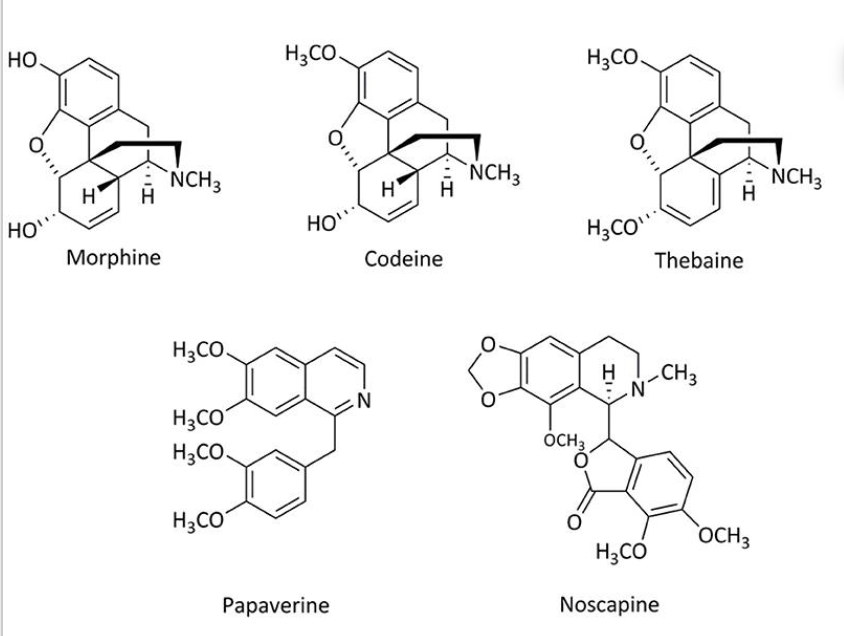
Which category of secondary metabolites do all 5 of these structures belong to?
Alkaloids
Spring is here, which means that summer is around corner! To get ready for her Hot Girl Summer, Taylor decides tha she wants to lose weight and FAST. While doing some weight loss research, she comes across an alkaloid that will get the job done. However, it turns out that it was banned by the FDA in 2004. What alkaloid did Taylor see research on?
none of the above
Notice any differences between general Flavonoid structure and Anthocyanin?
• Both are phenolic compounds!
• Positive charge on Anthocyanins!
Flavonoids: Anthocyanins
• Water soluble pigments that impart red, blue, and even purple colors to plants.
Wide range of uses for anthocyanins:
• Dyes!
• Food colorants
• Traditional medicine
General Benefits to humans:
• Antidiabetic
• Anticancer
• Anti-inflammation
• Anti-obesity
• Prevention of cardiovascular diseases
Anthocyanin vs. Anthocyanidin
• Anthocyanin: contains a sugar molecule
• Anthocyanidin: Aglycone form!
Cyanidin
Vaccinium macrocarpon
• Reddish-purple pigment in plants.
Delphinidin
Vitis vinifera
• Common “Table” Grape.
• Important products:
• Fruit, wine, etc.
• Blue, red, or purplish pigment in plants.
Malvidin
Rubus fruticosus
• Extremely invasive.
• It’s actually here in SC
• Will grow pretty much anywhere it can.
• Purple color in plants.
Pelargonidin
Punica granatum
• Does well right here in SC!
• Grenadine comes from pomegranates!
• Red pigment in plants.
• Imparts orange hue to flowers.
Peonidin
Euterpe oleracea
• Magenta pigmentation in plants.
• Abundant in berries, grapes, red wines!
Petunidin
Vaccinium corymbosum
• “Blueberry”
• Wild species of Vaccinium were cultivated by Native Americans.
• Dark red or purple pigment in plants.
What is a key structural difference between anthocyanins and general flavonoids?
Anthocyanins have a positive charge
Anthocyanins are best described as:
Water-soluble pigments
What colors do anthocyanins typically impart to plants?
Red, blue, and purple
In acidic conditions, anthocyanins appear:
Red
In alkaline conditions, anthocyanins appear:
Blue
Anthocyanins are commonly found in which plant parts?
Flowers, fruits, and tubers
What is the main difference between anthocyanins and anthocyanidins?
Anthocyanins contain a sugar molecule
Anthocyanidins are best described as:
Aglycone forms
Which anthocyanidin is the most abundant in plants?
Cyanidin
Cyanidin typically produces what color in plants?
Reddish-purple
Delphinidin is associated with which type of pigment?
Blue, red, or purplish
Malvidin is responsible for which color in plants?
Purple
Pelargonidin contributes primarily to which color?
Red
Peonidin is commonly associated with which pigmentation?
Magenta

