unit 8 marine bio
 Call Kai
 Learn
Learn Practice Test
 Spaced Repetition
 Match
Match Flashcards
 Knowt Play
1/33

There's no tags or description
Looks like no tags are added yet.
Name | Mastery | Learn | Test | Matching | Spaced | Call with Kai |
|---|
No analytics yet
Send a link to your students to track their progress
34 Terms
This class of Cnidaria has a tiny larval phase as a polyp, and a long life as a solitary medusa. It is considered a large zooplankton in the pelagic environment. Some can grow quite large.
Class Scyphozoa
Which of the following is a threat to coral reef survival?
all of the above might threaten a coral reef community
Coral reefs contain twenty-five percent of all marine species
True
An advantage to being radially symmetrical is the ability to
get food and protect in all directions
The stinging cells in Cnidaria are triggered when
something brushes against it
With the presence of black band disease that primarily affects star corals, the population of their competitor, the _____ will ______.
staghorn corals; increase
The organisms in this class of Cnidaria live as polyps with a short solitary medusa stage. They grow in branching sessile colonies. A Portuguese man-of-war, with several forms in its life, is an example of an organism in this class. Some are hermaphroditic, and also can reproduce asexually through budding.
Class Hydrozoa
The red lionfish and the crown-of-thorns seastar are both examples of ____ and _____ on a coral reef.
biotic factors; invasive species
Nutrient flow in an ecosystem is
cyclic
Erosion of a reef by organisms is called bioerosion
True
Coral reefs flourish in nutrient deserts. Sudden high nutrient concentrations from the massive doses of fertilizers used in Western-style agriculture or from treated nutrient-rich sewage, act just like fertilizers should.
The problem with this is that
Pollution from sewage, agriculture, and sedimentation from poor land use practices smother coral reefs in industrialized areas.
The most biodiverse location on a barrier reef is
on the outer edges of the reef. Though exposed to the open ocean, greater nutrients exist in these waters, supporting greater biodiversity.
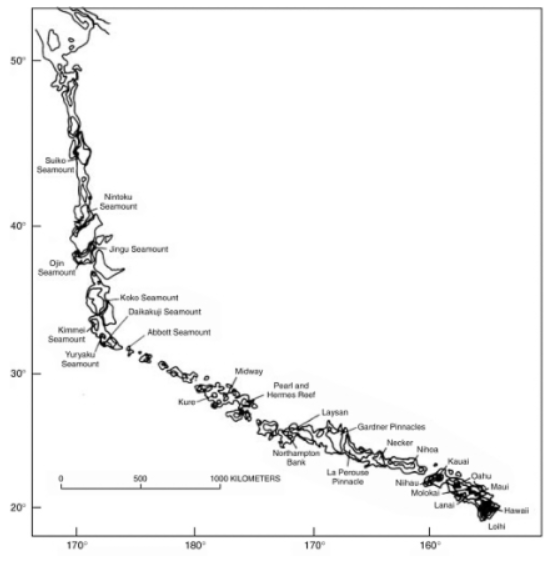
What does this image tell you about the Pacific Plate?
The Pacific Plate is now shifting to the NW after traveling primarily N. This is evidenced in the pattern of the hot spot created land-forms of Hawaii and the Emperor Seamounts.
The primitive sponge structure is supported by glasslike ___.
spicules
Energy flow in an ecosystem is
unidirectional
Coral reefs contain more algal biomass than animal biomass
True
Diversity is highest in coral reefs
True
The flagella in the sponge
both move water through and take in plankton
The loss of color in coral reef organisms is caused by
loss of zooxanthellae
A symbiotic relationship in which both participants benefit is called
mutualism
The stages of reef formation are;
fringing reef; plate movement; barrier reef; atoll
_____ removes vegetation that anchors soil and prevents erosion. This is an example of a(n) _____ factor.
Logging; abiotic
An atoll is a(n)
ring of white sand beaches in the south pacific. It is what remains of an island created by a hot spot The center of the ring is void of biodiversity, since it is mostly isolated from the nutrients of the open ocean.
The increase in the number of crown-of-thorn seastars has been strongly linked to human activities
False
On Carribean reefs, long-spined sea urchins are important because they ____ and ____.
keep the algae in check; prevent the reef from overgrowing
The nudibranch Phestilla is perfectly camouflaged to look exactly like the corals it eats, the epitonium snail eats and destroys mushroom corals, and there is a type of parasitic flatworm that eats the coral polyps and ingests the zoochlorellae and zooxanthellae and uses them to help with their own camouflage. These describe a ____ relationship.
parasitic
A symbiotic relationship is found between
dissimilar organisms in a close relationship
A sponge living in a limited supply of stagnant water would
die due to both starvation and low oxygen levels.
The amebocytes in the sponge
build the spicules
In addition to their nerve rings, and their 24 eyes, these organisms also have a statolith. They can swim fast in the direction of their choice, and avoid obstacles. This visual guidance, and advanced sensory system make it reasonable that their active fish-like swimming, which is as fast as 2 meters per second, allows them to hunt. These organisms belong to Class _______ .
Cubazoa
Sponges are thought to be an evolutionary dead end because
they have not evolved in thousands of years.
In 1842, ________ classified tropical reef structures into three types: fringing reefs, barrier reefs and atolls. We still use their classification of reef structures today.
Charles Darwin
Abusive fishing using cyanide, dynamite and muro-ami to collect fish on coral reefs, represent
a practice that is a threat to coral reefs like the predatory Crown-of-Thorns Seastar
This Cnidarian class grows through direct development. They can reproduce both sexually through broadcast spawning and asexually through budding. These organisms live primarily in shallow water because they depend on photosynthetic symbionts. Some members produce a skeleton of calcium carbonate.
Class Anthozoa
Explore top notes

