22. Bonus Class >> Neuro

0.0(0)
studied byStudied by 1 person
0.0(0)
full-widthCall Kai
learnLearn
examPractice Test
spaced repetitionSpaced Repetition
heart puzzleMatch
flashcardsFlashcards
GameKnowt Play
Card Sorting

1/34

encourage image

There's no tags or description

Looks like no tags are added yet.

Study Analytics
Name
Mastery
Learn
Test
Matching
Spaced

No study sessions yet.

35 Terms

1
New cards
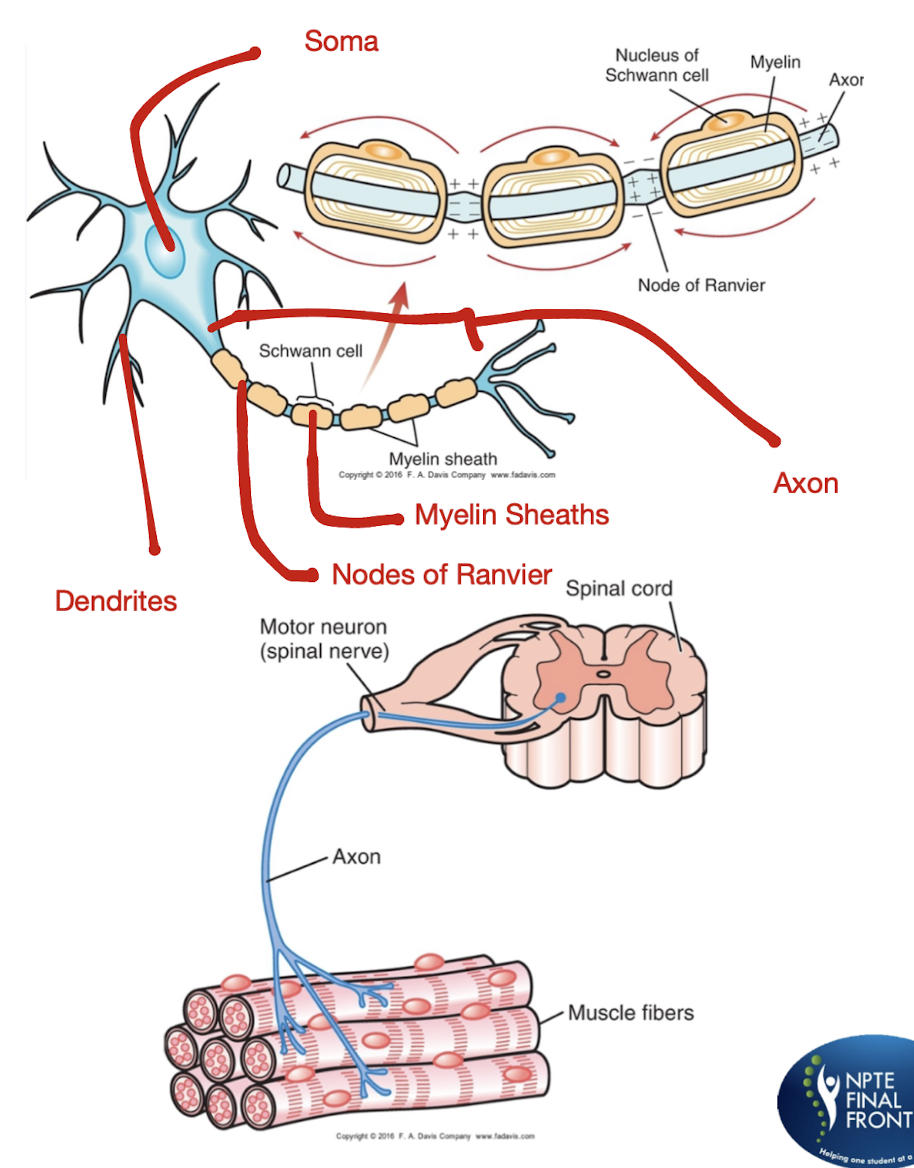
<p>Neuro Anatomy and Background:</p><ul><li><p>What is a Motor Unit?</p></li><li><p>A Motor Unit consists of what 6 structures?</p></li><li><p>Any disruption of the neuron or motor unit can cause what 2 things?</p></li></ul><p></p><p></p><p></p>

Neuro Anatomy and Background:

  • What is a Motor Unit?

  • A Motor Unit consists of what 6 structures?

  • Any disruption of the neuron or motor unit can cause what 2 things?

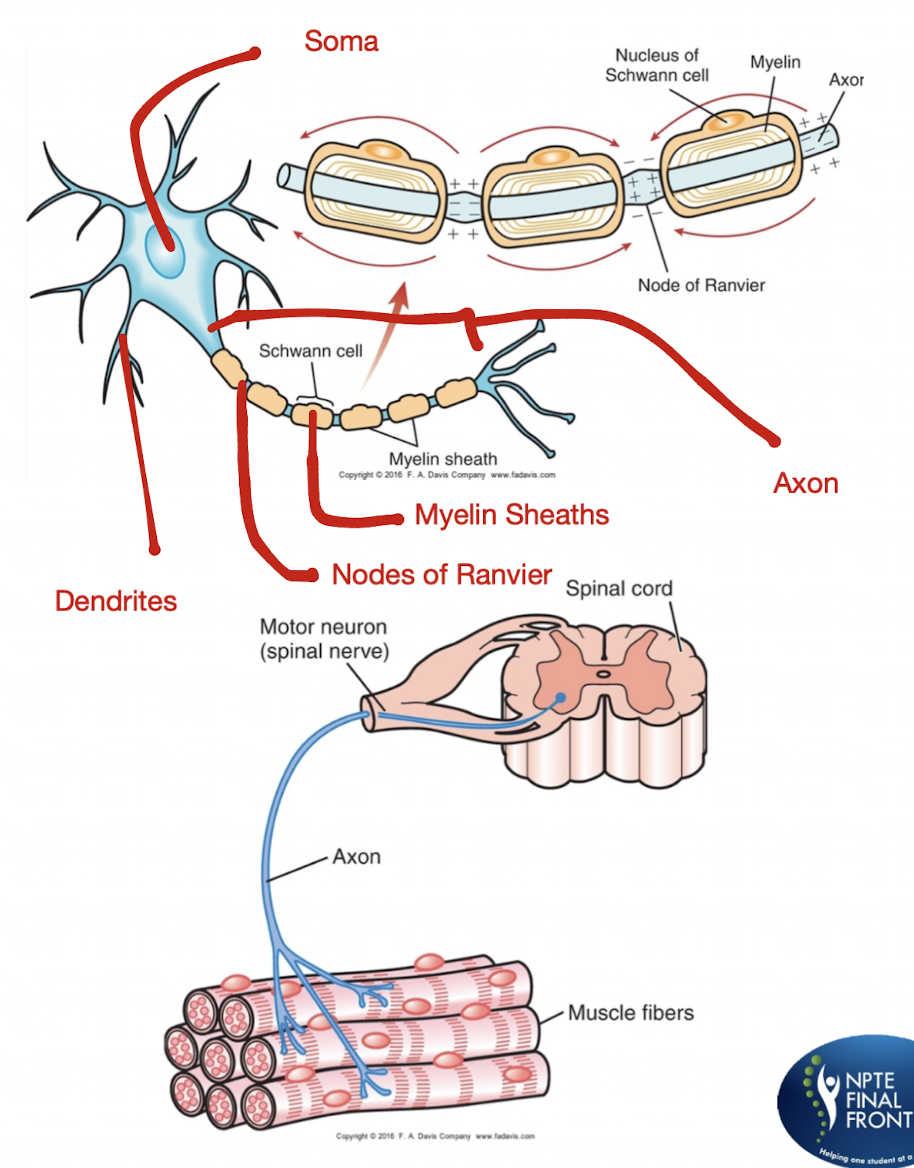
  • Motor Unit:

    • Functional unit of the peripheral neuromuscular system

  • Consists:

    • Anterior Horn Cell

    • Nerve Root

    • Plexus

    • Individual Nerve Fiber

    • NMJ

    • Muscle Fibers Innervated by that Axon

  • Cause:

    • Disruption in the flow of Information

    • Impairment in the neuromuscular system
<ul><li><p>Motor Unit:</p><ul><li><p>Functional unit of the peripheral neuromuscular system </p></li></ul></li><li><p>Consists:</p><ul><li><p>Anterior Horn Cell</p></li><li><p>Nerve Root</p></li><li><p>Plexus</p></li><li><p>Individual Nerve Fiber</p></li><li><p>NMJ</p></li><li><p>Muscle Fibers Innervated by that Axon</p></li></ul></li><li><p>Cause:</p><ul><li><p>Disruption in the flow of Information </p></li><li><p>Impairment in the neuromuscular system </p></li></ul></li></ul><p></p>
2
New cards

Practice Q 1:

Which of the following are periodic interruptions of myelin along the nerve axon that have relatively decreased resistance to ionic exchange, thus more easily permitting depolarization?

A. Schwann cells

B. Nodes of Ranvier

C. Anterior horn cells

D. Motor units

B. Nodes of Ranvier
3
New cards
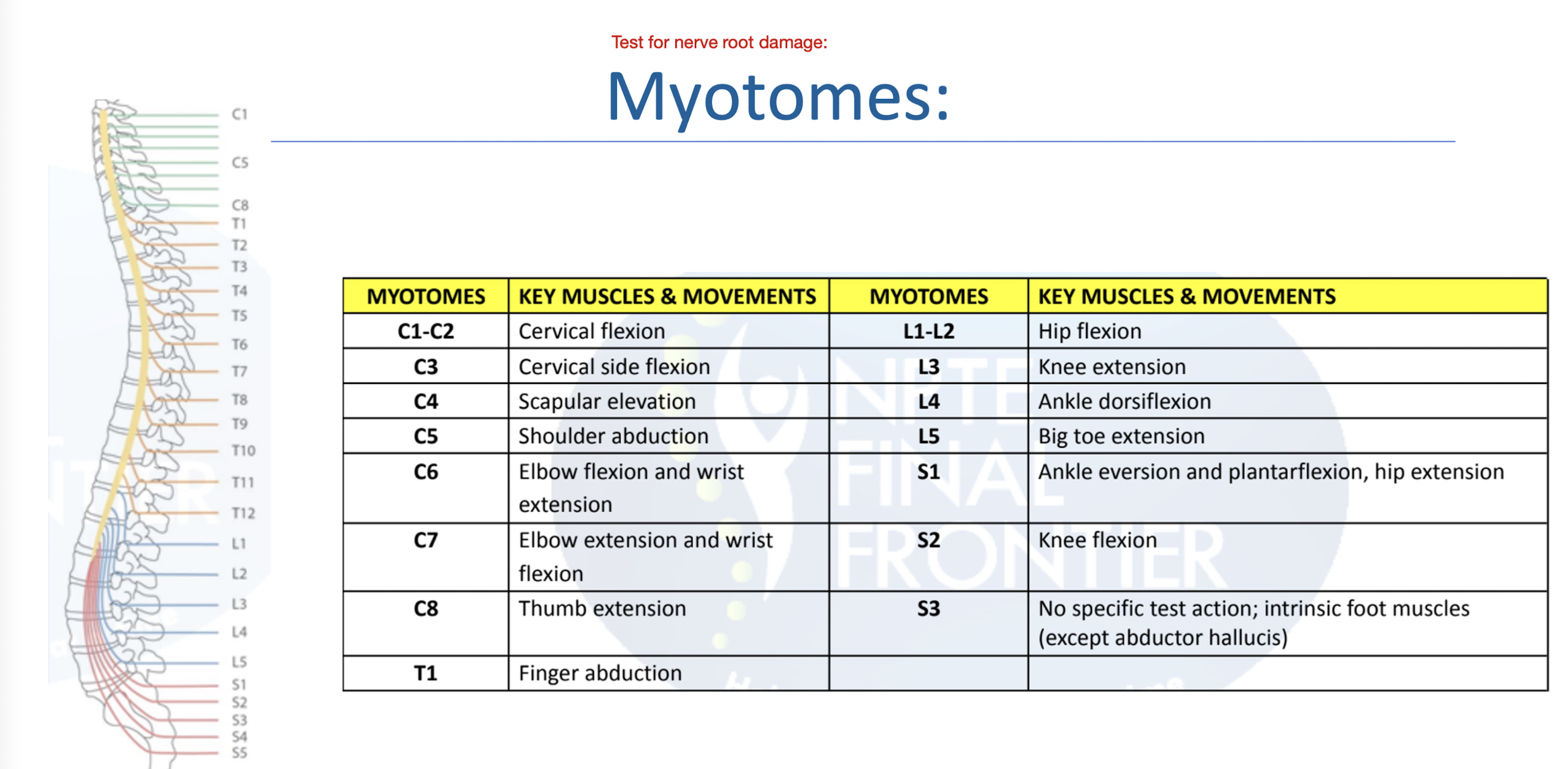
<p>UE and LE Myotomes: </p>

UE and LE Myotomes:

4
New cards
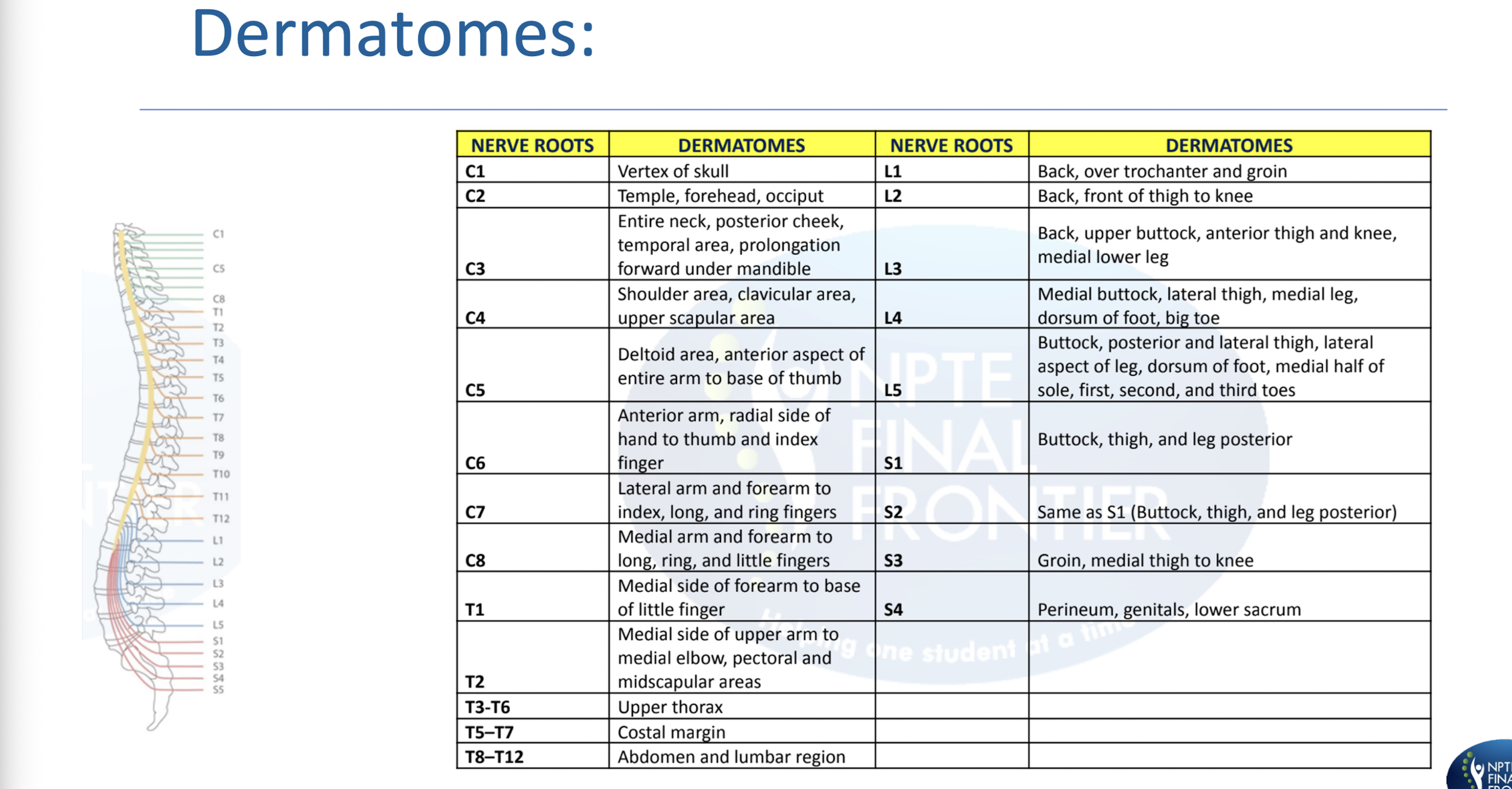
<p>UE and LE Dermatomes: </p>

UE and LE Dermatomes:

5
New cards

Practice Q 2:

Patient presents with weak knee extension on right lower extremity, and decreased sensation over upper buttock, anterior thigh and knee. Which of the following would be an appropriate diagnosis for this patient?

A. Femoral nerve entrapment

B. L3 nerve root compression

C. Obturator nerve lesion

D. Lateral stenosis compressing L4 nerve root

B. L3 nerve root compression
6
New cards
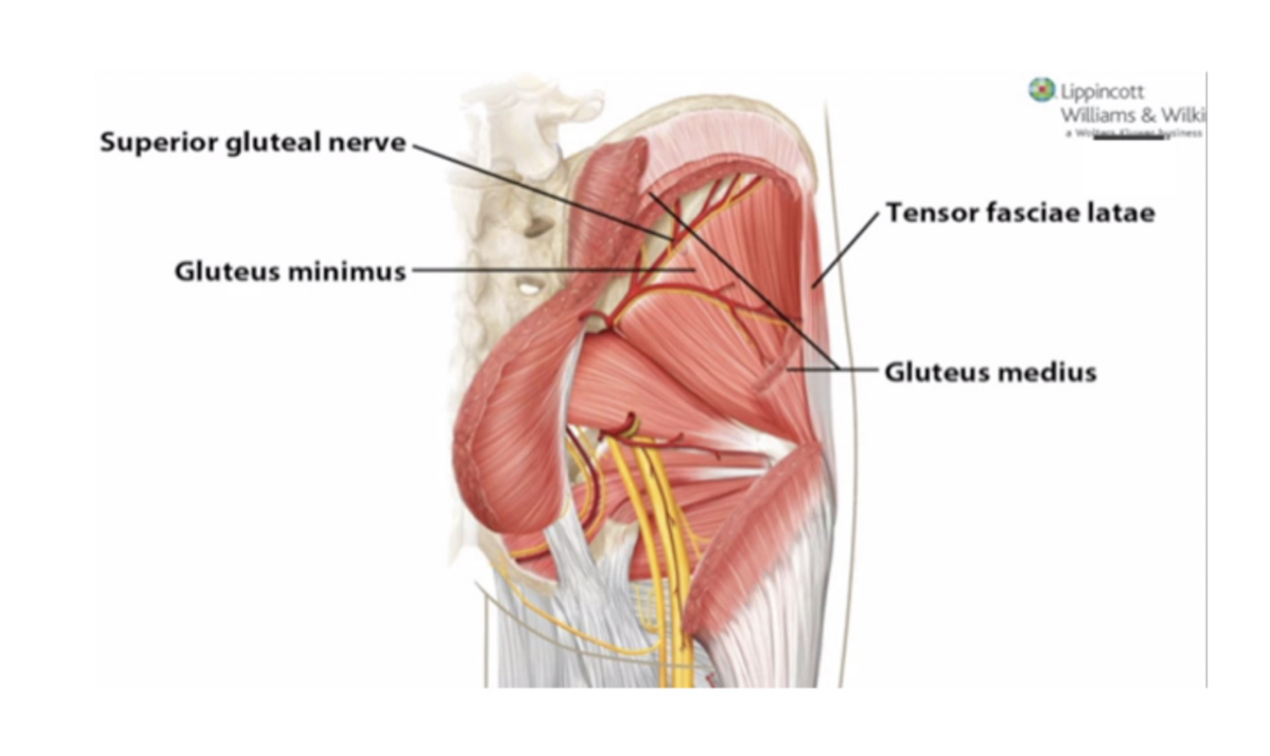
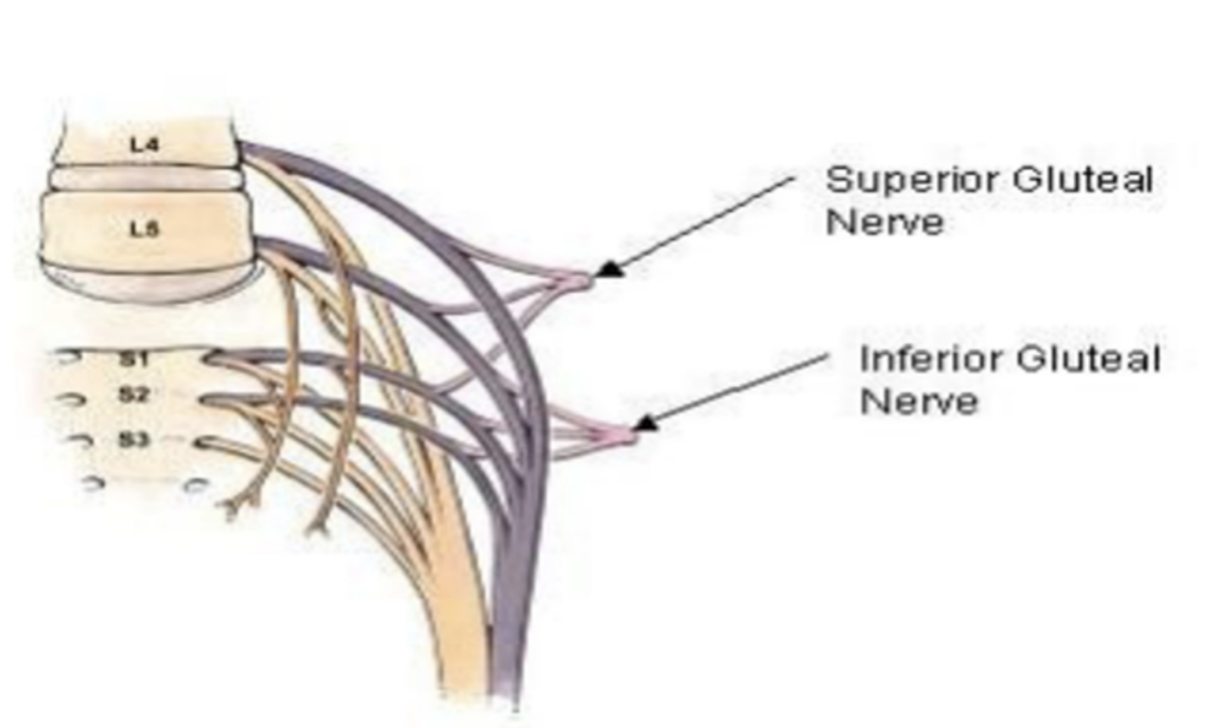
<p>Superior Gluteal Nerve:</p><ul><li><p>Nerve Roots:</p></li><li><p>Muscles Affected: (3)</p></li><li><p>Movement Impaired: (3) </p></li><li><p>Gait Pattern:</p></li></ul><p></p><p></p><p></p>

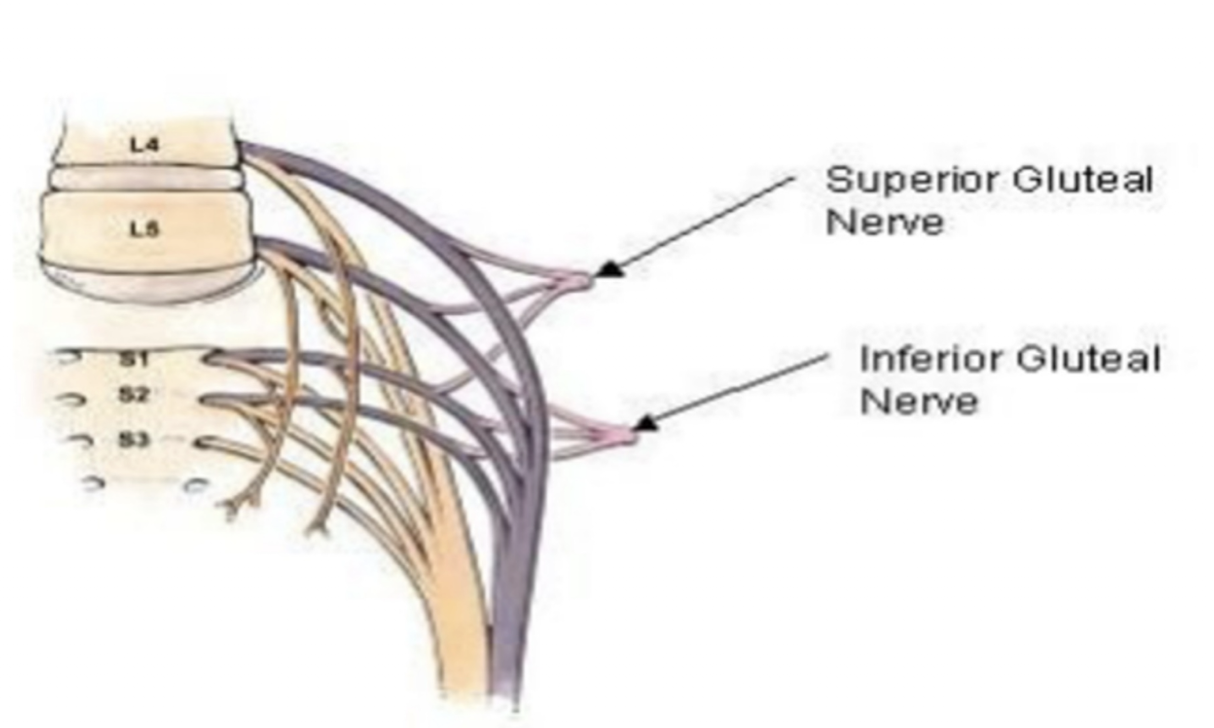
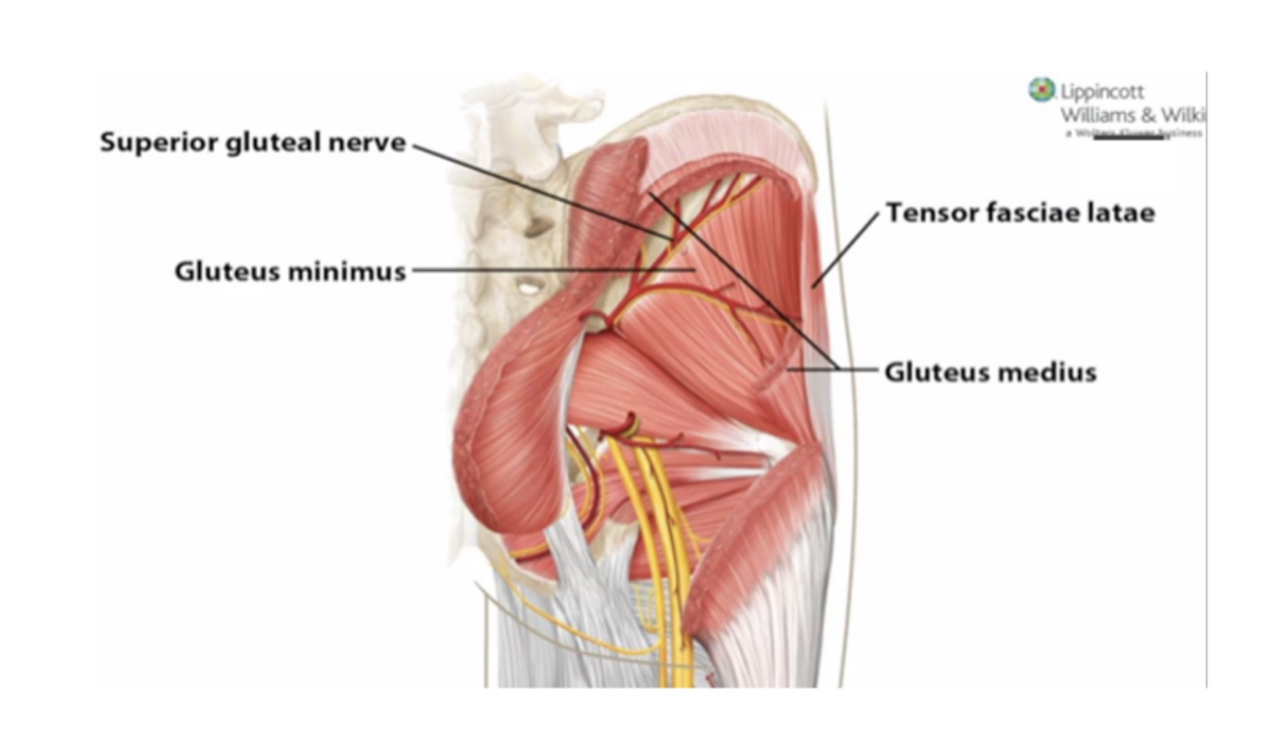
Superior Gluteal Nerve:

  • Nerve Roots:

  • Muscles Affected: (3)

  • Movement Impaired: (3)

  • Gait Pattern:

  • L4-S1

  • Muscles:

    • Glute Med

    • Glute Min

    • TFL

  • Movements:

    • Hip Abd

    • Hip Flex

    • Medial Rotation (IR)

  • Gait:

    • Trendelenberg Gait

<ul><li><p>L4-S1</p></li><li><p>Muscles:</p><ul><li><p>Glute Med</p></li><li><p>Glute Min</p></li><li><p>TFL</p></li></ul></li><li><p>Movements:</p><ul><li><p>Hip Abd</p></li><li><p>Hip Flex</p></li><li><p>Medial Rotation (IR)</p></li></ul></li><li><p>Gait:</p><ul><li><p>Trendelenberg Gait </p></li></ul></li></ul><p></p>
7
New cards
<p>Inferior Gluteal Nerve:</p><ul><li><p>Nerve Roots:</p></li><li><p>Muscle Affected:</p></li><li><p>Movement Impaired: (2)</p></li></ul><p></p><p></p>

Inferior Gluteal Nerve:

  • Nerve Roots:

  • Muscle Affected:

  • Movement Impaired: (2)

  • L5-S2

  • Muscles:

    • Glute Max

  • Movement:

    • Hip Extension

    • ER

<ul><li><p>L5-S2</p></li><li><p>Muscles:</p><ul><li><p>Glute Max</p></li></ul></li><li><p>Movement:</p><ul><li><p>Hip Extension </p></li><li><p>ER </p></li></ul></li></ul><p></p>
8
New cards
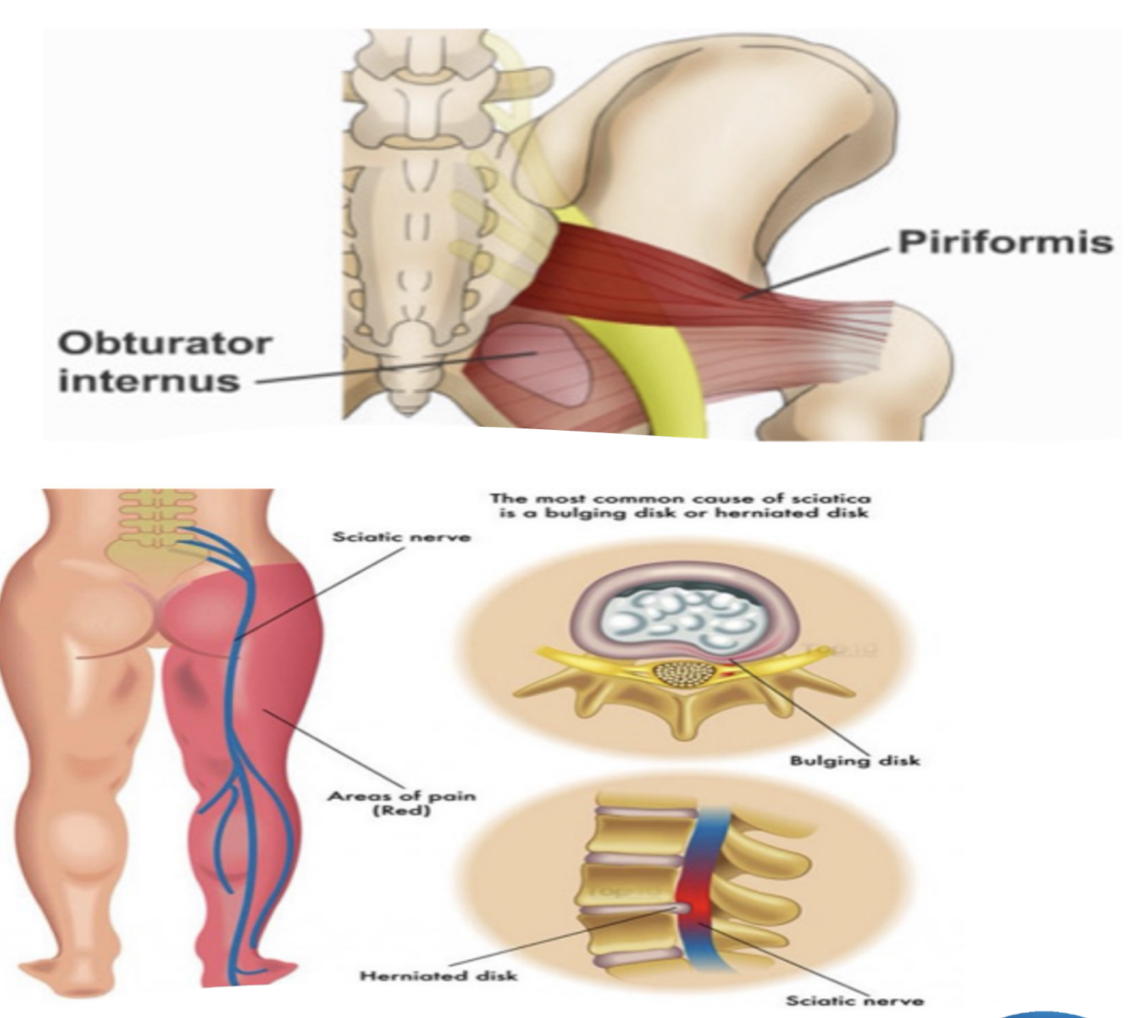
<p>Sciatic Nerve: </p><ul><li><p>Nerve Roots:</p></li><li><p>Originates and Crosses where?</p></li><li><p>Piriformis Syndrome » due to…</p></li></ul><p></p><p></p>

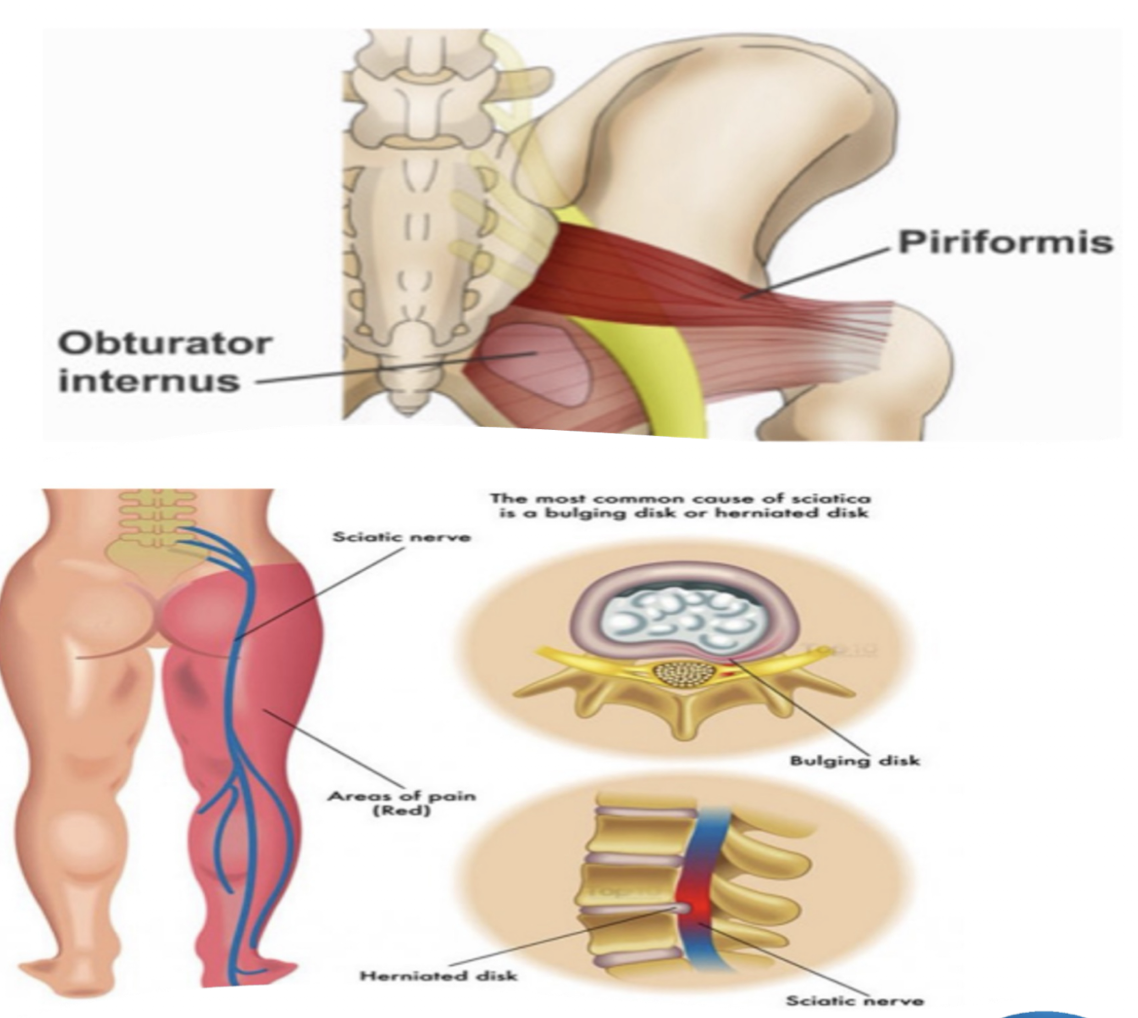
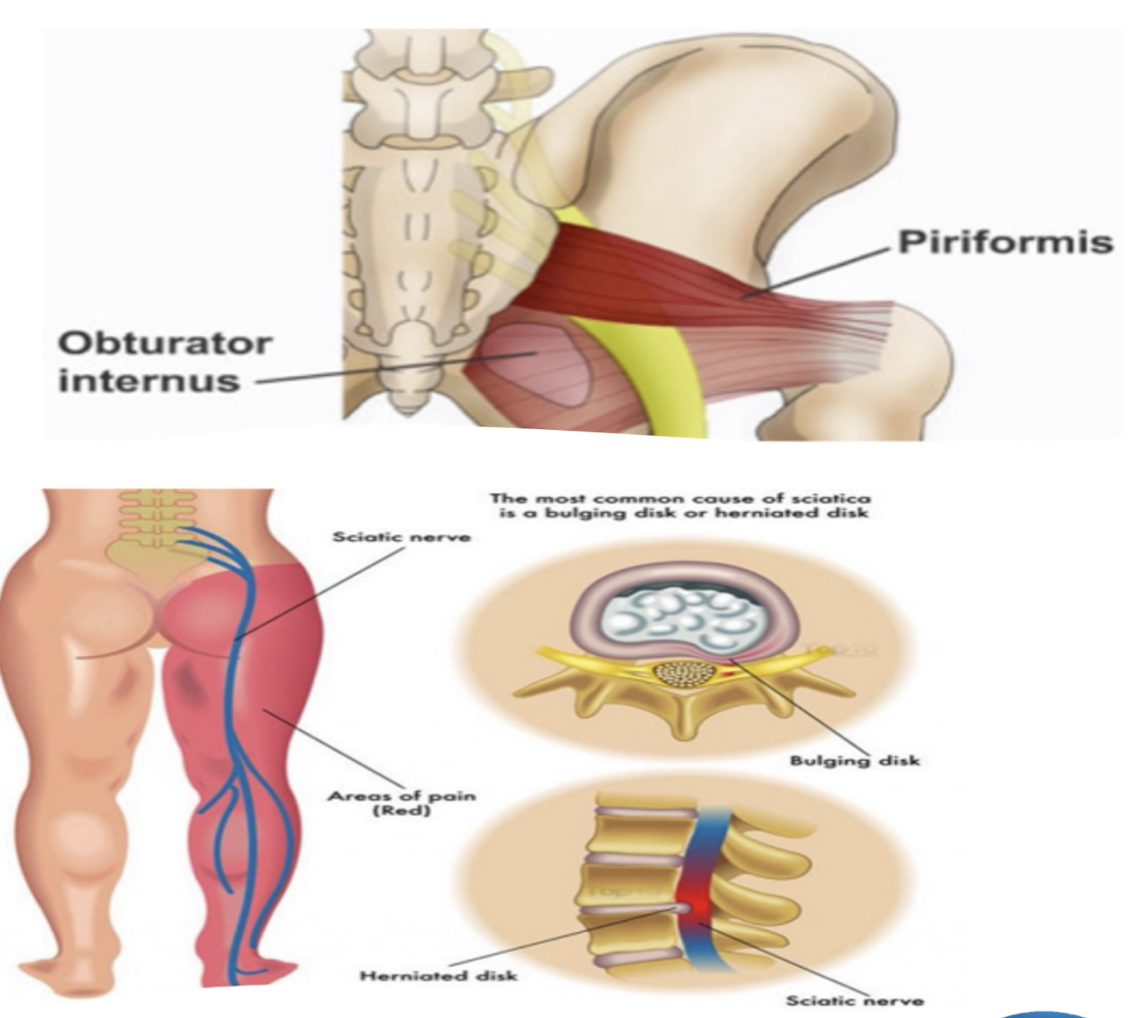
Sciatic Nerve:

  • Nerve Roots:

  • Originates and Crosses where?

  • Piriformis Syndrome » due to…

  • L4-S3

  • Originates from SACRAL PLEXUS and Crosses through GREATER SCIATIC FORAMEN in Pelvis

  • Piriformis:

    • Abnormal shortening of the muscle » compression and causing irritation at nerve site
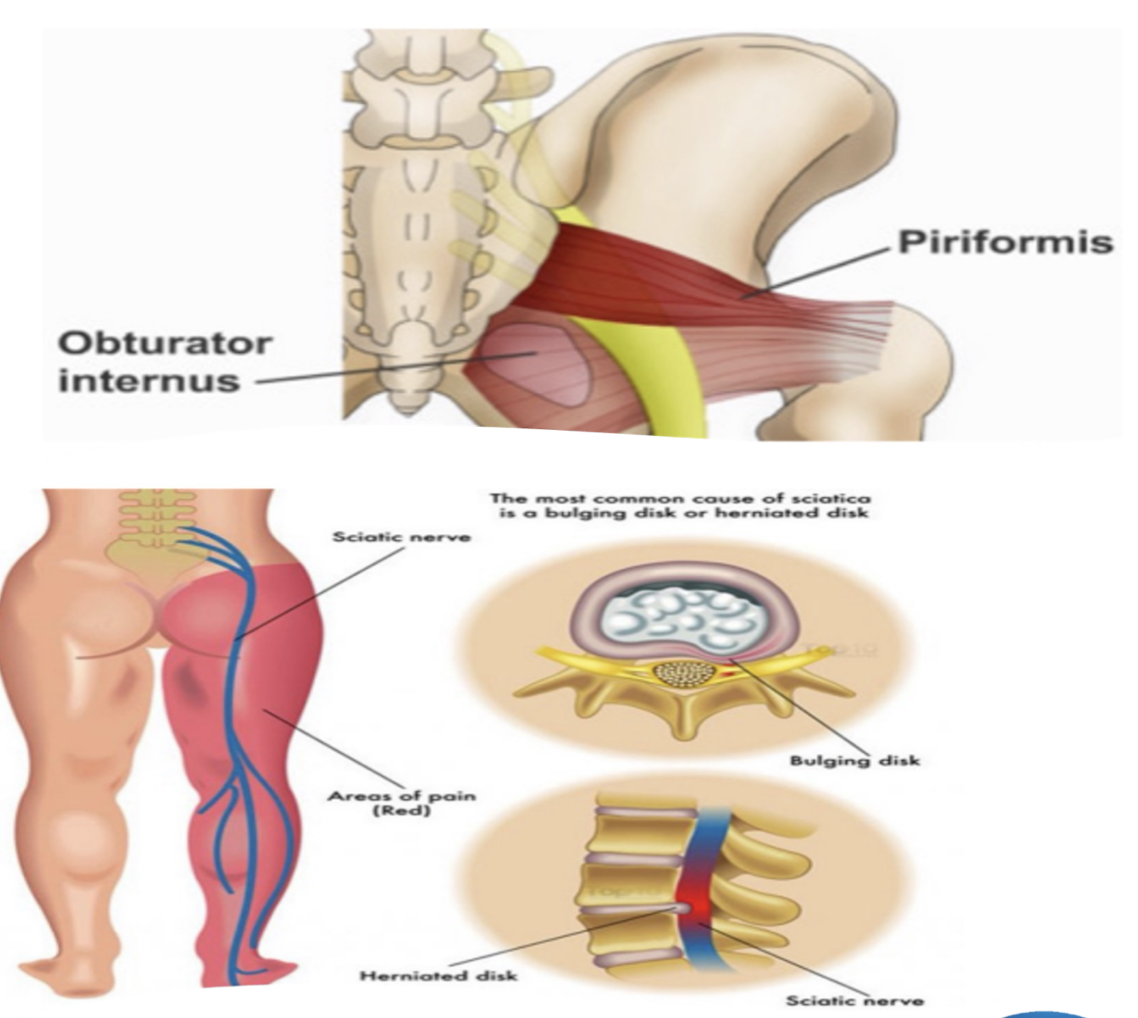
<ul><li><p>L4-S3</p></li><li><p>Originates from SACRAL PLEXUS and Crosses through GREATER SCIATIC FORAMEN in Pelvis</p></li><li><p>Piriformis:</p><ul><li><p>Abnormal shortening of the muscle » compression and causing irritation at nerve site </p></li></ul></li></ul><p></p><p></p>
9
New cards
<p>Sciatic Nerve:</p><ul><li><p>Sciatica » due to… </p></li><li><p>Muscles Affected: (4)</p></li></ul><p></p>

Sciatic Nerve:

  • Sciatica » due to…

  • Muscles Affected: (4)

  • Sciatica:

    • Herniated Disc OR Bone Spur that cormpresses Sciatic Nerve and causes radiating pain

  • Muscles: (BASS)

    • Biceps Femoris

    • Adductor Magnus

    • Semimembranosus

    • Semitendinosus

<ul><li><p>Sciatica:</p><ul><li><p>Herniated Disc OR Bone Spur that cormpresses Sciatic Nerve and causes radiating pain </p></li></ul></li><li><p>Muscles: (BASS)</p><ul><li><p>Biceps Femoris </p></li><li><p>Adductor Magnus </p></li><li><p>Semimembranosus</p></li><li><p>Semitendinosus </p></li></ul></li></ul><p></p>
10
New cards

Practice Q 3:

Pt presents with left hip drop while performing gait training on an even surface and no assistive device. Which of the following findings would be expected while examining the patient?

A. A compensatory left trunk lean during stance on the right lower extremity

B. A posterior lean during stance phase on the right lower extremity

C. A compensatory right trunk lean during stance on the right lower extremity
D. A decrease in step length of the the right lower extremity

C. A compensatory right trunk lean during stance on the right lower extremity

11
New cards
<p>Femoral Nerve:</p><ul><li><p>Nerve Roots:</p></li><li><p>Originated from where?</p></li><li><p>MOI: (3)</p></li></ul><p></p><p></p>

Femoral Nerve:

  • Nerve Roots:

  • Originated from where?

  • MOI: (3)

  • L2-L4

  • Originates from Lumbar Plexus

  • MOIS:

    • Upper femur or pelvis fx

    • Hip dislocation c reduction

    • Forceps pressure during labor

<ul><li><p>L2-L4</p></li><li><p>Originates from Lumbar Plexus</p></li><li><p>MOIS:</p><ul><li><p>Upper femur or pelvis fx</p></li><li><p>Hip dislocation c reduction </p></li><li><p>Forceps pressure during labor </p></li></ul></li></ul><p></p><p></p>
12
New cards
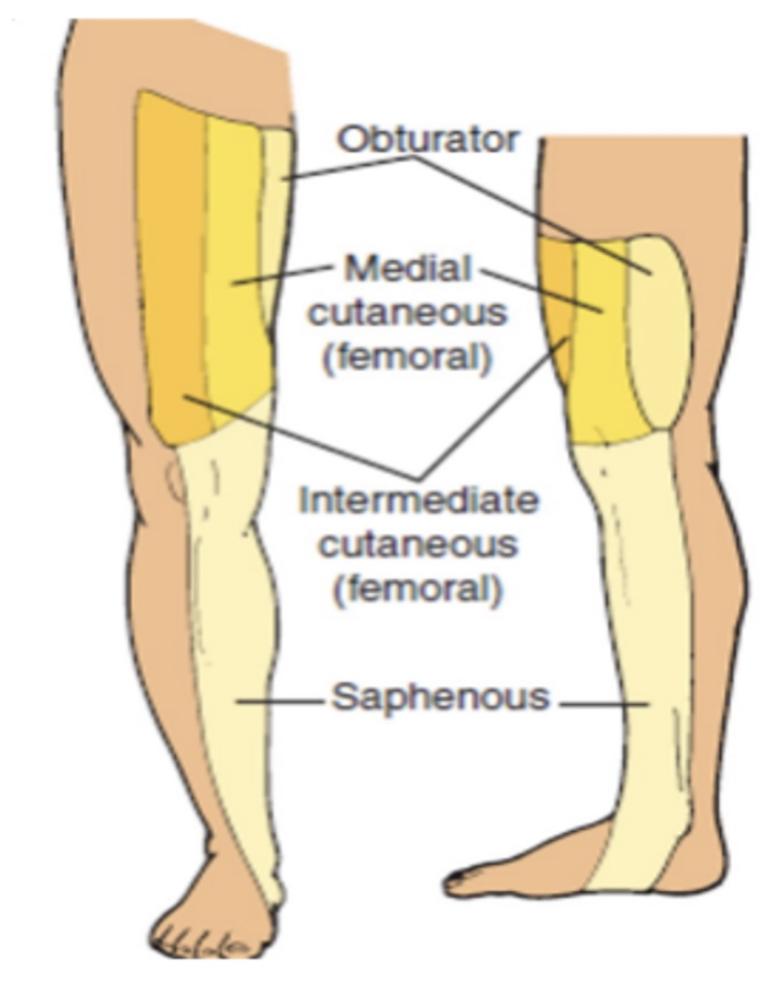
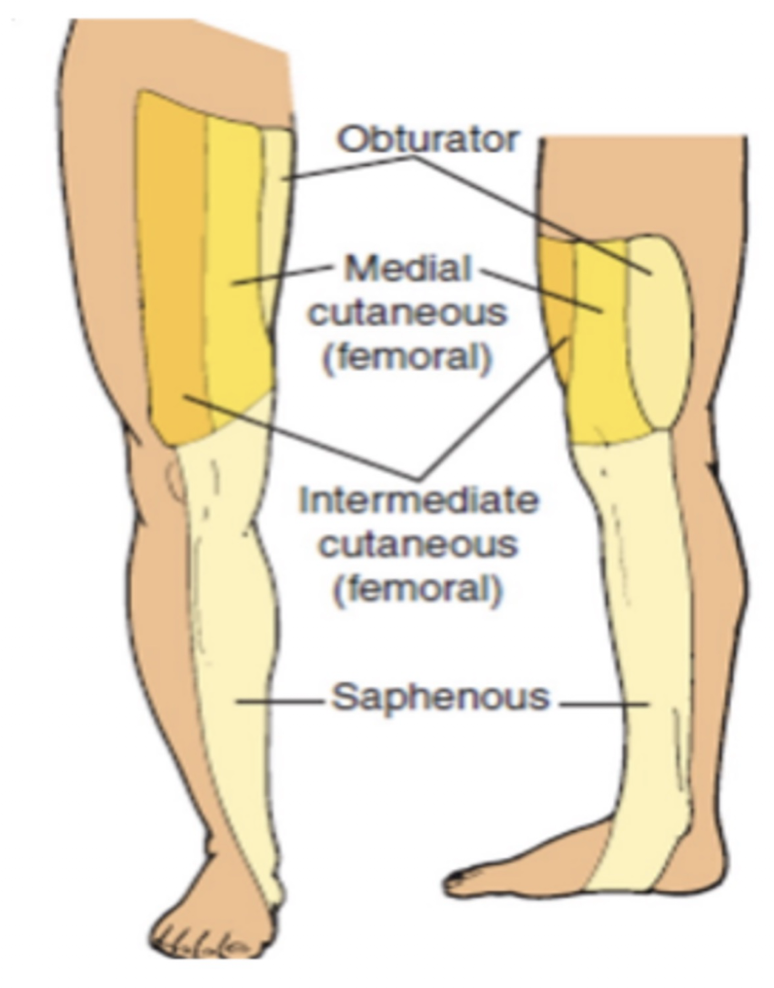
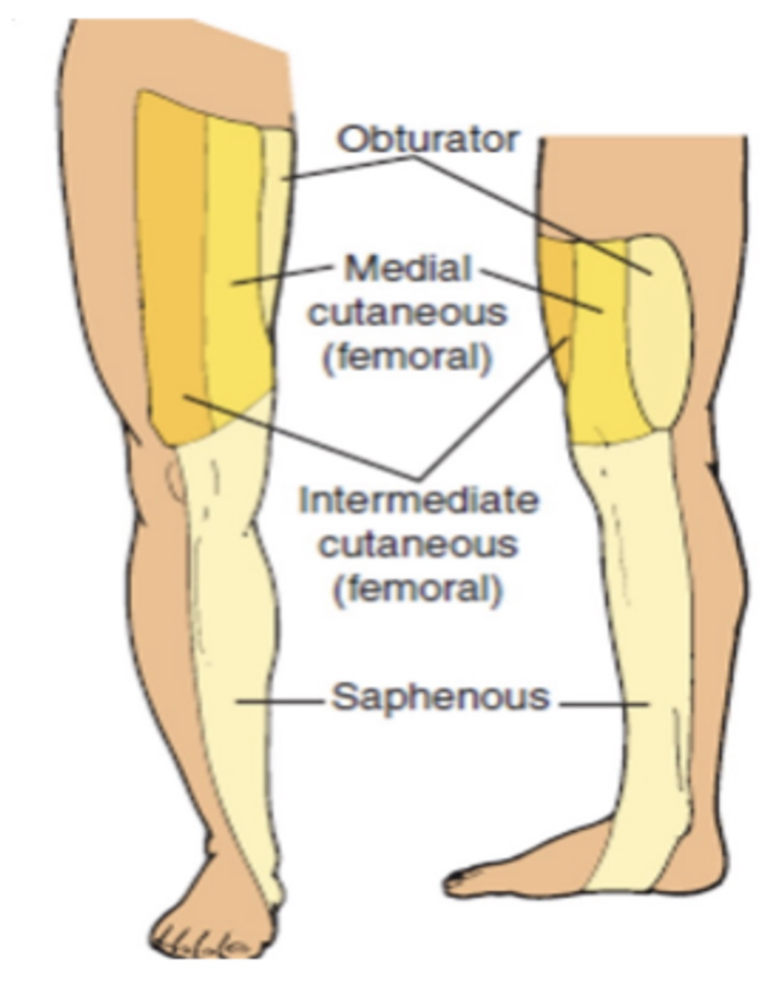
<p>Femoral Nerve:</p><ul><li><p>Muscle Affected: (3)</p></li><li><p>Sensory Impairments:</p><ul><li><p>Lateral Femoral Cutaneous Nerve:</p></li><li><p>Intermediate Femoral Cutaneous Nerve:</p></li><li><p>Medial Femoral Cutaneous Nerve:</p></li><li><p>Saphenous Nerve: (3)</p></li></ul></li></ul><p></p><p>NOTE: All these nerves are PURE SENSORY</p><p></p>

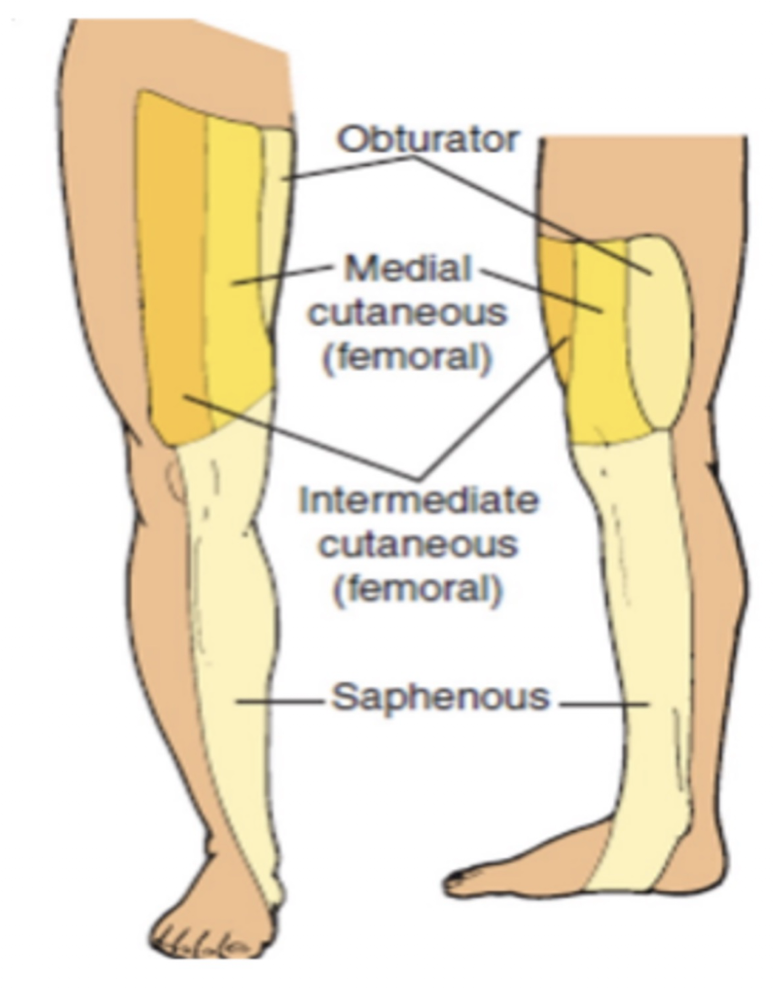
Femoral Nerve:

  • Muscle Affected: (3)

  • Sensory Impairments:

    • Lateral Femoral Cutaneous Nerve:

    • Intermediate Femoral Cutaneous Nerve:

    • Medial Femoral Cutaneous Nerve:

    • Saphenous Nerve: (3)

NOTE: All these nerves are PURE SENSORY

  • Muscles:

    • Quads

    • Pectinius

    • Sartorius

  • Sensory Impairments:

    • Lateral Femoral Cutaneous Nerve:

      • Lateral Thigh over ITB

    • Intermediate Femoral Cutaneous Nerve:

      • Anterior Thigh

    • Medial Femoral Cutaneous Nerve:

      • Anteromedial Thigh

    • Saphenous Nerve:

      • Medial Femoral Condyle

      • Posterior Medial Lower Leg

      • Medial Malleolus

<ul><li><p>Muscles:</p><ul><li><p>Quads</p></li><li><p>Pectinius </p></li><li><p>Sartorius </p></li></ul></li><li><p>Sensory Impairments:</p><ul><li><p>Lateral Femoral Cutaneous Nerve:</p><ul><li><p>Lateral Thigh over ITB</p></li></ul></li><li><p>Intermediate Femoral Cutaneous Nerve:</p><ul><li><p>Anterior Thigh </p></li></ul></li><li><p>Medial Femoral Cutaneous Nerve:</p><ul><li><p>Anteromedial Thigh </p></li></ul></li><li><p>Saphenous Nerve:</p><ul><li><p>Medial Femoral Condyle </p></li><li><p>Posterior Medial Lower Leg </p></li><li><p>Medial Malleolus </p></li></ul></li></ul></li></ul><p></p>
13
New cards
<p>Tibial Nerve:</p><ul><li><p>Nerve Roots:</p></li><li><p>Muscles: (7)</p></li></ul><p></p>

Tibial Nerve:

  • Nerve Roots:

  • Muscles: (7)

  • L4-S3

  • Muscles:

    • Gastroc

    • Soleus

    • Plantaris

    • Posterior Tib

    • Popliteus

    • Flexor Hallucis Longus

    • Flexor Digitorum Longus

<ul><li><p>L4-S3</p></li><li><p>Muscles:</p><ul><li><p>Gastroc</p></li><li><p>Soleus</p></li><li><p>Plantaris </p></li><li><p>Posterior Tib</p></li><li><p>Popliteus </p></li><li><p>Flexor Hallucis Longus </p></li><li><p>Flexor Digitorum Longus</p></li></ul></li></ul><p></p>
14
New cards
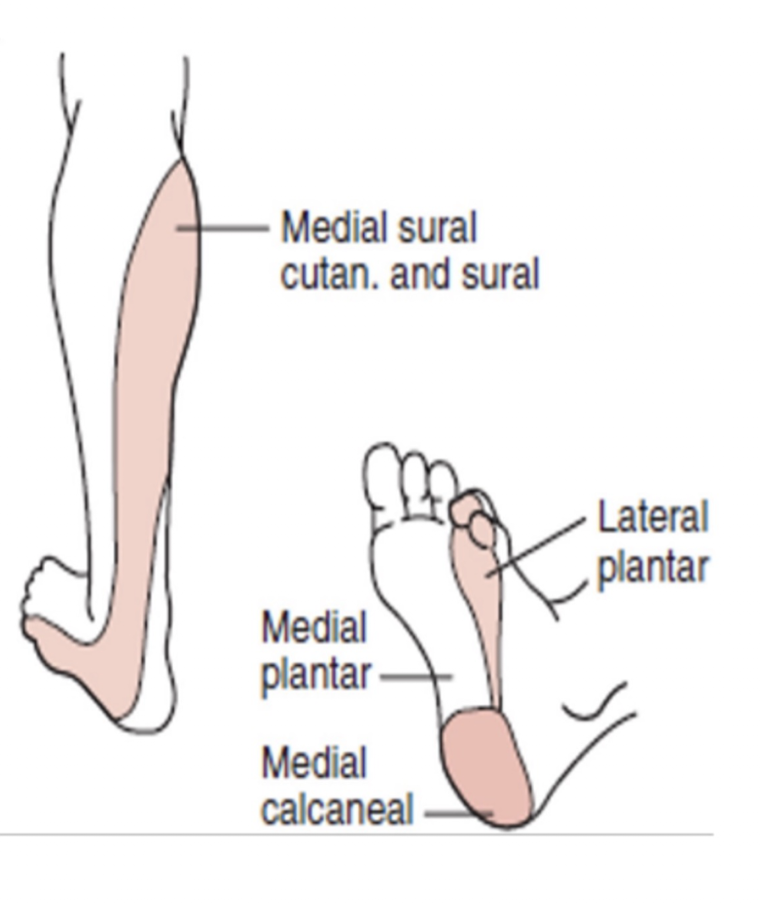
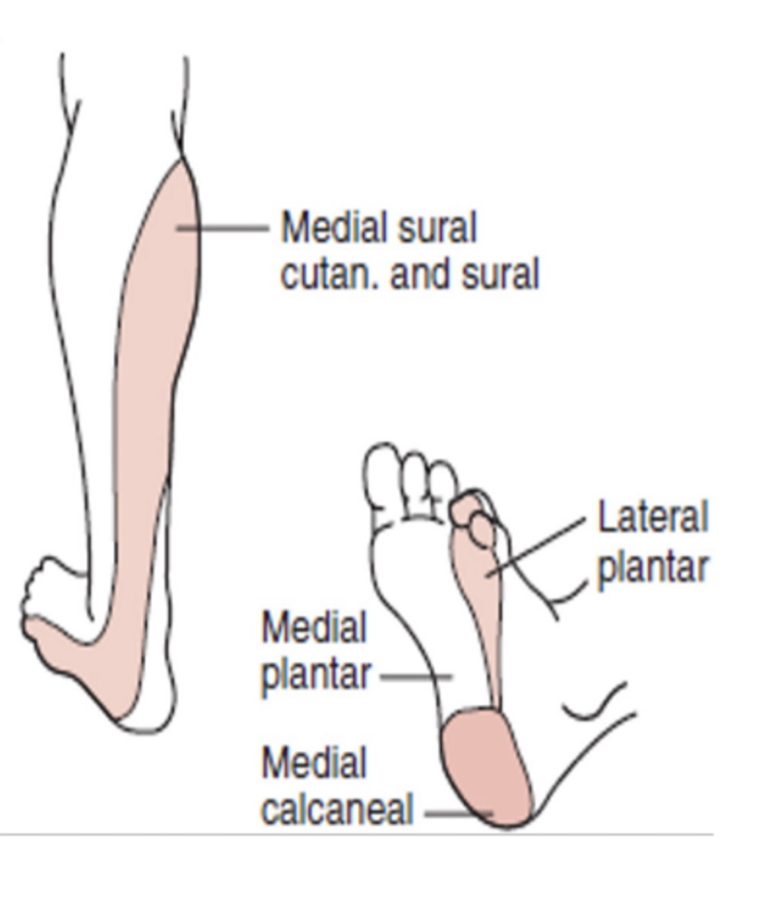
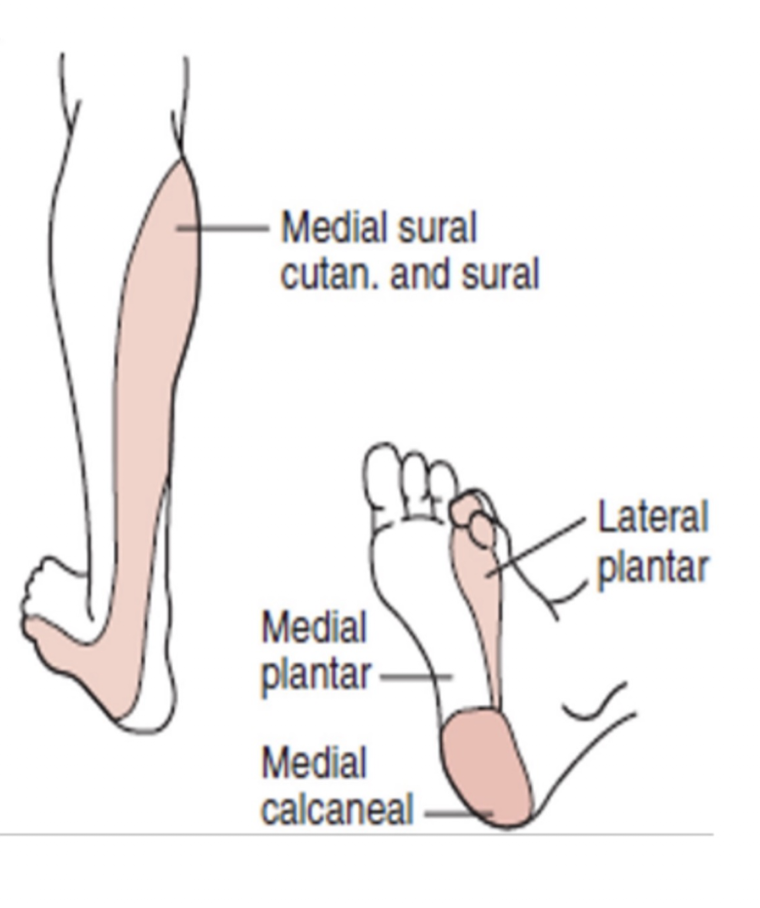
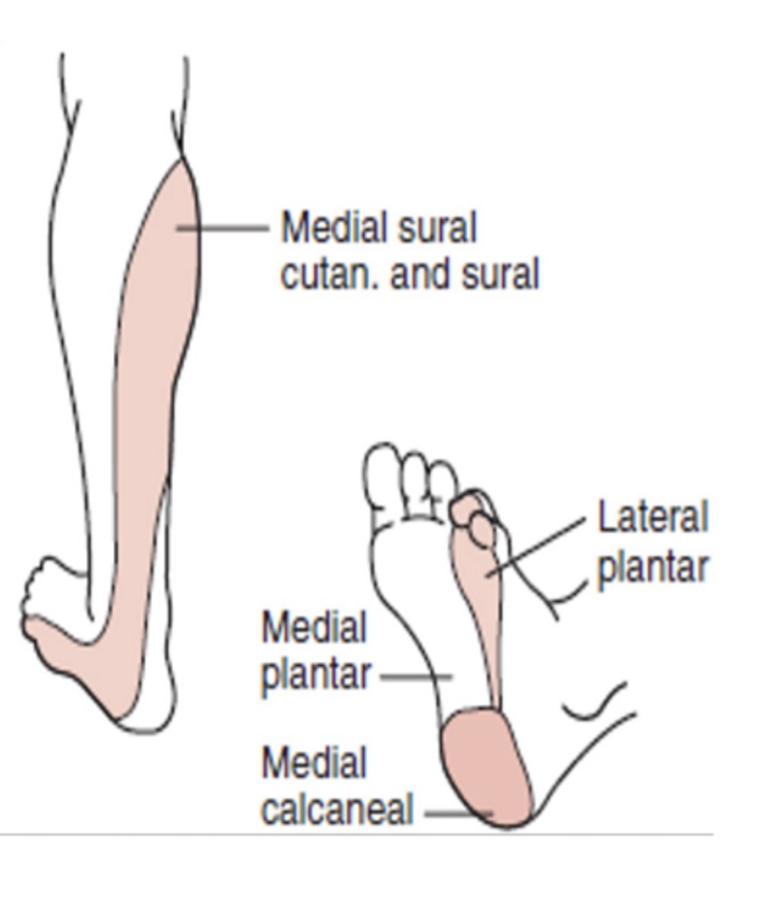
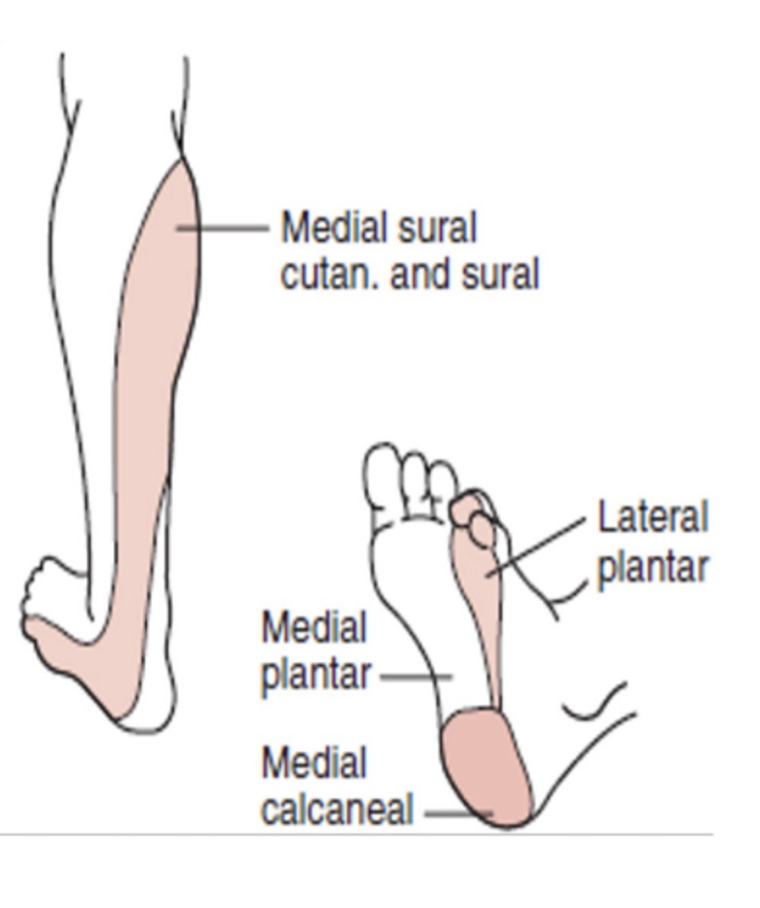
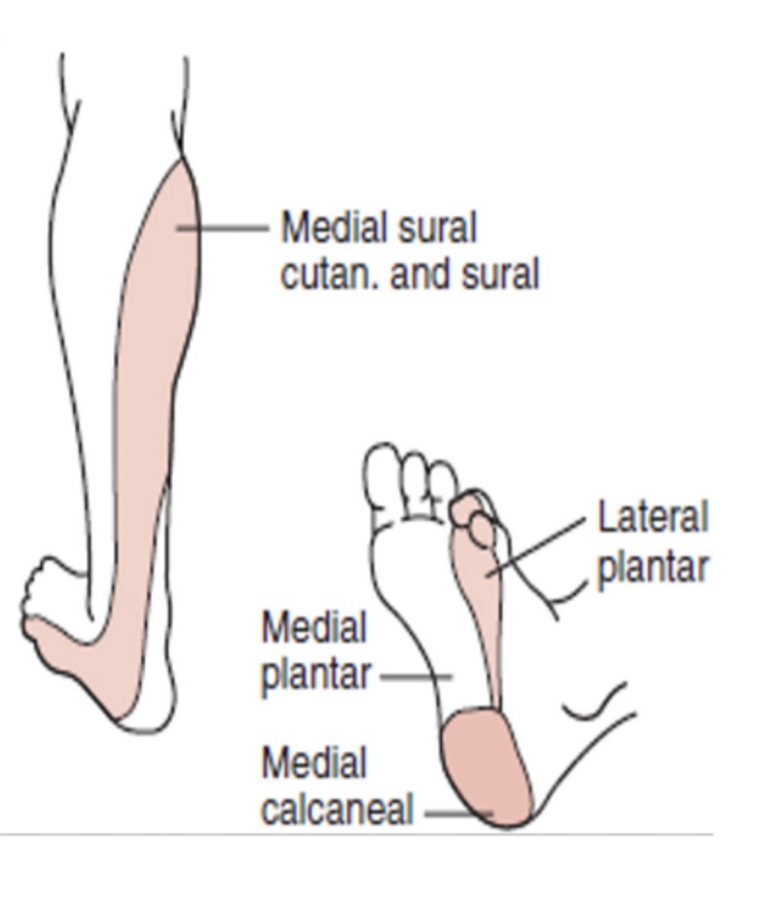
<p>Tibial Nerve:</p><ul><li><p>Sensory Branches:</p><ul><li><p>Medial Plantar Nerve:</p></li><li><p>Lateral Plantar Nerve:</p></li><li><p>Medial Calcaneal Nerve:</p></li><li><p>Sural Nerve: (3)</p></li></ul></li></ul><p>NOTE: All these nerves are PURE SENSORY</p><p></p><p></p>

Tibial Nerve:

  • Sensory Branches:

    • Medial Plantar Nerve:

    • Lateral Plantar Nerve:

    • Medial Calcaneal Nerve:

    • Sural Nerve: (3)

NOTE: All these nerves are PURE SENSORY

  • Medial Plantar Nerve:

    • Medial foot » Sole over 1, 2, 3 and medial half of the 4 digit

  • Lateral Plantar Nerve:

    • Lateral foot » Sole over lateral half of 4 toe and entire 5 digit

  • Medial Calcaneal Nerve:

    • Medial heel

  • Sural Nerve:

    • Posteriolateral lower leg

    • Lateral border of the dorsum of the foot

    • Lateral heel

<ul><li><p>Medial Plantar Nerve:</p><ul><li><p>Medial foot » Sole over 1, 2, 3 and medial half of the 4 digit</p></li></ul></li><li><p>Lateral Plantar Nerve:</p><ul><li><p>Lateral foot » Sole over lateral half of 4 toe and entire 5 digit</p></li></ul></li><li><p>Medial Calcaneal Nerve:</p><ul><li><p>Medial heel</p></li></ul></li><li><p>Sural Nerve:</p><ul><li><p>Posteriolateral lower leg</p></li><li><p>Lateral border of the dorsum of the foot</p></li><li><p>Lateral heel</p></li></ul></li></ul><p></p>
15
New cards
<p>Tibial Nerve:</p><ul><li><p>Tarsal Tunnel Syndrome:</p><ul><li><p>Describe:</p></li><li><p>S/S: (3)</p></li></ul></li><li><p>Postural Foot Changes d/t Compression Injury: </p><ul><li><p>Pes Cavus:</p></li><li><p>Pes Planus:</p></li><li><p>Claw Toes: </p></li></ul></li></ul><p></p>

Tibial Nerve:

  • Tarsal Tunnel Syndrome:

    • Describe:

    • S/S: (3)

  • Postural Foot Changes d/t Compression Injury:

    • Pes Cavus:

    • Pes Planus:

    • Claw Toes:

  • Tarsal Tunnel Syndrome:

    • Describe:

      • Tibial Nerve entrapped under mefial foot through Adductor Hallucis

    • S/S: (3)

      • Postermedial Plantar Foot Pain

      • Painful Heel

      • Pes Cavus = Pain

  • Postural Foot Changes d/t Compression Injury:

    • Pes Cavus:

      • High Longitudinal Arch

    • Pes Planus:

      • Collapsed Medial Arch marked by flat feet when WB

    • Claw Toes:

      • MTP Ext, PIP/DIP Flex

<ul><li><p>Tarsal Tunnel Syndrome:</p><ul><li><p>Describe:</p><ul><li><p>Tibial Nerve entrapped under mefial foot through Adductor Hallucis </p></li></ul></li><li><p>S/S: (3)</p><ul><li><p>Postermedial Plantar Foot Pain </p></li><li><p>Painful Heel </p></li><li><p>Pes Cavus = Pain </p></li></ul></li></ul></li><li><p>Postural Foot Changes d/t Compression Injury: </p><ul><li><p>Pes Cavus:</p><ul><li><p>High Longitudinal Arch </p></li></ul></li><li><p>Pes Planus:</p><ul><li><p>Collapsed Medial Arch marked by flat feet when WB</p></li></ul></li><li><p>Claw Toes: </p><ul><li><p>MTP Ext, PIP/DIP Flex</p></li></ul></li></ul></li></ul><p></p>
16
New cards
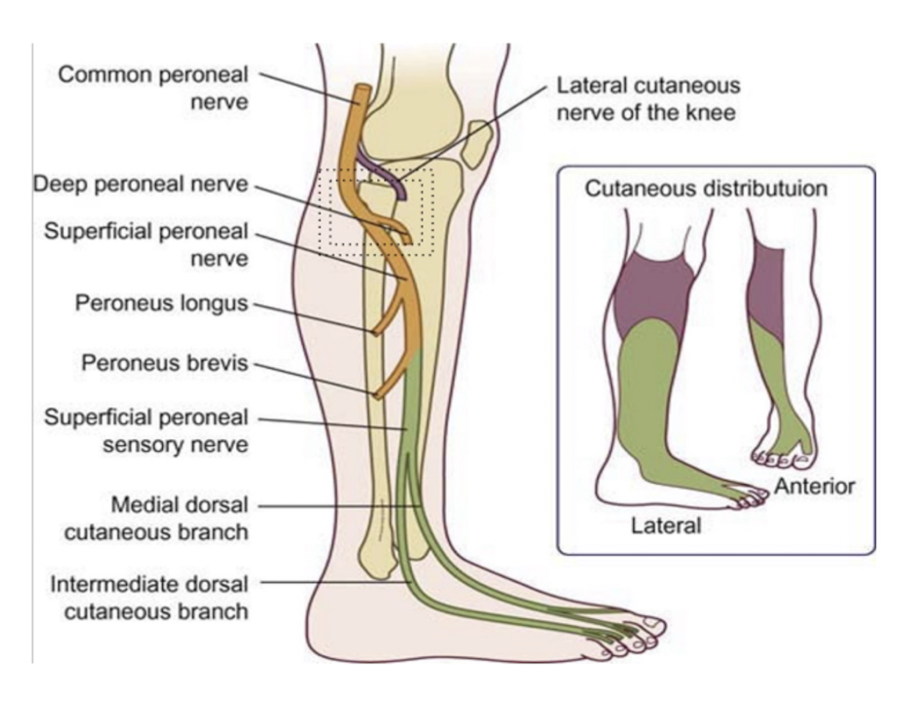
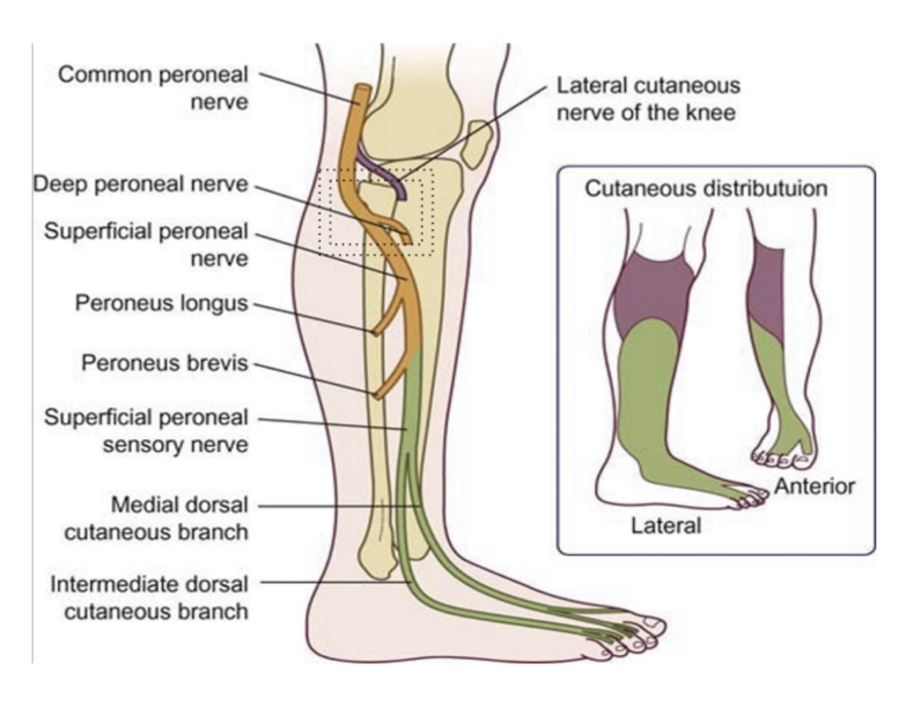
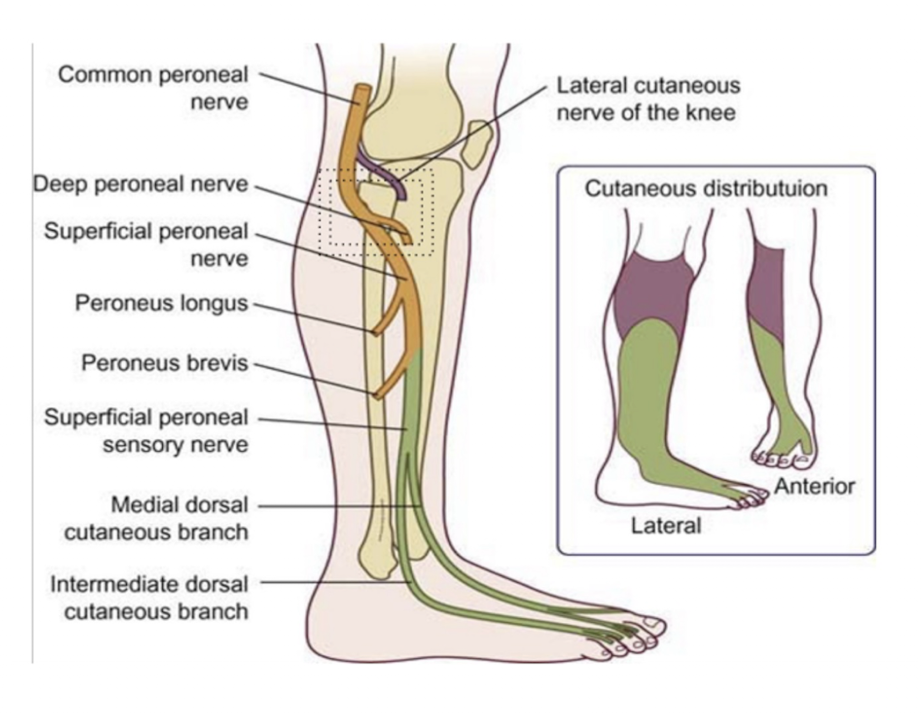
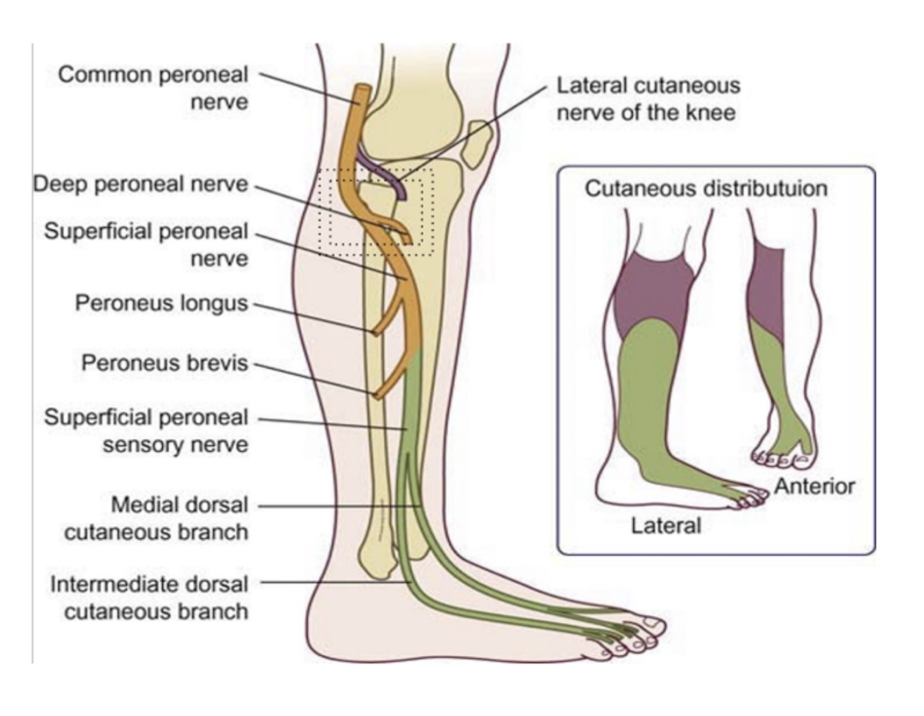
<p>Common Peroneal Nerve:</p><ul><li><p>Nerve Roots: </p></li><li><p>2 Branches: </p></li></ul><p></p><p></p>

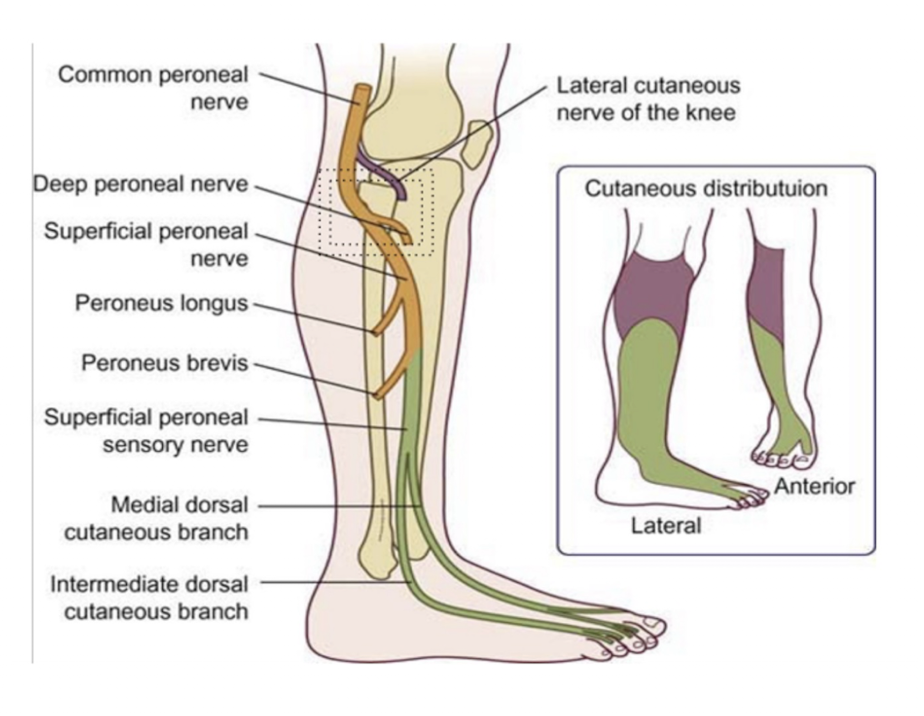
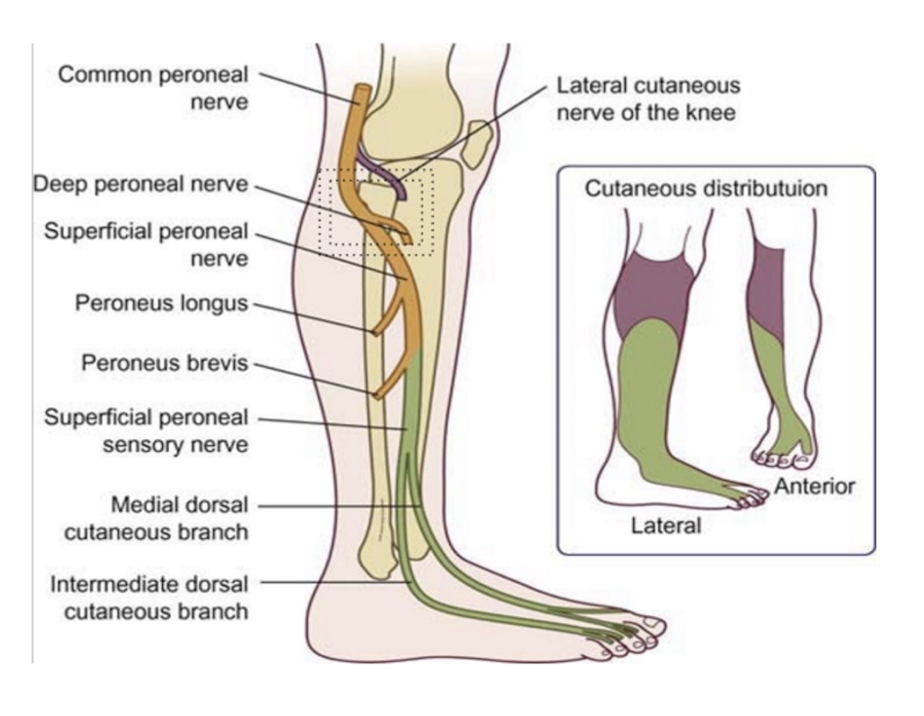
Common Peroneal Nerve:

  • Nerve Roots:

  • 2 Branches:

  • L4-S2

  • 2 Branches:

    • Superficial Peroneal

    • Deep Peroneal

<ul><li><p>L4-S2</p></li><li><p>2 Branches:</p><ul><li><p>Superficial Peroneal</p></li><li><p>Deep Peroneal</p></li></ul></li></ul><p></p><p></p>
17
New cards
<p>Common Peroneal » Superficial Peroneal:</p><ul><li><p>Sensory = (2)</p></li><li><p>Muscles = (2)</p></li><li><p>Injury = </p></li></ul><p></p><p></p>

Common Peroneal » Superficial Peroneal:

  • Sensory = (2)

  • Muscles = (2)

  • Injury =

  • Sensory:

    • Anterolateral Lower Leg

    • Dorsum of the Foot

  • Muscles:

    • Peroneus Longus

    • Peroneus Brevis

  • Injury:

    • Decreased eversion strength

<ul><li><p>Sensory:</p><ul><li><p>Anterolateral Lower Leg </p></li><li><p>Dorsum of the Foot</p></li></ul></li><li><p>Muscles:</p><ul><li><p>Peroneus Longus </p></li><li><p>Peroneus Brevis </p></li></ul></li><li><p>Injury:</p><ul><li><p>Decreased eversion strength </p></li></ul></li></ul><p></p><p></p>
18
New cards
<p>Common Peroneal » Deep Peroneal:</p><ul><li><p>Sensory =</p><ul><li><p>Paresthesia S/S = HALLMARK SIGN OF… </p></li></ul></li><li><p>Muscles = (6)</p></li><li><p>Injury = (2) </p></li></ul><p></p><p></p>

Common Peroneal » Deep Peroneal:

  • Sensory =

    • Paresthesia S/S = HALLMARK SIGN OF…

  • Muscles = (6)

  • Injury = (2)

  • Sensory:

    • Anterolateral Lower Leg

    • Dorsum of the Foot

      • Anterior Compartment Syndrome

  • Muscles:

    • Anterior Tib

    • Peroneus Tertius

    • Extensor Hallucis Longus

    • Extensor Hallucis Brevis

    • Extensor Digotorum Longus

    • Extensor Digitorum Brevis

  • Injury:

    • Foot Drop

    • Unopposed Eversion

<ul><li><p>Sensory:</p><ul><li><p>Anterolateral Lower Leg</p></li><li><p>Dorsum of the Foot </p><ul><li><p>Anterior Compartment Syndrome </p></li></ul></li></ul></li></ul><ul><li><p>Muscles:</p><ul><li><p>Anterior Tib</p></li><li><p>Peroneus Tertius </p></li><li><p>Extensor Hallucis Longus</p></li><li><p>Extensor Hallucis Brevis </p></li><li><p>Extensor Digotorum Longus</p></li><li><p>Extensor Digitorum Brevis </p></li></ul></li><li><p>Injury:</p><ul><li><p>Foot Drop </p></li><li><p>Unopposed Eversion </p></li></ul></li></ul><p></p><p></p>
19
New cards

Practcie Q 4:

Patient reports chronic left lower extremity weakness. During examination pt noted to have genu recurvatum during stance on the left lower extremity. Which of the following be the cause of this impairment?

A. Lesion to the femoral nerve

B. Lesion to the superior gluteal nerve

C. Lesion to the obturator nerve

D. Lesion to the sural nerve

A. Lesion to the femoral nerve
20
New cards
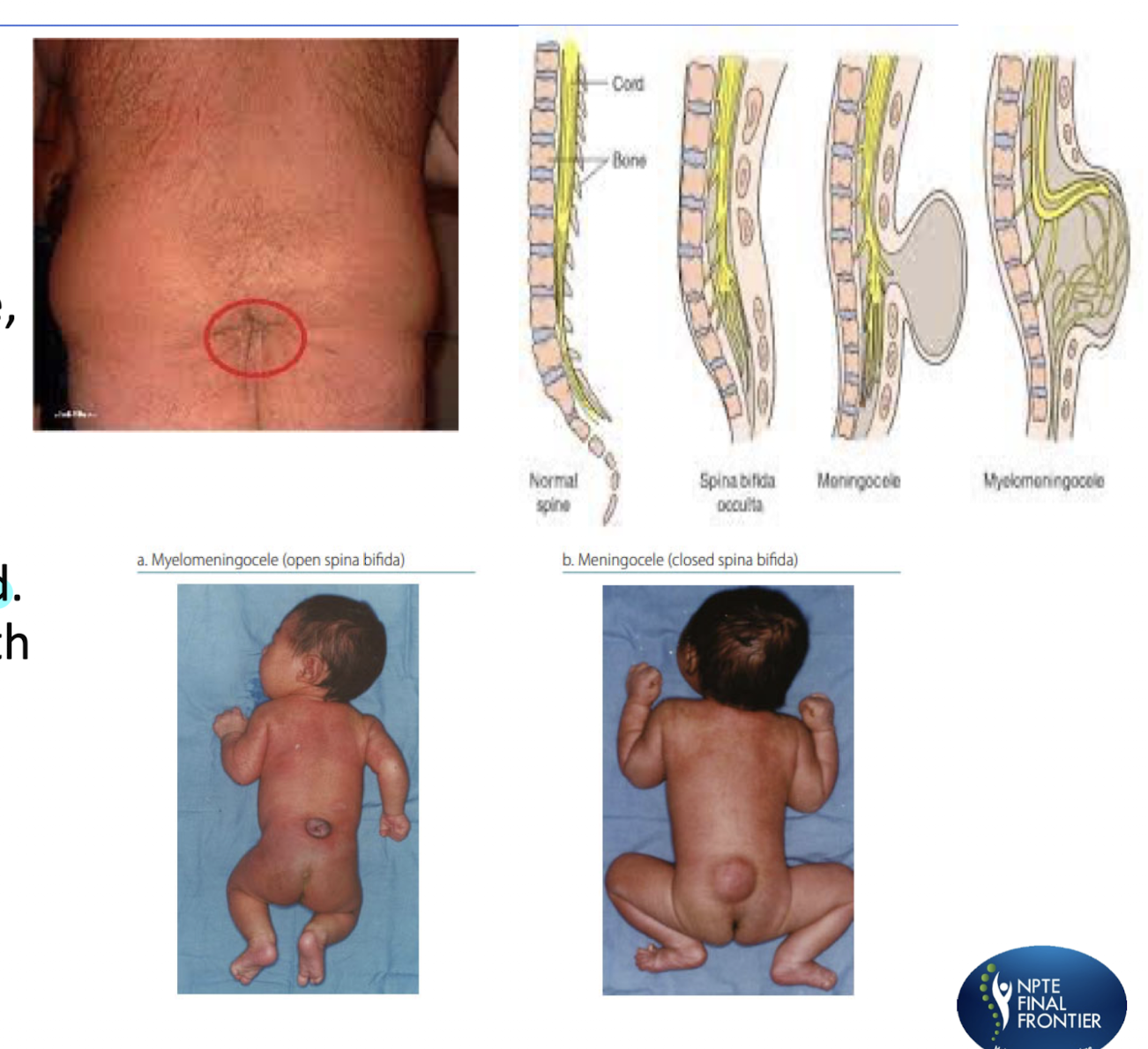
<p>Spina Bifida:</p><ul><li><p>What are the 3 types of Spina Bifida?</p><ul><li><p>Most Severe/Worst Prognosis:</p></li><li><p>Least Severe:</p></li></ul></li></ul><p></p><p></p>

Spina Bifida:

  • What are the 3 types of Spina Bifida?

    • Most Severe/Worst Prognosis:

    • Least Severe:

  • Myelomeningiocele (MOST Severe)

    • Sac of fluid comes out through opening contains SC tissue, meninges, and CSF

  • Meningocele

    • Sac of fluid comes through an opening

    • SC is NOT INVOLVED

    • Covered by skin and associated c NAUR PARALYSIS

  • Occulta (LEAST Severe) » Means Hidden/Closed

    • Impariement and non fusion of the SP of the vertebra, SC, and nerves are usually normal
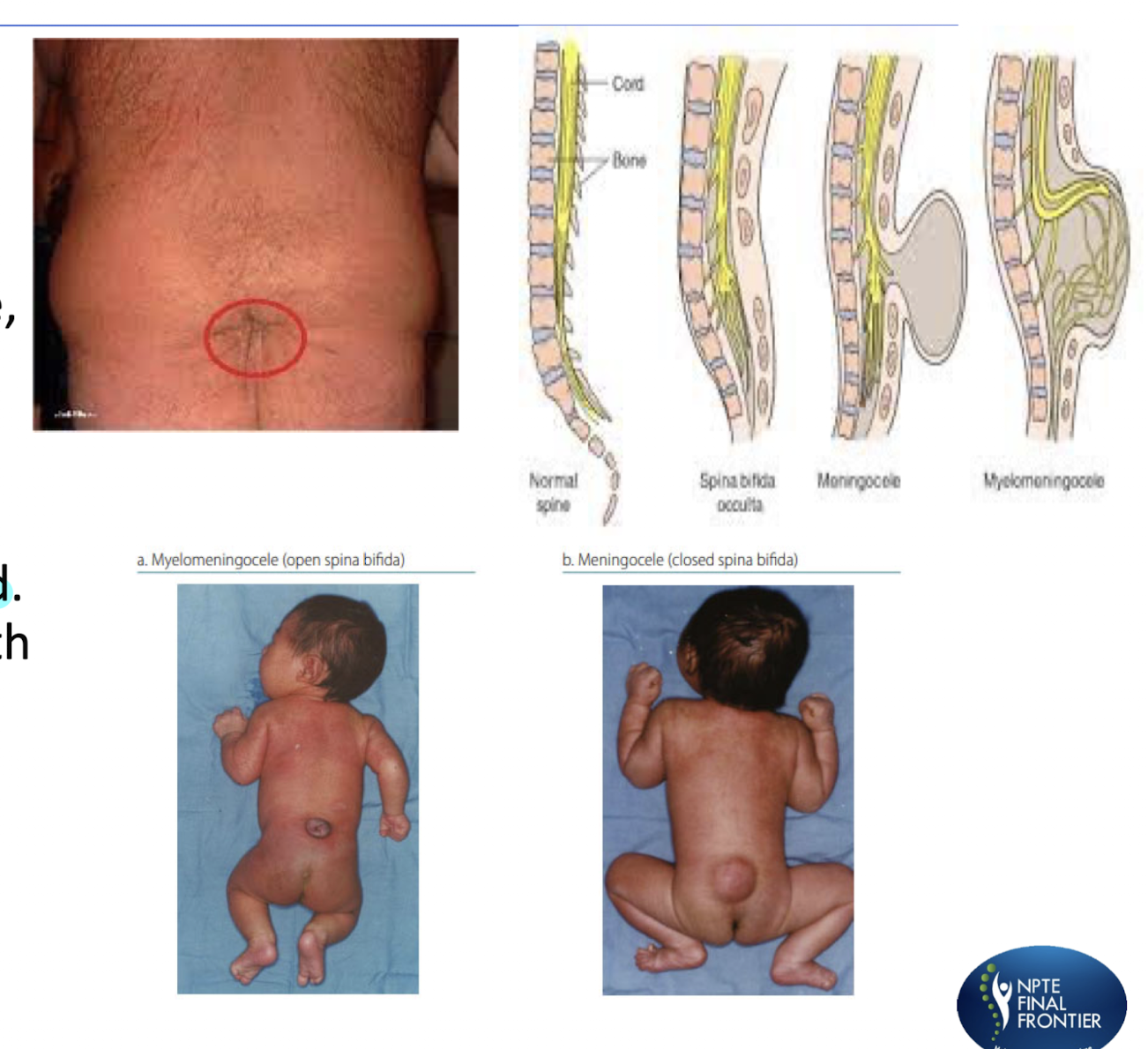
<ul><li><p>Myelomeningiocele (MOST Severe)</p><ul><li><p>Sac of fluid comes out through opening contains SC tissue, meninges, and CSF</p></li></ul></li><li><p>Meningocele</p><ul><li><p>Sac of fluid comes through an opening</p></li><li><p>SC is NOT INVOLVED</p></li><li><p>Covered by skin and associated c NAUR PARALYSIS </p></li></ul></li><li><p>Occulta (LEAST Severe) » Means Hidden/Closed</p><ul><li><p>Impariement and non fusion of the SP of the vertebra, SC, and nerves are usually normal </p></li></ul></li></ul><p></p>
21
New cards

Spina Bifida Causes:

  • 6 Causes:

  • Folic acid deficiency

  • Genetic factors

  • Excessive alcohol consumption

  • Anti-seizure medications

  • Recreational drugs

  • Higher than normal maternal temperature

22
New cards

Spina Bifida Causes;

  • What 2 tests are done by taking the mother’s blood to see if they have any factors that can cause Spina Bifida?

  • Maternal Serum Alpha Feto Protein (MSAFP) Test:

    • Checks Mom’s Alpha Fetoprotein (AFP) Levels

  • Triple Screen Blood Test:

    • AFO + Hyman Choronic Gonadotropin (hCG) + Estirol Levels
23
New cards
<p>Spina Bifida Functional Levels: </p>

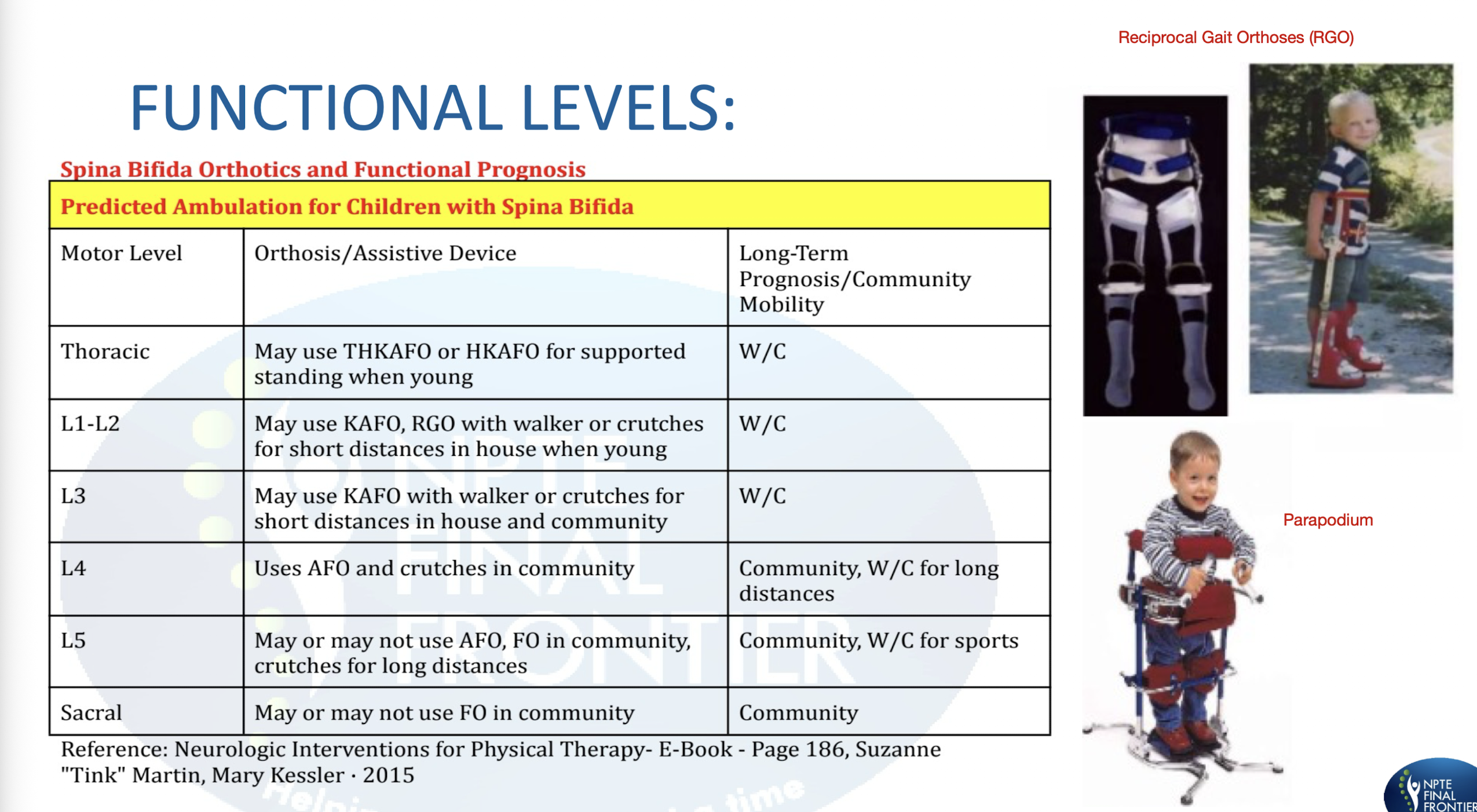
Spina Bifida Functional Levels:

24
New cards

Practics Q 5:

A clinician is treating a 2 y.o with L2 Spina Bifida myelomeningocele. The patient’s mother asks the clinician what is the long-term prognosis for walking. What is the BEST response from the clinician?

A)The patient will most likely require manual wheelchair for all functional mobility

B) The patient will most likely ambulate household distances with bilateral HKAFO’s and upper extremity support, manual wheelchair for all community mobility

C) The patient will most likely ambulate community distances with bilateral AFO’s

D)The patient will most likely ambulate household distances with bilateral KAFO and upper extremity support, manual wheelchair for all community mobility

D)The patient will most likely ambulate household distances with bilateral KAFO and upper extremity support, manual wheelchair for all community mobility

25
New cards

Balance Strategies: ANKLE

  • Perturbation/Force/Sway:

  • Muscle Activation:

  • Muscle Group Activation:

  • FWD Sway Ex:

  • Backward Sway Ex:

  • Perturbation/Force/Sway:

    • Small

    • Slow

    • Near Midline

  • Muscle Activation:

    • Distal to Proximal

  • Muscle Group Activation:

    • OPPOSITE

  • FWD Sway Ex:

    • Gastroc » HS » Paraspinals

  • Backward Sway Ex:

    • Ant Tib » Quads » Abs

26
New cards

Balance Strategies: HIP

  • Perturbation/Force/Sway:

  • Muscle Activation:

  • Muscle Group Activation:

  • FWD Sway Ex:

  • Backward Sway Ex:

  • Perturbation/Force/Sway:

    • Large

  • Muscle Activation:

    • Proximal to Distal

  • Muscle Group Activation:

    • SAME

  • FWD Sway Ex:

    • Abs » Quads » Ant Tib

  • Backward Sway Ex:

    • Paraspinals » HS » Gastroc

27
New cards

Balance Strategies » Protective:

  • Stepping Strategy:

    • Perturbations:

      • COM exceeds ___

      • Muscles activate to allow what?

  • Reaching/Grasping Strategy:

    • Use of…

    • Extend ___ to stabilize posture

Balance Strategy Order of Recruitement:

  • Stepping:

    • Perturbations: Fast and Large

      • BOS

      • Allow compensatory weight shift

  • Reaching:

    • UE

    • BOS

  • Order:

    • Ankle

    • Hip

    • Stepping

    • Reaching/Grasping

28
New cards

Practice Q 6:

While standing on a moving bus, a patient nearly falls when the bus suddenly stops. Which balance strategy is most likely used to recover stability in response to this quick, large perturbation?

A) Stepping Strategy

B) Ankle Strategy

C) Hip Strategy

D) Reaching Strategy

A) Stepping Strategy
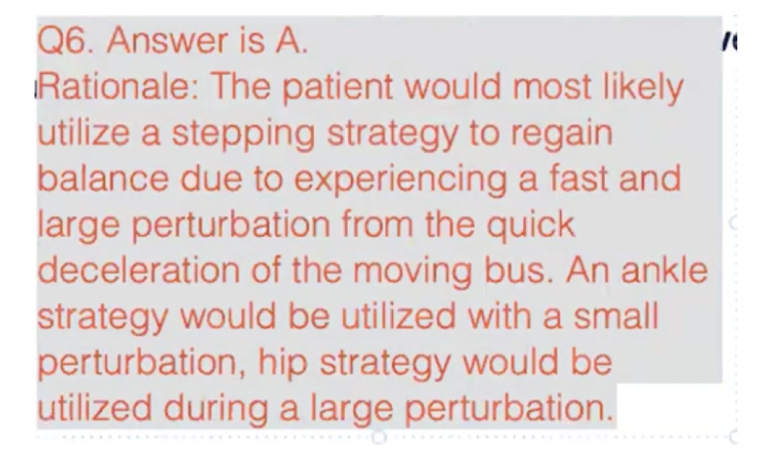
<p>A) Stepping Strategy</p>
29
New cards

Practice Q 7:

A physical therapist is treating a patient with a history of falls due to frequent tripping while walking. Examination reveals right foot flat initial contact during ambulation with decreased heel strike, patellar deep tendon reflex grading of 1+, and decreased sensation in the right lower extremity along the lateral thigh, medial leg, dorsum of foot, and big toe. The patient is demonstrating s/s that are MOST CONSISTENT with which of the following?

A)L MCA CVA

B) ASIA A SCI at T12

C) L4 radiculopathy

D)Tibial nerve neuropathy.

C) L4 radiculopathy
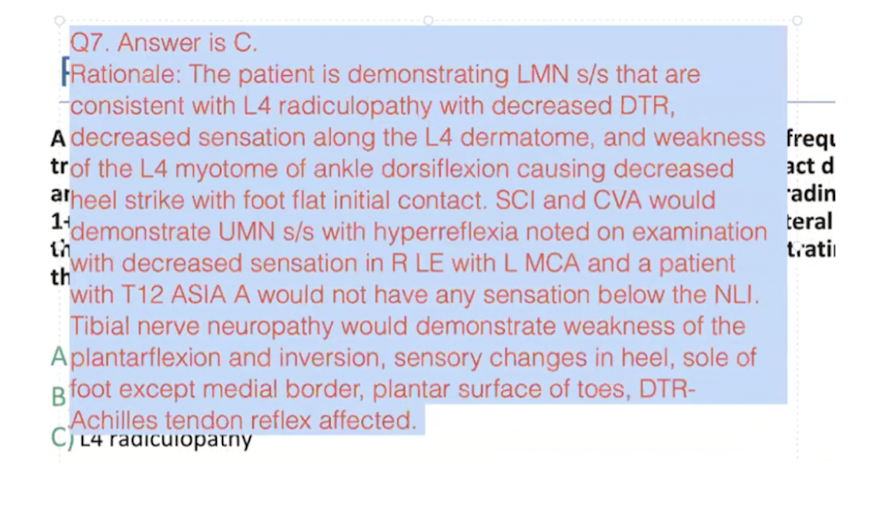
<p>C) L4 radiculopathy</p>
30
New cards
<p>UMN v LMN</p><p></p><p>FLIP » </p><p></p><p></p>

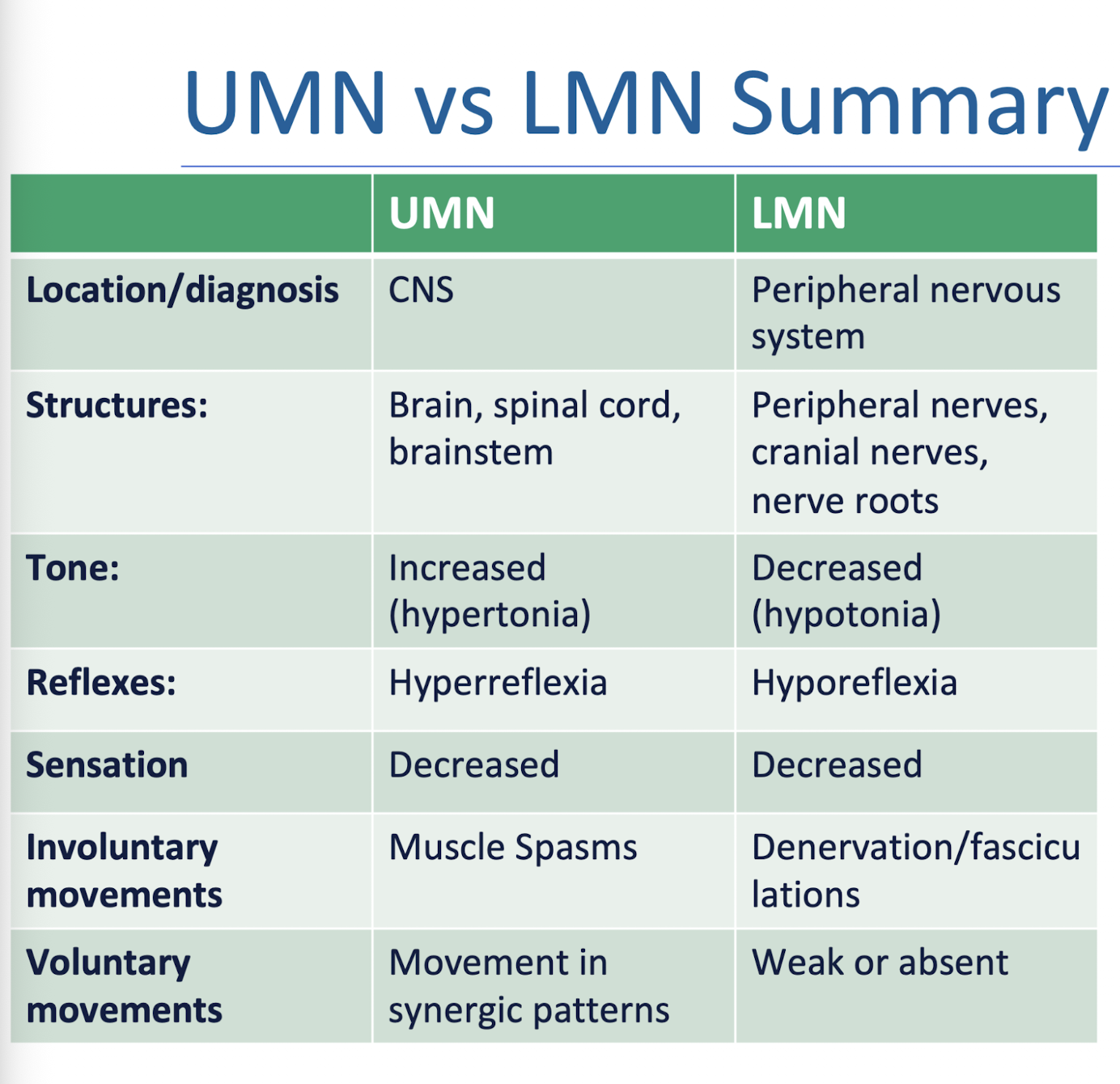
UMN v LMN

FLIP »

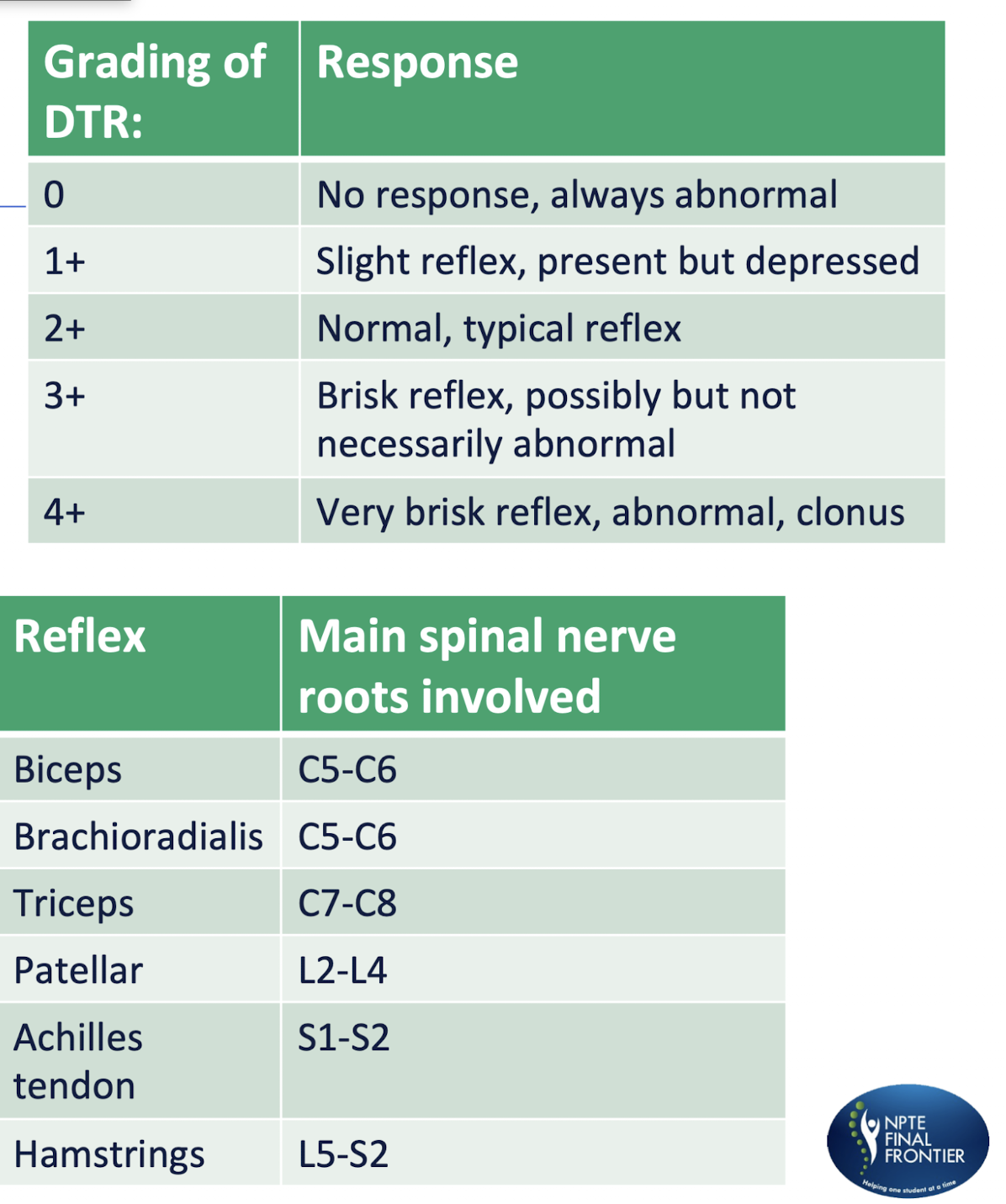
DTR Grading

Reflex
<p>DTR Grading</p><p></p><p>Reflex</p>
31
New cards
<p>Myesthenia Gravis:</p><ul><li><p>Describe: (3)</p></li></ul><ul><li><p>Cause:</p></li><li><p>UMN or LMN?</p></li></ul><p></p><p></p>

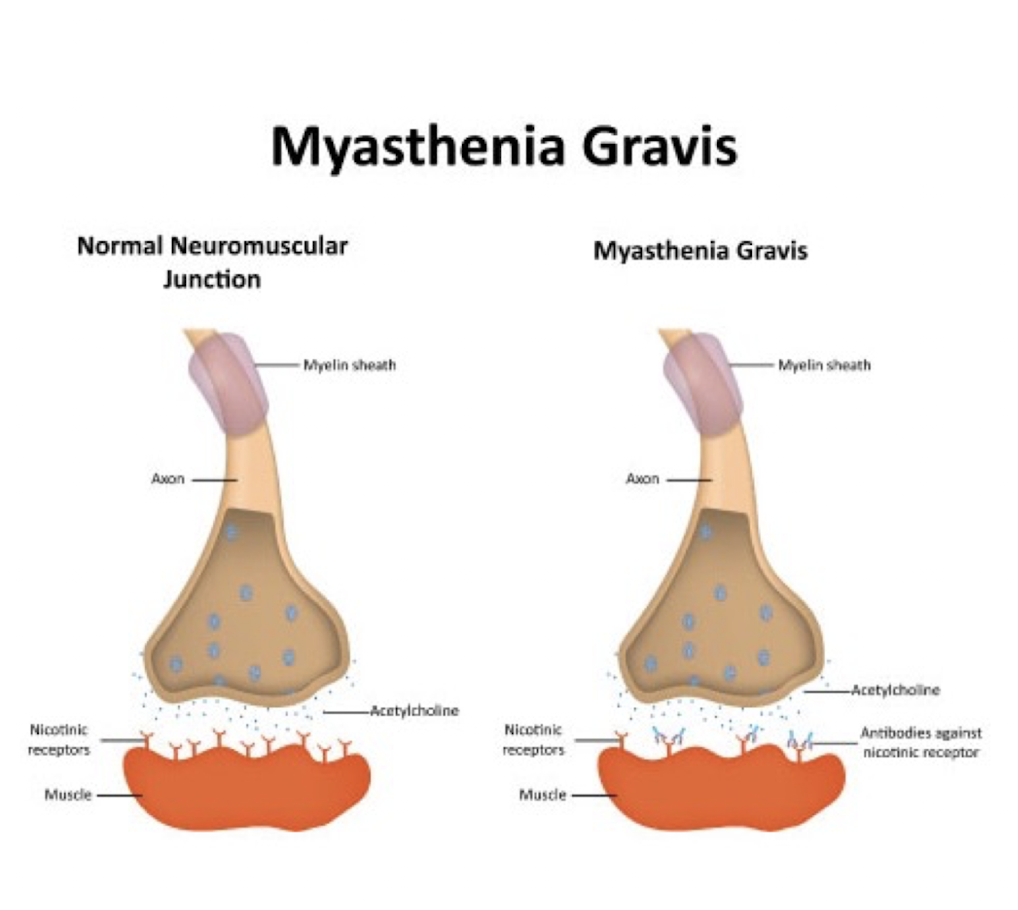
Myesthenia Gravis:

  • Describe: (3)

  • Cause:

  • UMN or LMN?

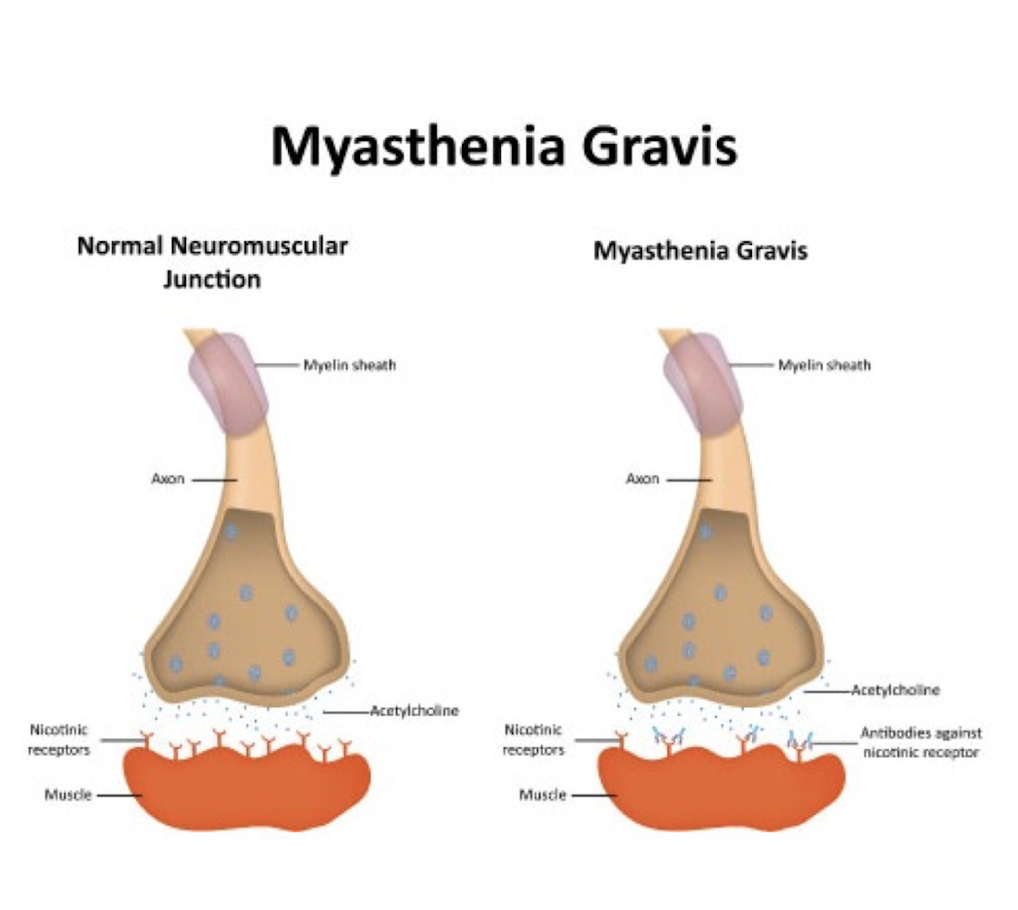
  • Describe:

    • Autoimmune

    • NMJ Disorder

    • Postsynaptic NMJ Disorder

      • Disruption of nerve impulses to muscles d/t antibodies blocking ACH receptors

  • Cause:

    • Enlarged Thymus AND associated c other immune disorders (DM, RA, SLE (Lupus))

  • UMN or LMN:

    • Neither » NMJ

<ul><li><p>Describe:</p><ul><li><p>Autoimmune</p></li><li><p>NMJ Disorder</p></li><li><p>Postsynaptic NMJ Disorder</p><ul><li><p>Disruption of nerve impulses to muscles d/t antibodies blocking ACH receptors</p></li></ul></li></ul></li><li><p>Cause:</p><ul><li><p>Enlarged Thymus AND associated c other immune disorders (DM, RA, SLE (Lupus))</p></li></ul></li><li><p>UMN or LMN:</p><ul><li><p>Neither » NMJ</p></li></ul></li></ul><p></p>
32
New cards
<p>Myesthenia Gravis:</p><ul><li><p>Diagnostic Test:</p></li><li><p>First S/S:</p></li></ul><p></p><p></p>

Myesthenia Gravis:

  • Diagnostic Test:

  • First S/S:

  • Diagnostic Test: Ice Pack Test

    • Take baseline ptosis » ice pack for 2-5 min » take ptosis measurement

    • Less ptosis/improvement ≥ 2mm = Positive Ice Pack Test

  • First S/S:

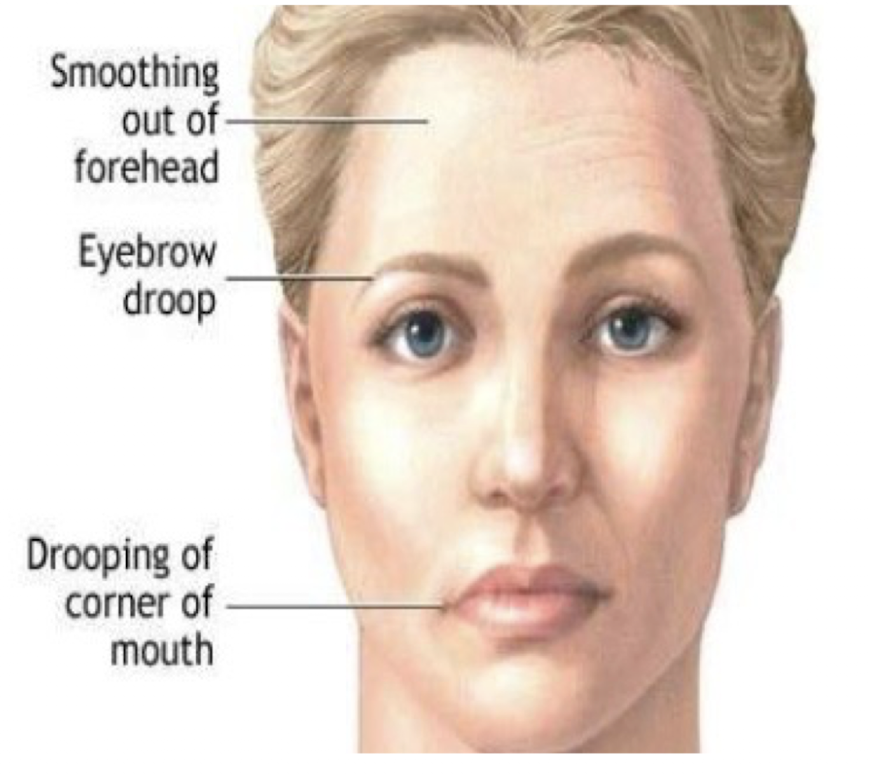
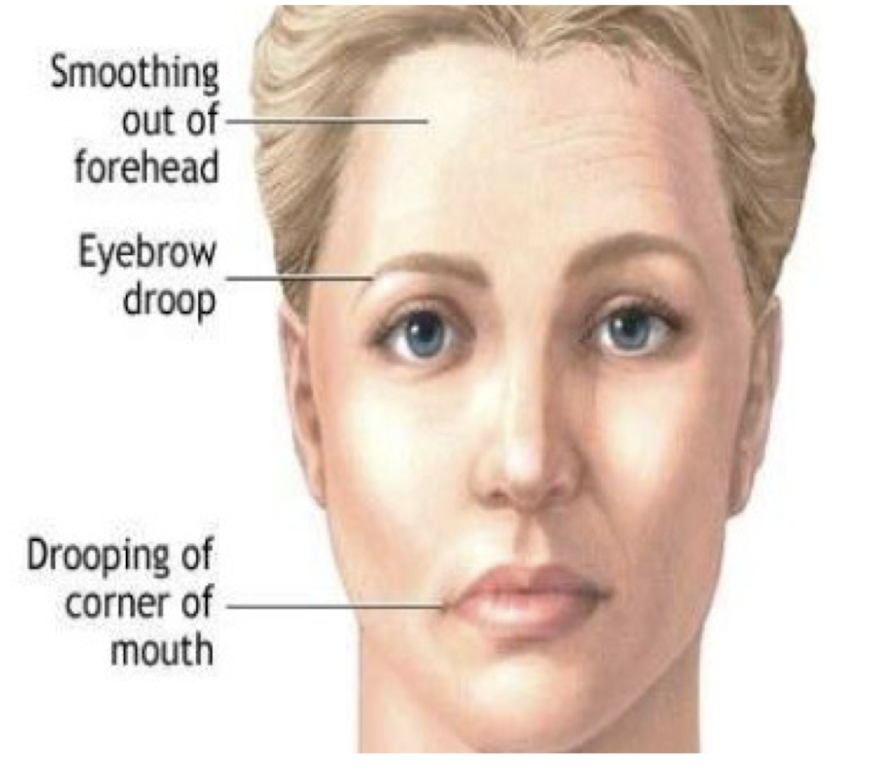
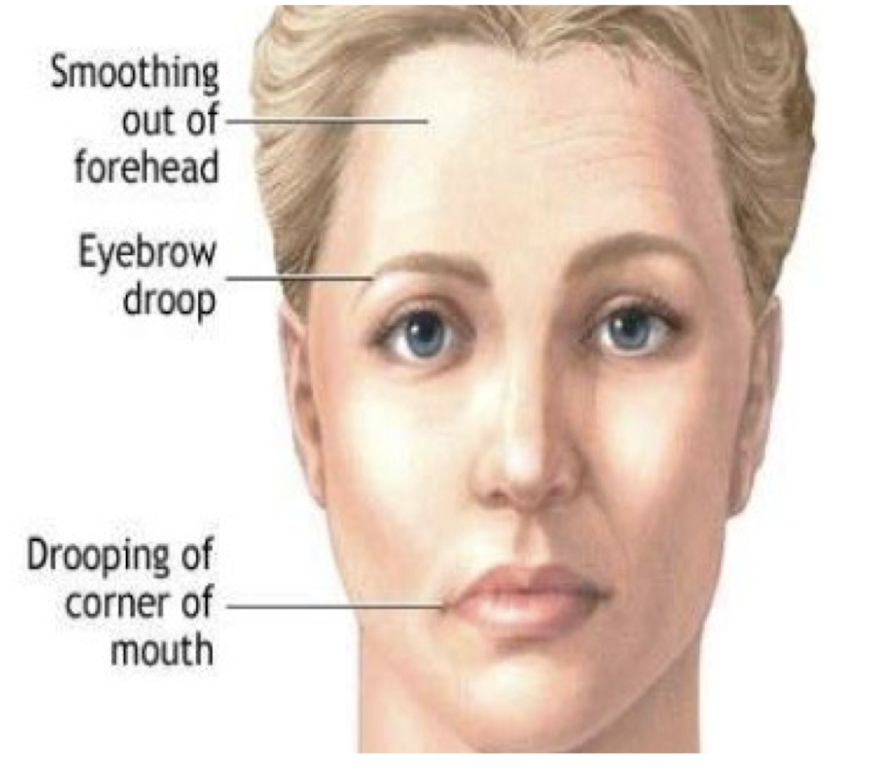
    • Ocular (and bulbar) muscles affected first

      • Diplopia

      • Bilateral Ptosis

<ul><li><p>Diagnostic Test: Ice Pack Test </p><ul><li><p>Take baseline ptosis » ice pack for 2-5 min » take ptosis measurement</p></li><li><p>Less ptosis/improvement ≥ 2mm = Positive Ice Pack Test </p></li></ul></li><li><p>First S/S:</p><ul><li><p>Ocular (and bulbar) muscles affected first </p><ul><li><p>Diplopia </p></li><li><p>Bilateral Ptosis </p></li></ul></li></ul></li></ul><p></p>
33
New cards
<p>Myesthenia Gravis:</p><ul><li><p>Other S/S: (4)</p></li></ul><p></p><p></p>

Myesthenia Gravis:

  • Other S/S: (4)

  • Progressive muscle weakness » fatiguability on exertion or repeated contractions

  • Worsens c activity and improves c rest

    • Activity Pacing

    • AM Exercise

  • Proximal limb-girdle muscle most affected

    • Prox > Dist

  • Resp Issues

<ul><li><p>Progressive muscle weakness » fatiguability on exertion or repeated contractions </p></li><li><p>Worsens c activity and improves c rest </p><ul><li><p>Activity Pacing</p></li><li><p>AM Exercise</p></li></ul></li><li><p>Proximal limb-girdle muscle most affected</p><ul><li><p>Prox &gt; Dist </p></li></ul></li><li><p>Resp Issues </p></li></ul><p></p>
34
New cards

Practice Q 8:

A patient reports progressive arm and leg weakness over 4 months with fine motor difficulty and frequent tripping. They have muscle cramps, fasciculations, muscle weakness, hyperreflexia (lower extremity deep tendon reflex 3+), mild dysarthria, and intact sensation with no ptosis or diplopia. Which of the following is the MOST LIKELY diagnosis?

A. Guillain-Barré Syndrome

B. Multiple Sclerosis

C. Myasthenia Gravis

D. Amyotrophic Lateral Sclerosis

D. Amyotrophic Lateral Sclerosis
35
New cards
<p>DDx: </p>

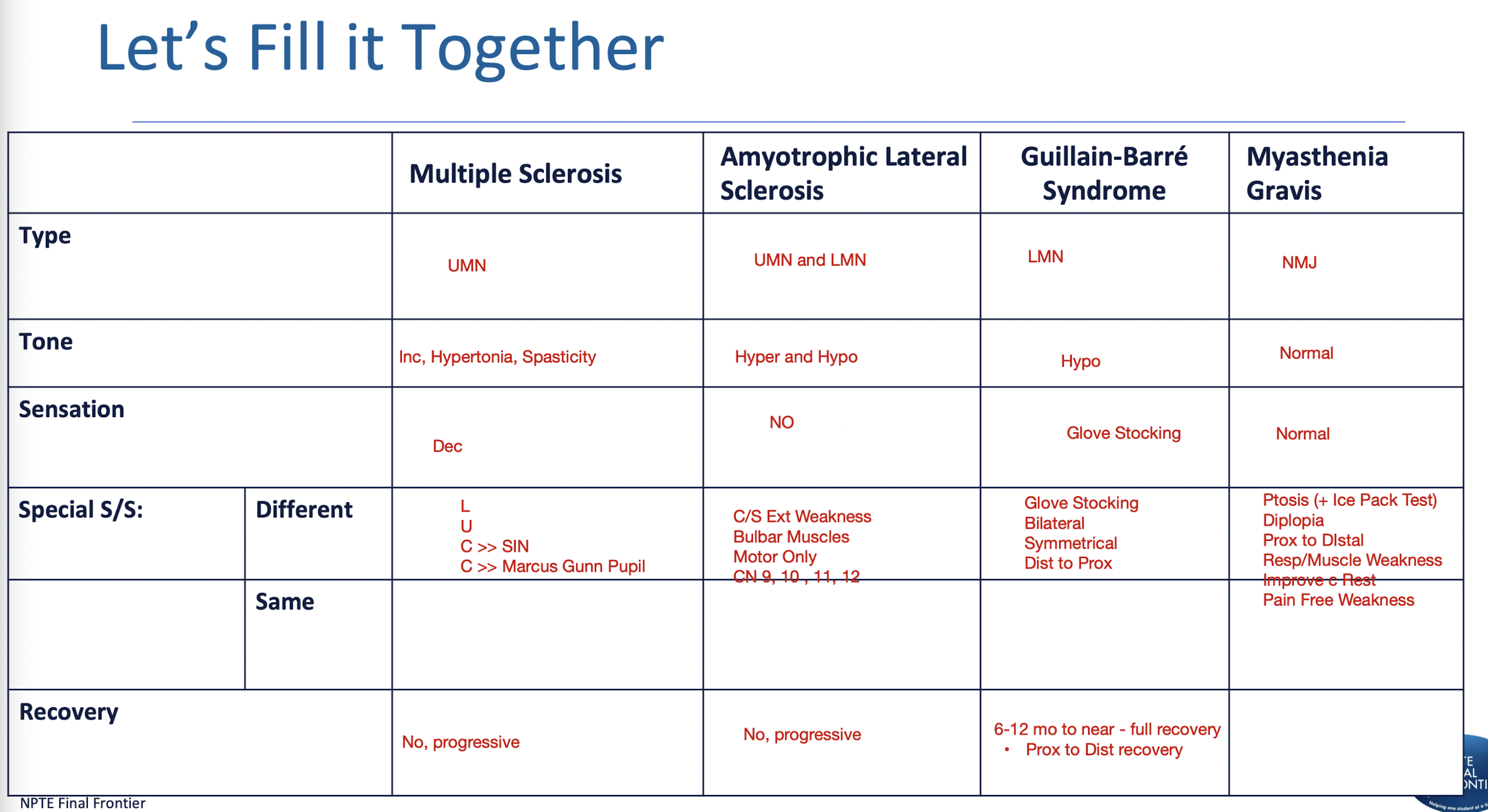
DDx: