IB Geography Urban Environments
 Studied by 0 people
 Call with Kai
 Learn
Learn Practice Test
 Spaced Repetition
 Match
Match Flashcards
 Knowt Play
1/47

There's no tags or description
Looks like no tags are added yet.
Name | Mastery | Learn | Test | Matching | Spaced | Call with Kai |
|---|
No study sessions yet.
48 Terms
greenfield site
a piece of land that has not been built on before, but is now being considered for development
urban consolidation
the process of increasing the density of residential buildings in an urban area. Infilling gaps, bringing disused buildings back into productive use, etc.
suburbanisation
outward growth of towns and cities to engulf surrounding villages and rural areas.
suburb
residential areas within or just outside the boundaries of a city
decentralisation
when manufacturing industries and people relocate outwards from the urban center
gentrification
when middle class people move into run down inner city areas with the intention of renovating the old buildings
distance decay
as distance from the PLVI increases, land prices decrease... also reflecting this, building heights decrease.
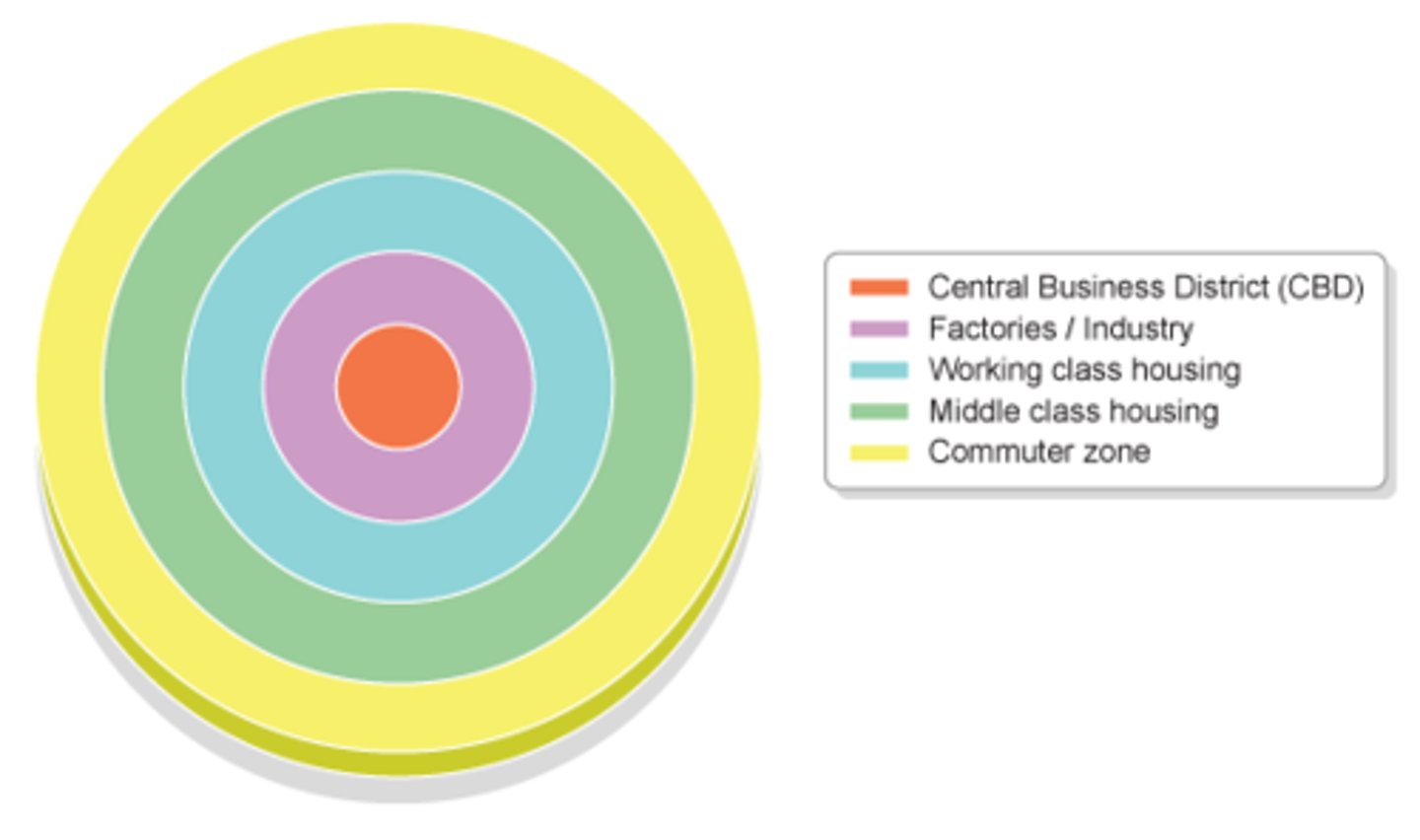
Burgess Model
land uses are arranged around the CBD in concentric circles, with the profitable uses being found closest to the city center
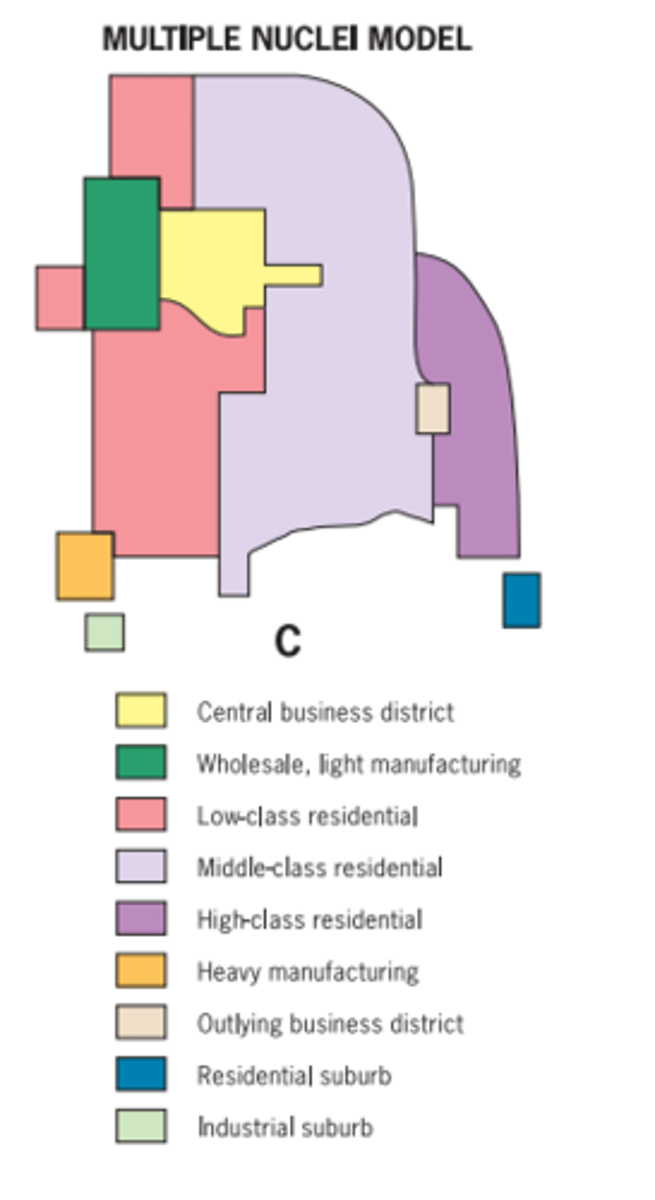
Multiple Nuclei Model
Argues that land uses tend to be arranged in cells or patches throughout the city depending on the availability and the quality of land
bid rent theory
retailers can afford the highest rents, but they are not prepared to pay high prices if they are not in highly accessible areas
population density hollow
in the CBD residential land use is usually outbid by retailing and office space so the population of the CBD part of the city is low
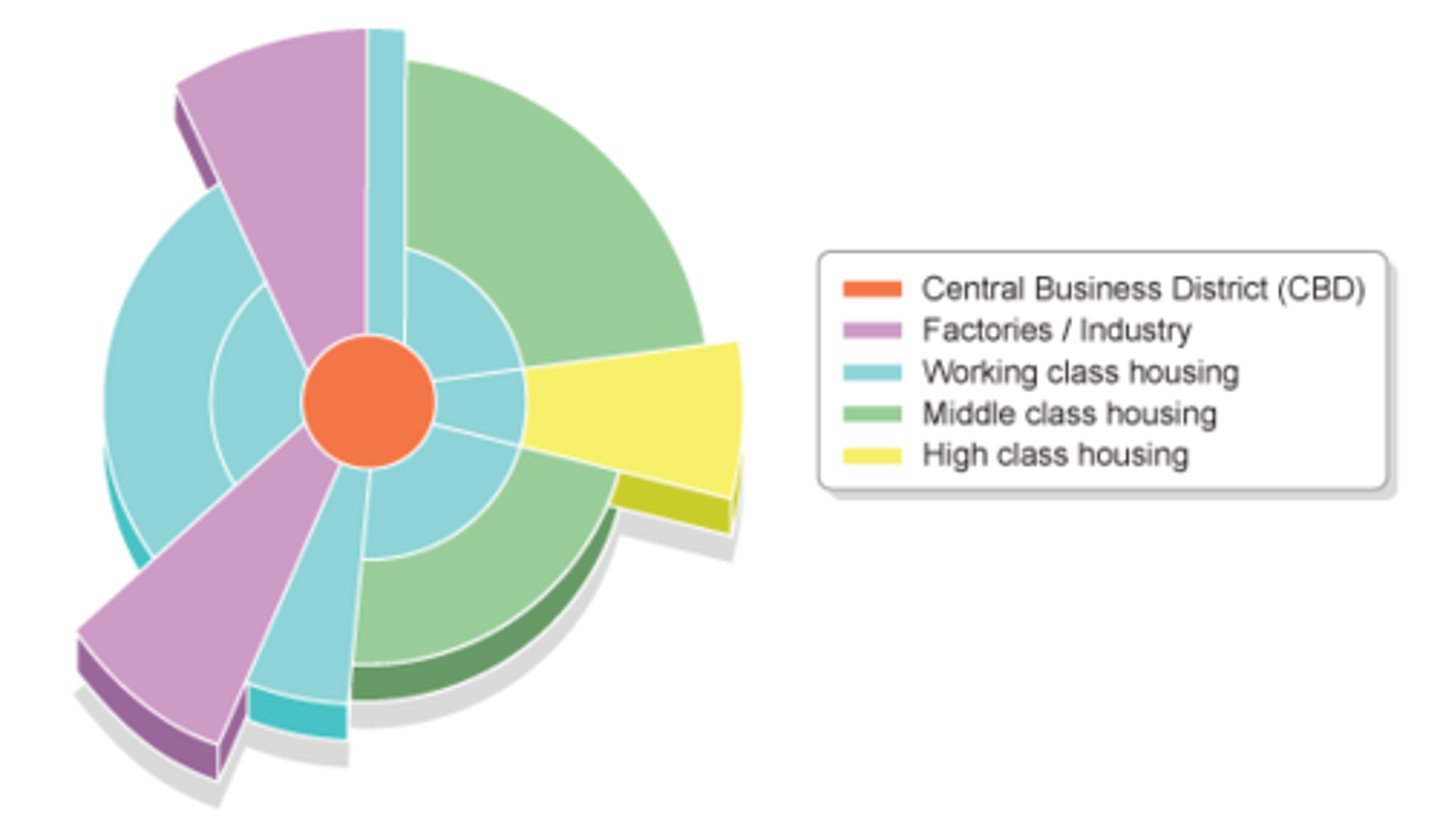
Hoyt (Sector) Model
based on the circles on the Burgess model, but adds sectors of similar land uses concentrated in parts of the city. Notice how some zones, eg the factories/industry zone, radiate out from the CBD.
Peak Land Value Intersection
the point of the highest land value often resulting from the intersection of communication routes
Megacity
A city with a population of at least 10 million people.
spatial exclusion
a process where wealthy residents become so concerned about their security and defending their luxury lifestyles that special access and freedom of movement becomes restricted
counter-urbanisation
movement of population away from inner urban areas to a new town, a new estate, a commuter town or a village on the edge or just beyond the city limits
ecological footprint
the theoretical measurement of the amount of land and water a population requires to produce the resources it consumes and to absorb its waste under prevailing technology
Brownfield Site
Abandoned or underused industrial buildings and land which may be contaminated but have potential to be redevelopment
Shanty Housing
'Homemade' housing using scavenged materials such as corrugated iron, cloth and plastic.
Squatters
People who have no legal title on the land they live on. The do not rent or own land and will build or live on vacant land, such as nearby railways or on steep slopes.
Urban Decay
Reflects the lack of inner-city demand. Many vacant blocks, derelict buildings, graffiti. It is not a source of employment, tax revenue or income.
re-urbanization
development of activities to increase residential population densities within the existing built-up area of a city.
Urban circular system
A sustainable city in which there are recycling, reuse and reduction of resources, renewable forms of energy, and measures taken to reduce the ecological footprint.
Urban Growth
Increase in size of an urban area or an increase in the number of people living in an urban area.
Urban Heat Island
Urban areas becoming warmer than their surroundings. Is done by cement retaining heat, car exhausts, pollution fumes, etc.
Urban Renewal
A governmental programme, converting run-down areas into attractive public areas. E.g. London Docklands in Sydney, Australia.
Urban Sprawl
Unplanned and uncontrolled physical expansion of a city into surrounding areas.
Urbanisation
An increasing percentage of a country's population moves into towns and cities. It can be due to migration or natural increase.
Centripetal movement
Movement toward the center. In this case, movement toward the city center.
Centrifugal movement
Movement away from the center. In this case, movement away from the city center.
Linear City System
Inputs come into the city such as people, natural resources and energy and products as well as waste, noise and congestion are the cities outputs.
The Urban ecological footprint
The land area required to sustain a population of any size. Measures the amount of farmland and aquatic resources that must be used to sustain a population, based on its consumption levels at a given point in time.
Sustainable urban management strategy
An approach to urban management that seeks to maintain and improve the quality of life for current and future urban dwellers. Aspects of management may be social (housing quality, crime), economic (jobs, income) or environmental (air, water, land, resources).
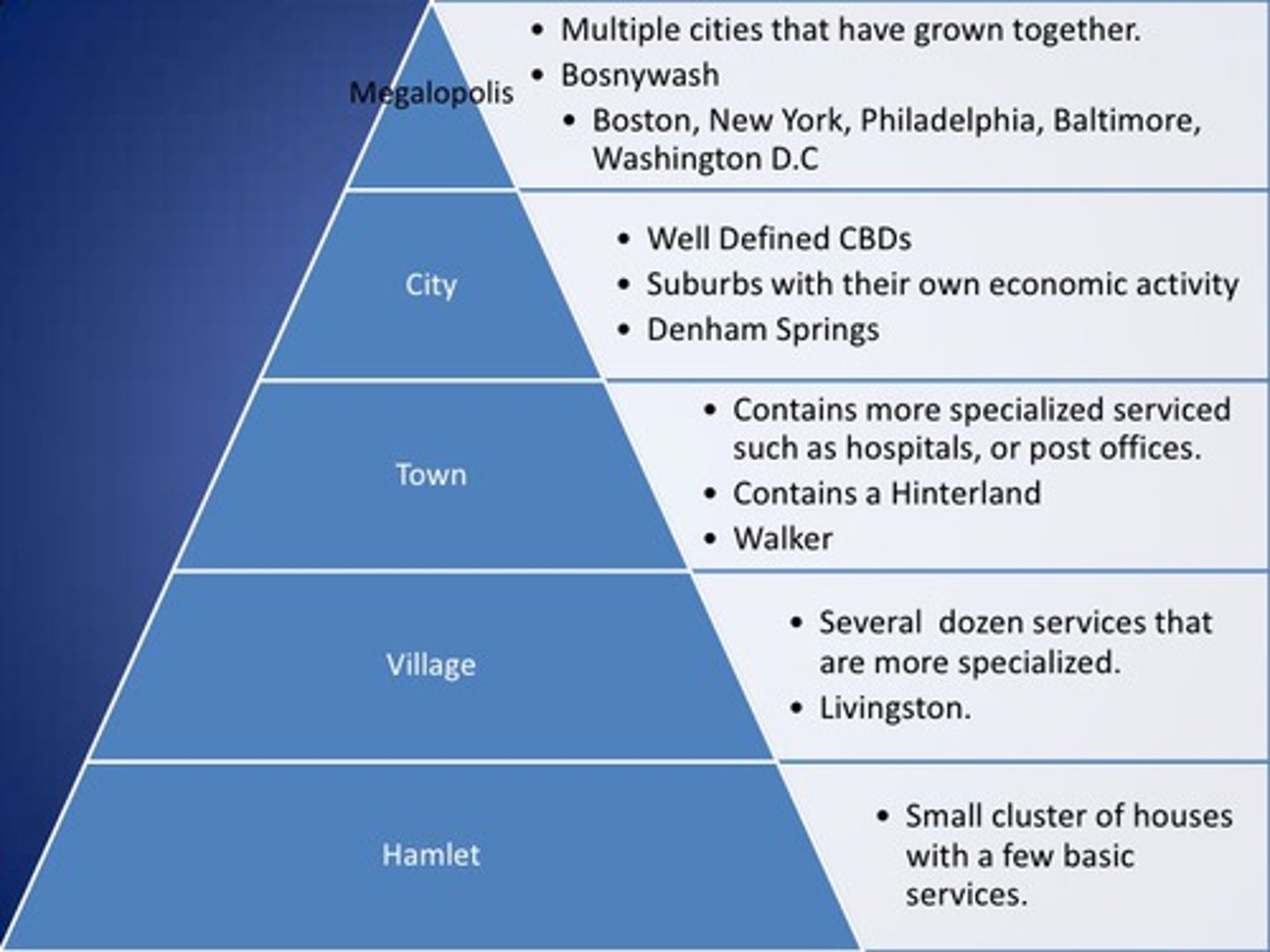
Urban Hierarchy
A national arrangement of urban areas, for example from one large city to many small villages.
Residential Segregation
The physical separation of population by culture, income or other criteria.
Ethnicity
One of the cause of segregation. The cultural differences between immigrants and existing residents often led to difficulties in communication, resulting in varying degrees of residential segregation.
The Family Life Cycle
A person is likely to move around different zones of a city, depending on their age and their need for a house of a certain size.
Physical Indicators of social deprivation
quality of housing, levels of pollution, incidence of crime, vandalism, graffiti
Social Indicators of social deprivation
inducing crime (reported and fear of); levels of health and access to health care; standards of education; proportion of population on subsidized benefits (unemployment, disability, free school meals); proportion of lone-parent families.
Economic Indicators of social deprivation
access to employment; unemployment and underemployment; levels of income.
Political indicators of social deprivation
opportunities to vote and to take part in community organization, or lack of the above
formal economy
The legal economy that is taxed and monitored by a government and is included in a government's Gross National Product; as opposed to an informal economy (ex. teacher, bank clerk)
informal economy
Economic activity that is neither taxed nor monitored by a government; and is not included in that government's Gross National Product; as opposed to a formal economy (ex. food vendor, domestic worker)
Central Business District (CBD)
The downtown or nucleus of a city where retail stores, offices, and cultural activities are concentrated; building densities are usually quite high; and transportation systems converge.
low-order goods
necessity good or those bought for convenience e.g. bread, rice, newspapers
high-order goods
Luxury or shopping good that are bought or used infrequently e.g. watches, cars
Situation
the location of a place relative to other places
Site
The physical character of a place
 Note
Note  Flashcards (55)