Topic 3 - Intro to Biological Macromolecules
 Studied by 0 people
 Call Kai
 Learn
Learn Practice Test
 Spaced Repetition
 Match
Match Flashcards
 Knowt Play
1/5

There's no tags or description
Looks like no tags are added yet.
Name | Mastery | Learn | Test | Matching | Spaced | Call with Kai |
|---|
No analytics yet
Send a link to your students to track their progress
6 Terms
What are the common chemical functional groups that are part of biological molecules and how did they affect the function and interactions of those molecules?
hydroxyl, carboxyl, amino, phosphate, carbonyl, sulfhydryl, methyl. Enable bonding, energy storage, enzyme activity, forming DNA, proteins, lipids, carbs
How do the subcomponents of biological molecules and their sequence determine the properties of that molecule?
through chemical interactions (hydrophobic, ionic, H-bonds) which determine its complex properties, shape, and biological function
What is a monomer?
small simple molecule that acts as a basic building block that can bond with many other identical or similar monomers to form a large chain - polymer
What is a polymer?
large molecule made of long chains of monomers
What happens during hydrolysis reactions?
a water molecule s
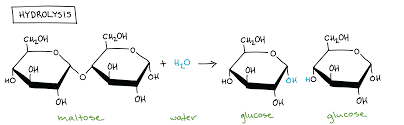
plits into a compound in two parts, with a hydrogen (H2O) joining one fragment and a hydroxyl (-OH) group joining another
breaks polymers down into monomers by adding a water molecule to break bonds
What happens during dehydration synthesis?
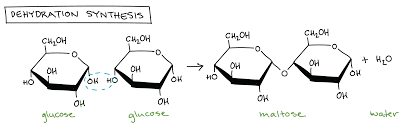
two smaller molecules (monomers) join to form a larger molecule by removing a water molecule, with a hydrogen from one molecule and a hydroxyl group from the other, combining to form water
linking monomers into polymers, releasing a water molecule for each bond formed
 Note
Note  Flashcards (72)