Action potential
 Call Kai
 Learn
Learn Practice Test
 Spaced Repetition
 Match
Match Flashcards
 Knowt Play
1/15

Earn XP
Description and Tags
propagation &
Name | Mastery | Learn | Test | Matching | Spaced | Call with Kai |
|---|
No analytics yet
Send a link to your students to track their progress
16 Terms
how does potential difference move along an axon
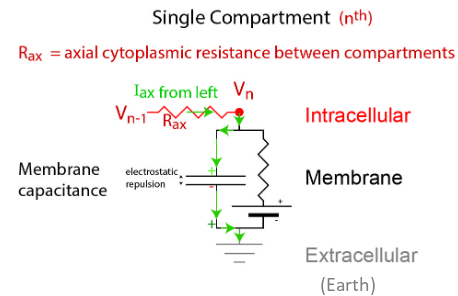
the potential difference between the AP site and the next segment of axon drives positive current (mainly K+) axially along tube of cytoplasm (ohms law means like charges repel)
the axial current deposits positive charge on the intracellular surface of the mb capacitance of the next segment of axon (making mb potential less negative)
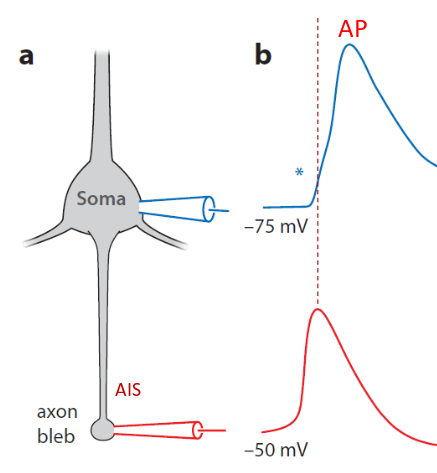
why is it that the axon initial segment (AIS) fires first even if current is injected at the soma?
-higher Na+ channel density
-Na+ channels open at more negative Vm than soma-dendritic Na+ channels
(can investigate though current injection into axon ‘bleb’ & sealed up cut end of axon initial segment)
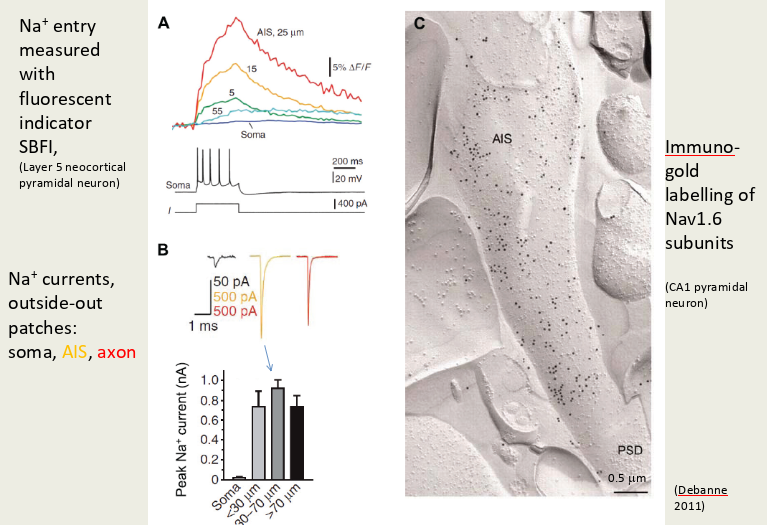
how could you investigate depolarisation from the AIS through the axon
-measure Na+ entry w fluorescent indicator SBFI
-Na+ currents using outside-out patches (soma, AIS, axon)
-immuno-gold labelling of ion channel subunits (Nave1.6)
what equation could you use for voltage and tracking charge across the mb
V = Q/C = Qd/e A
(Q = charge (on patch)
C = capacitance (of patch)
d = thickness of membrane
e = permittivity
A = surface area (of patch))
whats ohms law?
Iax = voltage drop (Vn-1 - Vn) / Rax = g ax x voltage drop (Rax is axial resistance)
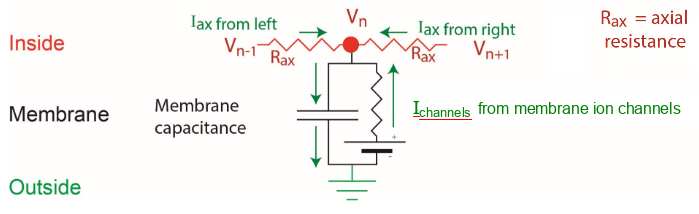
what equation can be used (adoption of ohms law) where current comes from right & left
Iax (from both compartment a & b) = g ax(Va - Vb) where g ax = 1/ Rax
for each compartment: I tot = I ax(left) + I ax(right) + I channels
(total inward current, flowing onto inside surface of mb capacitance = axial current flowing in + mb ion channel current flowing in)
constant velocity
constant velocity -> plot of waveform against time equivalent to plot of waveform against distance = instantaneous ‘snapshot’ of spatial extent, shape
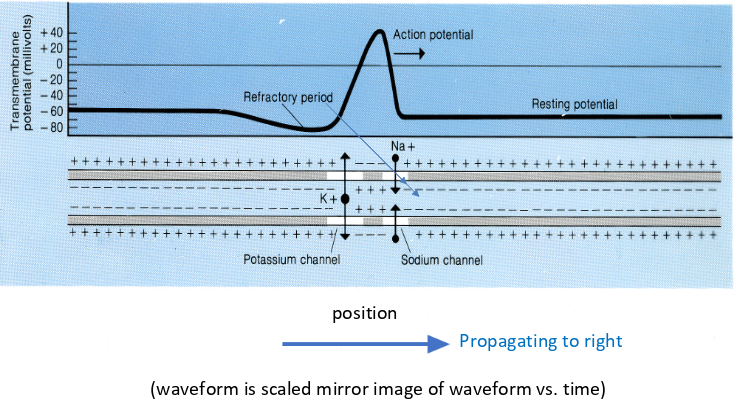
are charged ions actually flowing directly through fatty lipid at leading edge
no, capacitative currents indirectly ‘cross’ lipid- charge on intracellular side electrostatically repels same sign charge off extracellular side
how is speed related to axon diameter
speed is roughly a square root of diameter (myelinated)
whats the equation for specific mb capacitance (Cm)
C = e × area/thickness
(e is permittivity)
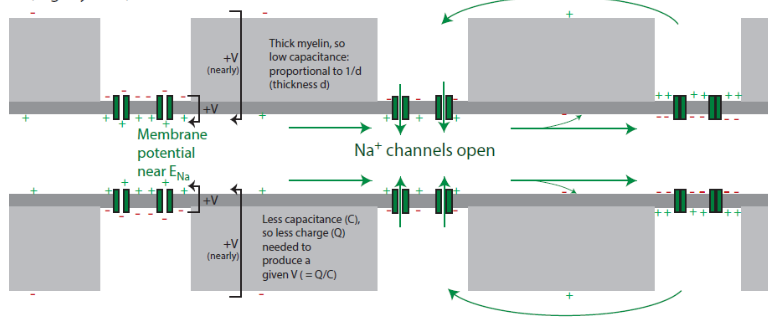
(therefore when myelin increases thickness, capacitance decreases= leass charge needed to produce a given voltage across mb)
what equation connects V, Q, d, e, area. separately= V, Q, & C
V = Q/C
V= Q d/ e Area
C= e Area/ d
(d is thickness)
explain saltatory propagation
-Entire internode undergoes AP waveform (more or less): just requires v. little charge to do so.
-Na+ influx i.e. active ‘regeneration’ of AP is what actually ‘jumps’ from node to node.
-Safety factor 5 to 10 internodes: axial current spreads far enough to trigger AP 5 to 10 nodes ahead if intervening nodes disabled
what are the pros of myelination
-speed (20m/s vs 120m/s in squid giant)
-efficiency (>5,000 less energy consumed in squid giant)
-space (increased diameter)
what are the cons of myelination
-metabolic & developmental costs of setting up
-vunerable to demyelinating diseases (e.g. multiple sclerosis)
how can different neurons differ, between species/ brain areas
-different sensitivities to ttx
-different lvls of myelination- diff species
-different densities of ion channels- diff species
how can an AP start at the axon/ soma & travel down the dendrites
via backpropagation & play role in synaptic plasticity

