Mitosis and Meiosis
 Studied by 0 people
 Call Kai
 Learn
Learn Practice Test
 Spaced Repetition
 Match
Match Flashcards
 Knowt Play
1/43

There's no tags or description
Looks like no tags are added yet.
Name | Mastery | Learn | Test | Matching | Spaced | Call with Kai |
|---|
No analytics yet
Send a link to your students to track their progress
44 Terms
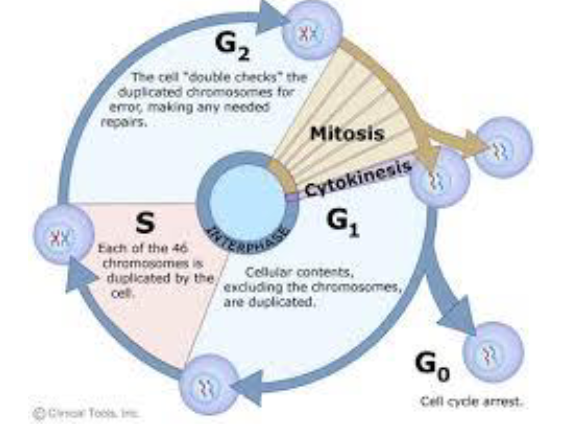
List the stages of the cell cycle (not just mitosis)
G1- cellular contents, excluding chromosomes, are duplicated. Cell grows
S- Each chromosome is replicated
G2- The cell “double checks” the duplicated chromosomes for errors, making any needed repairs. Prepares for mitosis.
Mitosis
Cytokinesis
**G0- cell cycle arrest
**Interphase is all the way up until mitosis and includes, G1, G1/S checkpoint, S, G2, and G2/M checkpoint. The cell is growing during interphase.
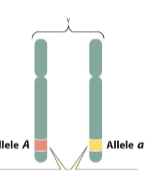
What are these called?
Homologous chromosomes
What is the relationship between homologous chromosomes?
Same size, centromere placement, and genes, but DIFFERENT alleles!
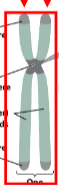
What are these called (individual arms)?
Sister chromatids
What is the relationship between sister chromatids?
They are IDENTICAL!
List the steps of mitosis and their functions
Prophase: Chromosomes condense. Each chromosome is composed of two sister chromatids (past S phase). The mitotic spindle begins to form.
Prometaphase: Nuclear membrane disintegrates. Spindle microtubules attach to chromosomes.
Metaphase: Chromosomes line up on the metaphase plate in no particular order
Anaphase: Sister chromatids are pulled apart towards opposite poles
Telophase: Chromosome arrives at poles. Nuclear membrane reforms, and chromosomes relax.
What do the chromosomes look like during interphase?
Uncondensed chromatin.
In mitosis, each daughter cell is __ to the parent. What is the ploidy of each daughter cell?
Identical, and 2n
Do germ or somatic cells undergo mitosis?
Somatic
How many divisions are there in mitosis? What about meiosis? How many daughter cells do we wind up with each?
Mitosis= 1 division, 2 daughter cells
Meiosis= 2 divisions, 4 daughter cells
In mitosis, what is the ploidy of each daughter cell?
n —> haploid!!
What kind of cells undergo meiosis?
Germ
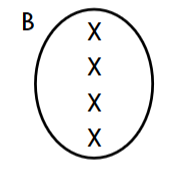
How many chromosomes are present here? How many DNA molecules?
4 chromosomes, 8 DNA molecules.
What happens in Prophase I of meiosis that DOESN’T occur in mitosis?
Homologous chromosomes are paired via attractions due to sequence homology
Synaptonemal complex forms: a groups of proteins that “zipper” the homologs up
Double strand breaks occur in the process of crossing over
What is chiasmata?
The point of contact between non-sister chromatids of homologous chromosomes that is an indication of crossing over happening
What is different about metaphase I of meiosis compared to mitosis? What about anaphase I?
Homologous pairs of chromosomes connected at the synaptonemal complex line up side by side at the metaphase plate. In mitosis, homologs are not paired and they don’t line up in any particular order.
In anaphase I of meiosis, homologous chromosomes are pulled apart, NOT sister chromatids like in anaphase of mitosis.
At what point in meiosis does the cell become haploid?
Telophase I!
When do sister chromatids separate in meiosis?
Anaphase II
Why do we not get exactly ¼ of each of our grandparents DNA, when we get just about 50/50 of our parents? What does this mean for ancestry tests?
Due to crossing over and independent assortment! Some parts of our ancestors chromosomes may be completely lost because of this, and we may only receive small fractions. This means many of our ancestors may not be represented through ancestry tests.
What does independent assortment result in?
The shuffling of maternal and paternal chromosomes (homologs STILL pair up in metaphase I, but it depends if the maternal or paternal homolog is on the right or left side). This results in genetically unique gametes.
How to calculate # of different arrangements possible during metaphase I (independent assortment)? How to calculate the # of unique gametes possible to form?
Arrangements: 2^n-1, where n= # pairs
Possible gametes: 2^n
When doing independent assortment calculations, there will always be __ the number of potential gametes than arrangements
Gametes.
If a cell is undergoing meiosis and n=3, how many possible arrangements of chromosomes are there? How many potential gametes?
Arrangements: 2^(3-1) = 4
Potential gametes: 2³= 8
Crossing over generates ___ chromosomes
Recombinant
Due to crossing over and independent assortment, each of the 4 daughter cells produced in meiosis are genetically ___
Unique
What is a haplotype?
A set of linked variants (different genes) on a single chromosome that tend to be inherited together because they are so close in proximity. During crossing over, they will move together.
How are mitochondria inherited?
From the mother!
a single mitochondria has __ copies of its genome
Multiple
The mitochondrial genome encodes for about __ proteins that function in cellular respiration
13
Does the mitochondria only use genes from its genome?
No! it also gets info from the nuclear genome- that’s why not all mitochondrial diseases can be cured via mitochondrial replacement therapy
T or F: Mitochondria (and chloroplasts) replicate independently of the cell and are distributed at random during cell division
T!
Define homo and heteroplasmic cells
Homoplastic: one “type” of mitochondria
Heteroplasmic: >1 “type” of mitochondria
Out of the brain, heart and skin, which has the greatest mitochondrial (E) demands? Which would be most impacted by a “mild” mitochondrial disease?
Brain!!! Then heart, then skin
How does mitochondrial replacement therapy work?
Mother has “sick” mitochondria and doesn’t want her kid to get them
An anucleated donor cell, with healthy mitochondria, is provided. The parents put their nuclei into the donor cell, so the embryo has their genomic DNA, but healthy mitochondrial DNA
Each chromatid represents __ DNA molecule
1
What stage of the cell cycle are primary oocytes arrested in? What about secondary oocytes?
Primary: prophase I
Secondary: Metaphase II
What condition must be met in order for meiosis II to be completed?
The secondary oocyte (arrested in metaphase II), must get fertilized!
After each round of meiosis, what happens to one of the daughter cells?
It’s a polar body, it dies
What happens to the secondary oocyte if it is not fertilized?
It gets ovulated
At what point in life does a primary oocyte finally complete meiosis I?
At puberty, when the follicles are mature
What is nondisjunction?
Chromosomes don’t separate properly during meiosis I or II.
What is the ploidy of the daughter cells if non-disjunction occurs in meiosis I? What about in meiosis II?
Meiosis I: n+1, n+1, n-1,n-1
Meiosis II: n+1, n-1, n, n (Two are normal)
How does non-disjunction occur?
The synaptonemal complex is not functioning properly or crossing over fails. The homologues (in terms of meiosis I) get connected to the same spindle fiber and are pulled to the same pole.
Why does risk of non-disjunction increase with a woman’s age?
The synaptonemal complex breaks down
 Note
Note  Flashcards (248)