ch 26 viki study gold - urinary system
 Call Kai
 Learn
Learn Practice Test
 Spaced Repetition
 Match
Match Flashcards
 Knowt Play
1/55

There's no tags or description
Looks like no tags are added yet.
Name | Mastery | Learn | Test | Matching | Spaced | Call with Kai |
|---|
No analytics yet
Send a link to your students to track their progress
56 Terms
The urinary system does all of the following except:
A. eliminating organic waste products.
B. regulating plasma concentrations of electrolytes.
C. excreting excess albumin molecules.
D. regulating blood volume.
E. contributing to stabilizing blood pH.
C. excreting excess albumin molecules.
The prominent indentation on the medial surface of the kidney is the
hilum.
The cells of the macula densa and the juxtaglomerular cells form the
juxtaglomerular complex.
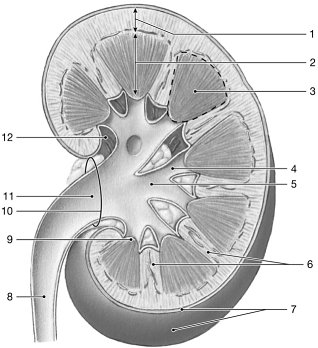
Figure 26-1 The Structure of the Kidney
Use Figure 26-1 to answer the following questions:
Identify the structure labeled "3."
renal pyramid
Which of the following is not a normal constituent of urine?
A. creatinine
B. hydrogen ions
C. large proteins
D. urea
E. amino acids
C. large proteins
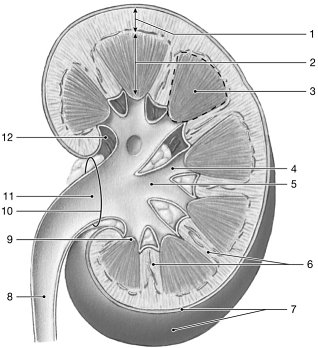
Figure 26-1 The Structure of the Kidney
Use Figure 26-1 to answer the following questions:
Identify the structure labeled "4."
minor calyx
Renal blood flow is about ___ liter/min
1 liter/min.
Substances larger than ________ are normally not allowed to pass through the filtration membrane.
albumin
One mechanism the kidney uses to raise systemic blood pressure is to
increase secretion of renin by the juxtaglomerular complex.
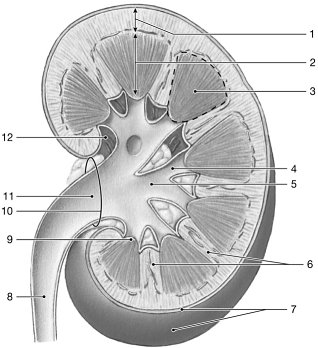
Figure 26-1 The Structure of the Kidney
Use Figure 26-1 to answer the following questions:
Identify the structure labeled "8."
ureter
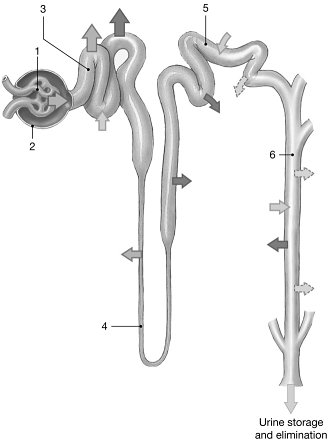
Figure 26-2 The Nephron
Use Figure 26-2 to answer the following questions:
What physiological process occurs at the structure labeled "1"?
filtration
The ability to form concentrated urine depends on the functions of the
loop of Henle and the collecting duct.
As the filtrate passes through the renal tubules, approximately what percentage is reabsorbed and returned to the circulation?
99
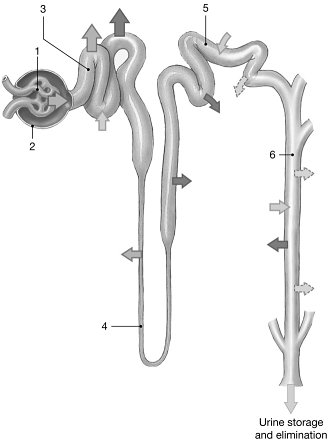
Figure 26-2 The Nephron
Use Figure 26-2 to answer the following questions:
Where does countercurrent multiplication occur?
4
When the level of ADH (antidiuretic hormone) decreases,
the osmolarity of the urine decreases.
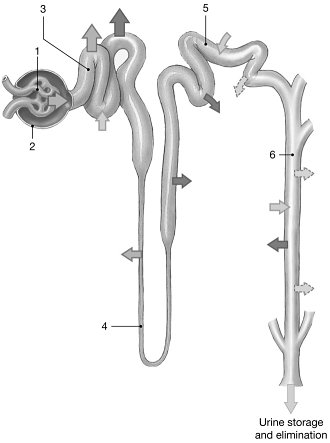
Figure 26-2 The Nephron
Use Figure 26-2 to answer the following questions:
Where does most nutrient reabsorption occur?
3
Filtrate in the proximal convoluted tubule normally contains
urea.
hydrogen ions.
nutrients.
water.
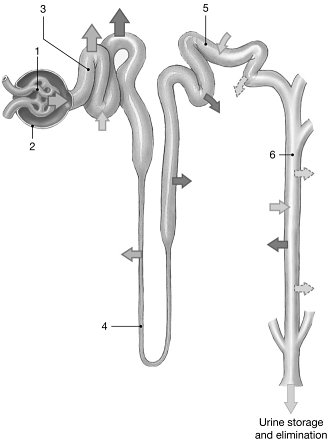
Figure 26-2 The Nephron
Use Figure 26-2 to answer the following questions:
Which area is sensitive to the hormone ADH?
5 and 6
Which of the following substances are not normally found in the filtrate?
A. protein
B. chloride ions
C. urea
D. potassium ions
E. water
A. protein
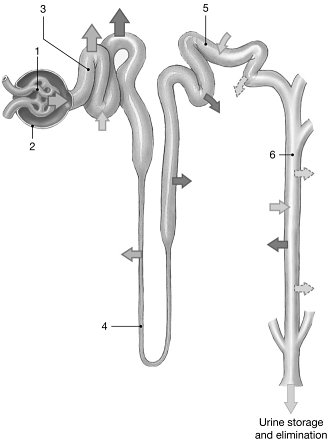
Figure 26-2 The Nephron
Use Figure 26-2 to answer the following questions:
Where would penicillin be secreted?
5
Substances secreted by the distal convoluted tubule include
creatinine.
hydrogen ions.
penicillin.
potassium ions.
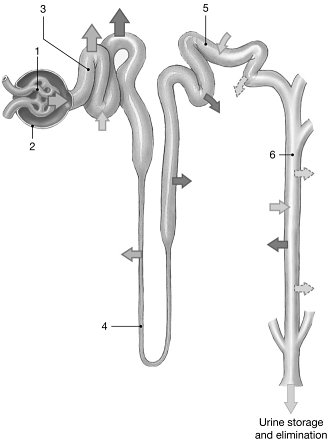
Figure 26-2 The Nephron
Use Figure 26-2 to answer the following questions:
Where does secretion mostly occur?
5
If a urine sample is distinctly yellow in color, which of the following will be true?
A. Its pH is below normal.
B. It will contain excess chloride ion.
C. It will contain large amounts of urobilin.
D. It will have the odor of ammonia.
E. It will have a low pH.
C. It will contain large amounts of urobilin.
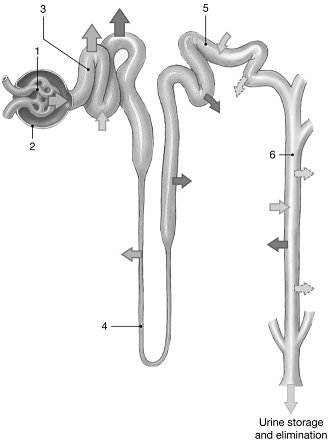
Figure 26-2 The Nephron
Use Figure 26-2 to answer the following questions:
Where does osmosis of water in the countercurrent multiplier process occur?
4
Antidiuretic hormone function
increases the permeability of the collecting ducts to water.
A patient excretes a large volume of very dilute urine on a continuing basis. This is may be due to
absence of ADH.
The mechanism for producing a concentrated urine involves
A. aquaporins being inserted into the membranes of the collecting duct cells.
B. the secretion of antidiuretic hormone (ADH) by the neurohypophysis.
C. a high concentration of NaCl in the interstitial fluid that surrounds the collecting ducts.
D. an increase in facultative water reabsorption.
E. All the answers are correct
E. All the answers are correct
Why might a person take diuretics?
to reduce water retention
to reduce blood pressure
to reduce body weight
to treat congestive heart failure
The ________ is a capillary bed that parallels the nephron loop (loop of Henle).
vasa recta
Which of the following activities is not related to kidney function?
A. control of hydrogen ion and pH in the blood
B. lipid digestion
C. regulation of blood pressure
D. maintenance of various blood ion concentrations
E. control of wastes in the blood
B. lipid digestion
Sympathetic stimulation of the kidney can do all of the following except
A. reduce blood flow to kidneys.
B. increase the glomerular filtration rate.
C. trigger renin release.
D. produce renal ischemia.
E. produce powerful vasoconstriction of the afferent arterioles.
B. increase the glomerular filtration rate.
Eighty percent of nephrons in the human kidney are located in the ________ and have short nephron loops.
cortex
Urine is temporarily stored in the
urinary bladder.
The process of filtration is driven mainly by
blood hydrostatic pressure.
The glomeruli are best described as being tufts of
capillaries.
The inability of the kidneys to excrete adequately to maintain homeostasis is
renal failure.
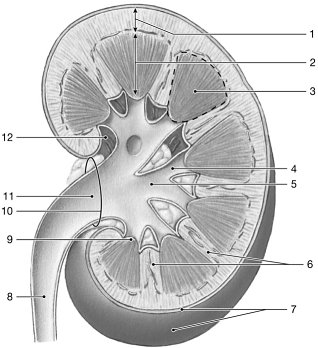
Figure 26-1 The Structure of the KidneyUse Figure
26-1 to answer the following questions:
Identify the structure labeled "9."
renal papilla
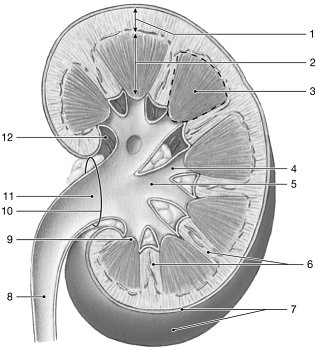
Figure 26-1 The Structure of the Kidney
Use Figure 26-1 to answer the following questions:
Identify the structure labeled "11."
renal pelvis
The following is a list of the blood vessels that carry blood to the kidney. In what order does blood pass through these vessels?
1. afferent arteriole
2. arcuate artery
3. interlobar artery
4. renal artery
5. glomerulus
6. cortical radiate artery
7. efferent arteriole
8. peritubular capillary
4, 3, 2, 6, 1, 5, 7, 8
The process of filtration occurs at the
glomerular (Bowman's) capsule.
The primary function of the proximal convoluted tubule is
absorption of ions, organic molecules, vitamins, and water.
Which of the following descriptions best matches the term renal papilla?
A. final urine enters here.
B. It is the tip of the medullary pyramid.
C. It releases renin.
D. initial filtrate enters here.
E. It creates high interstitial NaCl concentration.
B. It is the tip of the medullary pyramid.
The efferent arteriole of a nephron divides to form a network of capillaries within the cortex called the ________ capillaries.
peritubular
The filtration of plasma takes place in the
renal corpuscle.
Filtrate first passes from the glomerular capsule to the
proximal convoluted tubule.
________ is an inherited abnormality that affects the development and structure of kidney tubules.
Polycystic kidney disease
The expanded beginning of the ureter connects to the
renal pelvis.
Major calyces are
large branches of the renal pelvis.
In the renal corpuscle, the glomerular epithelium is a layer of specialized cells called
podocytes.
A glomerulus is
a knot of capillaries within the renal corpuscle.
The ________ delivers urine to a minor calyx.
papillary duct
The left kidney lies ________ to the right kidney.
superior
The cavity of the kidney that receives urine from the calyces is called the
renal pelvis.
The renal sinus is
an internal cavity lined by the fibrous capsule.
Urine passes, in the order given, through which of the following structures?
collecting duct, renal pelvis, ureter, bladder, urethra
Urine is eliminated through the
Urethra

