OVL, Chapter 3, Ten Steps
 Studied by 0 people
 Call Kai
 Learn
Learn Practice Test
 Spaced Repetition
 Match
Match Flashcards
 Knowt Play
1/25

There's no tags or description
Looks like no tags are added yet.
Name | Mastery | Learn | Test | Matching | Spaced | Call with Kai |
|---|
No analytics yet
Send a link to your students to track their progress
26 Terms
design of learning task
heart of the training blueprint.
design of supportive information
pertains to all information that may help learners carry out the problem-solving, reasoning, and decision making aspects of the learning. task within a particular task class.
design of procedural information
pertains to all information that exactly specifies how to carry out the routine
(i.e., recurrent) aspects of the learning tasks.
procedural information
is necessary to carry out the learning tasks’ recur-rent aspects. It specifes exactly how to carry out these aspects and is preferably presented just in time, precisely when learners need it while working on the learning tasks.
design of part-task practice
practice may be necessary for developing selected to-be-automated recurrent aspects to a very high level of automaticity.
design of performance assessments
makes it possible to determine to what degree learners have reached prespecifed standards for acceptable performance. It is up to the designer or design team to deter-mine what is acceptable.
sequencing of learning tasks
describes a simple-to-complex progression of categories of tasks that learners may work on. It organizes the tasks in such a way that learning is optimized.
on-demand education
learners can select their learning tasks but often receive support and guidance for doing this.
second-order
performance assessments that require learners to apply knowledge in complex, authentic situations.
bidirectional relationship
One is not conditional to another.
analysis of cognitive strategies
answers the question: How do profcient task performers systematically approach
problems in the task domain?
analysis of mental models
answers the question: How do profcient task performers organize the task domain?
analysis of cognitive rules
identi-fes the condition-action pairs that enable experts to perform routine aspectsof tasks without conscious efort (IF condition THEN action).
analysis of prerequisite knowledge
identifes what experts need to know to apply those condition-action pairs correctly.
layers of necessity
It means providing instructional support in layers based on what learners actually need to perform a task—starting with essential information and only adding extra explanations or theory when necessary, to avoid cognitive overload.
iteration
means learners repeatedly perform whole tasks in cycles, with each repetition increasing in complexity or decreasing in support, so skills are gradually refined and strengthened.
reusing instructional materials
Many instructional design projects do not design training programs from scratch but redesign existing training programs. This reduces the need to carry out certain analysis and design activities and almost certainly reduces the need to do this at a very high level of detail.
Mash-ups
recombine and modify existing digital media fles into new instructional materials.
Open Educational Resources (OERs):
reely accessible, openly licensed documents and media for teaching, learning, and assessing.
Zigzag Design
terations, layers of necessity, and switches between independent activities result in highly dynamic, nonlinear forms of zigzag design.
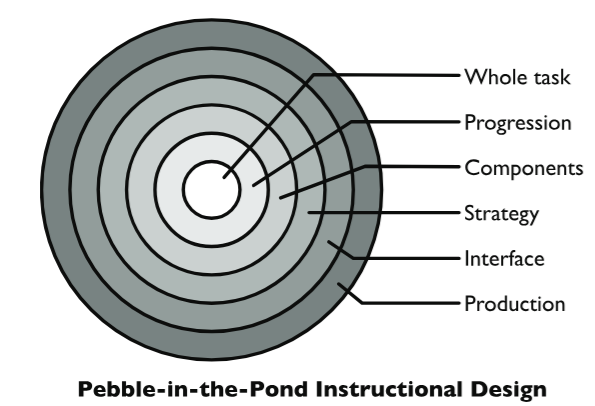
pebble-in-the-pond approach for instructional design
It is a content-centered modifcation of traditional instructional design in which a designer frst spec-ifes the contents to be learned and not the abstract learning objectives.
The frst three steps aim at the development of a series of whole tasks that
serve as the backbone for the educational blueprint:
Step 1: Design Learning Tasks.
Step 2: Design Performance Assessments.
Step 3: Sequence Learning Tasks.
The steps followed for designing and developing supportive information are:
Step 4: Design Supportive Information.
Step 5: Analyze Cognitive Strategies.
Step 6: Analyze Mental Models.
The steps for designing and developing procedural information are:
Step 7: Design Procedural Information.
Step 8: Analyze Cognitive Rules.
Step 9: Analyze Prerequisite Knowledge.
Step 10: Design Part-task Practice.
supportive information
helps learners carry out the nonrecurrent aspects of the learning tasks related to problem solving, reasoning, and decision
making.
ISD (instructional systems design) context/models (e.g. ADDIE model)
have a broad scope and typically divide the instructional design process into fve phases:
analysis
design
development
implementation
summative evaluation
to guide the creation and improvement of instruction.
cognitive task analysis
is a method for identifying the mental processes (such as decision making, judgments, and problem solving) that experts use when performing a task, so these can be explicitly taught to learners.
rapid prototyping
is an iterative design approach where a simple version of instruction is quickly created, tested with users, and revised repeatedly, allowing for continuous improvement based on feedback.
system dynamics
is an approach for understanding how complex systems change over time by modeling interactions, feedback loops, and delays between system components.
 Note
Note  Flashcards (46)