Forces and Energy
 Call Kai
 Learn
Learn Practice Test
 Spaced Repetition
 Match
Match Flashcards
 Knowt Play
1/34

There's no tags or description
Looks like no tags are added yet.
Name | Mastery | Learn | Test | Matching | Spaced | Call with Kai |
|---|
No analytics yet
Send a link to your students to track their progress
35 Terms
Chemical Energy::
Energy stored in chemical bonds of substances like food,fuel
Gravitational Potential Energy:
Energy an object possessed due to its position relative to a a refrence point usually the earth
Elastic Strain Energy
Energy stored in an object when its compressed, streched or deformed
Kinetic Energy
Energy possessed by a moving object
Elerctostatic energy
energy stored in charged objects due to their seperation in an electric field
Nucleur Energy
Energy stores in the nucleus of an atom
(Internal) Thermal Energy
Total energy stored in the microscopic motions anf interactions of particles within a substance
Mechanical Working:
Transfer of energy by the action of a force like lifting a weight
Electrical Working
Transfer of energy by an electric current, such as in batteries or eletric motors
Waves( electromagnetic and sound)
Transfer of energy through waves like light and sound waves
heating
Transfer of energy through thermal proccess like heating water in a boiler
Kinetic Energy formula
Kinetic Energy= ½ x m x v²
Change in Gravitational Potential Energy:
Gravitaional potentail= mass x gravity x change in height
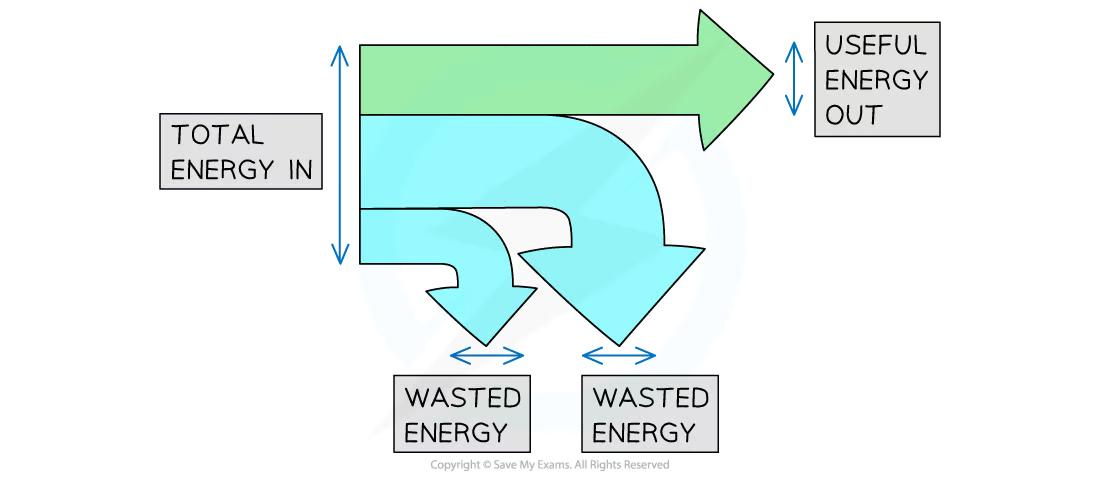
Sankey Diagram
show energy transfer- that energy cannot be lsto or destyoed
he straight arrow pointing to the right represents the energy that ends up in the desired store; this is the useful energy output
The arrows that bend away represent the wasted energy
Main source of all energy
Radiation from the Sun is the main source of energy for all our energy resources except geothermal, nuclear and tidal
Fossil fuels (chemical energy)
- Fossil fuels are burned in a boiler
Chemical energy → thermal energy (heat)
Water is heated to produce steam
Steam turns a turbine
Turbine drives a generator
Generator produces electrical energy
Advantages:
Reliability: They offer consistent and high-power output on demand, unlike intermittent sources like wind or solar.
Disadvantages:
Greenhouse Gas Emissions: Burning fossil fuels releases , contributing significantly to global warming and climate change,
Biofuels (chemical energy)
- Biofuels are burned like fossil fuels
Chemical energy → heat
Heat produces steam
Steam turns a turbine → generator
Electrical energy is produced
Same process as fossil fuels, just different fuel source
Advantages: Renewable:
Can be replenished relatively quickly by growing new plants, unlike finite fossil fuels.
Disadvantages:
Small scale
Hydroelectric (dam)
Water stored at height → gravitational potential energy
Water flows down → kinetic energy
Turns turbine
Turbine drives generator
Advantages:
Renewable
Disadvantages:
Reliability Depends on rainfall
Tides
Movement of water due to tides
Water flows through turbines
Drives generator
Generator produces electrical energy
Advantages:
Renewable
Disadvantages:
Reliability Depends on tides
Waves
Wave motion moves devices (e.g. floats)
Motion used to turn turbines
Drives generator
Generator produces electrical energy
Advantages:
It is a renewable energy resource, meaning it will not run out.
It produces no greenhouse gases (like $CO_{2}$) during operation.
Disadvantages:
Not reliable- relies on wave pattern
Geothermal energy
Heat from inside the Earth heats water
Produces steam
Steam turns turbine
Turbine drives generator
Generator produces electrical energy
Advantages:
No pollution
Disadvantages:
Only possible in geothermal areas
Nuclear fuel
Nuclear reactions release thermal energy
Heat used to produce steam
Steam turns turbine
Turbine drives generator
Generator produces electrical energy
Advantages:
Efficient source of electricity
Disadvantages:
Very expensive to build and to run
Solar cells
Light energy from Sun falls on solar cells
Light energy → electrical energy directly
No turbine or generator needed
Advantages:
Clean and Cheap
Disadvantages:
Not reliable- Needs good weather
Needs big area
Wind
Sun heats Earth unevenly → causes air movement (wind)
Wind turns turbine
Turbine drives generator
Generator produces electrical energy
Advantages:
Clean
Cheap to run
Disadvantages:
Not reliable- Needs wind
Expensive build cost
Solar panels (heating water)
Infrared radiation from Sun heats water directly
creating steam
turning turbine
Turbine drives a generator
Generator produces electrical energy
Advantages:
Renewable Energy: Uses sunlight to directly heat water, making it sustainable and non-polluting.
Disadvantages:
Reliability- needs the sun
Sun energy
Energy is released by nuclear fusion in the Sun
Nucleur Fusion
Research is being carried out to investigate how energy released by nuclear fusion can be used to produce electrical energy on a large scale
Efficiency of energy transfers and power
Recall and use the equation:
efficiency = useful energy output/Total energy output × 100%
or
efficiency = power input useful/ total power output ×100%
Work Formula
Work = force x distance moved in the direction of the force
work is in joules
Same as energy transferred
force is in newtons
Work
mechanical or electrical work done is equal to the energy transferred( same thing) eg: 2400j of work done = 2400j gravitation potential
work is only done if there is movemnt against an oppsoing force
Power Definition
The rate at which works is done or
The rate at which energy is change from one form to another
Power Formula
P= (delta)E/t or P = W/t
Power= change in energy/time
Power = work done / time take or
Power = energy transferred/time
units: watts (W) / or 1 joule/second
Delta Notation:
Delta: Meaning a Change in

Prefix
kilowatt (kW) = 10310^3103 W = 1,000 W
megawatt (MW) = 10610^6106 W = 1,000,000 W

