psych100 -- ch 9
 Studied by 3 people
 Call Kai
 Learn
Learn Practice Test
 Spaced Repetition
 Match
Match Flashcards
 Knowt Play
1/74

There's no tags or description
Looks like no tags are added yet.
Name | Mastery | Learn | Test | Matching | Spaced | Call with Kai |
|---|
No analytics yet
Send a link to your students to track their progress
75 Terms
thinking
processes that underlie the mental manipulation of knowledge and ideas
increases chances of survival
cognition
all activities that underlie all forms of thought
thinking is used to:
reach a goal
solve a problem
understand and communicate with others
language
gives us the ability to communicate our thoughts, feelings, and needs to other
powerful and can create vivid thought processes
linguistic relativity hypothesis states
suggests that language not only shapes how we think but also influences how we perceive the world but does not completely determine thought
structure of language
to qualify as a language, communication system but have grammar
grammar
the rules of language that enable the communicator to combine symbols to convey meaning
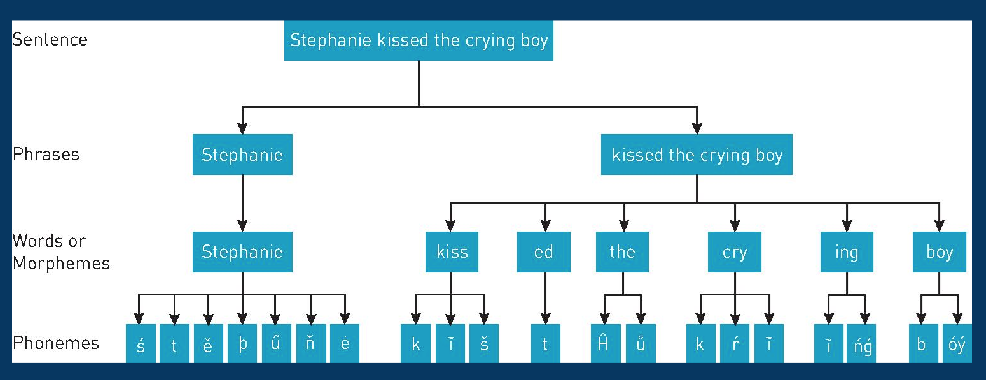
grammar — phonology
rules of combining sounds to make words
grammar — syntax
rules of combining words to make sentences
grammar — semantics
rules used to communicate meaning
morphemes
the smallest language units that have meaning, including suffixes and prefixes
ex. english has 50,000-80,000
ex. “students” = 3 morphemes ← students = study + -ent + -s

phonemes
the basic sounds of speech, the building blocks of language
produced through a complex coordination of the vocal cords, lungs, lips, tongue, and even teeth
ex. english has about 40-45
ex. unaspirated /p/ and aspirated /p^h/ are the same phoneme
ex. in thai and hindi, park vs. apple are different phenomes
surface structure
noam chomsky, 1957
literal ordering of words in a sentence
ex. “visiting relatives can be a nuisance” ← same surface structures
ex. “stephanie kissed the crying boy” vs. “the crying boy was kissed by stephanie” ← different surface structures
deep structure
noam chomsky, 1957
underlying meaning of the sentence. more abstract
ex. “visiting relatives can be a nuisance” ← different deep structures
ex. “stephanie kissed the crying boy” vs. “the crying boy was kissed by stephanie” ← same deep structures
language comprehension
ability to derive meaning from written or oral language
language comprehension — factors that facilitate quick comprehension
past knowledge
shared knowledge among speakers
anticipation at our communication partner’s next words (top-down processing)
pragmatics
practical knowledge used to comprehend the intentions of a speaker and produce an appropriate response
ex. “can you close the window?”
paul grice (1975)’s four maxims of conversation
be informative (quantity)
tell the truth (quality)
be relevant (relation)
be clear (manner)
paul grice (1975)’s four maxims of conversation — be informative (quantity)
say enough information but not too much
“make your contribution as informative as is required (for the current purposes of the exchange)”
“do not make your contribution more informative than is required.”
paul grice (1975)’s four maxims of conversation — tell the truth (quality)
be truthful
do not give false or unsupported information
“try to make your contribution one that is true”
“do not say what you believe to be false”
“do not say that for which you lack adequate evidence”
paul grice (1975)’s four maxims of conversation — be relevant (relation)
stay relevant to the topic & pertinent to the discussion
paul grice (1975)’s four maxims of conversation — be clear (manner)
be clear, brief & orderly
avoid obscurity and ambiguity
“avoid obscurity of expression”
“avoid ambiguity”
“be brief (avoid unnecessary prolixity)”
“be orderly”
maxim of quantity example
“there are at least four students in the room”
aphasia
a language disorder that results in deficits in language production and comprehension
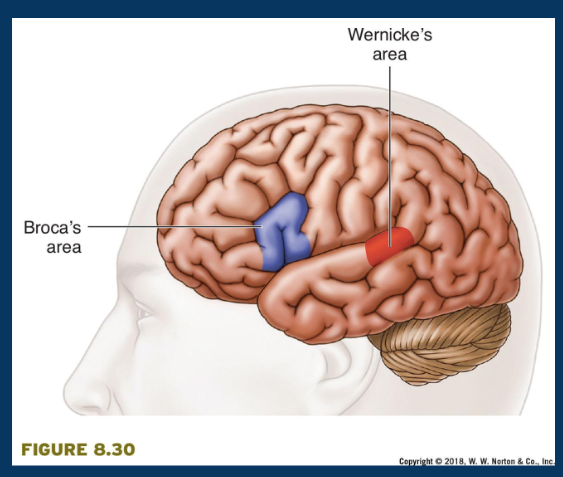
broca’s area
located in the frontal lobe in left hemisphere of brain and associated with language production
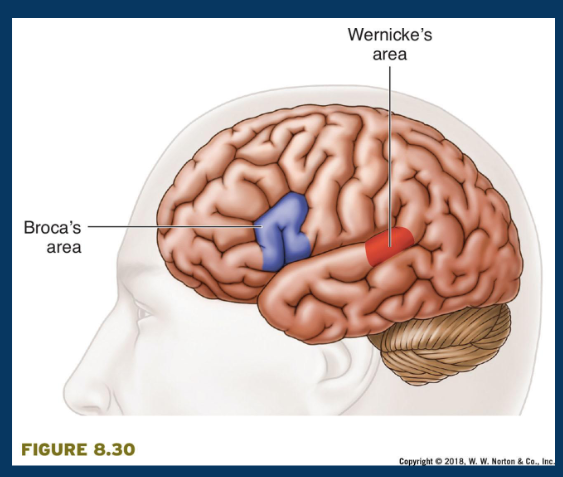
wernicke’s area
an area of the left hemisphere where the temporal and parietal lobes meet, involved in speech comprehension
learning phonemes
the language or languages spoken by mothers during pregnancy influences listening preferences in newborns
newborns suck on a pacifier at a different rate when hearing their mother’s voice compared to a stranger’s voice, indicating recognition of the familiar voice (decasper & fifer, 1980)
pattern of language development — 3-5 weeks
cooing
linguistic highlights: repetition of vowel sounds such as “ooh” and “aah”
interpretation: vocalization milestone that occurs before formal language development
similar across cultures
highlights the universality of language
pattern of language development — 4-6 months
babbling
linguistic highlights: reptition of vowel-consonant combinations such as “kaka” or “baba”
interpretation: vocalization milestone that occurs before formal language development
similar across cultures
highlights the universality of language
pattern of language development — 6-18 months
first word
linguistic highlights: vocalizations become specific to the native language
the first word is spoken by the end of the first year
interpretation: experience plays a role in vocalization as a baby’s babblings are shaped into language-specific sounds
language comprehension is rapidly developing
pattern of language development — 24 months
telegraphic speech
linguistic highlights: vocabulary of at least 200 words
the child shows telegraphic speech
grammatical two-word combinations
interpretation: speech reflects knowledge of syntax, as words are almost always combined in the proper order
pattern of language development — preschool years
full sentence production
linguistic highlights: ability to produce and comprehend sentences
interpretation: the child is now showing most of the important features of adult syntax
developmental milestones — 3 months
cooing and gurgling
developmental milestones — 6 months
babbling
developmental milestones — 12 months
first words
developmental milestones — 18 months
knows 5-40 words
developmental milestones — 2 years
150-300 words
knows 2-3 sentences
developmental milestones — 3 years
900-1000 words
asks short questions
developmental milestones — 4 years
2000 words
5+ word sentences
developmental milestones — 5 years
identifying letters
creating longer sentences
overgeneralizations
as children begin to use language in more sophisticated ways, one relatively rare but telling error they make is to over apply new grammar rules they learn
“look! i growed up!”
uniqueness of human language — creativity
humans can create new expressions, but animals can’t
uniqueness of human language — arbitrariness
no natural or necessary connection between a word’s sound or form and its meaning
animal communication is highly symbolic
ex. the longer a bee’s waggle run, the farther away the food source is
uniqueness of human language — productivity
the syntax of language allows an infinite number of sentences to be produced
animal communication systems don’t have this ability
language is an adaptation
language capacity has been beneficial to humans evolutionarily
the answers to why and how language developed is still controversial
evidence that language is a product of evolution (ex. steven pinker, 1994)
language is associated with particular brain regions
language is learned very quickly by children
the human ear and vocal tract are well-suited for hearing and producing speech
some people inherit tendencies to make certain types of grammatical errors
ex. omitting grammatical endings, using incorrect verb tense, etc.
certain aspects of grammar processing are at least partially encoded in out genes
category
a class of objects (people, places, things) that most people agree belong together
ex. animals, vegetables, cities, birds, etc.
allow us to inger invidible properties about objects
ex. kite and doll are both children’s toys
can make predictions about the future once you know an object’s category
ex. “junk food” likely to have poor health outcomes
defining features
set of features necessary to make objects acceptable members of a category
the object must have all of the defining features
problematic because ← does not fit for all categories (like natural objects)
works well for mathematical categories (ex. square vs. triangle)
family resemblance
rosch & mervis, 1975
the core feature that category members share
a given member of the category may have some but not necessarily all of the features
defined by the collection of core features that an object possesses
establishes good and poor members of a category
ex. car vs. elevator
prototype
the best/most representative member of a category
ex. bird → robin, fruit → apple
some cognitive psychologists suggest that we store protypes in long-term memory and use them to help determine category membership ← similar to Piaget’s principles of assimilation and accommodation
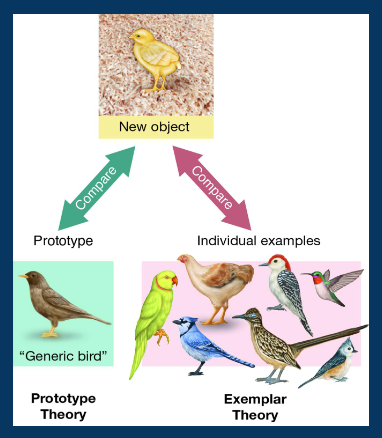
category exemplars
specific examples of category members that are stored in long-term memory (favored theory)
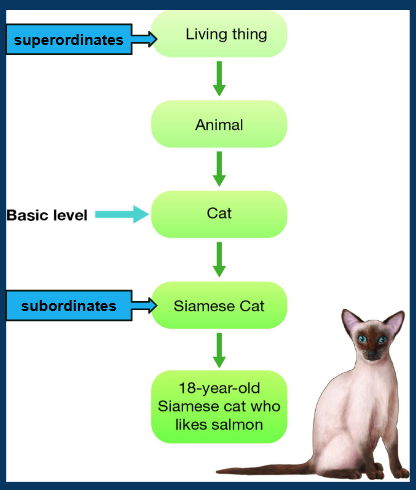
hierarchical structure of categories
most structures have a built-in hierarchical structure
the more general the level = the more inclusive it is
basic-level categories
the category level of the hierarchy that offers the most useful information ← just the right amount of information
ex. cat
development of categorization
ability to make predictions
ex. come across a snake = you know how it might behave and the dangers
some categories can be specific to particular cultures, age groups, or professions
Special Categories
more universal categories
ex. living things vs. non-living things
makes sense from an evolutionary perspective
well-defined problems
well-stated goal
clear starting point
relatively easy way to tell when a solution has been reached
ex. “i will dedicate 1 hour each day to learn a new language”
ill-defined problems
no well-stated goal
no clear starting points
no effective mechanisms for evaluating progress
ex. finding the secret of happiness
problem representation
we must first understand the information we have and how it can be used
oftentimes, our preconceptions can offer an incorrect view of the problem
functional fixedness
the tendency to see objects and their functions in certain fixed ways
this can get in the way of problem solving effectively
algorithms
step-by-step rules or procedures that if applied correctly, guarantee a solution
ex. solving mathematical problems
not useful for ill-defined problems
ex. how to get a job
heuristics
rules of thumb to solve problems but do not offer a guaranteed solution
ex. knowledge-based guesses
types of heuritstics
means-end analysis
working backwards
searching for analogies
types of heuristics — means-end analysis
devising “means” or actions to lessen the distance between starting point and the “end” or goal
types of heuristics — working backwards
starting at the goal and trying to move backwards towards the starting point
types of heuristics — searching for analogies
working to find a connection between the current problem and a previously solved task
another problem-solving strategy: mental set
tendencies t rely on particular problem-solving strategies that were successful in the past
insight
the moment a problem solution pops into one’s mind
colutions can come in all or non fashion
not in a slow, steady manner
not all solutions come along by trial and error
the process is not well understood but problem representation is important
brain areas associated with insight
temporal cortex
limbic system including hippocampus
decision making
thought process involved in evaluating and choosing from among a set of alternatives ← usually involving some sort of risk
framing
the manner that alternatives in a decision making situation are presented
ex. medical decisions, military risks, advertising
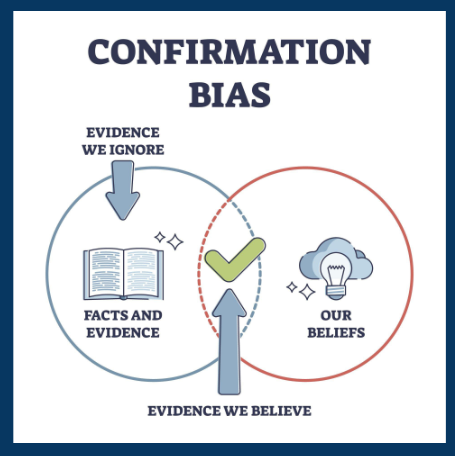
confirmation bias
the tendency to seek out information that confirms a prior decision or belief
ex. research on the double standards for men and women related to sexual behavior
belief persistence
the tendency to stick to one’s own beliefs despite contradictory evidence
ex. staying in a toxic relationship
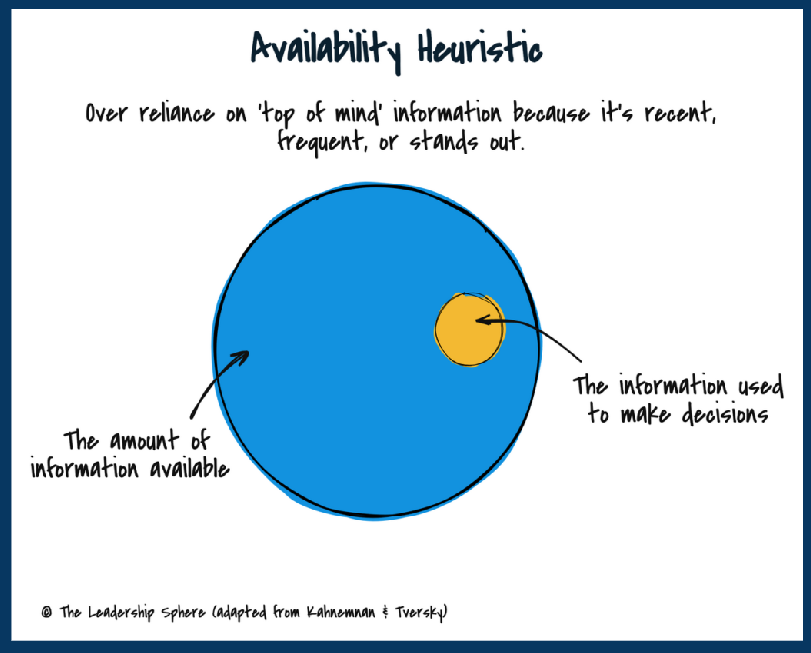
availability heuristic
over reliance on “top of mind” information because it’s recent, frequent, or stands out
estimate the odds of some event occurring on the basis of how easily examples come to mind
anchoring and adjustment heuristics
tendency to rely heavily on the first piece of information encountered when making decisions or estimates
anchor = initial information
serves as reference point from which we then adjust to reach our final judgement

representative heuristics
arrive at decision by comparing the similarity of the object or event to the average member of each class
 Note
Note  Flashcards (72)