chapter 6 - primates
 Studied by 0 people
 Call Kai
 Learn
Learn Practice Test
 Spaced Repetition
 Match
Match Flashcards
 Knowt Play
1/38

There's no tags or description
Looks like no tags are added yet.
Name | Mastery | Learn | Test | Matching | Spaced | Call with Kai |
|---|
No analytics yet
Send a link to your students to track their progress
39 Terms
What are all taxa defined based on
Shared derived traits
5 primitive mammal traits
Thermoregulation
Tetrapod body plan - four limbs
Different life stages - period of growth and development
Dichromatism - 2 color vision
Heteronym detition - 4 type of teeth
Chordata characteristics
Notochord provides support and flexibility
bilateral symmetry
Vertebrata characteristics
vertebral column
Presence of cranium
Mammalia characteristics
mammary glands
Hair
3 ear ossicles (bones)
Eutheria characteristics
greater placental development
Live birth
3 Archonta (primate ancestors)
Plesiadapiformes (stem primates)
Scandentia (tree shrews)
Dermoptera (flying lemurs)
5 Primate characteristics
all primates have mammal traits
Opposable thumbs
Finger nails and tactile pads
Post orbital bar (eye socket bone)
Stereoscopic vision (3D)
Big brains
Prosimians hands
Has grooming claw on second digit of hind foot but have nails on all other digits
Primate suborder
Strepsirhini (wet nose) and haplorhini (dry nose)
Strepsirrhini : lorises and lemurs traits
Shared derived trait - tooth comb (combined front teeth used for grooming and scraping sap from trees)
their canines are like incisors and premolars are more like canines
Primitive traits - wet nosed, grooming claw, mostly nocturnal and tapetum lucidum (eyeshine)
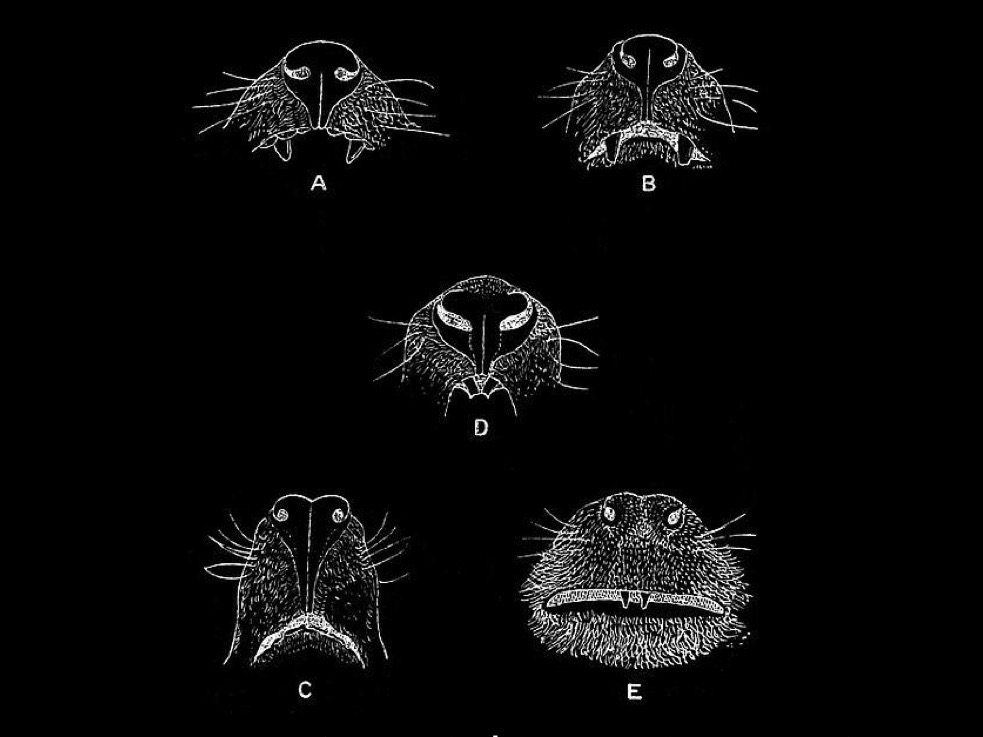
Which noses are strepsirrhines and how do you identify ?
A-D: are strepsirrhines since they have a rhinarium
E: is a haplorhin since no rhinarium
Splits upper nose (midline) and has no hair on it
Haplorhini traits
clade defined based on loss of rhinarium
Shared derived traits
loss of rhinarium - flat nose
Loss of tapetum lucidum - no eyeshine
Trichromatism - 3 color vision
Post orbital enclosure
Tarsiers and their derived/primitaive traits
Part of haplorhini And has longest evolutionary history
Primitive
nocturnal
Retained grooming claw
Lack of tooth comb
Derived
dry nosed (no rhinarium)
Platyrrhini and derived traits
part of haplorhini and is a new world monkey
Derived traits
dry nose - nostrils wide and turned outwards
Mostly dinural - live mostly during day (poly, di, and tri vision)
Prehensile tail in some (no other primates have)- using tail as arms
How did monkeys get from Africa to South America
Floated and drifted through the ocean.
monkeys that live in trees, the trees break into the river basically turning into a raft for monkeys to float
which is why platyrrhini are represented as a single clade (founders effect)
Catarrhini
part of haplorhini
Characterized by dry, downward pointing noses and a 2-1-2-3 dental formula
divides into 2 superfamilies cercopithecodiea (old world monkeys) and hominoidea (apes)
How do apes and old world monkeys differ
Apes have several shared derived traits
loss of tail
Distinct “Y5” molar shape
Sub groups and suffixes
Super family -oidea
Family -idae
Subfamily -inae
Tribe -ini
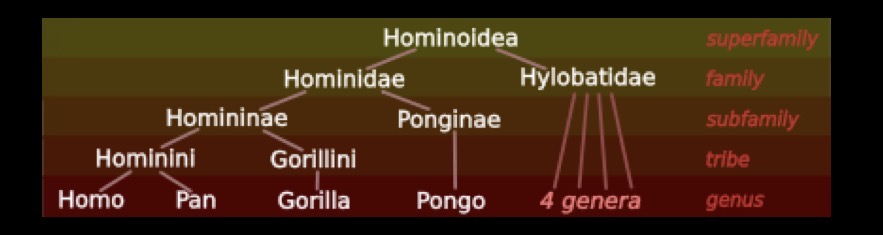
Cladistics of family hominoidea
Family hominidae - great apes
Family hylobatidade - lesser apes
Subfamily - homininae (African ape) and ponginae (orangutans)
Tribes - hominini (humans and chimps) and gorillini (gorillas)
Subtribe - homininia (humans) and panina (chimps and bonobos)
6 forms of locomotion in primates for different taxa
Quadrupedalism (most common) - arboreal and terrestrial (leaping using hind limbs) (baboon and howler monkey)
Vertical clinging and leaping - body is propelled from one branch to another by hind limbs (tarsier and lemur)
Slow climbing - only one limb is moved at a time (loris and orangutan)
Brachiation - hand over movement in trees (spider monkey, gibbon and orangutan)
Knuckle walking - quadrupedal movement using knuckles and sometimes standing up (chimps and gorilla)
Bipedalism - upright walking on hind limbs (humans)
2 skeletal features in primates related to teeth and snout
Shortened snout - reduce number of teeth, sense of smell and increase vision
Heterodont detition - incisors, canines, premolars and molars
variety of different teeth to eat and process various foods
This is generalized mammalian trait
Homodont and heterodont in mammalian detition
Homo - all teeth sinimilar in form, sharp and replaced throughout life
Ex. Sharks
Hetero - different types of teeth for specialized chewing
one set of deciduous (baby) replaced by diphyodont (adult) as mammal matures
Ex. Humans
4 types of mammal teeth
Incisors - cutting teeth front of jaw
Canines - long sharp dog teeth (for communication or for hunting)
Premolars - more flat teeth
Molars - flat chewing teeth
numbers and patterns of teeth are distinctive for different mammals
Eutherian dental formula
3 incisors, 1 canine, 4 pre molars and 3 molars
for each side (double it for total teeth)
Formula : 3-1-4-3/3-1-4-3
number of one side / number of other side
Incisors - canine - pre molars - molar
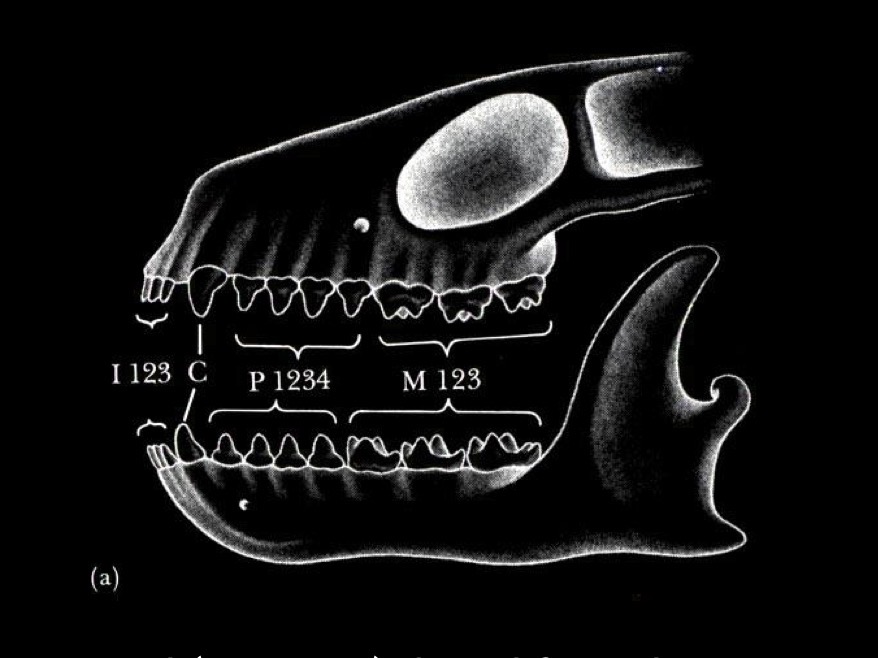
Human dental formulae
2-1-2-3 / 2-1-2-3
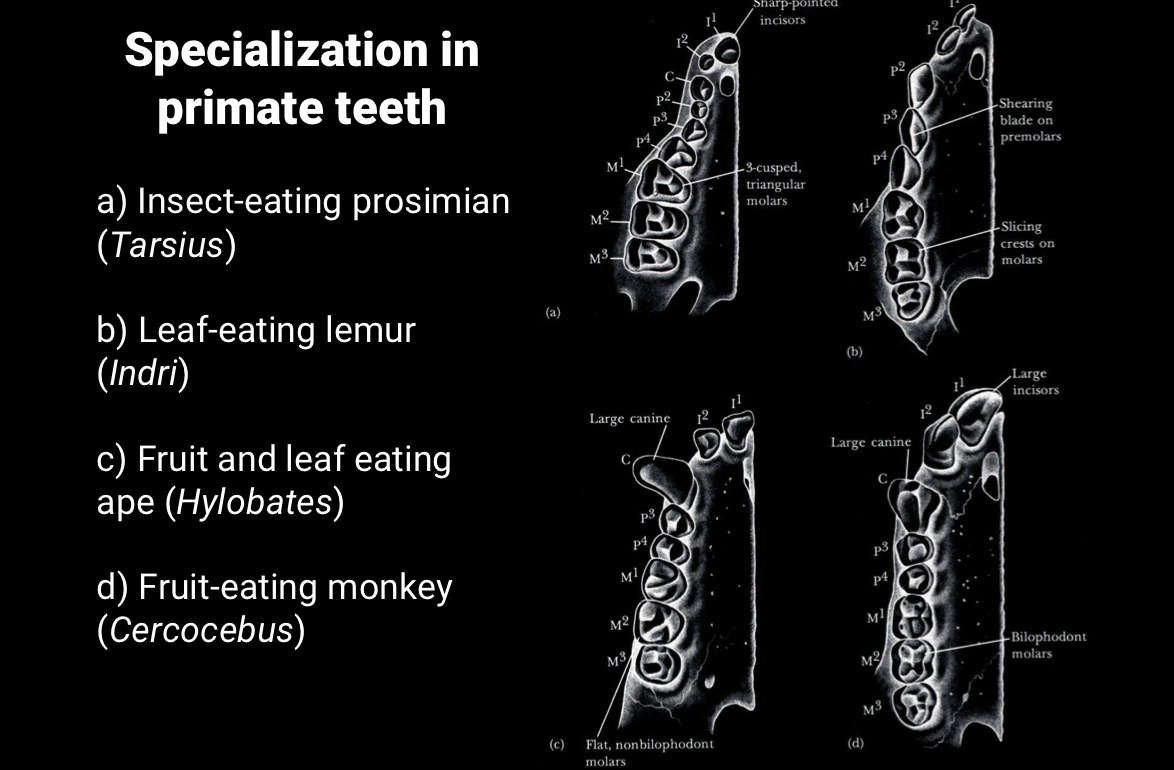
Specialization in primate teeth
(Idk how this is tested)
Diets and digestive system of primates
Diets - are mostly generalists (eat variety of foods) But depends on size and behaviors
we’ve adapted to basically every food type available
Bigger primates rely more on foods that are easily available (ex. Larger primates have to rely on leaves since they never run out)
Given fish, reptiles, birds, mammals and primates and humans, smallest to largest
Reptiles, fish, birds, other mammals, primates and humans
Characteristics related to brain size
Advanced learning ability and advanced social structure
2 theories of primate origins
Arboreal theory
Adapting to living in the forest gave us the traits we know today through adaptations
Visual predation theory
binocular vision, good grasping skills and highly refined eye hand coordination are adaptions for insects hunting in low branches
Behavior
Anything organisms do that involve action in response to stimuli (internal or external)
ex. Responses to environment (conscious or unconscious, mostly unconscious)
Behavioural ecology
Focuses on relationship between behaviours, natural environment and biological traits of species
has evolved through natural selection
Behaviours are influenced by genes but they also have abilities to exercise a range of behaviors in any situation (environment)
Genes DONT code for specific behaviours
Evolution of behaviour genetically and physically
behaviour constitutes a phenotype and the phenotypes that increase fitness will be able to pass their gene at a faster rate
Genetic factors limits species ability to learn and have behavioural flexibility
Natural selection acts on genetic factors shaped by ecological setting of past and present
What behaviour are humans
It’s a primate behaviour, there’s nothing special about our behaviour
HUMAN BEHAVIOUR IS SAME AS PRIAMATE BEHAVIOUR
Primate social structure
Primates are social animals and is one of the major topics in primate research
broad subject
Is being social a pro or a con as a primate
Very beneficial, aids in predator defense and resource sharing through communication
How did group living evolved
group living evolved as an adaptive response to a number of ecological variable
4 types of Primate social group
One male, multi female (baboons and gorillas)
Matrilines - females, their daughters and their offsprings. They’re alpha, females choose which males are good enough to mate with them (macaques)
Pair bonds - both male and female coparent their offspring, can be permanent or not (humans and gibbons)
Multi male, multi female - every individual mate with one another, they have sex with everybody (bonobos)
 Note
Note  Flashcards (31)