Exam Three health assessment
 Call Kai
 Learn
Learn Practice Test
 Spaced Repetition
 Match
Match Flashcards
 Knowt Play
1/112

There's no tags or description
Looks like no tags are added yet.
Name | Mastery | Learn | Test | Matching | Spaced | Call with Kai |
|---|
No analytics yet
Send a link to your students to track their progress
113 Terms
Vision complaints direct a more focused assessment on what
eyes
Hearing complaints need these test
Weber, whisper, Rinne
Swallowing problems may indicate
neck, throat, or airway issues
The head includes the
cranium and face
The cranium protects the
brain
The face contains structures important for
sensation, expression, and communication
The mandible is considered the
only movable facial bone
how many cranial bones
8 bones
How many face bones
14 bones
Cranial structures
coronal, sagittal, squamosal, lambdoid
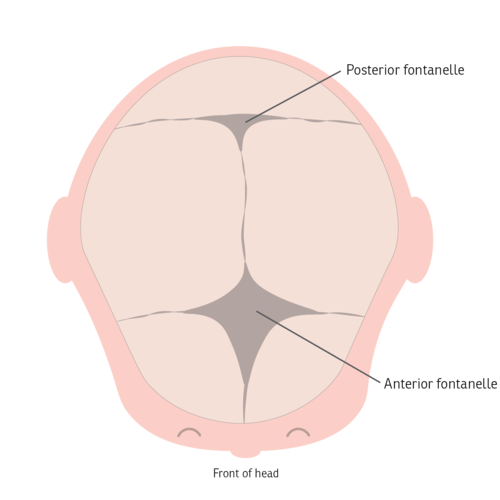
Fontanelles
anterior and posterior
Anterior fontanelle (diamond shaped)
front
13-24 months to close
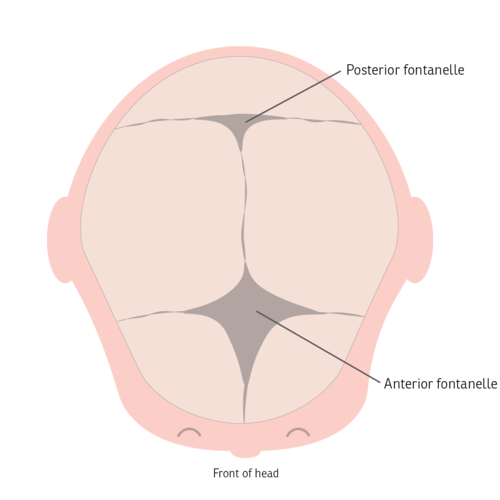
Posterior fontanelle (triangular)
in the back of head
6-8 weeks
Sunken fontanelle may suggest
dehydration
Bulging fontanelle may suggest
increase intracranial pressure
expected findings of the head
round skull
midline
appropriate size for body structure
symmetrical facial features
smooth skin with relatively uniform color
no masses or lesions
expected variations for head
mild asymmetry
dry, brittle, or thinning hair
Unexpected findings
significant asymmetry
lumps or depressions
ecchymosis
lesions
edema
redness
hair loss
facial tension
infestations
Microcephaly
small head for body
Normocephalic
normal head size for body
Acromegaly
big head for body
Clinical significance (Abnormal facial symmetry may suggest)
stroke
cranial nerve dysfunction
Trauma
infection
endocrine disorder
Faces and TMJ - inspection
facial symmetry
movement
expression
Faces and TMJ - palpate
temporal artery
temporomandibular (TMJ)
Face and TMJ - expected findings
symmetric facial movement
no abnormal involuntary movement
temporal artery elastic and nontender
TMJ without swelling, tenderness, or crepitus
jaw opens and closes fully
Face and TMJ - unexpected
facial droop
limited jaw motion
pain with chewing
TMJ clicking or crepitation
Neck contains
muscles
lymph nodes
thyroid and parathyroid glands
major vessels
trachea
Important muscles and landmarks in neck
sternocleidomastoid
trapezius
neck divided into anterior and posterior triangles
sternocleidomastoid
rotates and flexes the head
Trapezius
extends the head and moves the shoulders
neck expected findings
Centered and symmetric
Normal color
Smooth muscles
No stiffness
Smooth, controlled ROM
Painless swallowing
Trachea midline
Thyroid cartilage rises symmetrically with swallowing
C7 vertebra prominens visible/palpable
flexion normal range of motion
45 degrees
extension normal range of motion
55 degrees
lateral abduction range of motion
40 degrees
rotation normal range of motion
70 degrees
Neck unexpected findings
pain or limited movement
tracheal shifting
swelling
visible lymph nodes
difficulty swallowing
lump of anterior neck
- stridor
respiratory distress
neck clinical manifestations (abnormalities)
infection
thyroid disorder
lymphatic problem
mass
airway compromise
Neck red flags : a lump on the anterior neck with
stridor
difficulty swallowing
voice change
respiratory distress
requires prompt follow up
Eyes contain
eyebrows
eyelids
eyelashes
lacrimal apparatus
conjunctiva (palpebral bulbar)
sclera
cornea
irirs
pupil
lens
extra ocular muscles (superior rectus, lateral rectus, inferior rectus)
inferior oblique
medical rectus
superior oblique
expected findings on eyes
• Eyes parallel and aligned
• No protrusion or sinking
• Symmetrical eyebrows
• Even eyelash distribution
• Smooth eyelids
• No redness or edema
• Clear, glossy sclera
• Pink conjunctiva
• Pupils black, round, equal, about 3–5 mm
• Pupils constrict bilaterally to light
Visual tests
visual acuity
peripheral vision
Accommodation
pupillary reaction
extrascular motor function
Visual acuity expected
distant vision (20/20) snallen chart
near vision (14/14) read passage 12-14 inches
peripheral vision expected
twinkle fingers until patient sees and when you see your finders so should the patient
Accommodation
move object closer to nose than farther away
pupillary response
shine penlight into each eye one at a time looking for constriction and dilation
consensual response
direct response
Extrascular muscle function
six cardinal fields of gaze
eye movement should be smooth and symmetric
PERRLA
P = pupil
E = equal
R = round
R = reactive
L = light
A= accommodation
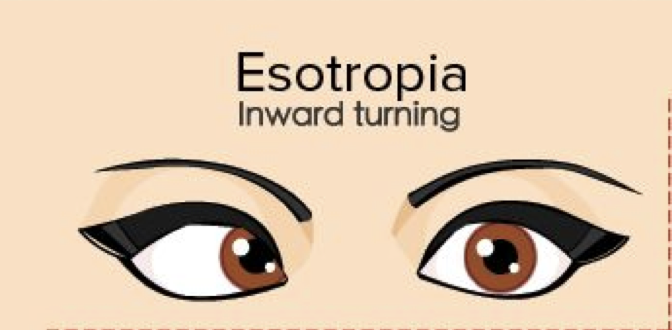
Esotropia
goes inward
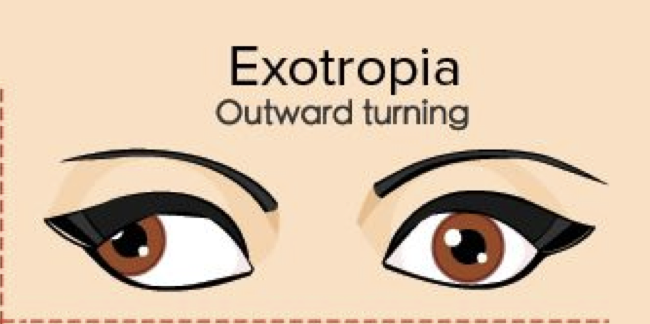
Exotropia
goes outward
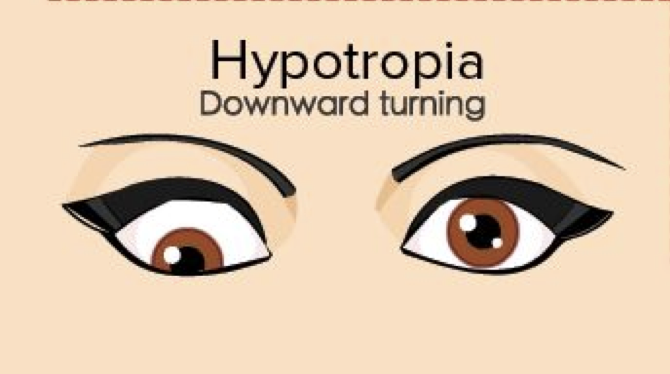
Hypotropia
goes downward
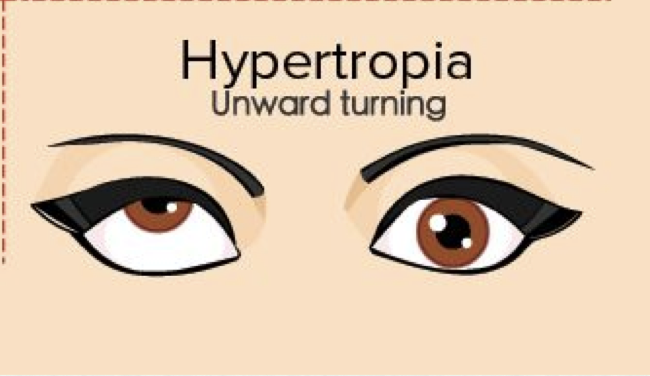
Hypertropia
unward turning
Ptosis
drooping eyelids
Strabismus
eye misalignment
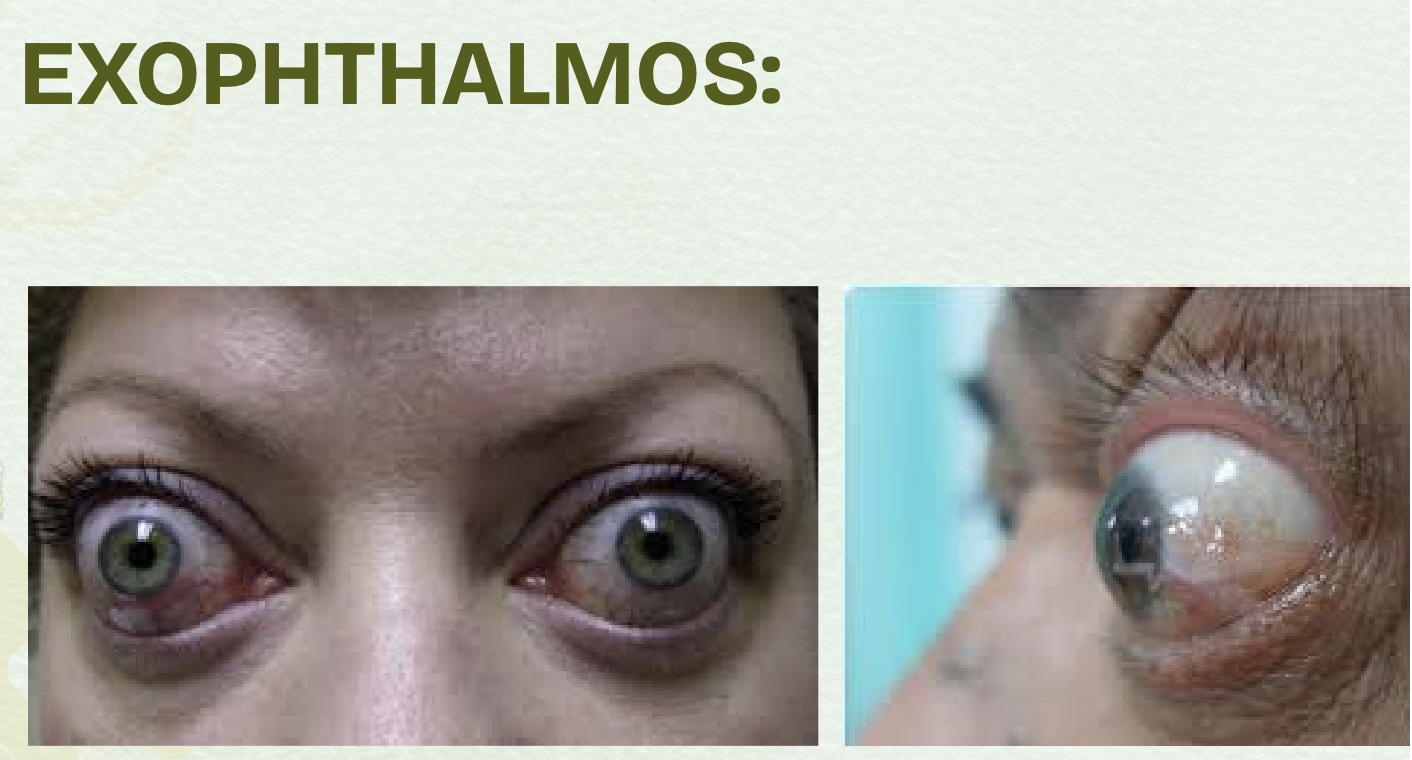
Exophthalmos
bulging eye
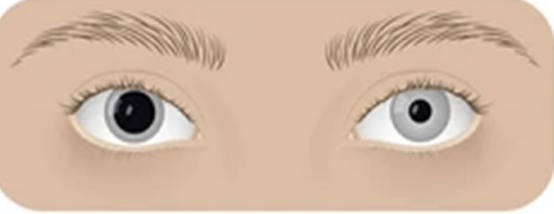
Anisocoria
unequal pupils
Mydriasis
dilated pupil
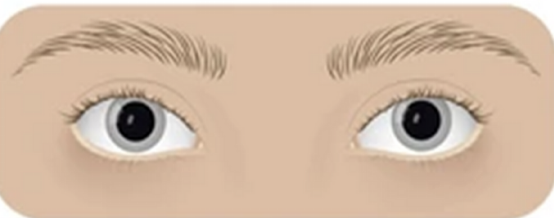
Miosis
constricted pupil
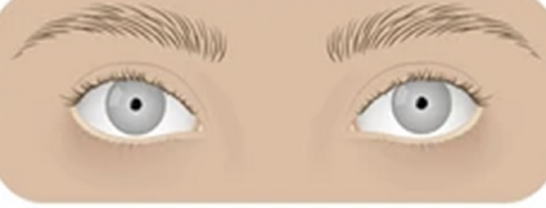
Nystagmus
involuntary eye movement
Eye unexpected finding
• Exophthalmos
• Strabismus
• Eyelid redness
• Eyelid drooping
• Eyelid edema
• Discolored sclera
• Subconjunctival hemorrhage
• Conjunctivitis
• Unequal pupil size
• Altered pupillary reaction
Eye problems may mean (clinical significance of eye abnormalities)
thyroid disease
infection
neurological injury
trauma
vision threatening disorder
cranial nerve dysfunction
Note on nystagmus
slight nystagmus at extreme lateral gaze may be normal
More pronounced nystagmus may indicate
inner ear disorder
multiple sclerosis
brain lesion
narcotic use
Vision abnormalities
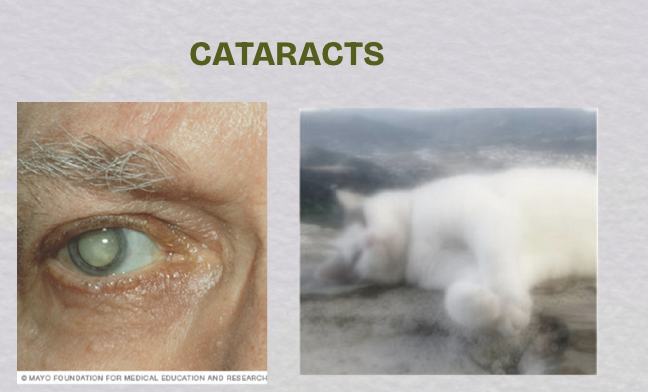
cataracts
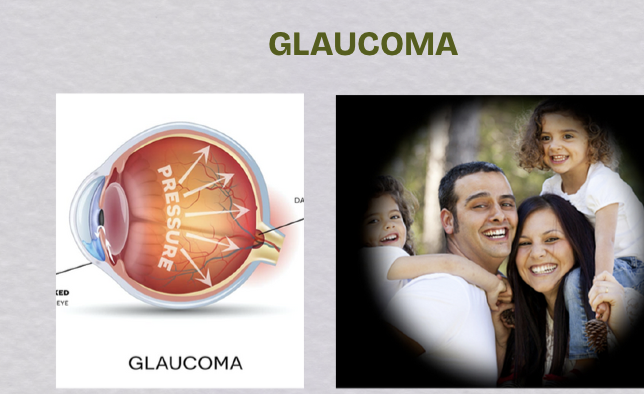
Glaucoma
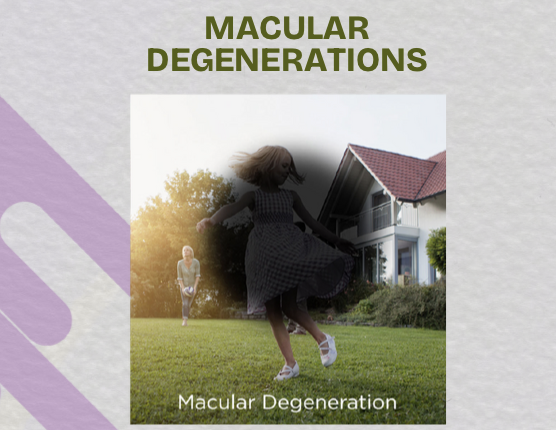
Mascular degeneration
Diabetic retinopathy
Cataracts
cloudy or dirty vision
Glaucoma
peripheral vision loss
Macular degeneration
central vision loss
Diabetic retinopathy
Patchy or sporadic vision loss

Eye reports
sudden vision change
painful red eye
abnormal pupil findings
unilateral sudden vision loss
Ears components
external ear channels sound inward
cerumen protects the canal
tympanic membrane separates external and middle ear
middle ear (malleus, incus, stapes)
Eustachian tube equalizes pressure
inner ear is responsible for (hearing, balance)
Inner ear structures
vestibule
semicircular canals
Cochlea
Ear expected findings
Auricles symmetric
• Auricles aligned with outer corner of the eye
• Normal skin color
• No lumps, edema, or lesions
• Canal walls pink and smooth
• Cerumen may be yellow, orange, red, brown, gray, or black
• Auricle, tragus, and lobule smooth and flexible
• No tenderness
Ear unexpected findings
• Redness
• Drainage
• Blood
• Hearing deficit
• Tenderness
• Mastoid pain
• External deformity
Ear Clinical significance
infection
trauma
conductive or sensorineural hearing loss
skull fracture in trauma cases
Ear important red flags
Clear watery or blood-tinged drainage after trauma may indicate skull fracture
Hearing and Equilibrium Tests
whisper
weber
rinne
Romberg
whisper test
Correct repetition of whispered letters, numbers, or two-syllable words
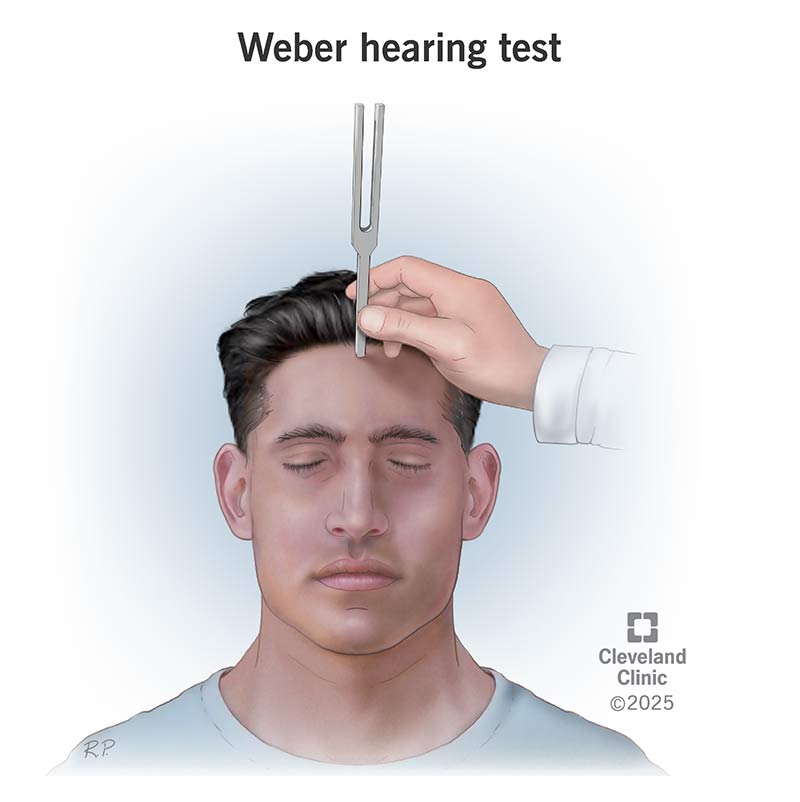
Weber test
• Tuning fork placed at midline of skull
• Normal: sound heard equally in both ears
Weber interpretation
• Conductive hearing loss: sound lateralizes to affected ear
• Sensorineural hearing loss: sound lateralizes to good ear
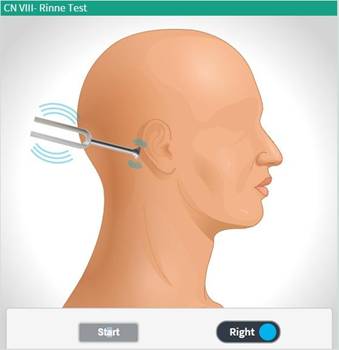
Rinne test
• Compare air conduction and bone conduction
• Normal: AC > BC
Rinne interpretation
Conductive loss: BC ≥ AC
Sensorineural loss: AC > BC
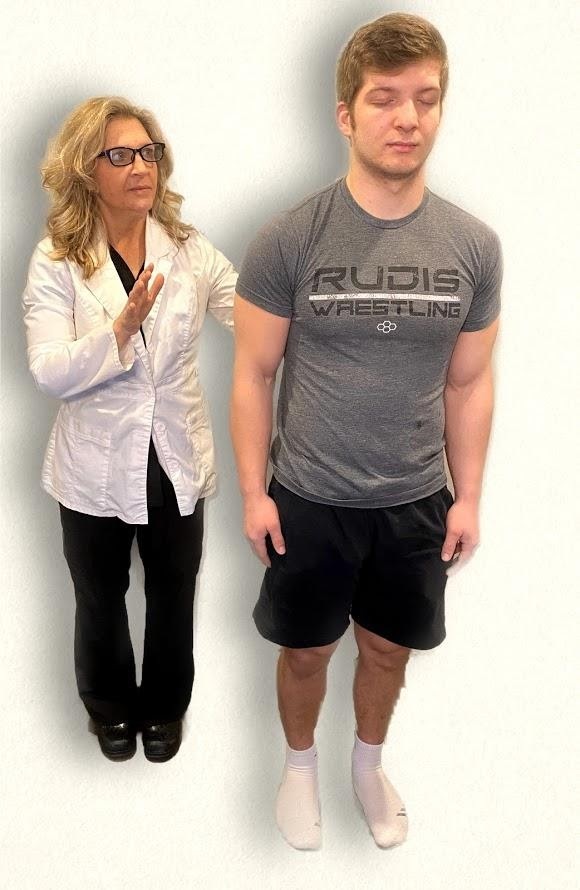
Romberg test expected
Client stands for 20 seconds with minimal sway
Romberg test abnormal
Swaying or movement of feet may indicate vestibular disorder
Conductive hearing loss
Problem with sound transmission through:
• External ear
• Middle ear
Sensorineural hearing loss
Inner ear
Auditory nerve pathway
Bone conduction sound moves through
Air
Bone
Fluid
Key distinction of conductive and Sensorineural
Conductive = blockage or mechanical problem
Sensorineural = nerve or inner ear problem
The nose job
• Warms air
• Moistens air
• Filters air
• Supports smell
The sinuses job
• Lighten skull weight
• Create voice resonance
• Drain mucus
nose and sinus expected
• External nose symmetric and midline
• Color consistent with face
• Nares patent
• Nasal mucosa dark pink and moist
• Septum midline
• No swelling
• No bleeding
No discharge
• No obstruction
• Frontal and maxillary sinuses nontender
• No crepitus
nose and sinus Unexpected findings
Pale mucosa
• Boggy mucosa
• Red swollen mucosa
• Bleeding
• Discharge
• Tenderness
• Obstruction
• Foul-smelling unilateral drainage
nose and sinus Clinical patterns
• Pale, boggy mucosa: allergies
• Red, swollen mucosa: URI/cold
• Yellow-green drainage: infection
• Foul unilateral drainage: foreign body or chronic infection
Sinus palpation
Frontal sinuses: under eyebrows
• Maxillary sinuses: below cheekbones
• Do not press on eyes
Mouth and Throat structures
• Lips
• Teeth
• Gums
• Buccal mucosa
• Tongue
• Hard palate
• Soft palate
• Uvula
• Tonsils
• Pharynx
Mouth and Throat Expected findings
• Lips smooth and moist
• Teeth pearly white
• No obvious decay
• 28–32 teeth
• Jaws aligned
• Gums smooth and tight around teeth
• Buccal mucosa pink and moist
• Tongue pink and moist with moderate papillae
• Hard palate intact and pale pink/white
• Soft palate intact, movable, pink, smooth
• Uvula pink, midline, movable
• Tonsils pink, symmetrical, no exudate
Mouth and SinuUnexpected findings
• Smooth dark red swollen tongue
• Swollen gums
• Yellow palate
• Petechiae
• Mouth or throat soreness
• Ulcerations
• White plaques
• Exudate
• Uvular deviation
Mouth and Throat Clinical significance
Smooth dark red tongue: possible vitamin B12 deficiency
• Swollen/bleeding gums: gingivitis
• White plaques: possible thrush
• Exudate: possible infection
• Uvular deviation: abnormal neurologic or structural issue
Tonsil Grading
Tonsils should be described using a grading scale rather than vague terms
Also assess in tonsils
• Color
• Symmetry
• Swelling
• Exudate
Tension headache
Dull
• Tight
• Diffuse
• Often stress-related
Migraine
Severe
• Throbbing
• Often unilateral
• May include nausea, photophobia, aura

