(Exam 3) Pt. 5 Ventilatory and Blood-Gas Responses to Exercise Acid-Base
 Call Kai
 Learn
Learn Practice Test
 Spaced Repetition
 Match
Match Flashcards
 Knowt Play
1/24

There's no tags or description
Looks like no tags are added yet.
Name | Mastery | Learn | Test | Matching | Spaced | Call with Kai |
|---|
No analytics yet
Send a link to your students to track their progress
25 Terms
Ventilatory changes during exercise:
Ventilation increases as exercise intensity [….]
Ventilation increases […]after beginning of exercise
Compared to HR and VO2 peak; ventilation and VO2 start out linear and we see a spike, b/c eventually has a flexion point because of intensity. (Ventilatory threshold)
increases
rapidly
Ventilatory changes during constant-load moderate intensity exercise:
When exercise is constant there is […].
The figure implies intensity is […]
Partial pressure of O2 and CO2 is constant; does not change.
What changes is the amount of time we […]
VE increases […] at the onset of exercise followed by slower rise to steady state
Arterial PO2 and PCO2 are unchanged indicating excellent homeostatic control
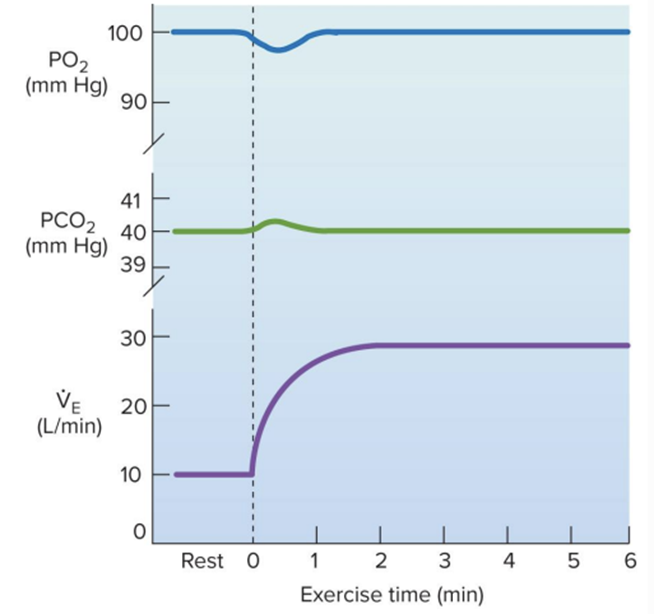
no threshold
constant
breathe
rapidly
![<h2 id="d94af98e-aef4-4d3a-bfa0-b8d855855a4c" data-toc-id="d94af98e-aef4-4d3a-bfa0-b8d855855a4c" collapsed="false" seolevelmigrated="true">Changes in ventilation, blood gases, and pH during incremental exercise:</h2><ul><li><p>Ventilatory threshold does not always happen at 60%.</p></li><li><p class="MsoListParagraphCxSpMiddle"><span style="font-family: "Times New Roman"; line-height: normal; font-size: 7pt;"> </span>In untrained 50-60% and in trained individuals […]</p></li><li><p class="MsoListParagraphCxSpMiddle">In elite runners when the person reaches 100% it actually 90-95%; we see drastic drop in the PO2.</p></li><li><p class="MsoListParagraphCxSpMiddle"><span style="font-family: "Times New Roman"; line-height: normal; font-size: 7pt;"> </span>Key points:</p><ul><li><p class="MsoListParagraphCxSpMiddle"><span style="font-family: "Times New Roman"; line-height: normal; font-size: 7pt;"> </span>Linear increase in VE up to ~50-75% VO2 followed by exponential […] in VE (ventilatory threshold)</p></li><li><p class="MsoListParagraphCxSpMiddle"><span style="font-family: "Times New Roman"; line-height: normal; font-size: 7pt;"> </span>Note differences in arterial PO2 between untrained individual versus elite trained distance runner</p><ul><li><p class="MsoListParagraphCxSpLast"><span style="font-family: "Times New Roman"; line-height: normal; font-size: 7pt;"> </span>Possible causes of [….] due: short RBC transit time due to high cardiac output</p></li></ul></li></ul></li><li><p class="MsoListParagraphCxSpLast">The idea is that high intensity cardiac output in athlete is very high</p><ul><li><p class="MsoListParagraphCxSpMiddle"><span> </span>That time, specifically RBC spent on pulmonary capillaries are not enough.</p></li><li><p class="MsoListParagraphCxSpMiddle"><span> </span>As a result, oxygen molecules diffuse from the alveoli compartment to the blood.</p></li><li><p class="MsoListParagraphCxSpMiddle">RBC don’t fully load with oxygen which leads to lower arterial PO2 </p></li><li><p class="MsoListParagraphCxSpMiddle">This is possible and not 100% proven. </p></li></ul></li></ul><p></p>](https://assets.knowt.com/user-attachments/c2be0162-9c5e-4e87-bb53-c911077daf83.png)
Changes in ventilation, blood gases, and pH during incremental exercise:
Ventilatory threshold does not always happen at 60%.
In untrained 50-60% and in trained individuals […]
In elite runners when the person reaches 100% it actually 90-95%; we see drastic drop in the PO2.
Key points:
Linear increase in VE up to ~50-75% VO2 followed by exponential […] in VE (ventilatory threshold)
Note differences in arterial PO2 between untrained individual versus elite trained distance runner
Possible causes of [….] due: short RBC transit time due to high cardiac output
The idea is that high intensity cardiac output in athlete is very high
That time, specifically RBC spent on pulmonary capillaries are not enough.
As a result, oxygen molecules diffuse from the alveoli compartment to the blood.
RBC don’t fully load with oxygen which leads to lower arterial PO2
This is possible and not 100% proven.
70-80%
increase
exercise-induced hypoxemia
Sex differences exist in work of breathing during exercise:
Before maturation, boys have higher risk of asthma than girls
men have […] airway and lungs
women have […] airway
smaller diameter […] the resistance
Smaller airways results in higher resistance to airflow and limitations to maximal ventilatory capacity during very heavy and severe exercise.
true for airflow and blood flow.
When matched for […], women have smaller airways than men
Increased airway resistance in women results in [….] work of breathing during exercise.
larger
smaller
greater
body weight
greater
Control of ventilation at rest:
Inspiration:
The neural pacemaker is […].
Aim to […] ventilation to the metabolic rate.
Respiratory control center is in the […]
Output from the […] regulates motor neurons in the spinal cord that control respiratory muscles.
Primary neural pacemaker responsible for inspiration is the preBotzinger complex (located in medulla oblongata)
preBotizinger complex
increase
medullar oblongata
respiratory control center
Control of ventilation at rest:
Expiration:
The neural pacemaker is […]
Function:
Increases […]to help match breathing to metabolic demand
Retrotrapezoid nucleus/ parafacial responsible for inspiration is the preBotzinger complex (located in medulla oblongata) controls active expiration.
Input to the respiratory control center from both humoral chemoreceptors and neural sources (higher brain centers and afferent pathways) for example, muscle mechanoreceptors and chemoreceptors.
RTN/pFRG
ventilation
Control of ventilation at rest:
Pontine respiratory center:
We have classes of neurons that communicate with neural pacemaker of the […] and […] muscles groups to find breathing and regulate rate and hierarchy.
[….] by coordinating signals between the brainstem respiratory centers.
inspiratory and expiratory
fine-tune breathing rhythm
Input to respiratory control center:
Humoral chemoreceptors:
Specialized neurons that can respond to changes in the […]environment
Two types:
[…] chemoreceptors:
Located in the medulla
Sensitive to PCO2 and H+ concentration on cerebrospinal fluid
[…] chemoreceptors:
Aortic and carotid bodies
Sensitive to PO2, PCO2, H+, and K+ in blood.
internal
Central
Peripheral
Input to respiratory control center:
Neural input:
Comes from […] receptors.
Has two receptors
Muscle [….]:
Muscle spindles, Golgi tendon organs, joint pressure receptors
Muscle [….]:
Sensitive to K+ and H+ concentration
motor cortex and skeletal muscle
mechanoreceptors
chemoreceptors
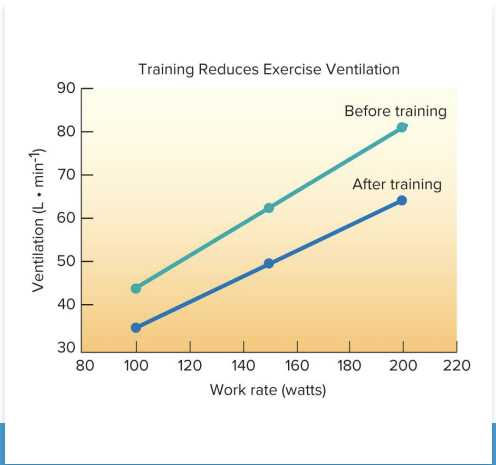
Training reduces the ventilatory response to exercise:
Endurance promotes decreasing ventilation degree moderate to high intensity exercise.
Ventilation is […] during exercise following endurance training
Exercise ventilation is 20-30% lower at same submaximal work rate
Plausible mechanisms
Changes in aerobic capacity of locomotor muscles
Result in less production of […]
Less afferent feedback from muscle to stimulate breathing
lower
H+
Endurance training does not change lung structure:
Training does not […] lung structure
Normal lungs exceed demand for […]
Therefore, training-induced adaptation is not required for the lung to maintain […] during exercise
alter
gas exchange
blood-gas homeostasis
Does the pulmonary system limit exercise performance?
[…] intensity exercise
Pulmonary system does not limit exercise tolerance
[…] intensity exercise
Pulmonary ventilation/gas exchange is NOT a limitation in healthy individuals at sea level at most exercise intensities
[…] does occur during high intensity exercise (95- 100% VO2 max) and therefore, can limit [….] capacity during prolonged high intensity exercise
Low-to-moderate
High
Respiratory muscle fatigue
ventilatory
Acids and bases:
[…]
o Any atom that is missing electrons or has gained electrons (atom with an electric charge)
Ion
Acids and bases:
[….]
o Can release hydrogen ions
o Molecules that can liberate hydrogen ions (H+ )
o Acids increase the H+ concentration in a solution (decreases pH)
Acid
Acids and bases:
[…]
o Can combine with hydrogen ions
o Molecule capable of combining with (H+ )
o Bases decrease the H+ concentration in a solution (increases pH)
base
[…]
- The concentration of H+ in a solution is expressed in pH units on a 0 to 14 scale.
- pH solutions 7 are basic.
pH scale
Hydrogen ion production during exercise:
High intensity leads to […] in hydrogen atoms
High-intensity exercise decreases muscle and blood pH
Contributors:
Production of […]
CO2 + H2O «——» H+ + HCO3 –
Production of lactate during high-intensity exercise coincides with acidosis
ATP breakdown during muscle contraction:
Results in release of […]
ATP + H2O «——» ADP + HPO4 - + H+
increase
carbon dioxide
H+
Sport and exercise-induced disturbances in acid-base balance:
Sports that involve high intensity: (high-intensity exercise lasting > 45 seconds produces large amount of H+.
Have higher risk of […]
Why is this bad
Acidosis increases […]
Hydrogen binds to the troponin that impedes troponin and calcium resulting in no muscle contraction
When we increase concentration of hydrogen then pH goes down and it affects enzymatic activity
Acidosis can impair exercise performance
Contributes to […]
Increasing blood buffering capacity may improve performance in some events.
acidosis
hydrogen atoms
muscle fatigue
Acid-base buffer systems:
Acid-base balance maintained by […]
by releasing H+ when pH is high
Accept H+ ions when pH is low
[…]
Proteins, phosphate groups, and Bicarbonate
[…]:
Bicarbonate, hemoglobin, and blood proteins.
buffers
Intracellular buffers
Extracellular buffers
Intracellular buffers:
First line of defense against pH challenges
In skeletal muscle
Regulates pH by recruiting or employing chemicals that can […] hydrogen ions or by recruiting hydrogen ion transporters.
Four major classes in the cytosol of muscle
Recruits these chemicals to remove ions
Bicarbonate
Phosphates
Cellular proteins
Histidine –dipeptides (primarily carnosine)
Muscle pH is also regulated by H+ transporter
[...]
Exchanges one sodium ion for one hydrogen ion
Brings into the muscle one sodium ion and removes one hydrogen ion from the muscle into the interstitial space.
[…]
Co-transports, lactate and hydrogen from inside the muscle to the interstitial space.
remove
Sodium-hydrogen exchanger (NHE)
Monocarboxylate Transporter (MCT)
Influence of muscle fiber type and exercise training on intracellular buffering capacity:
Muscle buffering capacity is fiber-type specific:
[….] buffering capacity is greater in Type 2 fibers compared to Type 1
Because we are including type 2 fibers mostly during high intensity exercises.
This adaptation is advantageous in performances that rely on […] type fiber recruitment
Exercise training has been shown to increase intracellular content of […]
Intracellular
fast
carnosine and MCTs
Extracellular buffers:
Most important is […] buffering system
3 principal buffering systems
Proteins, hemoglobin, bicarbonate
Bases can combine with […]
Bicarbonate will combine with hydrogen ion
It will form […] acid; […] acid will split into water and CO2
Water will then be absorbed into […] or […] (gas)
CO2 leaves the body when we breathe out.

bicarbonate
hydrogen
carbonic
body or evaporate
Diets low in acids can increase plasma pH but do not improve performance during very heavy or severe exercise
Supplementation with sodium bicarbonate (baking soda)
Increase times to […]
Although large doses before an exercise session can lead to nausea and vomiting and can promote alkalosis.
Supplementation with […]
Promotes […]
It is an antioxidant
Precursor to carnosine synthesis
Carnosine serves as an intracellular buffer and can […] time to exhaustion during high-intensity exercise (events lasting 1 to 4 minutes)
Only known side effect is paresthesia (tingling of skin)
exhaustion
beta-alanine
carnosine
increase
Regulation of acid-base balance via the kidneys:
Kidneys are important in […]
Kidneys do not play a key role in acid-base balance during […]
Kidneys contribute to acid-base balance (at rest) by regulating […] concentration in blood
When blood pH […], bicarbonate excretion is reduced
When blood pH […], bicarbonate excretion is increased
long-term acid-base balance
exercise
bicarbonate
decreases
increases
Regulation of acid-base balance during exercise:
[…] depends on
\ Exercise intensity
Amount of muscle mass involved
Duration of exercise
[…] pH
Declines with increasing intensity of exercise
[…] pH
Declines with increasing intensity of exercise – muscle pH is lower than blood pH
Muscle is the site of H+ production and has lower buffering capacity.
H+ production
Blood
Muscle

