BIOL 2051 Exam 2 Luzan
 Studied by 2 people
 Call Kai
 Learn
Learn Practice Test
 Spaced Repetition
 Match
Match Flashcards
 Knowt Play
1/191

Earn XP
Description and Tags
Name | Mastery | Learn | Test | Matching | Spaced | Call with Kai |
|---|
No analytics yet
Send a link to your students to track their progress
192 Terms
Bacterial and archaeal promoters have distinct _______ _____, and are bound by _____ ________ ________.
Nucleotide sequences
DNA-binding proteins
What are inverted repeats?
Nucleotide sequence followed downstream by inverted complement
-frequently are specific binding sites for regulatory proteins`
DNA-binding proteins are often __________ or identical, and they contain what?
Homodimeric
-posses domain that binds to one inverted repeat
-many different DNA-binding proteins from Bacteria contain helix-turn-helix domain (lac and trap repressors of E. Coli)
What are transcription factors?
Proteins that control the rate of transcription by binding to specific DNA
What are the different types of transcription factors?
Activator and Repressor proteins
Effectors
Allosteric proteins
What do activator proteins do? (Transcription factor)
They turn on transcription
-bind to activator binding site UPSTREAM from the promoter sequence
What do repressor proteins do? (Transcription factor)
Turns off transcription
-bind to the operator sequence (downstream from promoter)
What do effectors do? (Transcription factors)
They are small molecules that control the binding sites of activators and repressors
What do allosteric proteins do?
Changes conformation when effector binds to it
The change determines whether transcription factor can bind to DNA
Inducers turn on transcription and corepressors turn off transcription
What are operons?
Several structural genes that code for important enzymes from the same metabolic pathway
What are operons regulated by, and what do they do?
Regulated by the same promoter and operator (regulatory) DNA sequences
-Promoter is recognized by the RNA polymerase
-Operator sequence codes for a repressor proteins
What are inducible operons?
Usually turned OFF until a substrate becomes present
-the presence of the substrate causes the production of an enzyme
-ensures enzymes are synthesized only when needed
Ex. Lactose operon:
-when there is no lactose, the repressor proteins binds to the operator sequence, which prevents RNA polymerase from transcribing the operon
-when allolactose is present (inducer), it binds repressor and deactivates it, allowing transcription to proceed
What are Repressible operons?
Usually turned ON until product accumulates in sufficient amounts
-when the product is absent, the repressor is inactive, and the operon is transcribed and translated to make product
-when the product is present, it binds to the repressor protein and activates it, which binds to the operator sequence and prevents RNA pol from transcribing operon
Ex. Tryptophan operon
What are positive controls?
Regulator proteins that facilitate transcription
-some operons are only transcribed if an activator protein is first bound to the DNA
Ex. Maltose operon
Operon is transcribed only after the regulator protein (activated by the maltose) binds to the activator binding site upstream from the promoter
What is a regulon?
more than one operon under the control of a single regulatory protein
What is the sensor kinase response regulator and where is it located?
-it is a two-component regulatory system that detects environmental signals and autophosphorylates at specific histidine residues
-it is located in the cytoplasmic membrane
What does the phosphatase enzyme do in sensor kinase regulatory systems?
they remove the phosphate from the response regulator and resets the system
Sensor kinases remove a phosphoryl group and transfers it where?
to a response regulator (located in the cytoplasm) which binds to DNA and induces or blocks transcription of certain genes
What is a good example of the two-component regulatory system?
osmotic pressure response
Bacteria use a modified version of the two-component system to do what?
to sense temporal changes in the concentration of attractants/repellants, and regulate flagellar rotation
-regulates existing proteins rather than transcription of new proteins
What is chemotaxis?
moving towards attractants, away from repellants in response to a change in concentration over time
What is the chemotaxis signal transduction path?
1) chemical from the environment
2) MCPs (methyl-accepting chemotaxis proteins)
3) sensor kinase (CheA and CheW)
4) CheY (response regulator)
5) control of flagellar rotation
What governs the direction of flagellar motion?
the Che Y or response regulator
How does the organism move if the flagella spins counterclockwise?
it runs or swims smoothly towards signal
How does the organism move if the flagella spins clockwise?
it tumbles or moves randomly and changes direction
When MCPs bind to a repellant what happens?
Che Y is phosphorylated and induces clockwise rotation and tumbling
When MCPs bind to an attractant what happens?
Che Y is unphosphorylated resulting in counterclockwise rotation and running
What does quorum sensing ensure?
it ensures many cells are present before initiating certain activity
Ex. bioluminescence
What is the mechanism for quorum sensing?
1) the autoinducer is produced
2) secreted out of the cell
3) then it reaches threshold concentration and diffuses back into the cells
4) binds to activator protein
5) which triggers transcription of genes
What are two examples of when quorum sensing is used?
Lux operon and in some pathogenic processes like E coli shiga toxin producing strain
Lactose and maltose regulons respond to a higher level regulatory mechanisms called what?
global controls
What are global controls?
Ex. catabolite repression in which the organism chooses the best carbon source to use when there is more than one present
-glucose is always used first
Catabolite repression leads to what?
diauxic growth-two exponential growth phases if two energy sources are available
What is the mechanism for catabolite repression?
1) Glucose is consumed first for the production of the most amount of ATP and then growth stops
2) After a lag (delay) growth resumes powered by the second energy source (lactose)
3) During the lag phase, the cell synthesizes all the proteins from the lactose operon to prepare for its degradation and ATP production
In catabolite repression, transcription is controlled by what?
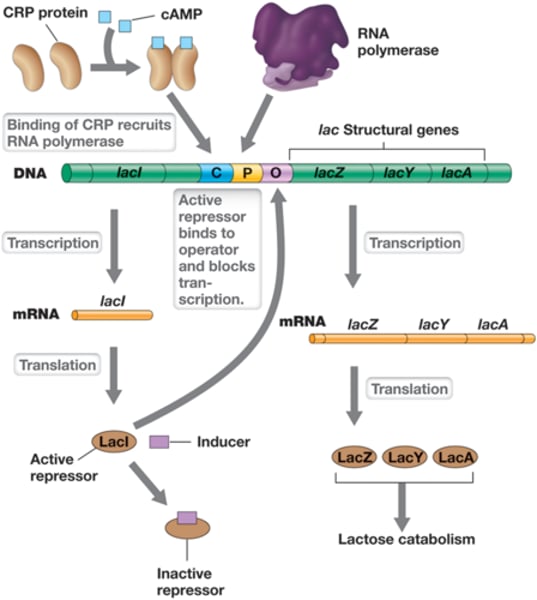
cyclic AMP receptor protein (CRP), an activator protein that binds to DNA only if it has first bound cyclic adenosine monophosphate (cAMP)
For lac genes to be transcribed what must happen?
-cyclic AMP levels must be high enough for CRP protein to bind to CRP-binding site (positive control)
-Lactose or another inducer must be present to prevent lactose repressor binding (negative control)
lac operon diagram
When is the stringent response triggered and what happens as a result?
activated in survival situations
-if shifted from amino acid excess to limitation, rRNA and tRNA synthesis stops and no new ribosomes produced
-protein and DNA synthesis stops, new amino acids biosynthesized
-later, rRNA synthesis and new ribosome production begin again at a slower rate
What triggers the stringent response?
2 regulatory nucleotides/alarmones
1. ppGpp (guanosine tetraphosphate)
2. pppGpp (guanosine pentaphosphate)
What is the heat shock response?
global control mechanism to protect cells from protein denaturation resulting from heat, high solvent levels, osmotic stress, and UV light
What are heat shock proteins?
helper proteins that counteract damage of denatured proteins and help cell recover from stress
What are chaperones?
they assist in protein folding process
How does the alternative sigma factor work to make transcription?
When heat shock occurs, RpoH degradation is inhibited, its level increases, increasing transcription of special heat shock operons, whose promoters are recognized
RpoH mRNA base pairs with itself regulating translation
What is horizontal gene transfer?
transfer of genes between cells other than reproduction
What is a mutation?
heritable change in genome
-some good, some bad, most have no effect
What are the three ways horizontal gene transfers occur?
transduction, transformation, and conjugation
What is the major source of mutations?
errors in DNA replication
Both mutations and horizontal gene transfers leads to what?
recombination which fuels bacterial evolution
What is a genotype?
genetic makeup of an organism
What is a phenotype?
physical characteristics of an organism
Wild type strains are isolated from what?
nature
Genotypes are characterized how?
three lowercase letters followed by an uppercase letter
Ex. hisC
Phenotypes are characterized how?
a capital letter and two lowercase letters then +/-
Ex. His+ makes histidine
What is the difference between a wild type phenotype and a mutant phenotype?
A mutant is a cell or virus that is derived from a wild type that carries a nucleotide sequence
Selectable mutations confer what?
An advantage and is relatively easy to detect
Ex. Antibiotic resistance
Nonselectable mutations do what?
Do not confer an advantage and requires screening which takes a long time to detect
Ex. Color change
When isolating mutants, what is preferred, screening or selection?
Selection is preferred whenever possible
What is the auxotorph class of mutation?
The inability to grow on a media lacking selected nutrient
What is the pigmentless class of mutation?
The loss of enzyme in bio synthetic pathway, results in presence of different color of lack of color
What is the sugar fermentation class of mutation?
Loss of an enzyme in a degradation pathway, lack of color change in a solid medium that has sugar and pH indicator
How do spontaneous mutations occur?
Without intervention mostly by occasional errors by DNA polymerase during replication
How do induced mutations occur?
Caused by intervention by an environment or by a researcher (deliberately)
Exposure to natural radiation or chemicals that chemically modify DNA
What is the nature of change in a point mutation?
One base pair is changed
- # of base pairs can change or stay the same
Point mutations occurring via substitution results in what?
A single base pair switch like A to G (# of base pairs stay the same)
The effect of substitution (aka phenotypic change) depends on what?
Exact location, divided into missense, non sense, and silent
What are missense mutations?
Changes in sequence of amino acids that could alter the resulted protein
Not all lead to dysfunction/nonfunction
Transitions are within purines or pyrimidines
Transversions are between purines and pyrimidines
What is a silent mutation?
alters a base but does not change the amino acid
Wobble hypothesis: there is room for error in the third base pair
What is a nonsense mutation?
When a stop codon is formed prematurely.
Results in a truncated or incomplete protein
What are frameshift mutations?
One base pair is added or deleted, everything shifts, most of the amino acids will change.
Frameshift mutations often result in what?
Complete loss of gene function
Can be lethal
Are insertions/deletions of three base pairs worse than an insertion/deletion of one or two base pairs?
No they are actually better
What is reversion?
DNA mutates back to original sequence because point mutations are typically reversible
What are revertants?
Strains that restore the original phenotype
What is the order of mutation rates in decreasing order of the following organisms? Bacteria, DNA viruses, RNA viruses, and Eukaryotes?
RNA vir
DNA vir
Bacteria
Eukaryotes
Why are RNA viruses error rates the highest?
Due to less proofreading and lack of RNA repair mechanisms
What is mutagenesis?
the production of mutations by environmental factors (mutagens) which can be imposed by the researcher
What are three types of mutagens?
chemical, physical, biological
What are the three types of chemical mutagens and what does each do?
1) Analog base pairs resemble nucleotide bases but have faulty base pairing which tricks the DNA polymerase into grabbing it instead of the real base resulting in single base subs
2) Alkylating agents introduce changes in either replicating or non replicating DNA resulting in single base substitutions
3) Intercalating agents insert themselves between tow bases, pushing them apart, triggering insertions or deletions
What are two types of physical mutagens?
1) Nonionizing radiation which forms pyrimidines dimers which kink DNA structure and make the DNA polymerase's job harder to do
) Ionizing radiation which results in free radicals such as hydroxyl radial OH.) that damage macromolecules causing double or single-stranded breaks and can lead to rearrangements or large deletions
What is the role of the rec A protein in the SOS response to DNA damage?
DNA damage activates the rec A protein which activates the protease activity of Lex A.
What is the role of Lex A in the SOS response to DNA damage?
Lex A normally represses the Lex operon which is made up of DNA repair genes. So when the presence of Rec A proteins deactivate Lex A, DNA repair genes are highly transcribed
What are the three mechanisms of genetic exchange?
Transformation, transduction, and conjugation
What are the three fates of genetic exchange?
The DNA fragment that got transferred will either be 1) degrade by host nucleases 2) will replicate on its own if it is a plasmid or 3) it will be incorporated (recombined) with host bacterial chromosome
What is recombination?
Physical exchange of DNA between genetic elements
What is homologous recombination?
Process that results in genetic exchange between homologous DNA from two different sources
What is transformation?
Genetic transfer process by which free DNA is incorporated into a recipient cell and brings about genetic change
What is competence in transformation?
A competent is an acceptor cell that can take up DNA and be transformed
What is transduction?
Transfer of DNA from one cell to another by a bacteriophage
What is generalized transduction and Specialized transduction?
GT: DNA from any portion of the host genome is packaged inside the virion
ST: DNA from a specific region of the host chromosome is intergrated directly into the virus genome, typically replacing viral genes
Where does transduction take place?
Occurs in many bacteria and at least one archaea
What is conjugation?
A process in which 2 organisms exchange genetic material
-requires cell-cell contact
-only donor cell contains conjugative plasmid (F plasmid)
-acceptor cell becomes F+ plasmid
What is the formation of Hfr strains and chromosome mobilization?
Occasionally integrated F plasmids may be excised from the chromosome sometimes incorporating chromosomal genes
-these plasmids are called F' plasmids which can transfer chromosomal genes to recipients at high frequency
In order for recombination to occur what must be true?
Some sort of homology must exist (the fragment should be somewhat similar to the host chromosome)
How do we detect recombination in the lab?
Usually by restoring a lost phenotype by creating a mutant that can not synthesize histidine and introducing a healthy gene to it try and restore the original phenotype
-the process of resting the wild phenotype is called complementation
In transduction, can the bacteria be a different species?
No
What do the F plasmids in conjugation contain?
Genes that regulate DNA replication
Transposable elements that allow the plasmid to integrate into the host chromosome
Tra genes that encode transfer functions
What are transposable elements?
Mobile DNA that have no origin of replication
What is CRISPR?
Clustered Regularly Interspaced Short Palindromic Repeats
What three things does the complementary interactions of nucleotides enable?
1) the DNA structure, double helix, to exist
2) semi-conservative nature of DNA replication
3) nucleic acid hybridization methods to exist
What is the semi-conservative DNA replication principle?
During DNA replication:
-DNA unwinds
-DNA pol binds to the DNA template at the origin of replication site and attaches the new nucleotides to the existing 3-OH end
 Note
Note  Flashcards (99)