AP Psychology Unit 2 (Perception, Sensation, Thinking)
 Call Kai
 Learn
Learn Practice Test
 Spaced Repetition
 Match
Match Flashcards
 Knowt Play
1/98

Earn XP
Description and Tags
Mrs. Weck LHS AP Psychology 2025
Name | Mastery | Learn | Test | Matching | Spaced | Call with Kai | Chat |
|---|
No analytics yet
Send a link to your students to track their progress
99 Terms
Sensation
The process by which sensory receptors & the nervous system detect stimuli
Transduction
The conversion of sensory stimuli into neural impulses which can be understood by the brain
Perception
The process through which the brain organizes and interprets sensory information to turn it into meaningful events
Absolute Threshold
The minimum amount of stimulation required for a stimuli to be detected
Just-Noticeable Difference
The smallest change in a stimulus that a person can detect
Sensory Adaptation
When sensory receptors become less responsive to constant stimuli over time
Weber’s Law
The bigger a stimulus is, the more stimulation is required to notice a difference
Sensory interaction
The belief that one sense can influence another
Synesthesia
A condition where stimulation of one sensory pathway leads to automatic activation of another sensory pathway
Retina
The part of the eye which converts light into neural signals
Blindspot
An area where vision is absent
Visual Nerve
A bundle of nerve fibers that transfer visual information from the retina to the brain where it is processed into images
Lens
A structure in the eye which focuses light onto the retina
Accomodation
When the lens changes shape to focus on objects at different distances
Nearsightedness
A vision condition where close objects appear clear, but distant objects appear blurry
Farsightedness
A vision condition where distant objects appear clear, but close objects appear blurry
Photoreceptors
Specialized cells in the retina that detect light & convert it into electrical signals
Rods
Photoreceptor cells in the retina responsible for vision in low-light conditions & detecting motion
Cones
Photoreceptor cells in the retina responsible for vision in bright-light & color vision
Trichromatic Theory
Vision is based on 3 types of cone receptors sensitive to either red, green, or blue light. The brain combines signals from the cones to create a wide range of colors.
Opponent-Process Theory
Color vision is based on pairs of opposing color processes: Red & Green; Blue & Yellow; Black & White
Fovea
The central area of the retina responsible for sharp, central vision
Afterimages
Visual images that remain after the stimulus is removed (caused by temporary overstimulation of cone cells)
Ganglion Cells
Specialized cells that transmit information to the brain via the optic nerve
Dichromatism
When people have only 2 working cone cells instead of 3
Monochromatism
When people only have 1 or NO working cone cells causing them to see in black & white
Prosopagnosia
The inability to recognize familiar faces
Blindsight
Being able to detect or “see” objects in your blindspot
Wavelength
The distance between peaks of a wave
Pitch
How high or low a sound is
Amplitude
The measure of the intensity of a soundwave
Greater amplitude = louder
Lower amplitude = quieter
Loudness
The perception of volume on a scale from loud to quiet
Pitch Perception
The brain’s interpretation of determining if a sound has a high or low tone
Higher frequency = higher pitch
Lower frequency = lower pitch
Place Theory
Different parts of the inner ear detect different sound frequencies
Volley Theory
Auditory neurons fire in rapid succession (volleys) to perceive pitches above the firing rate of individual neurons
Frequency Theory
The frequency of a sound wave directly corresponds to the rate at which auditory neurons fire
Sound Localization
The brain’s ability to determine the location of a sound source
Conduction Deafness
Hearing loss caused by problems to the outer or middle ear
Sensorineural Deafness
Hearing loss caused by damage to the inner ear or auditory nerve
Olfactory System
Receptors in the nose which detect smells & send signals to the brain
Thalamus
The brain's sensory control center (except for the sense of smell) which directs messages to sensory receiving areas in other parts of the brain.
Pheromones
Chemical substances released by humans & animals that trigger social or behavioral responses
Gustation
The sense of taste involving receptors on the tongue that detect different flavors
Sweet, Sour, Salty, Bitter, Umami, Oleogustus
Types of tastes
Sweet: associated with sugar
Sour: caused by acidic foods (ex: citruses)
Salty: associated with salt
Bitter: associated with unpleasant tastes (ex: dark chocolate)
Umami: associated with savory tastes (ex: meat, cheese)
Oleogustus: a proposed taste associated with fatty foods
Taste Receptors
Specialized cells on the tongue and mouth that detect different tastes
Supertasters
People who are highly sensitive to taste & experience flavors intensely
Medium Tasters
People who have an average sensitivity to taste & experience flavors moderately
Nontasters
People who are least sensitive to taste & experience flavors with minimal intensity
Warm/Cold Receptors
Specialized cells on the skin that detect changes in temperature
Pain
The emotional response to stimuli (which can vary from person-to-person)
Gate Control Theory
The theory that pain is controlled by a neural “gate” in the spinal cord which can open or close to allow or block pain.
Phantom Limb
When sensations can be “felt” in a missing body part
Vestibular Sense
The sense of orientation, balance, & movement due to inner ear receptors
Semicircular Canals
Inner ear structures that detect head movement
Kinesthesis
The awareness of your body parts’ own movement & position in space
Bottom-Up Processing
The way the brain makes sense of information by starting with small details then piecing them together to complete a perception.
Top-Down Processing
The way the brain makes sense of information based on context, prior knowledge, & expectations.
Perceptual Set
A mental tendency to notice some aspects of sensory data & ignore others a certain way influenced by expectations, experiences, or context.
Gestalt Psychology
We tend to perceive things as “wholes” rather than just “parts”
ex: seeing a full face rather than just eyes, noses, mouths, ears, etc..

Closure (Gestalt Principle)
Perceiving incomplete or interrupted patterns as complete, filling in the missing information to create a whole object

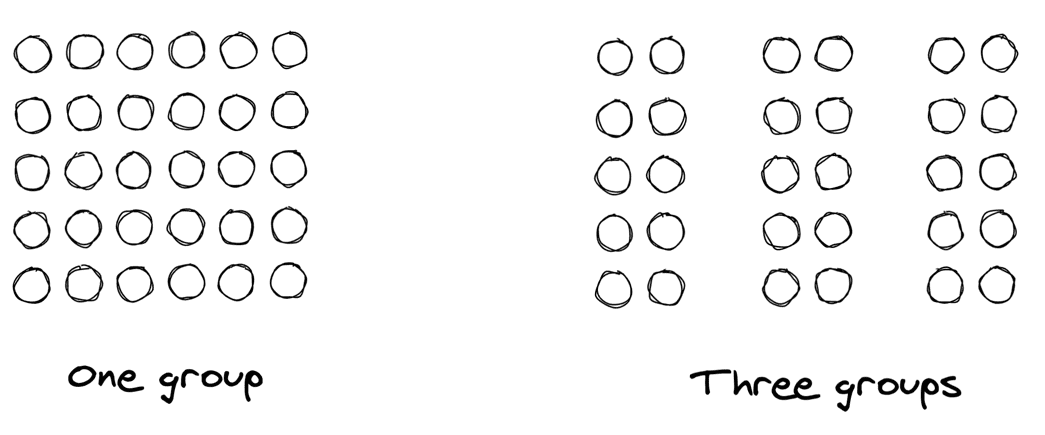
Proximity (Gestalt Principle)
Objects near each other are perceived as a group, rather than as individual elements
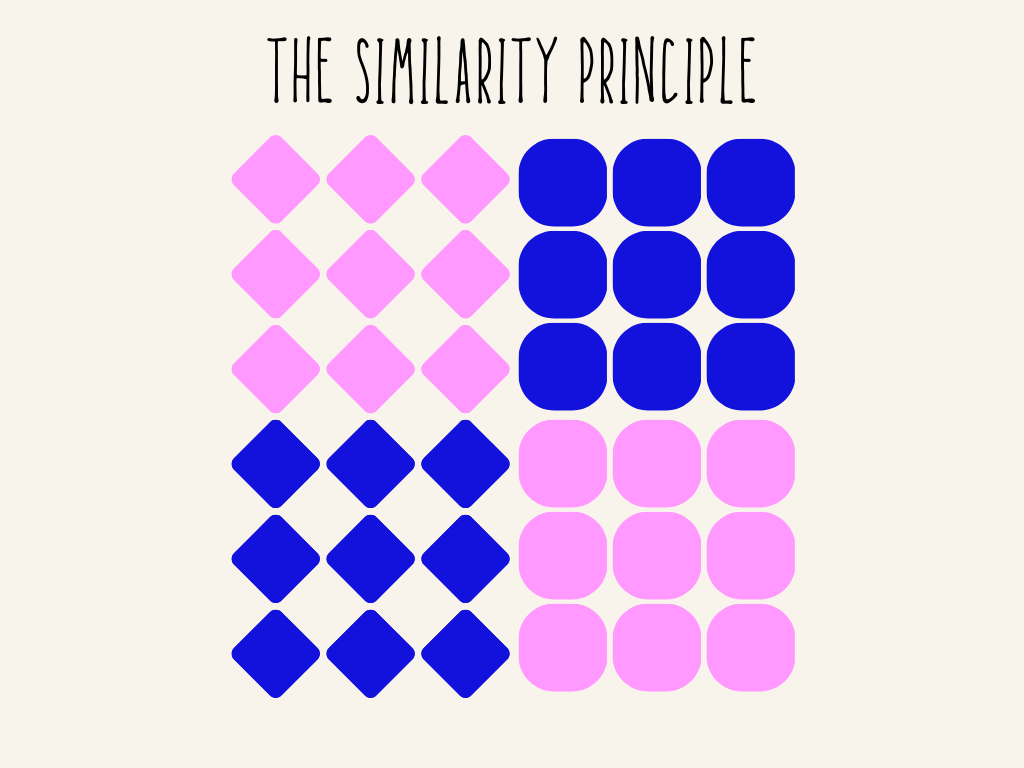
Similarity (Gestalt Principle)
Objects that look alike (color, shape, size, etc) are perceived to belong in a group.
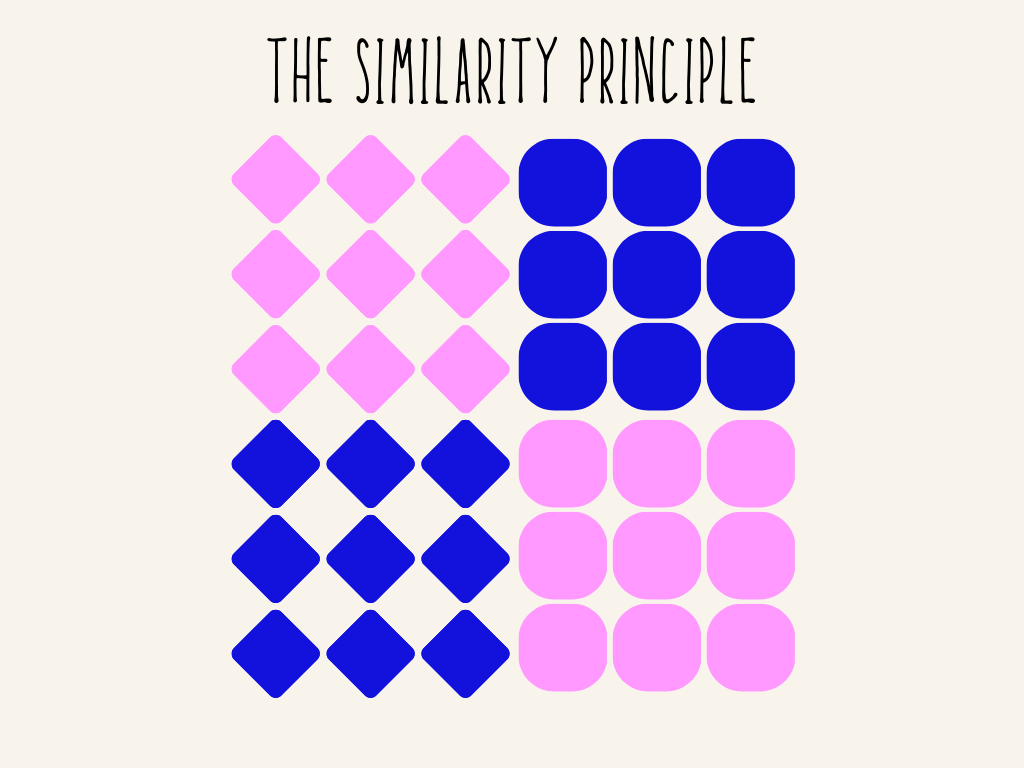

Figure & Ground (Gestalt Principle)
The ability to distinguish an object (figure) from its surroundings (ground)

Selective Attention
Focusing on a specific task while ignoring other stimuli in the background
Cocktail Party Effect
The ability to focus on a single conversation in a noisy environment
Inattentional Blindness
When people fail to notice an unexpected stimulus in their visual field because they’re focused on something else
Change Blindness
When people fail to notice large changes in their environment when the change occurs simultaneously with a visual disruption.
Binocular Depth Cues
Visual information that requires both eyes to perceive depth & distance
Retinal Disparity
When each eye sees a slightly different view due to their positions in the skull. (Helps with depth perception)
Convergence
When the eyes move inward to focus on close objects
Monocular Depth Cues
Visual information that requires one eye to perceive depth & distance
Relative Clarity
Closer objects appear clearer & more detailed
Further objects appear blurry & less detailed
Relative Size
Closer objects appear larger
Further objects appear smaller
Texture Gradient
The amount of detail a person can perceive decreases with distance
Linear Perspective
Parallel lines seem to meet at the horizon in the distance creating the illusion of depth & distance

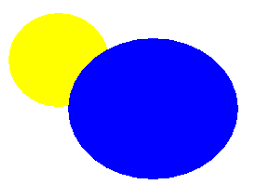
Interposition
When one object covers another making it appear closer
Perceptual Constancy
the brain's ability to perceive familiar objects as having stable qualities (size, shape, and color) despite changes in the sensory input, such as distance, lighting, or viewing angle
ex: a door still being a door despite being opened or closed
Apparent Movement
Perceiving objects as being in movement despite nothing actually moving
ex: Flashing Christmas lights appear to move, but they’re actually not
Prototype
Something that serves as the best example of a category
ex: an apple is a great (blank) for fruits because it is edible, sweet, has seeds, and is a plant.
Schema
Metal frameworks that help organize & recognize information based on past experiences & knowledge
ex: a girl sees a new animal for the first time
the animal has fur, a tail, barks, floppy ears, and has 4 legs
the girl creates a new (blank) for dogs
Next time the child sees a dog, she’ll know quickly
Assimilation
The process of fitting new information into already existing schemas
ex: a child sees a new breed of dog with pointy ears instead of floppy ones
while this dog is physically different from the ones in the child’s already existing schema, it still shares many characteristics
The new breed of dog is added to the child’s schema for dogs
Algorithms
Step by step procedures or formulas for solving problems that guarantee a correct solution
ex: a morning routine, or an exercise routine can be considered algorithms because they involve a specific, repeatable set of steps to achieve the goal of being prepared for sleep or a workout.
Heuristics
Mental shortcuts (rules of thumb) that simplify decision-making
ex: when buying a new phone, many people choose the most recent iPhone because they trust the quality even though they haven’t compared the other brands’ technologies
Representativeness Heuristic
A mental shortcut where people make judgments about something based on stereotypes
ex: You’re meeting a man on a blind date
He’s
Availability Heuristic
A mental shortcut where people rely on immediate examples that come to mind when evaluating a decision
ex: an airplane has recently crashed & there has been lots of media coverage
People have been more reluctant to buy plane tickets even though flying is the safest method of travel
The increased broadcasting has lead people to overestimate the danger
Mental Set
The tendency to approach situations in a certain way because that worked in the past
ex: You’re struggling to open a pickle jar
You keep twisting the lid forcefully because it worked the last time
This (blank) might prevent you from seeking out easier solutions such as tapping the lid against the counter to break the seal
Priming
Exposure to one stimulus influences the response to another stimulus without conscious intent
ex: A store displays fresh, vibrant flowers in its storefront
customers are more likely to perceive the store as having fresh, high quality produce
This (blank) can subconsciously influence customers to buy more fruits and vegetables than they would have if they hadn’t seen the flowers
Framing
The manner in which information is presented can influence decisions or perceptions
ex: people are more likely to believe cereal that markets itself as 90% fat-free is healthier than a cereal that has 10% fat even though they mean the same thing.
Gambler’s Fallacy
The belief that past events influence future ones
ex: “The coin has landed on tails 17 times in a row, it must land on heads on the next flip!”
The probability of the coin landing on either side is equally as likely as the next
Executive Functions
Cognitive processes that allow people to make goal-directed behaviors & have critical thinking
ex: preparing to apply to college by setting goals for your academic success, organizing college lists, and planning ahead
Sunk-Cost Fallacy
Continuing an activity just because you have already invested time, effort, or money even though you do not enjoy it.
Creativity
The ability to come up with new & unique ideas
Divergent Thinking
The ability to generate many different solutions to a problem.
ex: A teacher asks “How many uses can you think of for a paperclip?”
a student answers: making jewelry, picking a lock, creating art, or the usual holding papers
Convergent Thinking
Narrowing down options to select the single best answer to a problem
Functional Fixedness
A cognitive bias that makes a person see objects only in terms of their usual functions, which can block problem-solving
ex: a person needs to tighten a screw, but doesn’t have a screwdriver, so they give up rather than using a coin to tighten the screw.
Testing Effect
The improved memory that results from actively retrieving information (testing yourself) rather than just rereading or reviewing material.
ex: taking practice quizzes helps you study better for tests than simply reviewing notes
Metacognition
The awareness & understanding about your own thinking processes (thinking about thinking)