working memory model
 Call Kai
 Learn
Learn Practice Test
 Spaced Repetition
 Match
Match Flashcards
 Knowt Play
1/12

There's no tags or description
Looks like no tags are added yet.
Name | Mastery | Learn | Test | Matching | Spaced | Call with Kai |
|---|
No analytics yet
Send a link to your students to track their progress
13 Terms
Baddeley and Hitch (1974) working memory model
created the working memory model, a model of STM more complex than the MSM
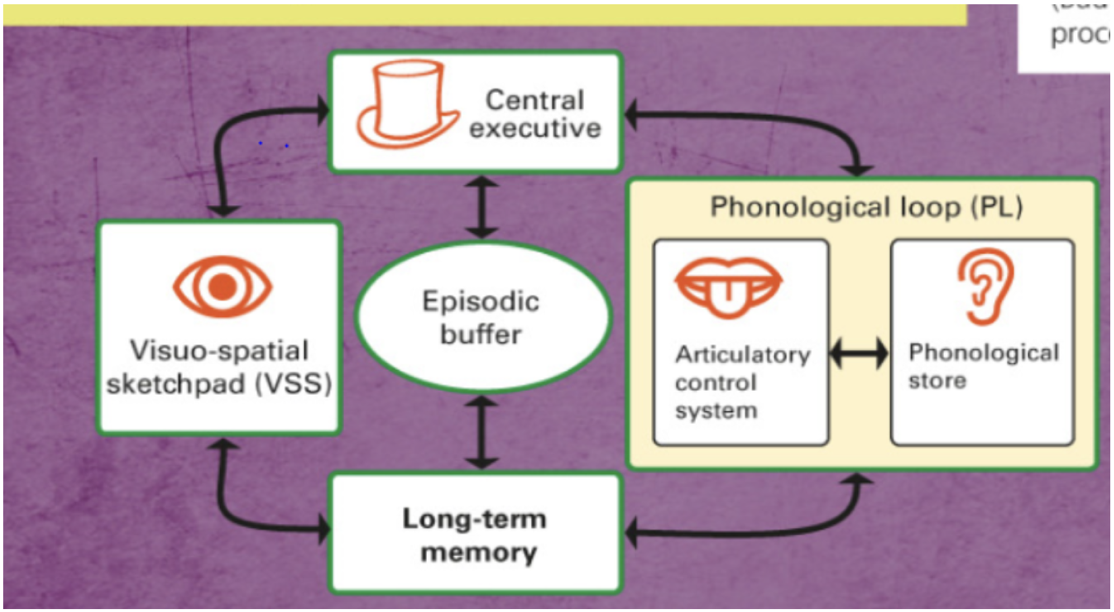
central executive
directs attention to particular tasks, controls other systems by determining how resources will be allocated and which subsystem will perform which task, monitors data from phonological loop and visuospatial sketchpad
reasoning and decision making
limited capacity, coding is modality free
phonological loop
controls auditory information (what you hear)
subdivided into phonological store, inner ear, which holds information in speech based from for 1-2 seconds and articulatory process, inner voice, used to rehearse verbal information from phonological store
capacity of 2 seconds worth of information (can be maintained by articulatory control process), coded acoustically
visuospatial sketchpad
processes visual and spatial information (how things look and where they are)
subdivided into visual cache which stores visual data and the inner scribe which records the arrangement of objects in the visual field
capacity of 3-4 objects, coded visually
episodic buffer
temporary, general store for information, added later to the model (2000) to account for things that use both visual and acoustic information, links WM to LTM and wider cognitive processes eg perception
maintains a sense of time sequencing (order of events), integrates and temporarily stores information from other subsystems
limited capacity, about 4 chunks, coding is modality free
Baddley et al (1975)- dual task performance
participants were given a visual tracking task to track a moving line with a pointer at they same time they were given 1 of 2 tasks: to describe the letter F (visual), to perform a verbal task
they peformed better in the 2nd because both visual tasks compete for the same slave systems whereas when doing a verbal and visual task there is no competition
case study of KF
in the 1970s, KF was in a motorcycle accident resulting in brain damage to his left occipital lobe, STM was damaged (digit span of 1), but LTM was normal, he remembers words better if presented visually over auditorally
although his LTM is intact his STM isn't which supports the MSM, however he remembers words better if presented visually which supports the WM model
case study of Phineas Gage
in 1848, there was an accident where he got an iron forced through his head, removing parts of his brain
he lived for 12 years after the accident, he was able to speak normally but his personality changed from being well liked, responsible and hardworking to being restless, indecisive and swore a lot
showed that parts of the brain could be removed without having a fatal effect, different areas of the brain are in control of different functions, damage to the front of the brain leads to personality changes
strength of the working memory model- support from clinical evidence
eg Shallice & Warrington (1970) studied patient KF who had a brain injury
his STM for auditory information was poor, damaged phonological loop, but he could process visual information normally, intact visuospatial sketchpad
supports the WMM view that there are separate visual and acoustic memory stores
WMM support from clinical evidence counterpoint
KF may have had other impairments which explained poor memory performance, apart from damage to his phonological loop
challenges evidence from clinical studies of brain injury
strength of the working memory model- dual task performance studies support the VSS
Baddley et al.'s (1975) participants found it harder to carry out 2 visual tasks at the sane time then do a verbal and visual task at together, same for 2 verbal tasks
because both visual tasks compete for the same subsystem (VSS), no competition with a verbal and visual task
therefore there must be a separate subsystem that processes visual input (VSS) and also a separate system for verbal processes (PL)
limitation of the working memory model- lack of clarity over the central executive
Baddley (2003) said the CE was the most important but the least understood component of the WM
there must be more to the CE than just being 'attention' eg it is made up of separate subcomponents
therefore the CE is an unsatisfactory component and this challenges the integrity of the model
limitation of the working memory model- validity of the model
• dual task studies support the WMM as they show there must be separate components processing visual (VSS) and verbal information (PL)
• however these studies are highly controlled and use tasks that are unlike everyday WM tasks eg recalling random sequences of letters
• challenges the validity of the model as it isn't certain that WM operates this way in everyday situations