Food Technology 2
 Call Kai
 Learn
Learn Practice Test
 Spaced Repetition
 Match
Match Flashcards
 Knowt Play
1/101

There's no tags or description
Looks like no tags are added yet.
Name | Mastery | Learn | Test | Matching | Spaced | Call with Kai |
|---|
No analytics yet
Send a link to your students to track their progress
102 Terms
What are 4 categories of animal origin products?
meat/meat products
milk/dairy products
fish/fish products
poultry/poultry products
What are 2 examples of meat products?
minced meats
fermented meats
why might you ferment meat
method of preservation
stable and highly nutritious
extended shelf life
safe product if handled correctly
What is the bulk of fermented meat products?
fermented sausages
what is likely to contaminate raw meat during slaughtering and butchering
spoilage organisms
potential pathogens
Where are fermented sausages commonly consumed?
europe - USA
What are the common meats for fermented sausages?
pork - beef
What other meats can be used for fermented sausages?
lamb - chicken - turkey - duck - buffalo
what are characteristic of specific types of fermented sausages
•Type of the meat used.
•The product formulation (amount of salt added, presence of nitrite and/or nitrate, sugar content before fermentation, spices, garlic, wine and other additives).
•Starter or natural flora is used for fermentation.
•Organisms used in the starter.
•Temperature of fermentation.
•Cooking.
•Smoking.
•Drying.
•Mould ripened.
What is the 1st ingredient added to form fermented sausages?
addition of nitrite or nitrate
What does nitrite/nitrate do to in fermentation?
suppress natural gram -ve flora
Promotes the growth of streptococci, micrococci, pediococci and lactobacilli that occur normally in meat in low numbers
What microbes do nitrite/nitrate promote?
streptococci - micrococci - pediococci - lactobacilli
How much natural fermentable carbohydrate is in raw meat?
0.1% glucose
How much fermentable carbohydrate is added to sausages?
0.3-2%
What does adding fermentable carbohydrate achieve?
sufficient lactic acid produced to give a pH of about 4.8
What does lactic acid do to water binding?
decreases water binding capacity of the meat protein
What process does lactic acid assist?
helps to assist the drying process
bc Presence of lactic acid also decreases the water binding capacity of the meat protein.
What does the speed of fermentation depend on?
level of carbohydrates used (low carbs = slow fermentation)
What do industries use for fermented sausages?
commercial starter proteins
What are 3 benefits of using starter cultures?
faster/more predictable drop in pH
safer product
earlier development of firmness
What are common starter organisms?
lactobacillus plantarum
pedicoccus acidlacti
yeasts
When are micrococcus starters often used?
if nitrate but no nitrite is added
Why is nitrite essential in fermented sausages?
prevent decolourisation
prevent oxidative rancidity
What is the ripening process in fermented sausages?
protein is hydrolysed by microbial proteinases to give amino acids
List the 7 steps to make fermented sausages?
raw meat/fat -> mince -> mix ingredients (salt/nitrate/carbs) -> add starter -> pack into casings -> ferment -> dry and ripen
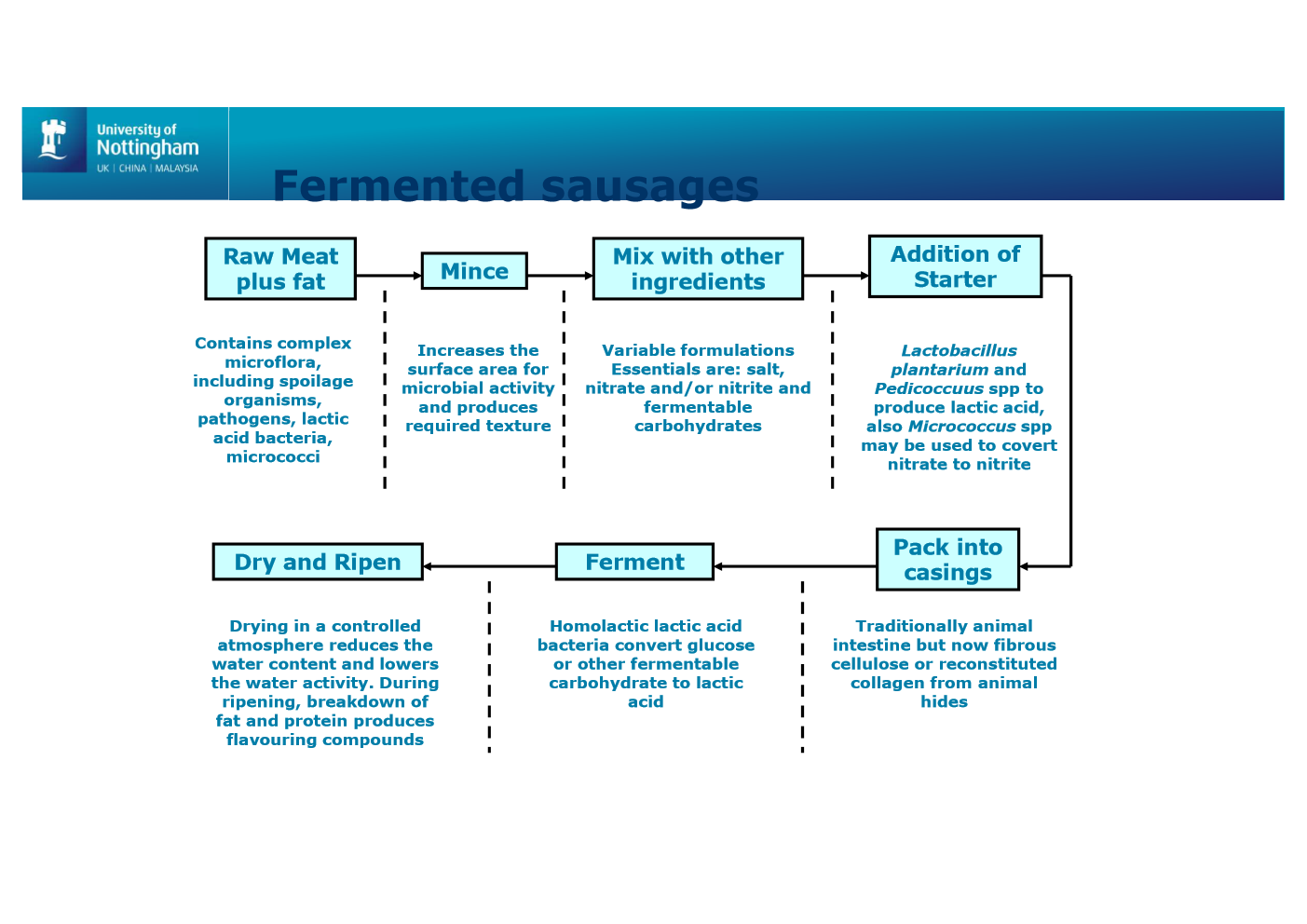
in the production of fermented sausages what happens in the raw meat plus fat stage
Contains complex microflora, including spoilage organisms, pathogens, lactic acid bacteria, micrococci
in the production of fermented sausages what happens in the mincing meat stage
inc SA for microbial activity - texture production
in the production of fermented sausages what happens in the mixing with other ingredients stage
Variable formulations Essentials are: salt, nitrate and/or nitrite and fermentable carbohydrates
in the production of fermented sausages what happens in the addition of starter stage
Lactobacillus plantarium and Pedicoccuus spp to produce lactic acid, also Micrococcus spp may be used to covert nitrate to nitrite
in the production of fermented sausages what happens in the pack into castings stage
Traditionally animal intestine but now fibrous cellulose or reconstituted collagen from animal hides
in the production of fermented sausages what happens in the fermentation stage
Homolactic lactic acid bacteria convert glucose or other fermentable carbohydrate to lactic acid
in the production of fermented sausages what happens in the dry and ripen stage
Drying in a controlled atmosphere reduces the water content and lowers the water activity. During ripening, breakdown of fat and protein produces flavouring compounds
What happens during fermentation (sausages)?
lactic acid (converts carbs to lactic acid)
Why are fermented sausages a stable food?
low pH - low water activity
What causes low pH in fermented sausages?
lactic acid
What causes reduced water activity in fermented sausages?
salt and drying
What are microbiological problems with fermented sausages?
1.Growth of green or black moulds on the surface.
2.Surface bacterial slime.
3.Souring due to excess lactic acid production.
4.Gassiness due to heterofermentative lactic acid bacteria.
5.Greening of the meat pigment caused by the production of hydrogen peroxide by Lactobacillus viridans.
What causes greening in fermented sausages?
hydrogen peroxide production from lactobacillus viridans
What is the minimum heat process for low acid canned foods?
give 12 decimal reductions of C. botulinum
What is the D value for C. botulinum at 121ºC?
0.21 minutes
What is the 12D processing time for C. botulinum at 121ºC?
•(12 x 0.21 = 2.52 minutes).
What 4 issues can cause spoilage in canned foods?
underfilling
quality of can seal
improper hygiene handling
hygiene of can transport system
How does smoking food work?
wood smoke contains substances with antimicrobial activity
What antimicrobial substances are in wood smoke?
formaldhyde - higher aldehydes - phenols - methanol
give some examples of diary products (fermented milks, yoghurt, cheese)
Fermented milks
Kefir
Yoghurt
Set, Stirred and Drinks
Cheese
Fermented and non-fermented
Brined cheeses
Soft, semi-hard, hard
What are 3 types of yoghurt?
set - stirred - drinks
What are 3 types of cheese?
fermented/non-fermented - brined cheeses - soft/semi-hard/hard
What is yoghurt?
product of bacterial fermentation of milk
What happens in yoghurt fermentation?
lactose is converted by the bacteria into lactic acid
What are the 6 steps to make set yoghurt?
raw milk -> add solids -> homogenisation -> heat treatment -> cooling/starter addition -> packaging/incubation/cooling/storage
what happens in each step to making yoghurts
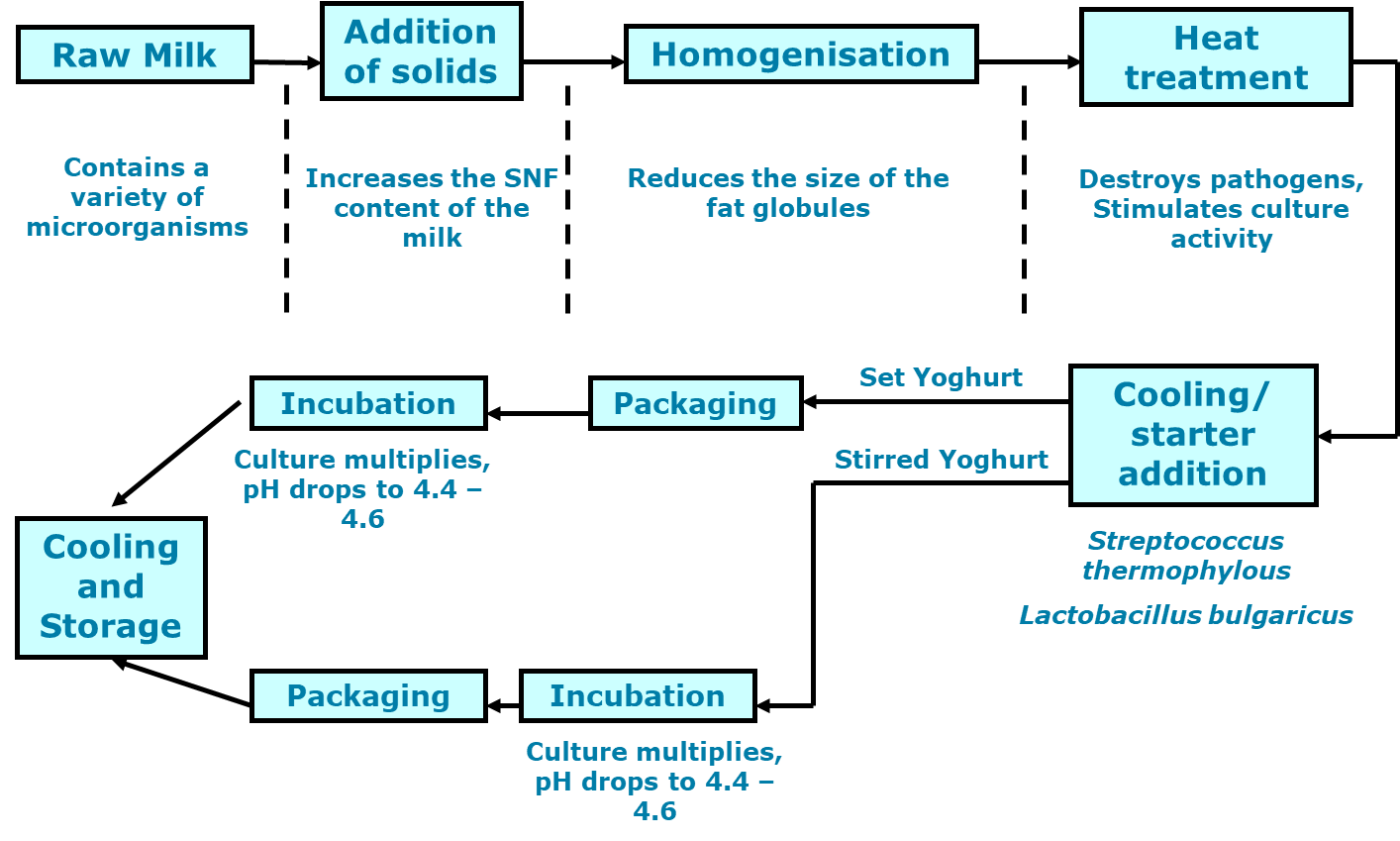
What is homogenisation?
reduces size of fat globules
Why is milk heat-treated for yoghurt?
destroys pathogens - stimulates culture activity
What is a common yoghurt starter?
lactobacillus bulgaricus
What are the 6 steps for stirred yoghurt?
raw milk -> add solids -> homogenisation -> heat treatment -> cooling/starter addition -> incubation/packaging/cooling/storage
What must milk for yoghurt production be free from?
antibiotic residues
What happens if antibiotics are in yoghurt milk?
culture will not develop - pH will not drop - yoghurt will not set
What else stops yoghurt from setting?
bacteria destroyed by bacteriophages
what happens in the yoghurt when the pH decreases
So the ph decreases
so the yoghurt sets
Lactobacillus and streptococcus grow and convert it to lactic acid
What are the 11 steps for cheese production?
raw milk -> pasteurisation -> starter addition -> incubation -> rennet/coagulation -> scalding -> cheddaring -> milling/salting -> moulding/pressing -> ripening -> packaging/storage
describe what happens at each step in the production of cheese
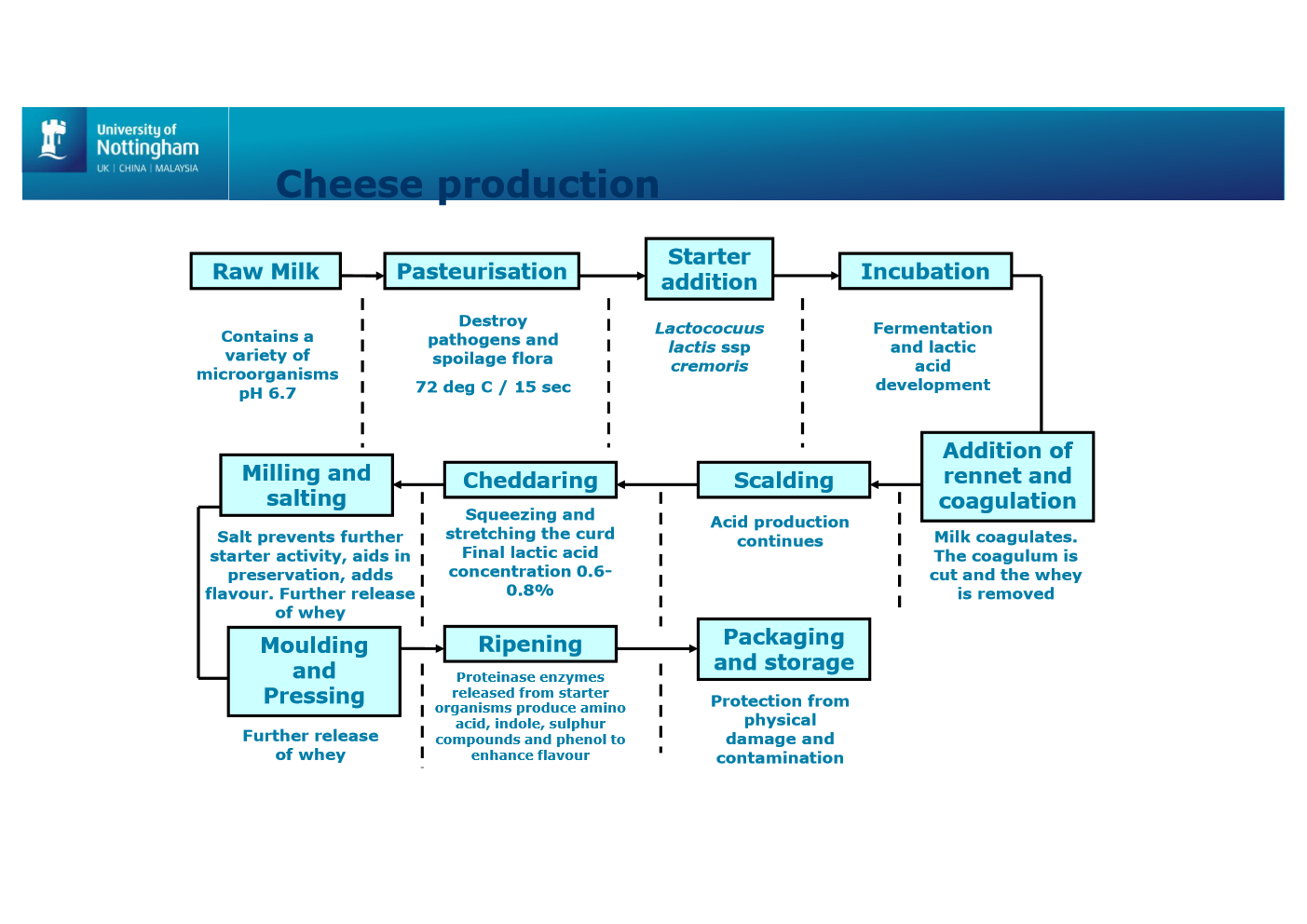
What is the pasteurisation standard for cheese milk?
72 degrees for 15 secs
What happens during cheese incubation?
fermentation - lactic acid development
What are 'early blowing' problems in cheese due to?
coliforms
What are 'late blowing' problems in cheese due to?
gas producing clostridia
what are microbial problems in cheese
blowing
mould growth
bacteriophages attacking starter
What is the general food safety risk of cheese?
generally a low risk food
What causes food issues in cheese?
poor hygiene - poor pastuerisation of milk
What are uses for microbiology in the food industry?
HACCP based systems
risk assessment -
raw materials/ ingredients
hygiene monitoring
process monitoring
finished products
crisis management
how is microbial info essential for building a HACCP plan
•Raw materials and associated sources of supply
•Production flow chart
•Process points that influence the growth, death, survival or contamination with micro-organisms
•Consequences of failure of any process stage
•CCPs determination and establishment of monitoring and reviewing systems
what is taken into account for risk assessments
Hazard identification
Hazard characterization
Exposure assessment
Risk characterization
whats the difference between a hazard and a risk
A hazard is something that can cause harm
A risk is the chance, high or low, that any hazard will actually cause somebody harm
list some pathogens found in rice
bacillus cereus
list some pathogens found in poultry and milk
campylobacter jejuni
list some pathogens found in veg, fish, peanuts, hazelnuts and honey
Clostridium botulinum
list some pathogens found in veg, red meat
Clostridium perfringens
list some pathogens found in red meat, fruit, milk and milk products, salad veg
E. Coli
list some pathogens found in milk (cheese) and meat products
Listeria monocytogenes
list some pathogens found in coconut, pepper, poultry, meat, chicken, eggs, fruit and fruit juice
Salmonella spp.
list some pathogens found in shellfish
Vibrio parahaemolyticus
What things can be monitored for hygiene?
Swabs
Surfaces, pipes, equipment
Solid or liquid samples
Soil (agriculture)-
•Rinse water
Personnel
Hand-swabbing
Hand-rinsing
Air
Exposure plates
Air sampling machines
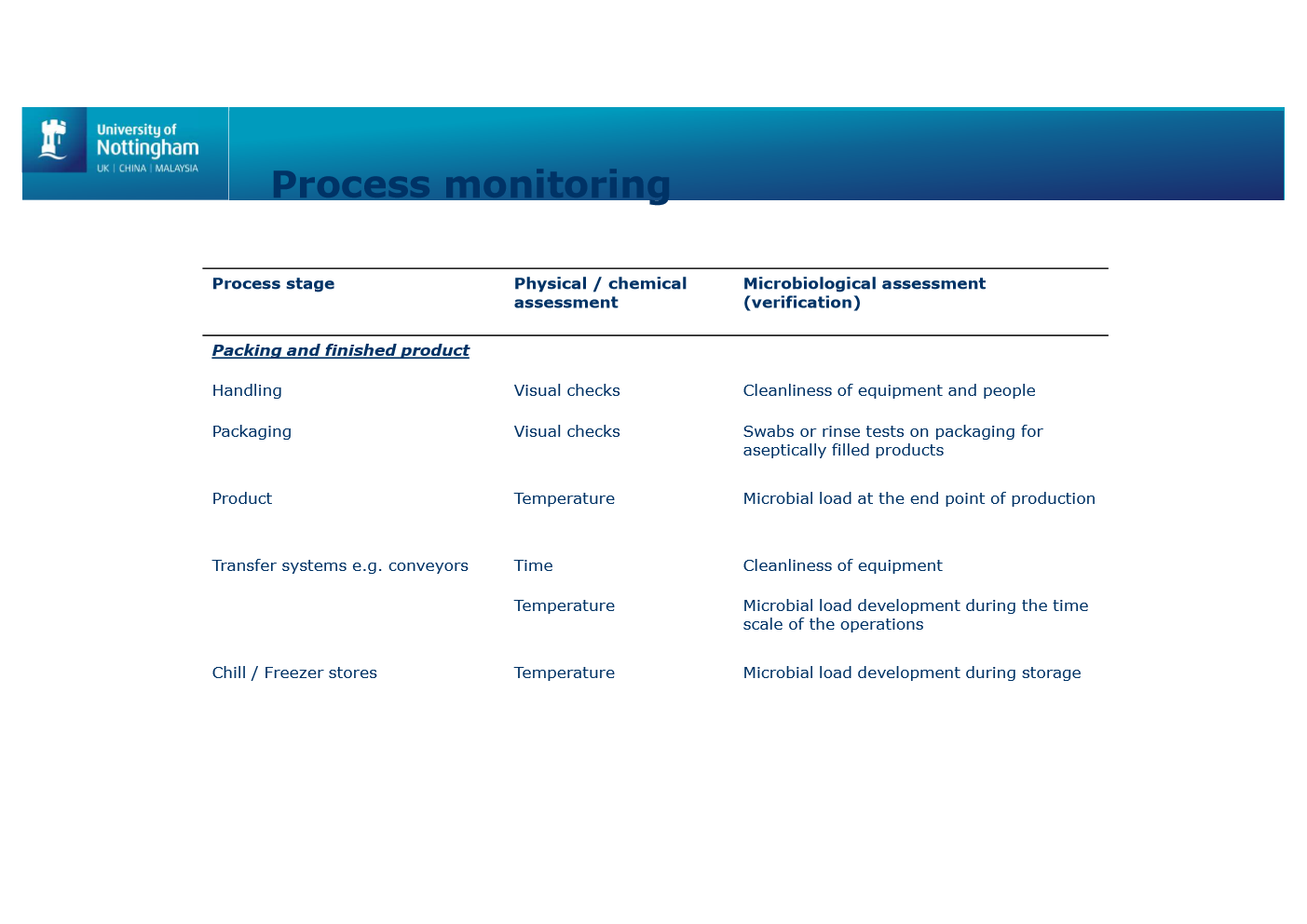
give some examples for assessing these processing stages
handling
packaging
product
transfer systems
chill/ freezer stores
how can finished products be tested
Conformance to microbial criteria
Product shelf life evaluations
Microbiological challenge testing
how are microbial criteria drawn up
Microbial criteria are drawn up in relation to specified foods and consist of:
1.A statement of the microorganisms and/or their toxins of concern to the food.
2.The methods to be used for their detection and/or enumeration.
3.A sampling plan.
4.The microbiological limits to be used in assessing the results
5.Guidance for interpreting the results.
Number of sample units that should conform to the limits.
What are components of microbial criteria for foods?
limits for
pathogens
microbial toxins
indicator micro-organisms
spoilage micro-organisms
frequency of sampling
A clear description of the food/sample type to be examined.
A clear description of the relevant microorganisms or toxins in concern.
An unambiguous sampling plan
what is a sampling plan
A sampling plan is a statement of the criteria of acceptance applied to a lot based on appropriate examinations of a required number of sample units by specified methods
what do sampling plans consist of
It consists of a sampling procedure and decision criteria
what can a sampling plan be
A sampling plan may be a two-class or a three-class plan
What 3 descriptive components are needed for microbial criteria?
clear description of food - clear example of relevant micro-organisms/toxins - unambiguous sampling plan
what does a 2 class plan consist of
A two-class plan consists of the following specifications: n, c and m
What do 'n' 'c', and 'm' mean in two-class sampling?
,n=number of samples - c=max acceptable units exceeding m - m=max bacteria/gram
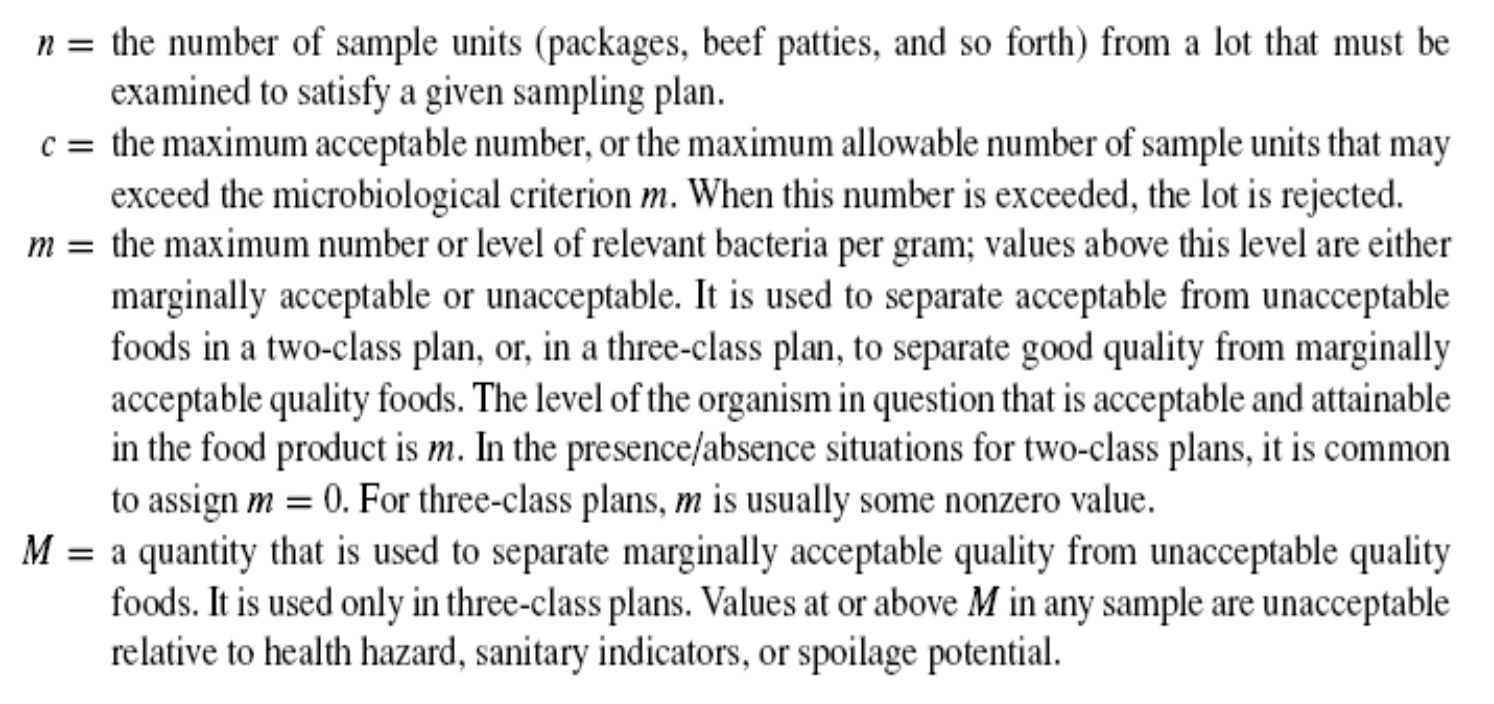
What is the difference in three-class sampling?
A three-class plan requires n, c, m, and M (adds 'M')
What does 'M' represent in three-class sampling?
seperate marginally acceptability from unacceptability
What happens if a sample value is at or above M?
whole batch will be rejected
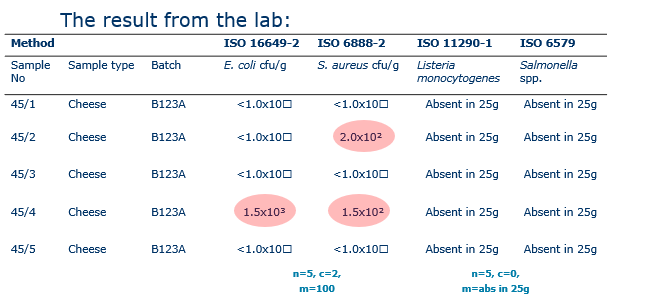
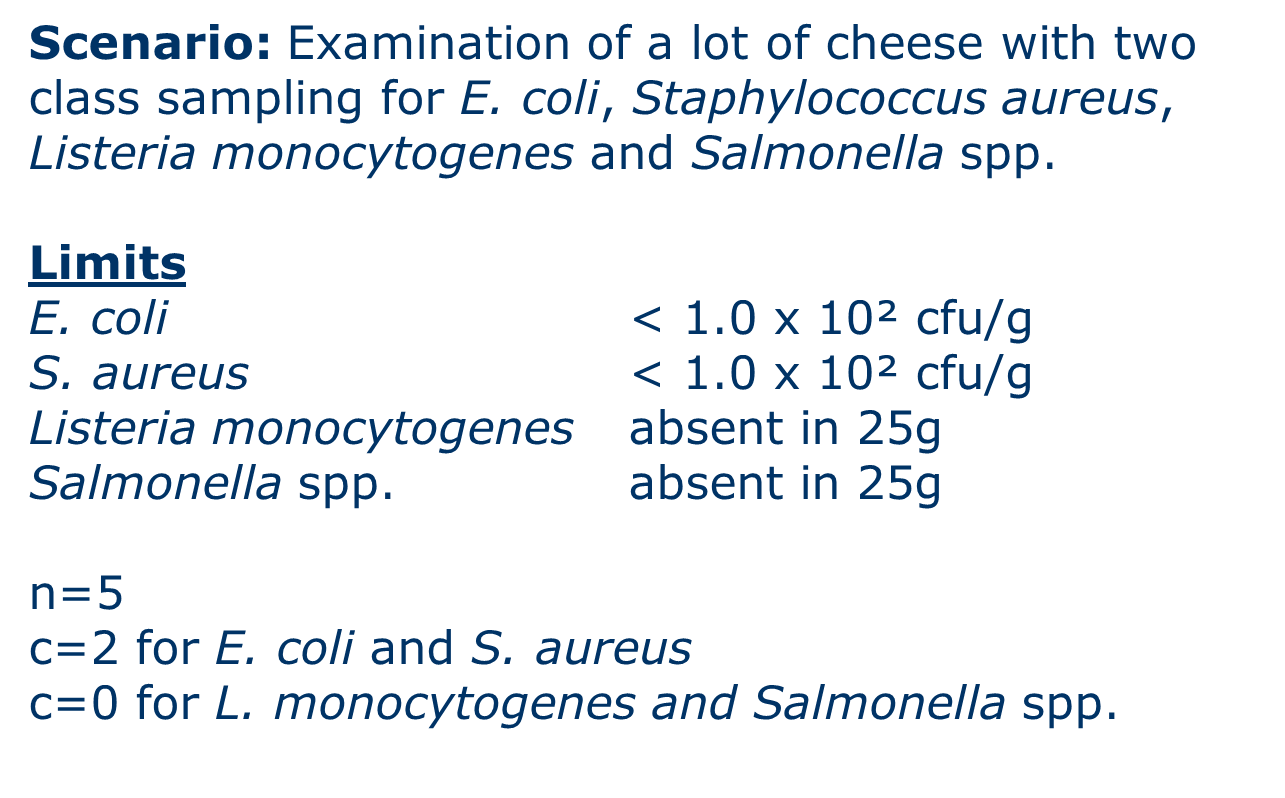
in this 2 class sample would the batch be accepted or rejected
One of the samples above m for E. coli
Two above for S. aureus
Listeria and Salmonella ok
so batch accepted
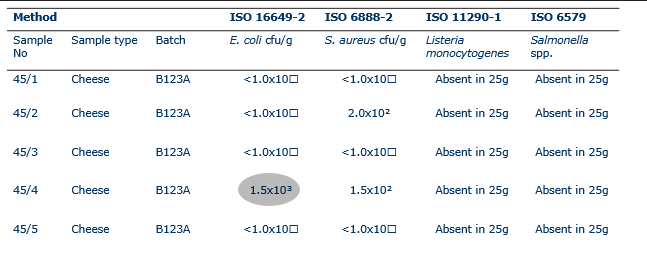
in this 3 class sample would the batch be accepted or rejected
For three class sampling M is introduced
M = 1000 cfu/g for E. coli and S. aureus
batch rejected
when would you use 2 and 3 class sampling
•For presence or absence tests we use a two-class plan.
•For count or concentration tests we use a three-class plan.
What regulation covers microbiological criteria for foods?
EC regulation 2073/2005
What factors are involved in shelf life evaluation?
•Deterioration in specific organoleptic qualities (flavour, aroma, appearance, texture).
•Microbial growth (bacterial pathogens, bacterial indicator organisms and spoilage organisms.
what does shelf life evaluation of perishable chilled products involve
storage of finished products at ‘specified’ and at abuse temperatures.

