plant physiology
 Call Kai
 Learn
Learn Practice Test
 Spaced Repetition
 Match
Match Flashcards
 Knowt Play
1/65

There's no tags or description
Looks like no tags are added yet.
Name | Mastery | Learn | Test | Matching | Spaced | Call with Kai |
|---|
No analytics yet
Send a link to your students to track their progress
66 Terms
Phloem:
- high conc of _
- under (+/-) pressure
- high conc of sugars
- under positive pressure
Fruit ripening is controlled by , which activates the transcription of genes that break down _ _
ethylene activates the breakdown of cell wall
The effect of phytohormones depends on (5)
concentration
tissue
organ
stage of development
plant species
Glutamine synthetase
incorporates NH4+ into an organic molecule (glutamate)
Hydroponic culture
allows for plant nutrition studies to determine the essentiality of a nutrient
Nitrate absorption occurs
across the plasma membrane via specific symporters
The main ions involved in stomatal opening:
Cl- and K+ entering the vacuole of guard cells
The most readily available form of nitrogen for plants is
nitrate, an essential macronutrient that is very stable and abundant in the soil
Stomatal opening occurs
through the activation of the ATPase pump in guard cells, which causes K and Cl to enter the guard cell from the companion cell, leading to the entry of water into the guard cell
Regarding essential elements
the plant absorbs an available form called a nutrient
In the nodule, rhizobia fix nitrogen and transfer it to the plant in exchange for
a carbon source from the plant
Nitrate reductase
reduces NO3- and NO2-
Differentiation processes involve
changes in gene expression
Sucrose
is loaded into the sieve tubes at the expense of ATP
In long-distance phloem transport
the sieve tubes at the source are loaded with sucrose, which increases their water potential
Pair of phytohormones that control seed germination
gibberellins/abscisic acid
Water potential indicates
the direction in which water moves between two compartments
Regarding essential mineral elements
an essential element cannot be replaced by another; it is directly involved in the plant’s metabolism; if the element is deficient, the plant cannot complete its life cycle
Pair of phytohormones that control systemic defense
salicylic acid/jasmonic acid
The plant growth regulator that controls elongation at the stem internodes is:
gibberellins
Plant growth refers to an increase in:
the number and size of cells
The ability of plant cells to differentiate into other cell types is called
totipotency, and only cells with a nucleus possess this ability throughout their entire life cycle
Cavitation occurs
when the water potential difference between the aerial parts and the soil is very high
The value of the osmotic potential is always negative, which means that:
solutes retain water, that is, they decrease the free energy of water
Chlorosis in leaves is:
yellowing of the leaf without cell death
Nitrogen transport within the plant occurs:
through the xylem, in the form of amino acids and nitrate, moving upward
The initiation of infection of legume root cells by rhizobia is due to the recognition of molecular signals:
plants emit flavonoids that the rhizobia identify and “respond” to with lipopolysaccharides (nod factors)
Nitrate assimilation consists of:
reduction of NO3- to NH4+ and subsequent incorporation into glutamate to form glutamine
Nitrite reductase:
is an enzyme present in the plastid; it uses ferredoxin (Fd) as a reducing agent and reduces NO2- to NH4+
Guttation:
the appearance of droplets on the edges of leaves in the early morning
Photosynthetic pigments are:
photoreceptors that contain chromophores capable of absorbing light energy
Regarding water absorption by the root:
the Caspary strips prevent water from passing into the xylem through the apoplast
Osmotic potential:
is a negative component because dissolved solutes decrease the water potential of the water
Water potential
Indicates the direction in which water moves within a system
How does water move from the root (base of the xylem) to the aerial parts of the plant?
By a water potential gradient, maintained by transpiration, along with capillarity.
The main ions involved in stomatal opening are:
Cl- and K+, which enter the vacuole of the guard cells
Stomatal opening is determined by:
increases in cell volume due to the entry of ions into the vacuoles of guard cells, which reduce their water potential.
Cavitation occurs:
when the difference in water potential between the aerial parts and the soil is very high.
If the concentration of ABA increases in the guard cells:
the stomata close due to inactivation of the ATPase pump in the guard cells
In the rhizobium-legume symbiosis, the first event is recognition between the plant and the bacterium. This occurs because:
the plant releases flavonoids that induce the expression of Nod genes in the bacterium.
Loading of the phloem occurs via:
companion cells, which possess specific H-ATPase pumps and specific sucrose transporters
In phloem transport:
at the source, the passage of sucrose into the sieve tube triggers the movement of water from the xylem to the phloem due to a difference in water potential
80% of the phloem’s content consists of sugars:
sucrose is the primary non-reducing sugar transported by the phloem
Regarding the plant’s acquisition of essential elements, we can state that:
the plant absorbs an available form called a nutrient, which crosses the plasma membrane via transporters
An essential element is one that:
cannot be replaced by another essential element
Macronutrients:
are just as essential as micronutrients
Which of the following functions is NOT characteristic of essential elements?:
maintaining the pH at values close to neutrality
Necrosis is a symptom of essential element deficiency that manifests as:
cell and tissue death, primarily at the leaf level
Nitrogen is an essential element that:
is absorbed primarily in the form of nitrate through a symport-type cotransport
NO3- in the plant:
is first reduced to NO2- (in the cytoplasm) and in a second step to NH4+ (in the plastid)
Nitrification involves:
the oxidation of ammonium to nitrite and then to nitrate, which occurs in the soil through the action of microorganisms
Regarding the movement of nitrogen within the plant:
NO3- is transported through the xylem
Reaction with nitrogen carried out by the nitrogenase complex
N2 + 18NADPH + 12H+ + 10e- -> 2NH4+ + 6H2 + 18NADP+
In nitrogen assimilation in the plant, energy (ATP) is consumed in the following steps:
in ammonium assimilation, in the step catalyzed by glutamine synthetase
In rhizobium-legume symbiosis, there is an exchange of:
sucrose from the photosynthetic zone to the nodule and nitrate from the nodule to the photosynthetic zone
Which of the following statements is true?:
Development involves phenomena of cell growth and differentiation
In general, we can state that the reversible inactivation of hormones occurs through:
glycosylation
Plant growth regulators are characterized, among other things, by:
the response depends on their concentration and the sensitivity of the tissue in which they act
Short-distance auxin transport:
is slow and occurs from cell to cell via specific transporters
According to the acid growth hypothesis:
auxins cause the acidification of the cell wall by activating expansins that break down cellulose
To increase sucrose production, we aim to lengthen the internodes of sugarcane stems. Which hormone would you use?:
gibberellins
The pair of phytohormones that controls the branching pattern of roots and stems is:
auxins/cytokinins
During germination, gibberellins:
are synthesized by the embryo, and their target tissue is the aleurone layer
Red light converts the inactive form of phytochrome (Pr) into
the active form (Pfr), triggering a light-dependent response
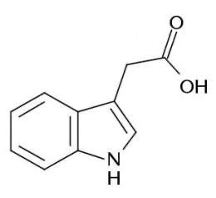
The following molecule corresponds to a
An auxin
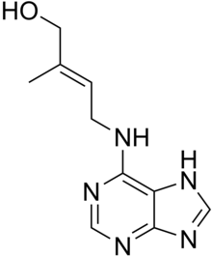
The following molecule corresponds to a
A cytokinin

