Week 1: sizing up the economy with GDP; 21.4 - Real and Nominal GDP
 Studied by 0 people
 Call with Kai
 Learn
Learn Practice Test
 Spaced Repetition
 Match
Match Flashcards
 Knowt Play
1/6

There's no tags or description
Looks like no tags are added yet.
Name | Mastery | Learn | Test | Matching | Spaced | Call with Kai |
|---|
No analytics yet
Send a link to your students to track their progress
7 Terms
What is nominal GDP?
GDP measured in today’s prices.
To calculate nominal GDP you add up the market value of total production in a year using the current prices prevailing in that year.
Nominal GDP is not very useful for making comparisons over time as a result of inflation. In ONS data, real GDP will be referred to as Current Price GDP.
What is Real GDP?
When you’re trying to evaluate changes over time in economic activity, you should use real GDP.
Real GDP is excludes the effects of price changes.
By focusing only on the quantity of output produced, real GDP isolates economic growth. In ONS data, real GDP will be referred to as Chained Volume, or Constant Price GDP.
How do you calculate nominal and real GDP?
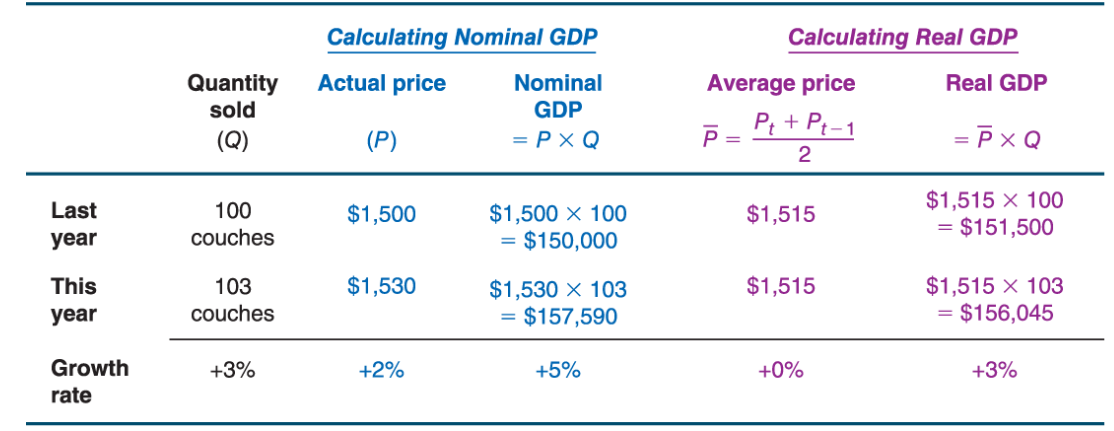
What approximations are used when the growth rate of prices and quantities are small?
When the growth rates of prices and quantities are small, the following approximation is accurate
% change in nominal GDP ≅ % change in real GDP + % change in prices
Or alternatively,
% change in real GDP ≅ % change in nominal GDP - % change in prices
% change in prices ≅ % change in nominal GDP - % change in real GDP
What are the limitations of GDP?
Prices are not values
Non-market activities are excluded
Shadow economy is missing
Environmental degradation is not counted
Leisure does not count
GDP ignores distribution
Why is GDP still used despite its limitations?
GDP per person measures average income in a country, and higher income makes it easier to invest in children’s health, in education, in creating beautiful art and poetry, and in taking the time to invest in your personal relationships.
By this argument, it’s not that GDP measures what matters, but rather that it measures the resources that a society has available to pursue what matters. If we use those resources well, then people who live in countries with high GDP per person will live happier, more fulfilling lives.
What are some strategies to help compare and scale large numbers, and a few examples?
Evaluate what it means per person
Compare to the size of the economy
Compare numbers to their own history
Use the rule of 70 to compare growth rates - The rule of 70 says that you can approximate the time it takes for a value to double by dividing 70 by the growth rate in percent.
 Note
Note  Flashcards (40)